 by Tom Gurney
Tom Gurney BSc (Hons) is an art history expert with over 20 years experience
Published on June 19, 2020 / Updated on November 20, 2026
Email: tomgurney1@gmail.com / Phone: +44 7429 011000
Introduction
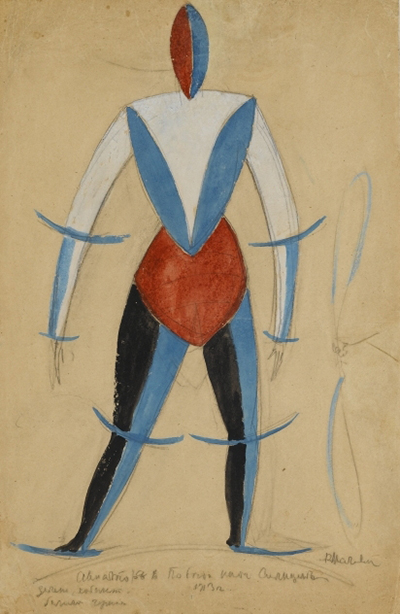
A standing figure seems assembled from coloured planes: a two-tone oval head, a white and blue upper body, a red shape at the waist, and long blue and black legs. Curved blue strokes reach around the arms and below the knees. This is Malevich’s Aviator in Victory over the Sun, a costume design connected with the Futurist opera performed in Saint Petersburg in 1913. The image on this page matches the Stedelijk Museum Amsterdam’s accession 4.2001(167). [1] [2]
The Stedelijk dates its object “1913 (version circa 1929)”. The first date belongs to the design and opera context; the parenthetical qualifies the physical version in its collection. Keeping both parts matters. This picture should not be presented as a securely surviving sheet used on the 1913 stage, nor as a newly conceived costume from 1929. The museum gives a size of 62.5 × 40.6 cm and credits a loan from the Khardzhiev Foundation. Its public item page does not identify the exact material or support. [1]
At a Glance
- ArtistKazimir Malevich
- Museum titleAviator v Pobede nad solntsem
- English titleAviator in Victory over the Sun
- Date1913 design; Stedelijk version circa 1929
- Dimensions62.5 × 40.6 cm
- Object numberStedelijk 4.2001(167)
- CreditOn loan from the Khardzhiev Foundation
- Exact mediumNot specified on the public item page
Contents
- Reading the aviator
- The 1913 opera
- Why the version date matters
- From costume to abstraction
- The design at stage distance
Reading the aviator
The figure is upright and nearly symmetrical, yet no half exactly repeats the other. One side of the oval head is red, the other blue. Blue wedges drop from broad white shoulders toward a red, pointed centre. The legs turn into alternating blue and black bands, while the feet stretch outward in opposing directions. A pale background keeps the person distinct from any scenery; the drawing can therefore be read as a proposal for a body that would appear on stage. [1]
Several blue curves extend outside the body. They can be followed as drawn marks around the limbs, but the accessible museum record does not explain whether they indicate motion, construction or revision. The small image also shows writing near the lower edge. It is too limited for a reliable transcription here. Describing the visible strokes is safer than inventing an instruction to the costume maker. [1]
The red, blue, white and black areas do more than decorate an ordinary silhouette. They change where its chest, waist and legs seem to begin. A viewer can still identify a head, hands and feet, but the body is interrupted by sharp blocks of colour. That tension between a human performer and a constructed visual figure is central to the design’s effect. [1]
The 1913 opera
Victory over the Sun was a collaborative Futurist opera staged in Saint Petersburg in December 1913. Malevich made sets and costumes; Aleksei Kruchenykh supplied the libretto and Mikhail Matyushin the music. The production used experimental language and a plot in which people capture the sun. The National Gallery of Art’s account of later reconstructions stresses that its original visual world, lighting and sound challenged the expectations of conventional theatre. [2] [3] [4]
The design belongs to a theatrical problem, not just to a sequence of easel pictures. Costume shapes had to transform a moving actor into a legible character under stage light. In this aviator, the arms and legs remain recognisable while coloured planes break up the body. The opera’s wider story about technology and a new world gives the word “aviator” context, but the pictured sheet alone does not establish what the performer said or did in a specific scene. [1] [3] [4]
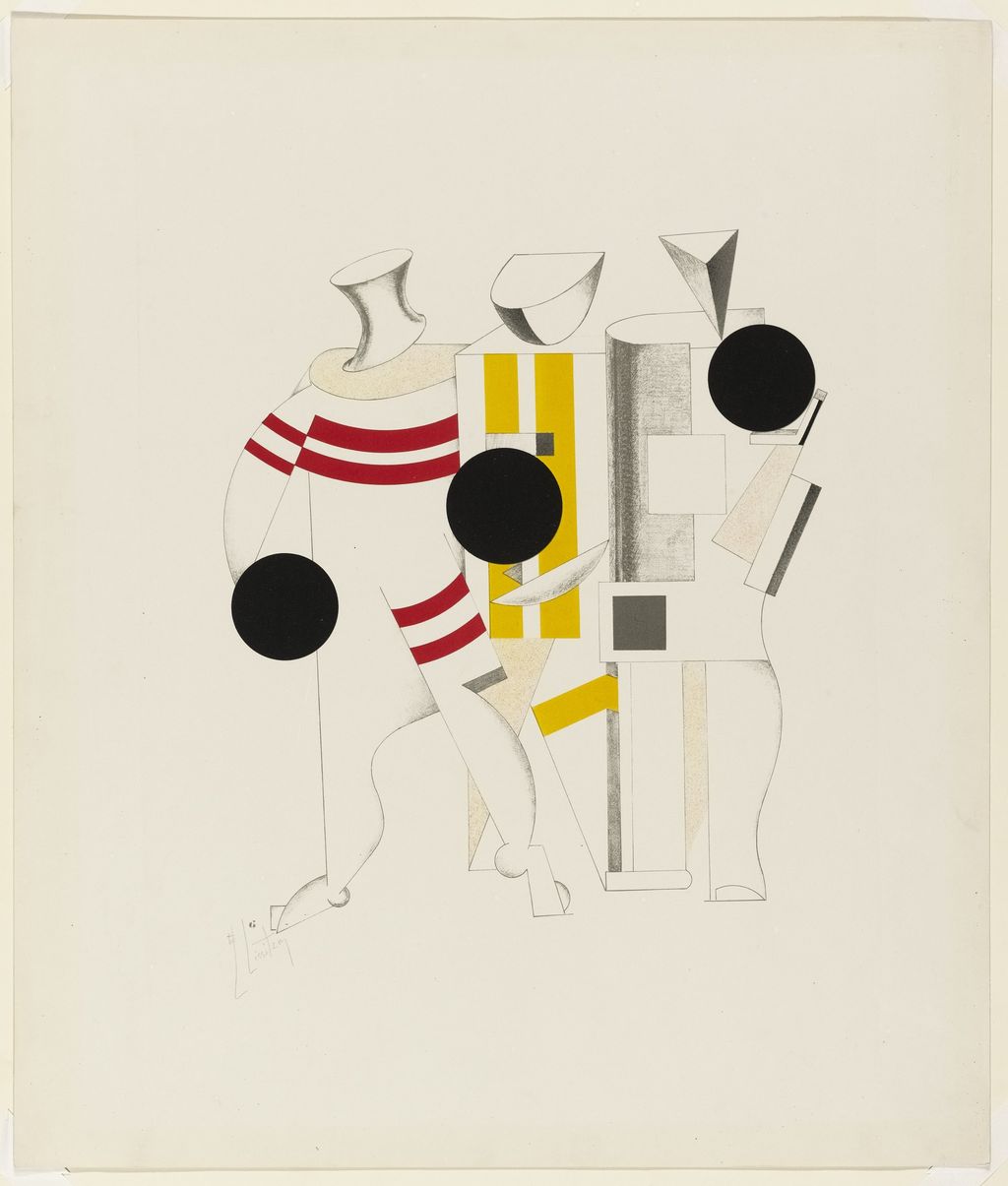
The surviving record also shows how easily opera-related images can be confused. El Lissitzky later made his own Victory over the Sun figures in 1920–21; MoMA identifies those as a separate, unrealised electromechanical theatre project. They are valuable evidence of the opera’s afterlife, but their machine-like designs should not be substituted for Malevich’s costume image. [3]
Why the version date matters
The Stedelijk’s formula, “1913 (version circa 1929),” is more precise than a single year. It preserves an early design and a later manifestation of it. Malevich revisited earlier ideas and sometimes produced later versions of compositions. This accession must therefore be identified by its number, image and date wording together. A label that says only “1913” hides the museum’s qualification; “1929” alone wrongly detaches it from the 1913 opera. [1]
The museum groups the object under “Drawings,” but that is a collection browsing category, not a full technical description. The visible colour does not establish whether the media are gouache, watercolour, crayon or another combination. Nor does the public text name the support. Those details should remain open until an accession-specific catalogue or conservation record can be checked. [1]
Its Khardzhiev Foundation loan credit also matters. The work is in the Stedelijk’s online collection display, but the public item does not call it an outright Stedelijk acquisition. The distinction helps a reader trace this particular version rather than assume that every Malevich work listed by the museum has the same owner or provenance. [1]
From costume to abstraction
Malevich’s opera work is often discussed beside the emergence of Suprematism and Black Square. The Centre Pompidou sees the production as a key setting for his experiments with elementary forms. There is a useful visual connection: this aviator’s colour blocks make the body look partly geometric. But the costume is still a figure, and this accession is a later version. It should not be presented as if it were itself the nonobjective 1915 square. [1] [2]
The move from a person in a costume to a painting without a depicted person was a change in purpose as well as appearance. In the opera design, colour and geometry shape an actor. In Suprematist painting, shapes can become the subject without needing to identify a body or a prop. Looking at the aviator makes that difference concrete: the head and feet keep bringing us back to a performer even when the middle of the figure looks almost like an arrangement of abstract panels. [1] [2]
The design at stage distance
Stand back from the image and the head and chest resolve into broad areas of colour before the smaller marks at the hands or feet are legible. At closer range the curves separate from the silhouette and can be traced independently. The two viewing distances reveal different decisions in the same design. The large blocks keep the figure coherent, while the thinner lines test where its outlines might continue into the surrounding space. The pale field makes those differences easy to follow on the sheet. An audience at the opera would have seen the figure in relation to other performers and a changing stage. [1] [4]
The Stedelijk image and the MoMA print also ask for different kinds of attention. Malevich’s single standing figure can be read through the sequence from head to legs. In Lissitzky’s Sportsmen, the overlapping figures and their marks share one printed composition. The contrast in format is a visible way to distinguish the individual costume study from the later portfolio even before reading either label. [1] [3]
Watch reconstructions of Victory over the Sun
Two venues documented the Stas Namin Theatre’s 2015 production, with costumes reconstructed from Malevich’s designs.
Victory over the sun at the Fondation Louis Vuitton
A short record of the Paris performances.
Watch on YouTubeFrequently Asked Questions
Is this the original 1913 sheet?
The Stedelijk calls it a 1913 design in a version circa 1929. Its wording does not establish that this physical sheet appeared at the 1913 performance. [1]
What materials were used?
The accessible Stedelijk item page does not state the precise material or support. “Drawings” is its collection category, not a sufficient material attribution. [1]
Who made the opera?
Is this Malevich’s painting The Aviator?
No. This route identifies the Stedelijk costume design 4.2001(167), with its standing red, blue, white and black figure. A shared word in the title does not make it the same object as a separate painting. [1]
Discussion
Which coloured shapes make the aviator appear most like a person, and which make it look constructed?
How do the blue curves around the limbs change your sense of the standing figure?
Reader Insights
Trace the blue wedges from the shoulders toward the red torso.
Compare the nearly symmetrical pose with the unequal red and blue shapes.
Keep the 1913 design distinct from the Stedelijk version dated circa 1929 and Lissitzky’s later designs.
Join the Conversation
Share a close observation or an accession-specific source for this aviator design.
References
- Stedelijk Museum Amsterdam, Aviator v Pobede nad solntsem: Object 4.2001(167); date and version, dimensions, translation, loan credit and image. Item page inspected directly on 30 September 2026; exact material omitted. View source.
- Centre Pompidou, Kasimir Malévitch: Institutional account of the December 1913 opera and Malevich’s sets and costumes. View source.
- Museum of Modern Art, El Lissitzky, Sportsmen from Victory over the Sun: Institutional explanation of the opera and Lissitzky’s separate 1920–21 redesign. View source.
- National Gallery of Art, Victory over the Sun reconstruction release: Museum account of the 1913 performances and experimental production, published for its 1990 presentation. View source.