 by Tom Gurney
Tom Gurney BSc (Hons) is an art history expert with over 20 years experience
Published on June 19, 2020 / Updated on November 20, 2026
Email: tomgurney1@gmail.com / Phone: +44 7429 011000
Introduction
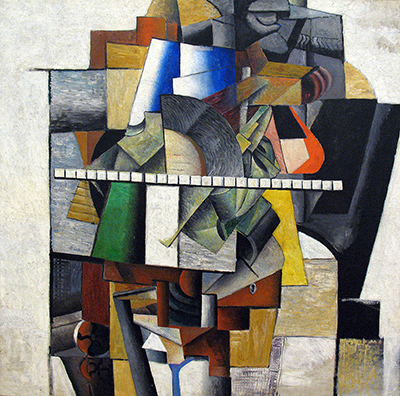
A pale horizontal strip crosses an intricate construction of blue, ochre, black, grey and white planes. Just above its centre, a forehead and dark hair begin to resolve into a human head; below it, a shirt front and tie appear among shapes that could be furniture, clothing or shallow architectural space. Kazimir Malevich called this work a portrait of the composer and artist Mikhail Matyushin. The saved image on this page matches the composition illustrated in the Tretyakov Gallery Magazine’s object record. [1] [2]
The magazine dates the oil-on-canvas painting 1913 and gives its dimensions as 106.5 × 106.5 cm. A Tretyakov education page uses 1913–14; the narrower and wider dates are therefore attributed here rather than flattened into an apparently unanimous fact. The work is in the State Tretyakov Gallery in Moscow. Its magazine record traces it through Matyushin’s widow O. Matyushina (Gromozova), Nikolai Khardzhiev and George Costakis, who donated it to the gallery in 1977. [1] [3]
At a Glance
- ArtistKazimir Malevich
- TitlePortrait of M. V. Matyushin
- Date1913 in the illustrated magazine record; 1913–14 on a Tretyakov education page
- MediumOil on canvas
- Size106.5 × 106.5 cm
- CollectionState Tretyakov Gallery, Moscow
- Recorded transferDonated by George Costakis, 1977
Contents
- Reading the portrait
- Matyushin and the opera
- Before Suprematism
- The painting and its record
- Following the divisions across the canvas
Reading the portrait
The composition postpones recognition. It places many differently shaded edges around a small naturalistic remnant of the sitter’s face. The National Gallery of Art teaching packet identifies a forehead and hair above the centre, with a shirt front and tie below. A viewer can test that reading against the image: the head is present, but it does not organise every neighbouring form into one stable body. Malevich makes a portrait that can be inspected slowly rather than grasped through a single likeness. [2]
The long pale strip, marked like a measuring device, is especially conspicuous. It crosses both the figure and the surrounding fragments and keeps the eye aware of the painted surface. The National Gallery of Art associates its divisions with Matyushin’s extended musical scale. That is an institutional interpretation, not an inscription explaining the object; the visible fact is a ruler-like band with regular intervals. The painting can be read with that musical possibility in mind without claiming that every division transcribes a note. [2]
A small drawer front with a keyhole appears lower down. In the National Gallery’s account, it may recall a line from the libretto of Victory over the Sun about a chest of drawers that is not as simple as it first appears. The cautious “may” matters: no surviving statement by Malevich on the public object record proves that he meant this exact allusion. What the picture certainly does is bring a familiar household motif into a difficult, splintered portrait. [2]
Curves, blocks and diagonals imply more than one kind of space. A sloping black shape behind the head can push it forward, while the ruler-like band cuts across that depth. Some passages look shaded and weighty; others are flat fields. This shifting relationship between surface and depth helps explain why the picture is often described as Cubo-Futurist, but it remains recognisably a portrait rather than an abstract arrangement without a named sitter. [1] [2]
Matyushin and the opera
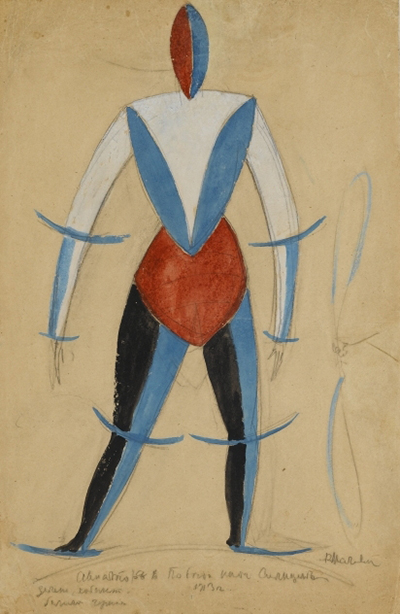
Matyushin was a composer, musician, painter and publisher. The National Gallery of Art account says he met the younger Malevich in 1912 and that their correspondence shows sustained discussion of artistic ideas. Their most visible collaboration in 1913 was the Futurist opera Victory over the Sun: Matyushin supplied the music, Aleksei Kruchenykh the libretto, and Malevich designed sets and costumes. The National Gallery places the portrait in autumn 1913, during their work on the production. [2]
That context offers a reason to look beyond physical likeness. The sitter was involved in experiments with music, theatre and perception. Malevich’s interlocking planes make those concerns available as visual questions: where does one object end, how does a figure occupy shallow space, and what happens when a repeated measured rhythm interrupts an image? These are readings of the painting’s form and context, not documentary claims that particular shapes represent particular instruments. [2]
The opera’s title and the subject’s identity also help connect this page to the wider Malevich cluster. The later Black Square is often discussed in relation to his stage work, but it is a distinct painting with its own 1915 exhibition history. This 1913 portrait has a sitter, a face fragment and several familiar objects. Seeing those features clearly makes the later departure from depicted things more intelligible. [2]

Before Suprematism
The National Gallery characterises the portrait as strongly influenced by synthetic Cubism. Broad flat shapes, patterned areas and modest cues to depth break up a recognisable human subject. Malevich did not simply hide a complete face behind a decorative grid. The viewer reconstructs a possible bust-length figure from scattered fragments, while the arrangement itself demands equal attention. [2]
The painting belongs to a period of fast experimentation rather than a straight path from portrait to square. In the same teaching packet, the National Gallery treats the stage designs for Victory over the Sun as an important step toward nonobjective art, while distinguishing that theatrical work from the first public showing of Suprematist paintings in 1915. The portrait demonstrates the earlier problem: how far can a painter transform visible reality while still making a named person the subject? [2]
A useful comparison is Malevich’s Perfected Portrait of Ivan Kliun, another 1913 work built from fractured forms. The names make both works portraits, but they are separate physical paintings in separate collections. Comparing their visible constructions can clarify the variety within this moment without turning them into interchangeable examples of one style. [1] [2]
The painting and its record
The Tretyakov Gallery Magazine’s illustrated record is unusually useful because it links identification, material, size and provenance on one page. It says that the painting came from O. Matyushina’s collection, was acquired from Nikolai Khardzhiev and was donated by George Costakis to the Tretyakov Gallery in 1977. The sequence is reported by that source; it does not establish every date of custody or a complete ownership chain. [1]
The National Gallery’s 1990 teaching packet lists a slightly different measurement, 106.35 × 106.3 cm, as printed there. The object record’s 106.5 × 106.5 cm is used in the summary above because it comes from the gallery-associated illustrated catalogue. The small difference is recorded here instead of silently combining the two figures. Neither source in this page’s evidence set gives an accession number, so the physical work is anchored by the illustrated record, owner collection, title, dimensions and provenance together. [1] [2]
Following the divisions across the canvas
The ruler-like band gives the viewer a way to other parts of the canvas. Start near the head and follow the band out to either side. The regular divisions sustain its horizontal course even where adjacent shapes change colour or direction. Then look down at the drawer front. It has its own edges and appears to occupy a different plane from the strip. Seen in that sequence, the ruler and drawer do more than offer possible clues to the sitter’s interests. They show how the painting places familiar objects at different depths while making them answer to the same flat surface. [1] [2]
The small area of hair and forehead rewards the opposite approach. Begin with the prominent horizontal strip and the portrait can look like a study in geometry. Begin with the hair and the strip can read as an interruption in a human likeness. The insistence of both readings is visible even without resolving the proposed musical allusion. [1] [2]
Frequently Asked Questions
Why is the sitter hard to see?
Malevich divides the face and body among geometric planes. The National Gallery identifies a forehead, hair, shirt and tie, but the work also asks the viewer to attend to its lines, colours and surface. [2]
What is the horizontal strip?
It is a ruler-like band with regular divisions. The National Gallery connects it to Matyushin’s experiments with musical scale; that connection remains an interpretation of the visible form. [2]
Where is the painting?
The State Tretyakov Gallery in Moscow holds it. The gallery magazine reports Costakis’s donation in 1977. [1]
When was it painted?
Discussion
Which fragments of Matyushin’s face or clothing can you find before reading the title?
How do the blue, ochre and grey planes balance the horizontal strip?
Reader Insights
Trace the measured strip across the centre of the painting.
Compare the partly recognisable face with the most abstract-looking passages.
Keep the 1913 Tretyakov portrait distinct from the 1915 Black Square and other Matyushin-related works.
Join the Conversation
Share a close observation or an object-specific source for this Matyushin portrait.
References
- Tretyakov Gallery Magazine, Portrait of M. V. Matyushin: Illustrated work record: 1913, oil on canvas, 106.5 × 106.5 cm, acquisition history and 1977 Costakis gift to the Tretyakov Gallery. View source.
- National Gallery of Art, Kazimir Malevich Teaching Packet (1990): Paula Wisotzki and Susan Freifeld, slide 10 and its accompanying text, PDF pages 29–30; object identification and a source-attributed interpretation of its visual details and opera context. View source.
- State Tretyakov Gallery, At the Avant-Garde: The gallery identifies Malevich’s Portrait of M. V. Matyushin as a work in its collection and dates it 1913–14 on this education page. This differs from the 1913 dating in the illustrated magazine record. View source.