 by Tom Gurney
Tom Gurney BSc (Hons) is an art history expert with over 20 years experience
Published on June 19, 2020 / Updated on November 20, 2026
Email: tomgurney1@gmail.com / Phone: +44 7429 011000
Introduction
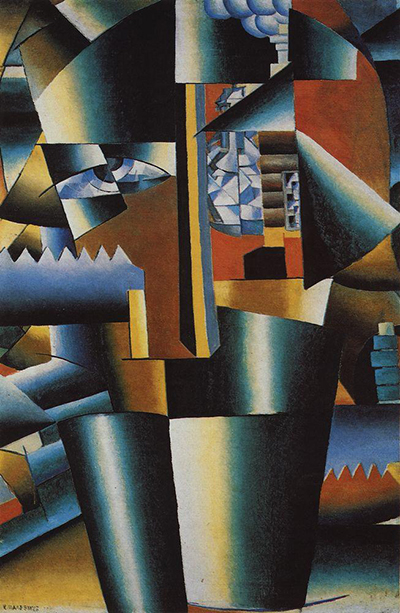
An eye emerges from a structure of angled planes, cylinders and hard-edged colour. A narrow vertical passage divides the face; dark teeth-like shapes interrupt the left edge. Malevich's Perfected Portrait of Ivan Kliun gives enough clues to suggest a head but makes the viewer assemble it from pieces. It is a portrait whose subject is also the act of remaking a portrait. [1] [2]
The State Russian Museum identifies the painting as 1913, oil on canvas, 111.5 × 70.5 cm, inventory ЖБ-1469. Its fuller English title matters. “Perfected” announces a transformed image rather than a straightforward likeness of Malevich's fellow artist Ivan Kliun. The museum calls the association with Kliun traditional and places the work within Malevich's recurring frontal-head motif. The site's older short title remains in its URL, while this article follows the owner's object record. [1] [2]
At a Glance
- ArtistKazimir Malevich
- Museum titlePerfected Portrait of Ivan Kliun
- Alternate title wordingPortrait of Ivan Vasilievich Kliun (Perfected Portrait of Kliun, Builder) in the Russian Museum tour label
- Date1913
- MediumOil on canvas
- Size111.5 × 70.5 cm
- CollectionState Russian Museum, St Petersburg
- InventoryЖБ-1469
- Early displayUnion of Youth exhibition, 1913–14, according to the museum
- Museum entryReceived in 1926; the Russian tour specifies transfer through GINKhUK
Contents
- How to look at the portrait
- Why “perfected”?
- Cubo-Futurism before Suprematism
- Title, date and collection
- Kliun as a painter
How to look at the portrait
Begin with the left eye. It is recognisable enough to establish a human face, yet the surrounding planes refuse to settle into a normal forehead, cheek and jaw. A dark form runs across the lower left; repeated triangular points make its edge jagged. A blue-white cluster lies to the right of the central vertical band. Below, broader curved and cylindrical forms give the composition weight without resolving into a conventional torso. [1] [2]
These are observations of the painted image, not a complete inventory of named objects. The Russian Museum proposes that some fragments carry particular associations: a tree trunk suggests Kliun's rural origins, blue-white forms and a smoking chimney suggest the sugar refinery where he worked, and a saw evokes cutting and rebuilding form. Those identifications offer a way to read an otherwise difficult picture. They should be kept as the museum's interpretation because several fragments are open to more than one visual description. [1]
The eye itself has a second possible register. The museum's catalogue text reads the cleaved eye in relation to an icon image of the Saviour and an All-Seeing Eye. The painting can be seen through that comparison without saying Malevich left a single, documented explanation for every feature. Its title, suggested tools and fragmented face allow religious, biographical and artistic readings to overlap. [1] [2]
Why “perfected”?
The word can sound as though Malevich intended a more accurate portrait. The visual result points in another direction: the face is taken apart and reconstructed. The Russian Museum interprets “perfected” as something newly made or better than what preceded it. It associates the saw with the painter's transformation of visible form into a new picture. This is a claim about artistic construction, not a measurement of resemblance to the sitter. [1]
That distinction helps explain why the painting still counts as a portrait. Its title identifies a person, and the large frontal head directs attention to a human subject. At the same time, geometric elements make the process of depiction unusually conspicuous. The viewer keeps moving between face and construction: recognising an eye, losing the head in angular parts, then finding it again. [1] [2]
Malevich was not picturing an anonymous mechanical man. Kliun was an artist in his own right. The Thyssen-Bornemisza Museum says the two met in 1907, that Malevich portrayed him in 1913, and that they later collaborated on the Supremus project in 1916. MoMA's artist record lists Kliun's independent work, including a 1916 Suprematism. Those sources supply context for the personal identification while leaving the Russian Museum's inventory as the authority for this physical canvas. [1] [4] [5]
Cubo-Futurism before Suprematism
The Russian Museum describes Perfected Portrait as a characteristic Cubo-Futurist work and records its appearance at the 1913–14 Union of Youth exhibition. The angular segmentation, shifting spatial planes and partial recognisability support that classification. The painting still offers fragments of a face and possible objects; it does not yet remove references to the world as Malevich's later nonobjective Suprematist works would. [1] [2]
The chronology matters. Malevich introduced Suprematist paintings publicly in 1915; this canvas is dated 1913 by its owner. Looking backward from Black Square can make every earlier geometric painting appear to be merely a preliminary version of it. Perfected Portrait has its own question: how far can a portrait be reassembled before the subject becomes difficult to recognise? Its close friend, an artist working in the same experimental world, gives that question an unusually personal focus. [1] [2] [4]
The National Gallery of Art later presented the painting as a 1913 Cubo-Futurist work from the Russian Museum in its Malevich exhibition. The report describes those works displayed near, but separately from, Suprematist paintings. That later exhibition arrangement reinforces a useful distinction for readers: this is part of the path through Malevich's changing art, rather than an example of the fully nonobjective language he would announce in 1915. [3]

Title, date and collection
English titles for this painting vary. The Russian Museum's object page uses Perfected Portrait of Ivan Kliun; its Benois Wing tour supplies a longer Russian label that also names Builder. The old site route's Portrait of Ivan Kliun is a shorter way to find it. The longer wording is useful because it identifies the constructive idea that the museum discusses, while the accession ЖБ-1469 fixes which physical picture is meant. [1] [2]
The museum dates that object 1913 and gives its oil-on-canvas medium and dimensions. The tour's Russian provenance line says it entered in 1926 through GINKhUK from the Museum of Artistic Culture collection; the English object page gives the receipt year without that fuller route. Neither page establishes that every earlier work called “Portrait of Kliun” is this canvas. This article keeps the specific museum record attached to the pictured composition. [1] [2]
The museum labels a Benois Wing room for the work but warns that gallery placement can change. A reader planning a visit should use the museum's current display information rather than treating the historic room reference as a guarantee. [1]
Kliun as a painter
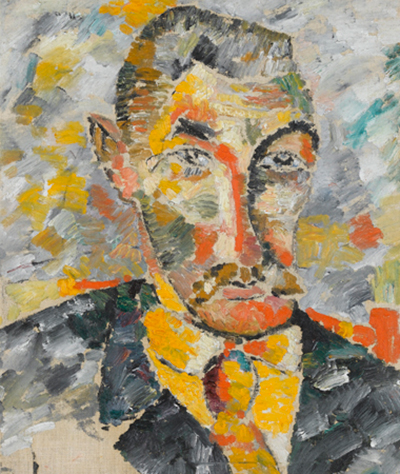
The Thyssen-Bornemisza’s illustrated Composition offers a chance to compare Kliun’s work with the portrait’s construction of his likeness. The museum dates that separate painting to 1917. Geometric forms there organize the field independently of a recognizable sitter. In Malevich’s earlier portrait, the eye is still a strong point of orientation and the visible fragments continually prompt the viewer to look for a face. That is a useful difference to keep in view when the two names appear together in an exhibition or an account of Supremus. One work portrays Kliun through a new treatment of likeness. The other gives him the opportunity to put his own abstract decisions on the canvas. [1] [4]
The Russian Museum offers biographical interpretations for parts of the 1913 portrait. Their force comes partly from knowing whom Malevich named. A reader can therefore move in two directions, from the museum’s account back to the visible details or from the visible face back to the name. Kliun’s separate work gives that name a meaning that survives any uncertainty over exactly how to interpret a chimney-like shape or a saw. [1] [2] [4] [5]
Frequently Asked Questions
Who was Ivan Kliun?
Kliun was a fellow artist and associate of Malevich. The Thyssen-Bornemisza Museum records their meeting in 1907 and later collaboration on Supremus; MoMA catalogues Kliun's own works. The portrait's subject is thus an artistic colleague, although its broken-up face is not a conventional likeness. [1] [4] [5]
Is this a Suprematist painting?
Why does the title say “perfected”?
The Russian Museum reads the word as referring to a new, transformed construction. The painting's fragmentation makes that interpretation more useful than assuming “perfected” means photographic accuracy. [1]
Where is the original?
Did Malevich intend the religious imagery?
The Russian Museum offers an icon and All-Seeing Eye reading of the split eye. The source presents an interpretation, not a quoted statement of Malevich's private intention for this exact painting. [1]
Discussion
Which part of the head do you recognise first?
How does the central strip change your reading of the face?
Reader Insights
The Russian Museum catalogues this physical painting as ЖБ-1469, dated 1913.
Its Cubo-Futurist fragments retain a subject, unlike Malevich’s later fully nonobjective work.
The museum’s tree, chimney, saw and icon readings are interpretations of the picture.
Join the Conversation
Share a close observation or an object-specific source for Russian Museum ЖБ-1469.
References
- State Russian Museum, Perfected Portrait of Ivan Kliun, ЖБ-1469: object identification, 1913 date, oil-on-canvas medium, dimensions, exhibition note and museum interpretation. View source.
- State Russian Museum, Benois Wing tour entry for Perfected Portrait of Ivan Kliun: Russian expanded title, collection route and parallel label. View source.
- National Gallery of Art, 1990 annual report: identifies the Russian Museum painting within the NGA Malevich exhibition's Cubo-Futurist display. View source.
- Museo Nacional Thyssen-Bornemisza, Ivan Kliun, Composition: Kliun–Malevich relationship and later Supremus collaboration; the illustrated 1917 composition is a separate artwork. View source.
- Museum of Modern Art, Ivan Kliun artist page: records Kliun's independent work. View source.