 by Tom Gurney
Tom Gurney BSc (Hons) is an art history expert with over 20 years experience
Published on June 19, 2020 / Updated on November 20, 2026
Email: tomgurney1@gmail.com / Phone: +44 7429 011000
Introduction
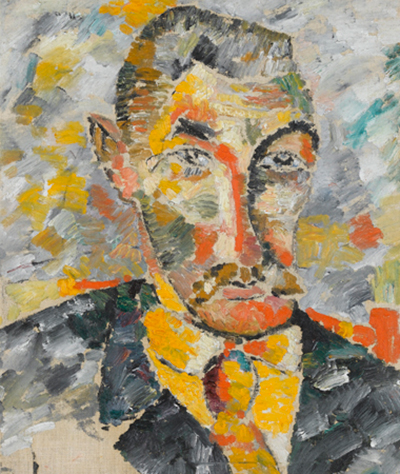
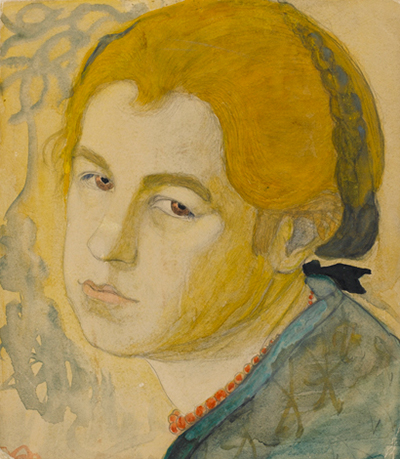
A man's face emerges from short strokes of yellow, orange, grey, white and black. Dark hair, a moustache and formal clothing remain recognizable, yet nearly every part of the portrait is broken into separate painted marks. The Stedelijk Museum Amsterdam catalogues the work as Portret van een man (Aleksei Morgunov?), translated Portrait of a Man (Alexei Morgunov?). It dates object 4.2001(085) to 1912 and lists it as a Khardzhiev Foundation loan. [1] [2]
The question mark belongs to the museum's title. This may be a portrait of the artist Aleksei Morgunov, a contemporary of Malevich, but the checked item does not establish the sitter beyond doubt. The article uses the tentative wording rather than converting an identification hypothesis into biography. [1] [3]
At a Glance
- ArtistKazimir Malevich
- Museum titlePortret van een man (Aleksei Morgunov?)
- English titlePortrait of a Man (Alexei Morgunov?)
- Date1912
- Object number4.2001(085)
- HoldingKhardzhiev Foundation loan at the Stedelijk Museum Amsterdam
- SitterPossibly Aleksei Morgunov; not securely identified
- Material and dimensionsNot specified in the owner item data captured for this page
Contents
- What does the picture show?
- Why is the sitter named with a question mark?
- Brushwork and the 1912 moment
- Holding and material limits
- Two ways Malevich built a likeness
What does the picture show?
The head and shoulders fill a vertical frame. The sitter's short dark hair has a neat contour at the top, but the skin beneath it is built from vigorous marks. Yellow and orange cut across the brow, nose and cheeks; grey and white strokes interrupt them. Dark eyes, moustache and mouth anchor the scattered colour into a face. [1] [2]
The clothing is dark and angular. A bright yellow passage at the neck may be read as a collar or neckwear, but the broken paint makes its exact form uncertain. Behind the figure, pale greys and creams carry further dashes of warm and cool colour. The background does not identify a room, street or studio. The face is the event of the work. [1] [2]
The uneven application of colour means the portrait can be seen in two ways. At a distance, the features and black clothing hold a person together. Up close, separate strokes of orange, ochre, blue-grey and white become the subject of attention. Those are observations of the reproduction, not a laboratory account of how the paint was layered. [1] [2]
Why is the sitter named with a question mark?
The Stedelijk's Dutch title gives “Aleksei Morgunov?” in parentheses. Its English rendering also preserves the uncertainty. The Malevich Society describes Morgunov as among artists exhibiting alongside Malevich at the Moscow Association of Artists in 1907; the two men therefore belonged to overlapping avant-garde circles. That context makes the proposed identity understandable, but it does not prove that this particular 1912 face is his. [1] [3]
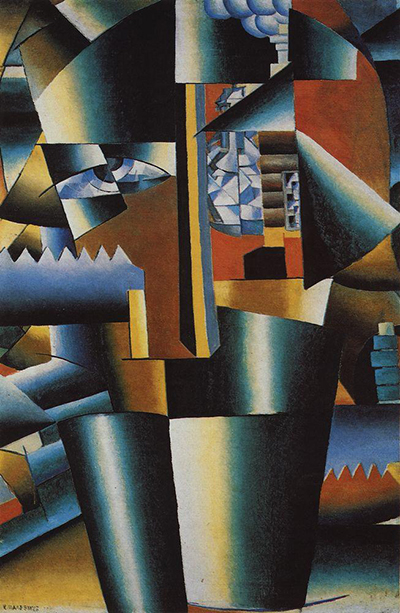
The work should not be confused with Malevich's Perfected Portrait of Ivan Kliun of 1913. That is a different sitter hypothesis, a different composition and a different museum object. “Portrait of a Man” can also describe small pencil drawings by Malevich; the accession 4.2001(085) and the image keep the present work distinct. [1] [4]
One can compare other artists' photographs or portraits of Morgunov, but likeness-based identification would require much more than resemblance in a web image. This page follows the owner catalogue's cautious attribution. [1]
Brushwork and the 1912 moment
The portrait is more recognizably human than Malevich's later Suprematist squares and crosses, yet its strokes refuse smooth modelling. Several marks seem to turn with the face; others run against it. The result is a tension between likeness and independent colour. [1] [2]
An academic study of Malevich's oeuvre notes this 1912 portrait as unusual within the year's works for its way of laying down strokes and its expressive painted forms. That judgement is a scholar's formal interpretation. The image itself supports a narrower observation: the surface is segmented into many separate colour marks around a still legible face. [5]
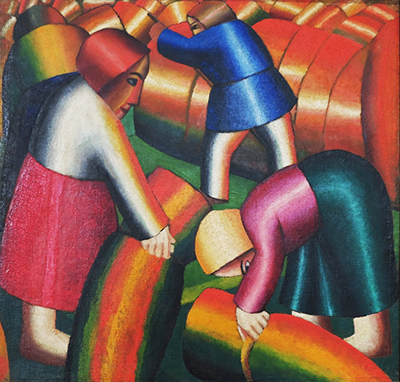
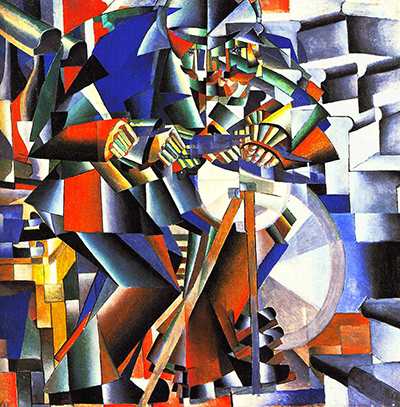
Malevich's work around 1912 spans different approaches to the figure. Taking in the Rye organizes rural bodies more broadly; The Knife Grinder breaks the worker and machinery into repeated angular facets. This portrait keeps a face as its focus while loosening the brushwork around it. These comparisons do not prove a single linear route from portraiture to abstraction; they show the range of methods he was trying. [1] [4] [6]
Holding and material limits
The Stedelijk item places 4.2001(085) on loan from the Khardzhiev Foundation. A loan credit is a relationship of custody and should not be rewritten as Stedelijk ownership. The accessible item metadata reviewed for this article do not provide a reliable material line or dimensions. Some derivative lists supply measurements, but those have not been reconciled to an owner item or catalogue and are omitted from the fact table. [1] [7]
The reproduced image is useful for examining the pattern of brushstrokes. It cannot establish a paint formula, support or restoration history. The bright marks across the face should therefore be read as visible formal details, not as evidence of a particular material process. [1] [2]
Two ways Malevich built a likeness
In this portrait, the painted face remains easy to find even though the strokes do not always blend into a continuous skin colour. Follow a darker stroke from the moustache or the edge of the head into a lighter patch. The transition tells a viewer about the face and also leaves the direction of the mark visible. The head keeps enough coherence for those short changes of colour to register as parts of one likeness. The Stedelijk’s question mark concerns the name of the sitter. The work’s concentrated treatment of a face is there to be seen independently of that identification. [1] [2] [5]
The following year’s Perfected Portrait of Ivan Kliun provides a distinctly different example. The Russian Museum describes a much taller oil on canvas, with a clearly named subject. A reader recognizes that portrait through a set of fragments organized around the eye. In the Stedelijk picture, a more complete outline provides the initial point of recognition. The comparison makes it possible to see how much can change about the construction of a likeness while both works retain the word portrait. It gives no reason to transfer the named sitter or the documented medium from one painting to the other. [1] [2] [4]
There is also a difference in the kind of work the eye does when it reaches the edge of the face. Broad planes in the Kliun painting can redirect attention away from bodily features. In the 1912 portrait, the small marks around the face keep drawing attention back towards it. That difference belongs to the visible handling, regardless of whether the proposed Morgunov identification is eventually confirmed. It is particularly clear at the edge of the moustache, where the small shift in value brings a feature into focus without requiring a single enclosing line. [1] [2] [4] [5]
Frequently Asked Questions
Was it painted in 1912?
The Stedelijk's item dates 4.2001(085) to 1912. [1]
Is the sitter definitely Aleksei Morgunov?
Is this Ivan Kliun?
The Kliun portrait is a different work. This image and accession belong to the Stedelijk's Portrait of a Man (Alexei Morgunov?). [1] [4]
What is the work made of?
The checked owner item data do not specify material or support, so the page does not claim a verified medium. [1]
Where is it held?
The Stedelijk Museum Amsterdam lists it as a Khardzhiev Foundation loan, object 4.2001(085). Current on-view status is unverified. [1]
Discussion
Which brushstrokes hold the face together?
How does the contrast between the dark jacket and bright face work?
Reader Insights
Notice the short separate colour marks around the brow, cheek and neck.
Step back from the image: which details establish likeness?
Why does the museum title retain a question mark after Morgunov’s name?
Join the Conversation
Share a close observation or a source-backed detail about Stedelijk 4.2001(085).
References
- Stedelijk Museum Amsterdam, Portret van een man (Aleksei Morgunov?), 4.2001(085): owner item for title, tentative sitter, 1912 date, accession and loan credit. View source.
- Wikimedia Commons, Portrait of a man (Malevich, 1912): Stedelijk-sourced exact-image cross-check; not used as authority for medium. View source.
- Malevich Society, “About the Artist”: contextual account of Malevich and Morgunov exhibiting in overlapping Moscow circles. View source.
- State Russian Museum, Perfected Portrait of Ivan Kliun, ЖБ-1469: different portrait and sitter. View source.
- Altai State University, academic study with Malevich chronology: formal assessment of the unusual brushwork in the 1912 Portrait of a Man (Alexei Morgunov?); secondary scholarly reading. View source.
- Yale University Art Gallery, official indexed catalogue listing for The Knife Grinder: separate 1912–13 figural comparison. View source.
- Stedelijk Museum Amsterdam, Khardzhiev collection account: context for the museum's Khardzhiev Foundation loans. View source.