 by Tom Gurney
Tom Gurney BSc (Hons) is an art history expert with over 20 years experience
Published on June 19, 2020 / Updated on November 20, 2026
Email: tomgurney1@gmail.com / Phone: +44 7429 011000
Introduction
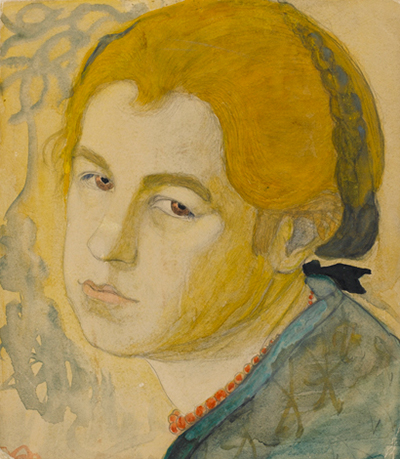
A young woman's head fills nearly all of a small, upright picture. Yellow-gold hair rises above her pale face, while a blue-green garment and red beads appear at the lower edge. She turns slightly, looking out of the image rather than posing frontally. The saved reproduction on this page matches the Stedelijk Museum Amsterdam's Portret van een jonge vrouw (waarschijnlijk Sofia Rafalovitch)—Portrait of a Young Woman (Probably Sofia Rafalovitch)—object 4.2001(166). The museum dates it 1908–1909, gives 25 × 22 cm, and credits it as a Khardzhiev Foundation loan. [1] [2]
The word “probably” in the museum title matters. The portrait may show Sofia Rafalovitch, but the checked object record does not establish her identity beyond doubt. It would be misleading to shorten that qualified identification to a certain portrait of Malevich's wife. [1] [3]
At a Glance
- ArtistKazimir Malevich
- Museum titlePortret van een jonge vrouw (waarschijnlijk Sofia Rafalovitch)
- English titlePortrait of a Young Woman (Probably Sofia Rafalovitch)
- Date1908–1909
- Dimensions25 × 22 cm
- Object number4.2001(166)
- HoldingKhardzhiev Foundation loan at the Stedelijk Museum Amsterdam
- MaterialNot specified in the owner item data reviewed here
Contents
- What is visible in the portrait?
- Is the sitter Sofia Rafalovitch?
- Colour and early style
- What is known about its material and holding?
- A face within a small field
What is visible in the portrait?
The sitter's head is close to the top and side edges. Her hair is painted in broad golden areas with darker linear accents, especially toward the right. The face is softly coloured with pale yellow, cream and warm ochre. A blue-grey line defines the garment's edge; a string of small red beads supplies a sharp accent near the neck. Behind her, the background is light and loosely patterned rather than built into a detailed room or landscape. [1] [2]
The large mass of hair and the small necklace pull attention in different ways. The hair frames the face through broad colour, while the individual beads invite close inspection. Her eyes are placed unevenly because the head is turned, and the modelling around cheek and nose remains gentle. These choices make the image feel intimate without giving us a documented account of the sitting or the sitter's thoughts. [1] [2]
The object is only 25 × 22 cm. A website may display its reproduction many times larger than life. At actual size, the face would still dominate, but the red beads and thin lines would be far smaller than on most screens. The dimensions help explain how much work Malevich gives the close crop. [1]
Is the sitter Sofia Rafalovitch?
The Stedelijk's Dutch title says “waarschijnlijk Sofia Rafalovitch”, meaning “probably Sofia Rafalovitch.” Its English translation preserves the same caution. A National Gallery of Art chronology records that Malevich married Sofia Mikhailovna Rafalovich in 1909. The portrait's 1908–1909 date makes the suggested identification historically plausible, but timing alone is not proof of who sat for it. [1] [3]
The spelling of her surname varies when transliterated from Russian. This page follows the Stedelijk's title when naming the possible sitter. It does not infer that the portrait depicts a particular meeting, engagement or marriage event; none is established in the checked item record. [1] [3]
This distinction is especially useful because Malevich painted other female portraits before and after this period. A title, approximate date or resemblance does not merge those works into one object. The accession 4.2001(166) and the precise image are the reliable identity anchors here. [1] [2]
Colour and early style
This small portrait belongs to Malevich's figurative years before the emergence of Suprematism in 1915. Its loose background, warm hair and softly modelled face show a painter working through colour and portrait likeness rather than the hard geometry of a later Black Square. That contrast helps locate the object in his career, but it should not turn every coloured patch into a supposed prediction of abstraction. [1] [4]
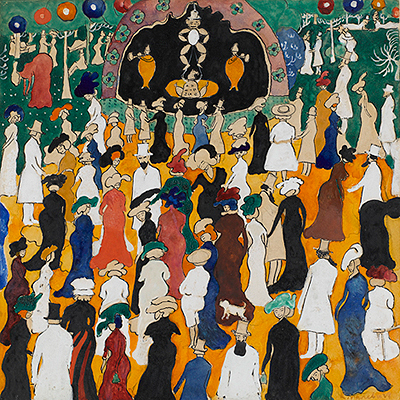
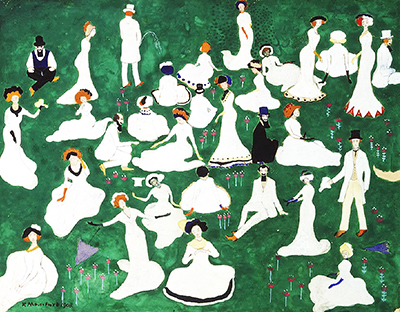
The red beads and blue-green clothing create a compact colour rhythm below the yellow hair. Light marks behind the figure leave the setting ambiguous. The portrait emphasizes a person and a face even while its brushwork remains expressive. One can compare it with the decorative crowd of Gallant Company in a Park and the spread-out figures of Relaxing (Society in Top Hats), both around 1908. These are separate works; the comparison only shows the range of Malevich's figure painting at the time. [1] [5] [6]
What is known about its material and holding?
The museum categorizes the item among its drawings and lists 25 × 22 cm. The material field captured for this object is blank. Some derivative lists describe gouache and watercolour on card, but that formulation should not be silently presented as an owner-confirmed fact. A technical description needs reconciliation against a catalogue or direct museum record. [1]
The Stedelijk credits the work as a Khardzhiev Foundation loan. That names its holding relationship and should not be simplified to Stedelijk ownership. The checked item does not provide an unbroken provenance from 1908 or verify whether it is on view today. [1] [7]
The Stedelijk identifies this work through its accession and its title. The title retains the uncertainty about the sitter even where a reproduction circulates without the longer caption. The two kinds of information travel together most reliably when a caption gives the date and collection credit alongside the possible name. [1] [2]
A face within a small field
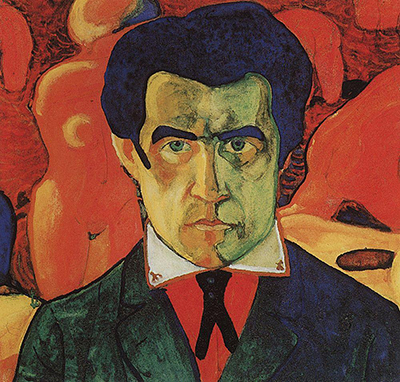
Set beside Malevich’s early Self-Portrait, the portrait raises a useful question about what gives a face its shape. The Tretyakov caption dates that other work to 1908–1910 and measures it at 27 by 26.8 centimetres. In the self-portrait, strong green and warm yellow changes make the planes of the face conspicuous. In the Stedelijk work, the lighter tones of the cheek and nose sit closer together. The sharper colour changes move out to the hair, collar and necklace. Both faces are prominent, but the boundaries a viewer notices first lie in different places. [1] [2] [8]
The woman’s turn allows the edge of the cheek to meet the surrounding colour at an oblique angle. In the frontal self-portrait, dark hair and jacket make an almost continuous frame around a face that meets the viewer directly. Here the unbalanced shapes around the head contribute to the impression of someone seen from nearby and at an angle. The necklace has only a small part of the total painted area, yet the sequence of red marks helps direct the eye along the lower edge of the figure. On a sheet with little room for setting, those small changes do much of the work that a room, furniture or other accessories might do in a larger portrait. [1] [2] [8]
The early self-portrait and the young woman also suggest different distances from the subject. In the self-portrait the face seems to advance against the red shapes behind it. In the young woman the lightly worked background comes close to the edge of the hair. That small distinction affects how much separation a viewer sees between the head and the rest of the image. [1] [2] [8]
Frequently Asked Questions
When was it made?
The Stedelijk item dates 4.2001(166) to 1908–1909. A shorter 1908 date appears in some maker listings, but the object item gives the wider range. [1]
Is it definitely Sofia Rafalovitch?
How large is it?
The Stedelijk gives 25 × 22 cm. [1]
What medium did Malevich use?
The checked owner item does not specify it. The page therefore leaves the medium open pending stronger catalogue evidence. [1]
Where is it held?
The Stedelijk Museum Amsterdam lists it as a Khardzhiev Foundation loan, object 4.2001(166). Current display is unverified. [1]
Discussion
What directs your attention first: the face, golden hair or red beads?
How does the close crop affect the portrait?
Reader Insights
Compare the softly modelled face with the broad hair colour.
Notice how the blue-green clothing and red beads meet.
What is the difference between a probable and a certain sitter identification?
Join the Conversation
Share a close observation or a source-backed detail about Stedelijk 4.2001(166).
References
- Stedelijk Museum Amsterdam, Portret van een jonge vrouw (waarschijnlijk Sofia Rafalovitch), 4.2001(166): owner item for title, tentative sitter, 1908–1909 date, size and holding credit. View source.
- Wikimedia Commons, Portrait of a young woman (Malevich, 1908–09): Stedelijk-sourced same-image visual cross-check; not used as material authority. View source.
- National Gallery of Art, Kazimir Malevich, 1878–1935 educational chronology: 1909 marriage to Sofia Mikhailovna Rafalovich; contextual chronology only. View source.
- Museum of Modern Art, The Russian Avant-Garde Book, 1910–1934 exhibition brochure: context for the later 1915 public introduction of Suprematism. View source.
- Stedelijk Museum Amsterdam, Gallant Company in a Park, 4.2001(165): distinct same-period figurative comparison. View source.
- State Russian Museum, Relaxing (Society in Top Hats), Ж-9403: distinct 1908 figurative comparison. View source.
- Stedelijk Museum Amsterdam, Khardzhiev collection account: institutional context for its Khardzhiev loan holdings. View source.
- Tretyakov Gallery Magazine, Malevich’s Self-Portrait: illustrated comparison, date, medium and dimensions. View source.