 by Tom Gurney
Tom Gurney BSc (Hons) is an art history expert with over 20 years experience
Published on June 19, 2020 / Updated on November 20, 2026
Email: tomgurney1@gmail.com / Phone: +44 7429 011000
Introduction
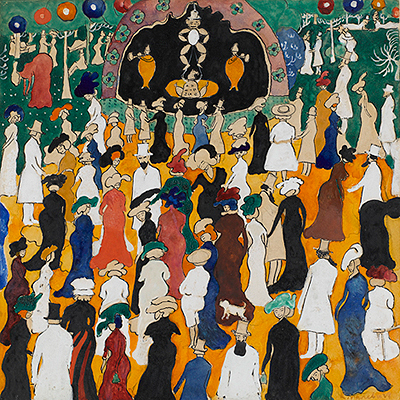
A crowd of elegantly dressed people gathers around a dark central stage or pavilion. White hats and clothes punctuate orange, green, blue and red figures; circular decorations fill the top of the image. The saved picture on this page matches the Stedelijk Museum Amsterdam's Elegant gezelschap in een park, translated Gallant Company in a Park, object 4.2001(165). The museum dates it circa 1908, measures it 20.4 × 20.2 cm, and credits it as a Khardzhiev Foundation loan. [1] [2]
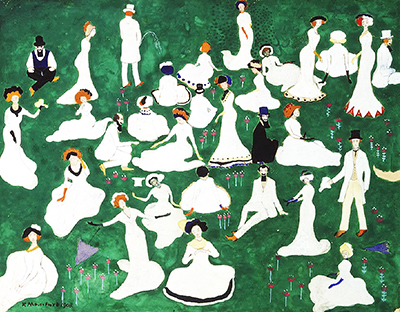
The near-square image is a different object from Malevich's other 1908 social scene, Relaxing (Society in Top Hats). That work has white-clad figures spread over a dark green lawn and belongs to the State Russian Museum as Ж-9403. The two subjects are related, but their compositions, dimensions, holders and accession numbers are distinct. [1] [3]
At a Glance
- ArtistKazimir Malevich
- Museum titleElegant gezelschap in een park; English Gallant Company in a Park
- DateCirca 1908
- Dimensions20.4 × 20.2 cm
- Object number4.2001(165)
- HoldingKhardzhiev Foundation loan at the Stedelijk Museum Amsterdam
- MaterialNot specified in the owner item data reviewed here
- Separate social sceneRussian Museum Relaxing (Society in Top Hats), Ж-9403
Contents
- What is happening in the picture?
- Colour, costume and crowd
- Two different 1908 gatherings
- Where does it sit in Malevich's career?
- Holding and material limits
- How to follow the groups
What is happening in the picture?
Groups of people stand shoulder to shoulder in the lower half, many wearing broad hats. Pale dresses and coats stand out beside dark blue, red and brown garments. At the centre, figures seem to face a dark arched area containing ornamental shapes and bright yellow forms. The image suggests a public amusement or gathering, but the museum's title is the secure description; the checked record does not identify a named event or venue. [1] [2]
Small figures appear on a raised band along the top. Bright discs hang above them. The arrangement makes the crowd feel deeper than the object’s twenty-centimetre size might suggest: near figures are large and partially cut by the bottom edge, while distant people fit into a thin upper strip. The park is made through density and pattern as much as through realistic depth cues. [1]
The central dark shape controls the eye. People cluster below it, and its black field makes the pale decorative forms unusually visible. One can call it stage-like or pavilion-like, but the image alone does not prove an exact architectural function. This article keeps that uncertainty instead of inventing a specific performance. [1]
Colour, costume and crowd
Malevich differentiates many figures by clothing rather than individual facial detail. Hats form pale ovals and wedges; blue and red coats break up the masses of white and ochre. Vertical bodies overlap, with relatively little open ground between them. That is a distinctive visual choice within his early figurative output. [1] [2]
The work is small and nearly square: 20.4 × 20.2 cm. On a computer screen, the image may appear much larger than the object. Magnification makes each costume easier to inspect, while an original-size view would likely make the crowd read more as an overall ornamental pattern. The Stedelijk's dimensions are therefore part of the interpretation, not merely catalogue trivia. [1]
The bright discs at the top echo rounded hats and faces below. The repetition links decorative park features to the human crowd. The image is lively, but whether a particular figure is dancing, watching music or waiting for a spectacle is not established by the checked source. [1]
Two different 1908 gatherings
The Russian Museum work spreads figures over a wide dark-green ground. It has people sitting or reclining in light clothes and a few black top hats. The museum calls it Relaxing (Society in Top Hats) and records a 23.8 × 30.2 cm work on paper. In contrast, this Stedelijk scene compresses a vertical crowd around a dark central feature. [1] [3]
The Russian Museum interprets its own scene in relation to a famous painting by Manet and identifies a comic figure within it. That interpretation belongs to Ж-9403 and should not be transferred to the Stedelijk 4.2001(165) simply because both show leisure or fashionable company. The Stedelijk's item data reviewed here contain no parallel claim about a Manet response for this object. [1] [3]
The two works help show that Malevich could use decorative colour in several ways at roughly the same time. In one, small costumes and crowd overlap generate movement. In the other, white silhouettes float across an open green field. Their connection is comparative, not evidence that they formed a planned pair. [1] [3]
Where does it sit in Malevich's career?
The museum's circa-1908 date puts this work before Malevich's 1915 introduction of Suprematism, documented in MoMA's Russian avant-garde material. The scene still depicts people and a setting. Its patterned colours and simplified bodies demonstrate an early interest in arrangement, but they do not make the crowd a prototype for any single later abstract composition. [1] [4]
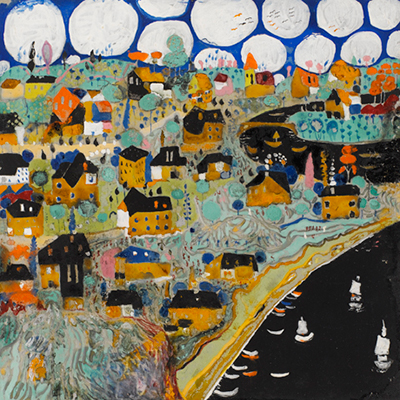
A comparison with Little Village is useful for scale and density. That 1908 Stedelijk work packs many small houses and round sky forms into a 14 × 13.9 cm field; this park scene packs people and hats into a slightly larger square. The objects have different accessions and subjects, so shared visual strategies should not erase their identities. [1] [5]
Holding and material limits
The Stedelijk credits 4.2001(165) as a Khardzhiev Foundation loan. Its institutional account says the Khardzhiev collection has been housed at the museum since the late 1990s. The loan credit records a holding relationship, not Stedelijk ownership or an unbroken chain of provenance from 1908. The checked item does not establish current on-view status. [1] [6]
The owner item field captured for this page does not give a specific material. Secondary lists propose gouache and lacquer on card, but the page does not publish that as an owner-confirmed fact. The physical medium remains a point for further catalogue reconciliation. [1]
How to follow the groups
The people can be picked out by looking for changes in colour across the picture rather than by trying to identify every face. A brighter shape can bring one cluster forward while a darker mark nearby identifies another person or part of a costume. The small format makes the intervals between groups worth noticing. An open gap provides enough space for the eye to move from one incident to the next. The same attention to intervals helps distinguish the structure and the people who gather around it even where their outlines are loosely described. [1] [2]
The Russian Museum’s separate Relaxing (Society in Top Hats) gives its pale figures the run of a broader green field. Here the gathering is more tightly collected around a point in the scene, so movement between the groups feels different. Both works are useful for seeing how an arrangement of figures can suggest a social occasion while leaving the details of an individual outing open. Their similarities make the illustrated collection numbers and separate dimensions especially important in captions. [1] [2] [3]
Frequently Asked Questions
When was it made?
The Stedelijk dates 4.2001(165) circa 1908. The date is approximate. [1]
How big is it?
The museum gives 20.4 × 20.2 cm, a small near-square object. [1]
Is this the same as the green lawn scene called Party?
What is the central structure?
It appears stage-like or pavilion-like, but the checked museum item does not identify its exact function. [1]
Where is it held?
The Stedelijk Museum Amsterdam lists it as a Khardzhiev Foundation loan. Current display is not verified here. [1]
Discussion
How are the people arranged across the scene?
Which colours and shapes make this gathering distinct from the other 1908 work?
Reader Insights
Locate the strongest dark and pale contrasts.
Compare the open lawn with the densely packed crowd in the related article.
Why does the accession number matter when two works share a social subject?
Join the Conversation
Share a close observation or source-backed detail about object 4.2001(165).
References
- Stedelijk Museum Amsterdam, Elegant gezelschap in een park / Gallant Company in a Park, 4.2001(165): owner item for title, approximate date, size and holding credit. View source.
- Wikimedia Commons, illustrated Gallant Company in a Park file: visual cross-check identifying the Stedelijk scene; secondary material metadata are not imported. View source.
- State Russian Museum, Relaxing (Society in Top Hats), Ж-9403: separate 1908 object, material, size and museum interpretation. View source.
- The Museum of Modern Art, The Russian Avant-Garde Book, 1910–1934 exhibition brochure: broader 1915 Suprematism chronology. View source.
- Stedelijk Museum Amsterdam, Little Village, 4.2001(168): separate small 1908 comparison. View source.
- Stedelijk Museum Amsterdam, Khardzhiev collection account: institutional context for its loan holdings. View source.