 by Tom Gurney
Tom Gurney BSc (Hons) is an art history expert with over 20 years experience
Published on June 19, 2020 / Updated on November 20, 2026
Email: tomgurney1@gmail.com / Phone: +44 7429 011000
Introduction
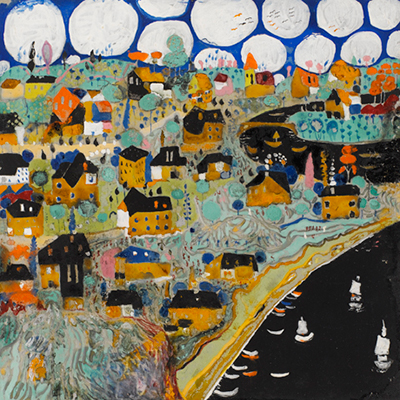
Tiny ochre, orange and pink houses fill a patterned settlement beside a dark waterway. Large white circles crowd the blue sky. The Stedelijk Museum Amsterdam catalogues the work as Dorpje, translated Little Village, object 4.2001(168). It dates the work 1908, measures it 14 × 13.9 cm, and credits it as a Khardzhiev Foundation loan. The saved image on this page matches the illustrated composition. [1] [2]
Although the reproduction fills a browser window, the original object is about fourteen centimetres square. That scale matters when reading its many small buildings, trees and pale boat-like marks. The Stedelijk item data checked here do not specify a material, so this page does not turn a general website category or a reproduction label into a definitive medium. [1]
At a Glance
- ArtistKazimir Malevich
- Museum titleDorpje; English translation Little Village
- Date1908
- Dimensions14 × 13.9 cm
- Object number4.2001(168)
- HoldingKhardzhiev Foundation loan at the Stedelijk Museum Amsterdam
- MaterialNot specified in the owner item data checked here
- Separate village workStedelijk Dorp / Village, 4.2001(090), dated circa 1906
Contents
- What is in the picture?
- How does scale change the view?
- Which village work is this?
- Malevich before the abstract square
- Holding and documentation limits
- Looking through the small format
What is in the picture?
Dozens of low houses and small tree-like circles spread across the land. Dark triangular roofs sit over yellow, orange and pink walls. The buildings are not aligned as a conventional street view; they step irregularly toward the horizon and overlap gardens or paths. Near the top, a few darker forms and a band of stronger colour mark the settlement's far side. [1] [2]
At the right, a broad black shape cuts diagonally into the square. Small white forms sit on it and can be read as boats or reflected lights on water. The image does not establish whether the water is a river, harbour or sea. The old site copy named a shore and harbour as if their geography were known; here they remain possible visual readings rather than documented place names. [1]
Above the village, white circles of varying size are separated by thick blue lines. They resemble clouds, yet their nearly geometric repetition also creates a decorative ceiling over the miniature houses. Below, rounded green and blue marks repeat the sky's circular rhythm at smaller scale. These shapes help hold together a scene that might otherwise feel crowded with separate tiny details. [1] [2]
How does scale change the view?
The Stedelijk's 14 × 13.9 cm measurement makes this a very small, nearly square object. A large screen reproduction magnifies the individual houses and strokes many times. That can be useful for looking, but it also changes our sense of density. The tiny roofs and white marks may have worked as an overall pattern when viewed at original size. [1]
The composition has little empty space. Houses fill the centre and left, the dark water presses in from the right, and the discs fill almost the whole sky. The viewer's eye moves back and forth between small repeated units and broad enclosing shapes. Malevich preserves a recognizable village while allowing colour and pattern to organize it. [1]
The source record does not identify the pictured village or prove that Malevich drew a real place. This article therefore calls it a village scene, following the museum title, without assigning it to a specific shoreline or settlement. [1]
Which village work is this?
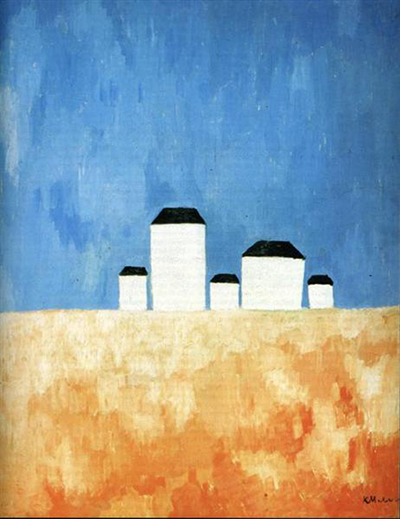
Little Village is 4.2001(168), dated 1908. The Stedelijk separately catalogues Dorp (Village) as 4.2001(090), circa 1906. A generic “Malevich village” title can easily hide that accession difference. The two objects should not exchange their dates, physical measurements or loan notes. [1] [3]
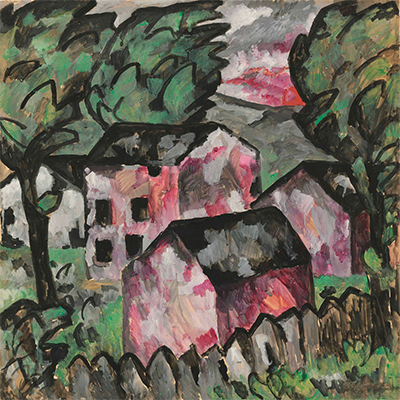
Another differently titled and much larger village view is Landscape (1911), which Christie’s documented as a 106 × 106 cm gouache with three red houses. Its dark-edged trees and zigzag fence create a very different composition from Little Village's repeated tiny houses, white circular sky and dark diagonal water. [4]
A 1915 Stedelijk drawing translated Alogism 29. Village is yet another object, with its own accession 4.2001(139). No title resemblance establishes that it is a study for this 1908 scene. In this cluster, the accession and image together carry more identifying value than the common word “village.” [1] [5]
Malevich before the abstract square
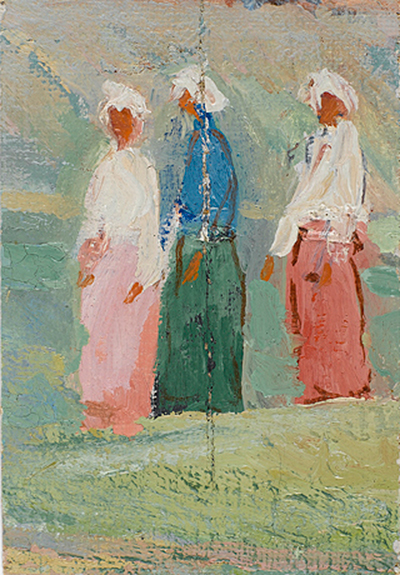
The 1908 date places this work in Malevich's early representational output. He depicts recognizable buildings, trees, sky and water, although he renders them in a compact, pattern-led way. The page can be compared with his early Three Female Figures, another small work in the Stedelijk's care. Each uses scale and simplified shapes differently: one is a three-person scene, the other a densely populated settlement. [1] [6]
Malevich later introduced Suprematism publicly in 1915, as documented in MoMA's Russian avant-garde exhibition material. Looking back from Black Square can make the circular clouds and flat roofs seem like signs of an inevitable destination. The 1908 picture still deserves to be read as a village scene in its own right. Its geometric-looking elements serve this particular landscape rather than proving a direct plan for a later nonobjective painting. [1] [7]
The old page made broad comparisons with Klimt and Kandinsky. Such comparisons can be visually interesting, but no checked object source establishes that those artists influenced this specific composition. The revised page concentrates on the documented Stedelijk object and its observable colour and spatial choices. [1]
Holding and documentation limits
The Stedelijk credits the work as a Khardzhiev Foundation loan. Nikolai Khardzhiev's Russian avant-garde collection has been housed at the Stedelijk since the late 1990s, according to the museum's institutional account. A loan credit is not equivalent to museum ownership. The online item checked here does not confirm whether Little Village is currently on view. [1] [8]
The captured owner material field is empty. Some secondary lists propose gouache on card, but this article does not present that as an owner-verified field. It remains a research lead until an item-specific catalogue or technical source is reconciled with the Stedelijk object number. [1]
Looking through the small format
A thumbnail can make the scene look like an arrangement of a few tiles of colour. The original measurements make that impression worth examining. At about fourteen centimetres across, the small gaps between buildings can keep their role without needing the kind of detail a much larger village scene might accommodate. The shapes of roofs and walls establish a settlement very economically. The open band beside them gives the eye a place to rest and provides a scale against which the clusters of marks seem especially dense. [1] [2]
Compare the much larger Landscape of 1911, catalogued at 106 centimetres square. Its broad areas of hill, foliage and buildings can spill in several directions at once. In Little Village, the closeness of the marks to the edges of the small object is more consequential. An enlarged reproduction brings the two pictures closer in apparent size, while their proportions in the viewer’s hands or on a gallery wall would yield quite different encounters. [1] [4]
Frequently Asked Questions
When was it made?
The Stedelijk dates 4.2001(168) to 1908. [1]
Is the water a sea or river?
The picture shows a dark water-like area with small white marks. The checked record does not name a body of water or a real location. [1]
How big is the original?
The museum measures it at 14 × 13.9 cm, nearly square. [1]
Is it owned by the Stedelijk?
The museum credits it as a Khardzhiev Foundation loan. Its current display status is not confirmed here. [1]
Is it the same as Village or Landscape (1911)?
Discussion
How do the repeated roofs and white circles organize this very small image?
What can you see in the dark diagonal shape at right?
Reader Insights
Compare the scale of the largest white sky circle with the houses below.
Locate the small pale marks along the dark water-like area.
Why is Stedelijk object 4.2001(168) different from its separate Village record?
Join the Conversation
Share a close observation or source-backed detail about Stedelijk Little Village 4.2001(168).
References
- Stedelijk Museum Amsterdam, Dorpje / Little Village, 4.2001(168): owner item for title, 1908 date, dimensions and Khardzhiev loan credit. View source.
- Wikimedia Commons, illustrated Little Village 1908 file: image cross-check attributed to the Stedelijk; secondary medium assertions are not imported. View source.
- Stedelijk Museum Amsterdam, Dorp / Village, 4.2001(090): separate circa-1906 work. View source.
- Christie’s, illustrated Landscape 1911 lot 6155243: separate 106 cm square gouache with three red houses. View source.
- Stedelijk Museum Amsterdam, Alogisme 29. Derevnya / Alogism 29. Village, 4.2001(139): separate 1915 object. View source.
- Stedelijk Museum Amsterdam, Three Female Figures, 4.2001(092): separate small early figurative comparison. View source.
- The Museum of Modern Art, The Russian Avant-Garde Book, 1910–1934 exhibition brochure: dates Malevich's public introduction of Suprematism to December 1915. View source.
- Stedelijk Museum Amsterdam, Khardzhiev collection account: institutional context for the collection, not an object record for Little Village. View source.