


 by Tom Gurney
Tom Gurney BSc (Hons) is an art history expert with over 20 years experience
Published on June 19, 2020 / Updated on November 20, 2026
Email: tomgurney1@gmail.com / Phone: +44 7429 011000
Introduction
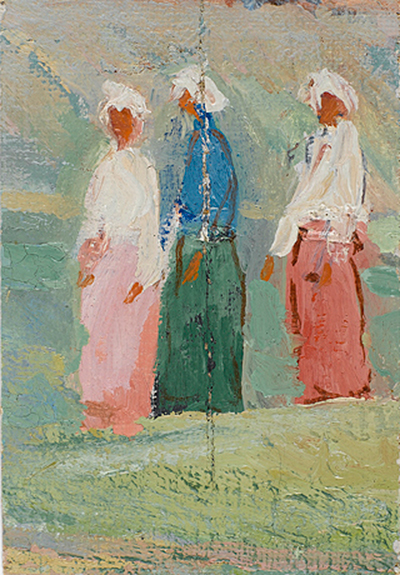
Three women stand together in a small landscape. Their white head coverings form a row of bright accents above pale pink, blue-green and reddish skirts. The image on this page matches Kazimir Malevich's Drie vrouwenfiguren (Three Female Figures) in the Stedelijk Museum Amsterdam's collection, object 4.2001(092). The museum dates it circa 1905–1906 and records its size as 10.7 × 7.3 cm. It is credited as a Khardzhiev Foundation loan. [1] [2]
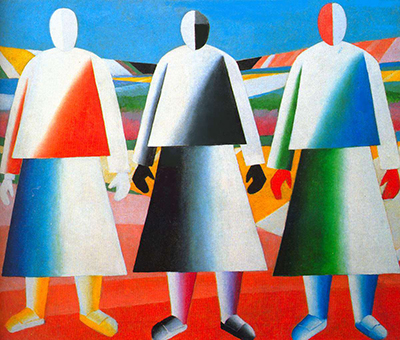
The exact identification matters because other Malevich works have similar English titles. The State Russian Museum owns a Three Female Figures dated to the early 1930s, accession Ж-9471, an oil-on-canvas work measuring 47 × 63.5 cm. The Stedelijk also lists a separate 1930 drawing translated Three Women Standing, 4.2001(081). Neither later object should supply facts for this tiny early image. [1] [3] [4]
At a Glance
- ArtistKazimir Malevich
- Museum titleDrie vrouwenfiguren; English Three Female Figures
- DateCirca 1905–1906
- Size10.7 × 7.3 cm
- Object number4.2001(092)
- HoldingKhardzhiev Foundation loan at the Stedelijk Museum Amsterdam
- MaterialNot specified in the Stedelijk item data reviewed here
- Distinct later namesakeState Russian Museum Ж-9471, early 1930s, 47 × 63.5 cm
Contents
- What do we see?
- How small is it?
- What does the style suggest?
- Which Three Female Figures is this?
- Collection and material limits
- An early group and a later canvas
What do we see?
The three women occupy most of the narrow composition. A light-dressed figure at left turns toward the centre. The central figure's blue upper body and long green skirt make the strongest vertical colour division. At right, the third woman wears a pale upper garment above a warm red-pink skirt. Their faces are small and scarcely articulated in this reproduction, while the head coverings and broad clothing shapes carry the grouping. [1] [2]
The ground is made of short bands and broken strokes of green, blue and yellow. Behind the figures, muted colour suggests foliage and open air rather than a precisely mapped place. A pale sky closes the scene at the top. The women appear to pause or stand together, but the checked museum record does not name an event, identify the sitters or establish what they may be saying. [1]
The local photograph shows a slender vertical seam or surface line near the middle of the work. It crosses the central figure and surrounding ground. The digital image allows us to locate that feature, but it is not enough to diagnose its cause, age or conservation treatment. A tiny work reproduced many times larger on a screen can also make individual marks seem coarser than they would appear at original scale. [1] [2]
How small is it?
At 10.7 cm high and 7.3 cm wide, the object is much smaller than a standard postcard. That museum measurement makes the close grouping striking: three full figures, a foreground and background all fit inside a narrow vertical field. The colour accents become a useful way to separate the women when facial detail is limited. [1]
The dimensions also help resolve the title collision. The Russian Museum's later Three Female Figures is 47 × 63.5 cm and horizontal, whereas this early Stedelijk image is 10.7 × 7.3 cm and vertical. An article that imports the later painting's oil-on-canvas medium or early-1930s date would be describing a different object. [1] [3]
What does the style suggest?
The image uses broken, visible-looking colour touches to build the ground and figures. It retains a recognizable outdoor subject while allowing brushwork and colour to take much of the descriptive work. That makes it useful when looking at Malevich before the radical abstraction associated with Black Square. The museum's circa-1905–06 dating places it nearly a decade before the 1915 presentation of Suprematism. [1] [5]
A stylistic comparison can be made with other early figurative works, but this one should not be flattened into a single, inevitable path toward the square. The three women are people in a landscape, with differentiated clothing and positions. Later Malevich paintings often treat figures and ground in very different ways. What this image documents first is a particular small, early object, not the artist's entire development. [1] [5]
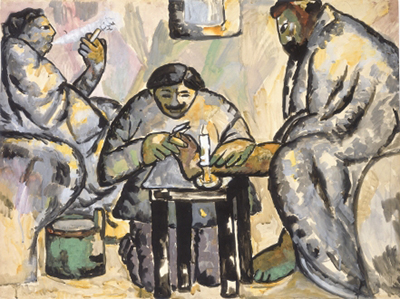
The Corn Cutter of 1911 offers a closer chronological comparison than his 1930s peasant figures. Both show recognizable people, though the later bathhouse scene uses heavier outlines and more compact, rounded bodies. Their differences suggest changes in pictorial method over several years without proving a direct influence between two specific works. [1] [6]
Which Three Female Figures is this?
The Stedelijk's early work is 4.2001(092). An illustrated Wikimedia file identifies the same accession, date and dimensions and shows the same three headscarved figures as the saved local image. That independent image-file cross-check supports the route match, while the museum record supplies the factual catalogue fields. [1] [2]
The State Russian Museum's Ж-9471 is a different physical painting. Its current object page says Three Female Figures, dates it to the early 1930s and identifies oil on canvas. The National Gallery of Art's conservation research discusses a work with that later title and date range; those paint-surface observations are about the late work and have not been applied to the Stedelijk miniature. [3] [7]
The Stedelijk's 4.2001(081) is yet another object, a 1930 drawing translated Three Women Standing. Similar subject words do not establish that it was a preparatory study for either painting. Accession, date, dimensions and reproduction must be checked together. [4]
Collection and material limits
The museum credits the early work as a Khardzhiev Foundation loan. The phrase identifies its holding relationship at the Stedelijk, not museum ownership or a full provenance back to 1905. The checked online item does not verify whether the object is currently on gallery display. [1]
Some secondary image records describe a specific painting medium and support. The owner item data captured for this article do not provide an explicit material statement, so the public fact table leaves material open. This avoids turning a broad maker-list category or an unsourced image caption into an object-level certainty. [1] [2]
An early group and a later canvas
The Stedelijk figures occupy a small upright object. Their grouping can be followed over a short distance, so the changes between one head or shoulder and the next make much of the impression. The large shapes only need to differ slightly before a viewer can begin to count three. This compactness is easy to lose when the image is enlarged. On the physical object, the three figures and nearby field share a surface considerably smaller than the hand. [1] [2]
The Russian Museum distinguishes its later oil by a 47 by 63.5 centimetre measurement and by accession Ж-9471. Its wider field gives a viewer a different encounter with a group of three. The early Stedelijk object can be recognized by the narrower proportions as well as its headscarved figures. The contrast is worth keeping in mind when a reproduction is printed without a scale. A recurring subject and an English title offer a way to find related works, while the museum identifiers determine which objects actually bear the date and material in a particular caption. [1] [2] [3]
Frequently Asked Questions
When was this small work made?
The Stedelijk dates 4.2001(092) circa 1905–1906. The approximation is part of its catalogue date. [1]
Is it the Russian Museum painting of the same title?
Where is it held?
The Stedelijk Museum Amsterdam lists the work as a Khardzhiev Foundation loan, accession 4.2001(092). Current on-view status is not confirmed here. [1]
What are the figures doing?
They stand close together in a landscape. The checked sources do not establish a named event or identify the women. [1]
Discussion
How does Malevich separate the three women within such a small field?
Which colours and strokes suggest the setting?
Reader Insights
Compare the three white head coverings and differently coloured skirts.
Look for the vertical line visible through the centre of the reproduction without assuming its cause.
Why do accession and dimensions matter when later works share the title?
Join the Conversation
Share a close observation or source-backed detail about Stedelijk object 4.2001(092).
References
- Stedelijk Museum Amsterdam, Drie vrouwenfiguren / Three Female Figures, 4.2001(092): owner record for date, dimensions, accession and Khardzhiev holding credit. View source.
- Wikimedia Commons, illustrated file for Three Female Figures c. 1905–06: image-file cross-check explicitly identifies Stedelijk 4.2001(092); its material metadata are not adopted. View source.
- State Russian Museum, Three Female Figures, Ж-9471: distinct early-1930s, 47 × 63.5 cm oil-on-canvas object. View source.
- Stedelijk Museum Amsterdam, Drie staande vrouwen / Three Women Standing, 4.2001(081): distinct 1930 drawing. View source.
- The Museum of Modern Art, The Russian Avant-Garde Book, 1910–1934 exhibition brochure: chronology of Malevich's 1915 presentation of Suprematism. View source.
- Stedelijk Museum Amsterdam, De likdoornsnijder / The Corn Cutter, A 7654: separate 1911 figurative comparison. View source.
- National Gallery of Art, Ann Hoenigswald, “Kazimir Malevich's Paintings: Surface and Intended Appearance,” Conservation Research 1996/1997: discussion of a later Three Female Figures, deliberately kept separate. View source.



