


 by Tom Gurney
Tom Gurney BSc (Hons) is an art history expert with over 20 years experience
Published on June 19, 2020 / Updated on November 20, 2026
Email: tomgurney1@gmail.com / Phone: +44 7429 011000
Introduction
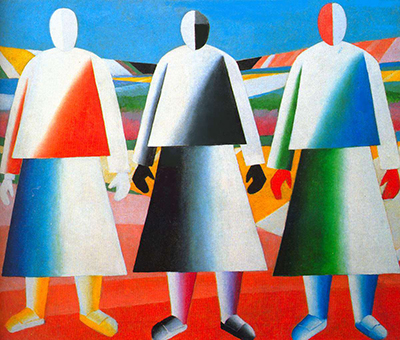
Three faceless figures stand shoulder to shoulder before a landscape of coloured bands. Their poses and broad clothing shapes repeat, while red, black, blue, green and yellow distribute differently across their bodies. Kazimir Malevich's Girls in a Field brings the human figure back into view without giving any of the three women a portrait identity. The State Russian Museum owns the canvas as Ж-9433 and dates it 1928–29. [1]
At a Glance
- ArtistKazimir Malevich
- Museum titleGirls in a Field
- Date1928–29; the reverse carries an earlier, 1912 inscription
- MediumOil on canvas
- Dimensions106 × 125 cm, as displayed by the museum
- CollectionState Russian Museum, Saint Petersburg, Ж-9433
- Main questionHow can repeated figures remain human while their identities disappear?
Contents
- What can you see in the painting?
- Why does the date say 1928–29 when Malevich wrote 1912?
- The late peasant figures
- Reading the group from left to right
What can you see in the painting?
The three figures fill most of the canvas width. Each has an oval head with no eyes, nose or mouth. The near-matching arms hang at the sides; the flared garments and visible shoes set a shared rhythm. Their heads and clothing nevertheless differ in colour. The figure at the left has a pale face and an orange-red triangular area on her upper garment. The centre figure's face is divided light and dark, and the right figure's head carries a red section. Those changes keep the repetition from becoming a single copied shape. [1]
The background has a strong horizontal structure. Blue sky spans the upper part of the picture. Beneath it, narrow stripes and angular passages move across the field behind the women; broad reddish ground supports their feet. There is no detailed path, crop, tool or building to tell us what the women are doing. “Field” identifies the setting in the title, while the painting's colour bands do much of the visual work that a more descriptive landscape might perform. [1]
The figures also set up a measured frontality. Their feet sit close to the picture's lower edge, and their upright bodies face the viewer. Yet the alternating areas of light and shadow do not model three naturalistic bodies consistently. The pale upper shapes and dark or coloured lower garments can be read both as clothing and as arrangements of painted colour. The tension between person and plane is visible before any historical explanation is added. [1]
Why does the date say 1928–29 when Malevich wrote 1912?
The date is the essential fact to get right. The Russian Museum dates the canvas 1928–29 and reports that Malevich added a title, the year 1912, and the term “Supranaturalism” with number 26 on its reverse. The inscribed year is therefore part of the work's history, not the museum's production date. The museum reads the inscription as Malevich placing his later invention earlier in his artistic sequence. [1]
Art historian Marie E. Gasper-Hulvat identifies this painting by the Russian Museum inventory number and likewise describes it as a 1928–29 work inscribed 1912. Her study places such late peasant paintings within the debates around Malevich's 1929 retrospective and his reconstruction of an earlier career. This provides a historical explanation for why a later canvas can carry an earlier date, though the precise intention behind every choice in this specific painting remains open to interpretation. [2]
The word “Supranaturalism” deserves care too. The museum explains it as a term Malevich made by joining ideas of Suprematism and naturalism. In the image, a figure remains recognizable but its body is simplified into strong, nearly geometric areas. It is useful to read the word alongside those visible forms. It would be misleading to call the canvas a straightforward 1912 Cubist work, or to treat the reverse inscription as proof that the three women were painted before Black Square. [1] [2]
The late peasant figures
Malevich's return to human figures after his non-objective paintings is sometimes presented as a clean reversal. Girls in a Field complicates that account. It shows people, but keeps the graphic force of separated colour areas, repeated geometry and a shallow, banded setting. The museum places it in a later peasant cycle and compares the figures' frontal rhythm with Russian icons and frescoes. That comparison is the museum's visual interpretation; it does not identify a particular icon that Malevich copied. [1]
The museum also suggests a relationship between the image and the changing peasant world around the artist. Gasper-Hulvat reads the faceless, repeated bodies in the broader circumstances of late-1920s Soviet culture. Neither reading requires the figures to stand for three named women or for a single, confirmed political message. The absence of faces invites a social interpretation, while the painting's construction asks the viewer to attend to line, interval and colour as well. [1] [2]
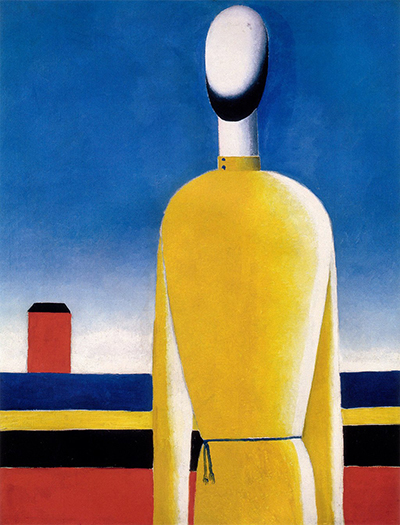
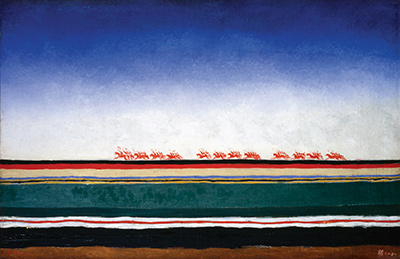
The best comparison is with another specific late work rather than with an imagined “typical” Malevich. In Torso in a Yellow Shirt (Complicated Premonition), one faceless body occupies a banded landscape. Here three bodies form a nearly even sequence. Both pictures retain identifiable people while withholding ordinary portrait detail. In Red Cavalry, a much smaller human motif is set against long horizontal bands. These visual comparisons show how differently Malevich could balance the figure and the field in his late period. [1]
Reading the group from left to right
The wide canvas makes it possible to take in the figures in sequence. A shape that looks nearly symmetrical on one body has a different weight when it is seen next to the neighbouring figure. The repeating outlines establish a common rhythm, while shifts in colour prevent the bodies from becoming interchangeable. The blank faces draw attention back to those differences. One can follow the joins between colour areas on a particular figure or move across the picture to compare how similar areas recur. [1] [2]
The Russian Museum compares the effect with groups of figures in frescoes and iconostases. The comparison helps explain how upright bodies can create a collective presence across a broad field. It does not identify a named icon or church as the model for the painting. Look at how the bodies divide up the width, then at how the coloured land continues between and around them. Those two rhythms make it possible to see the work as both a group of figures and a landscape. [1]
The Russian Museum used the painting to illustrate its Málaga exhibition announcement in 2018. The caption retains the 1928–29 date while using the English variant Girls in the Field. The title in the museum’s collection is Girls in a Field. The image and catalogue number are the more useful points of comparison across records. The exhibition page also reproduces other figures from Malevich’s career, including the museum’s later self-portrait. In that setting, the figures without faces could be seen as one way of treating the body within a much wider practice. [1] [3]
Frequently Asked Questions
Where is the original painting?
The State Russian Museum in Saint Petersburg holds it under inventory number Ж-9433. Its public page gives the collection information and a current location note, which visitors should verify with the museum before travelling. [1]
Is the painting from 1912?
Why are their faces blank?
The lack of facial features is visible, but there is no single documented explanation of each figure's identity or what the blankness means. The museum interprets these figures within Malevich's late peasant cycle; their repeated forms also create the painting's strong visual rhythm. [1]
Is “Girls in the Fields” a different painting?
No. “Girls in the Fields” is a common variation of the English title. The Russian Museum catalogues this canvas as Girls in a Field, Ж-9433. The object number and image identify the work more reliably than a small variation in wording. [1]
Discussion
How does the repeated pose change the way you see the three figures?
Where does the field read as landscape, and where does it read as a pattern of colour?
Reader Insights
Compare the three blank heads: how do their different colour divisions alter their effect?
How does the museum's 1928–29 date change your reading of the 1912 inscription?
Which parts of the figures still suggest clothing or bodies, and which become abstract shapes?
Join the Conversation
Share a close observation or a source-backed interpretation of this canvas.
References
- State Russian Museum, Girls in a Field, Ж-9433: illustrated owner record for date, medium, dimensions, acquisition note, reverse inscription and the museum's interpretive account. View source.
- Marie E. Gasper-Hulvat, Malevich’s Post-Suprematist Paintings and the Construction of History (2012): doctoral dissertation, especially figure 5 and discussion of the 1929 retrospective and redated peasant paintings. View source.
- State Russian Museum, Kazimir Malevich exhibition, 2018–19: past exhibition record featuring Girls in the Field under the 1928–29 date. View source.



