


 by Tom Gurney
Tom Gurney BSc (Hons) is an art history expert with over 20 years experience
Published on June 19, 2020 / Updated on November 20, 2026
Email: tomgurney1@gmail.com / Phone: +44 7429 011000
Introduction
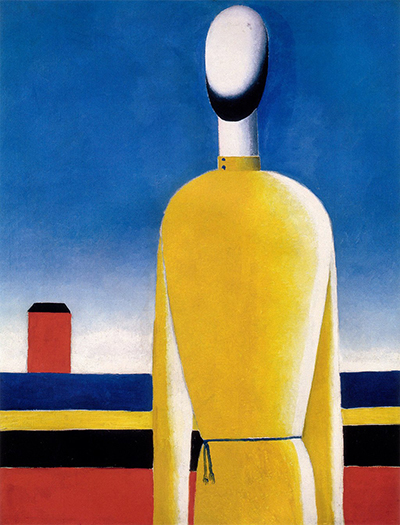
A solitary figure stands in front of a landscape compressed into bands of colour. Its head is a blank white oval; its yellow garment occupies nearly the full height of the canvas. Far to the left, a tiny red building stands against the horizon. In Kazimir Malevich's Torso in a Yellow Shirt (Complicated Premonition), a familiar human outline returns, yet the figure's missing features make an individual identity difficult to establish. [1]
The State Russian Museum catalogues this specific painting as Ж-9477, circa 1932, oil on canvas. Its English object page gives the dimensions as 79 × 99 centimetres without labelling height and width. The longer “Complex Presentiment: Half-Figure in a Yellow Shirt” wording commonly used for the painting refers to this same object. [1]
At a Glance
- ArtistKazimir Malevich
- Museum titleTorso in a Yellow Shirt (Complicated Premonition)
- DateCirca 1932, as catalogued by the Russian Museum
- MediumOil on canvas
- Dimensions79 × 99 cm, in the museum's displayed order
- CollectionState Russian Museum, Saint Petersburg, Ж-9477
- Visual focusFaceless yellow figure, blue sky, small red house and horizontal land bands
Contents
- Looking closely at figure and landscape
- A late image of uncertainty
- Title, date and source limits
- How the house changes the scale
Looking closely at figure and landscape
The torso is almost symmetrical but does not read as a rigid cut-out. White appears along the figure's neck and outer arm, the yellow garment curves over its shoulders, and a narrow dark cord crosses its waist. The hands are not separately described. A deep shadow under the oval head makes the blank face seem detached from the long white neck. The image gives enough cues to see a clothed person, while withholding the facial and bodily detail that would identify a particular sitter. [1]
The background is built from strikingly horizontal areas. Blue sky changes tone toward the horizon; beneath it, dark blue, yellow, black and red bands run behind the figure. They can be read as strips of land, but their straight edges and saturated colours remain conspicuous as painted shapes. The little red building at the left supplies a scale cue: it is small beside the figure. That difference does not settle how far away the house stands, because the picture offers few other depth markers. [1]
The red house has a black roof and no visible door or windows in the reproduction. It occupies little space, yet the composition makes it hard to ignore. The State Russian Museum interprets it as part of the painting's uneasy mood. Its more specific suggestion that the building evokes the “Bolshoi Dom” associated with state security in Leningrad is an interpretation proposed on the museum page, not a documented identification of the pictured structure. A reader can see the isolated red shape and dark cap without needing to accept one fixed symbolic meaning. [1]
A late image of uncertainty
The Russian Museum places Torso in a Yellow Shirt among Malevich's later peasant pictures and reads its faceless figure and empty setting in relation to the pressures of the early 1930s. The museum also notes Malevich's arrest in 1930. The owner's object heading says circa 1932; the explanatory text gives a broader 1928–1932 period for the painting. Those statements should not be flattened into an exact production date or used to claim that a known event directly caused a particular brushstroke. [1]
The museum reports an inscription on the back of the canvas that describes isolation, emptiness and the inability to escape. Its English account offers evidence that Malevich connected the work to distress. Since that public page does not show the verso itself, the careful formulation is that the museum reports this inscription, rather than claiming to have checked its original wording independently. The inscription is more specific evidence than a general assertion that all faceless figures in his late work mean the same thing. [1]
A different reading asks how the painting is constructed. An essay in the Yale Review of International Studies argues that the simplified yellow torso and broad colour planes keep elements of Malevich's Suprematist visual language in a scene with a human figure. One need not call the whole work a Suprematist painting to notice the relationship. The yellow garment is clothing, but its large smooth area also behaves like a colour shape. The land bands imply a setting, while their flatness interrupts a naturalistic view. This formal reading and the Russian Museum's account of anxiety illuminate different features of the same work. [1] [2]
The late figure should be distinguished from the pure non-objective forms of Black Square. Here a person and a house remain legible. They also resist the identifying details of conventional portrait and landscape painting. Looking back and forth between the face, the yellow body and the horizon reveals how Malevich could return to recognizable subjects without simply adopting an earlier naturalistic method. [1] [2]
Title, date and source limits
“Complicated Premonition,” “Complex Presentiment,” “Torso in a Yellow Shirt” and “Half-Figure in a Yellow Shirt” are English title variants used around this composition. For object-specific facts, the Russian Museum's current illustrated record and inventory number Ж-9477 are the anchor. A title variant alone would not identify a different copy or version; the museum illustration and this reproduction match in the arrangement of the figure, small house and bands. [1]
The Russian Museum says the painting came from Malevich's heirs in 1936 and mentions a 1977 transfer to the USSR Ministry of Culture. Those short catalogue notes should not be expanded into a complete exhibition or ownership history. Likewise, a small digital image can support descriptions of form and relative colour, but cannot establish the precise pigment, surface condition or the visual effect of the original under gallery lighting. [1]
How the house changes the scale
The upright figure is broad enough to establish a scale before the viewer has identified anything in the land behind it. The house is small beside that body, and sits far enough away from the main yellow area to make its outline worth searching for. If the eye starts at the house, the open stretch of colour around it makes the landscape feel more extensive. Starting with the figure, the same area can feel like an interval between strong bands of paint. Both readings are possible within the same image, and both give the building a role without assigning it a fixed symbolic identity. [1] [2]
The colour of the shirt is similarly active. It names a recognizable part of the body while making a broad interruption in the colours of the land and sky. In a portrait with a detailed likeness, the face could bring the viewer back to a particular person. Here the shape and placement of the yellow do much of that work. This helps explain why the different translations of the title can point either to the painted shirt or to a sensation without giving us a record of a named sitter. [1] [2]
Frequently Asked Questions
When was the painting made?
The Russian Museum's catalogue heading gives circa 1932. Its interpretive text discusses a broader 1928–1932 period. The circa date is the clearest concise identification of Ж-9477. [1]
Who is the figure?
The museum describes the person as a peasant. The face has no identifying features, and the public record does not name an individual sitter. It is safest to discuss the figure's visible form and the museum's interpretation separately. [1]
What does the little house mean?
Its red wall, black roof and isolation are visible. The museum proposes a darker historical allusion, but the public record does not establish the house as a literal portrait of a particular building. [1]
Is this painting Suprematist?
Discussion
Look first at the figure's blank face, then at the tiny house. What do those two areas leave unexplained?
The land is made from coloured bands. How does that structure change your sense of a natural landscape?
Reader Insights
How does the shadow below the oval head affect the figure's expression without facial features?
Does the house's small size establish distance, or do the flat bands resist that reading?
Compare the yellow garment as clothing and as a painted colour shape. Which reading dominates?
Join the Conversation
Share a close observation or a source-backed interpretation of this specific canvas.
References
- State Russian Museum, Torso in a Yellow Shirt (Complicated Premonition), Ж-9477: illustrated owner record for title, date, medium, dimensions, collection number, brief acquisition entry and the museum's interpretation. View source.
- Obliteration and Affirmation: The Language of Suprematism in Malevich's Late Work, Yale Review of International Studies: attributed formal reading of the yellow figure and colour planes in Complex Presentiment. View source.



