


 by Tom Gurney
Tom Gurney BSc (Hons) is an art history expert with over 20 years experience
Published on June 19, 2020 / Updated on November 20, 2026
Email: tomgurney1@gmail.com / Phone: +44 7429 011000
Introduction
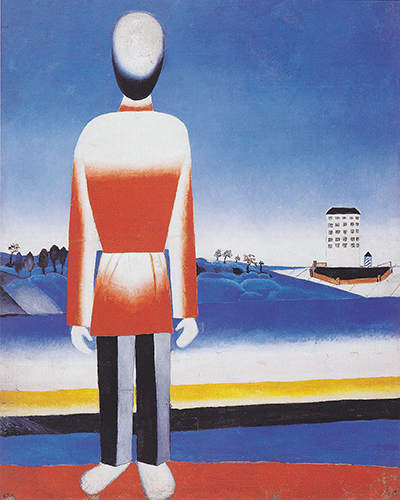
A faceless figure stands almost the full height of Kazimir Malevich's Man in a Suprematist Landscape. Behind him, a low landscape runs toward a white building with rows of small dark windows. The figure looks monumental but also isolated: he is close enough for us to see the red spread across his white shirt, while the building is too distant to enter. What might at first appear to be a spare landscape becomes unsettling when the viewer notices the gridded building and the figure's blank face. [1]
The ALBERTINA in Vienna catalogues this specific canvas as Mann in suprematistischer Landschaft (Man in a Suprematist Landscape), circa 1930–31, oil on canvas, 98 × 78 cm, object GE80DL in the Batliner Collection. Its bibliography also cites Andrei Nakov's catalogue raisonné number PS-99 under the French title Sensation d'un homme emprisonné. That alternate title explains this page's established English URL, but the physical painting is the same object. [1]
At a Glance
- ArtistKazimir Malevich
- Museum titleMan in a Suprematist Landscape (Mann in suprematistischer Landschaft)
- Alternate catalogue titleSensation of an Imprisoned Man (Sensation d'un homme emprisonné)
- DateCirca 1930–31, as catalogued by the ALBERTINA; the canvas bears “1915.”
- MediumOil on canvas
- Dimensions98 × 78 cm
- Collection and object numberALBERTINA, Vienna — Batliner Collection, GE80DL
- Catalogue reference cited by ownerNakov PS-99
Contents
- Looking closely at the figure and landscape
- Why the painting is dated circa 1930–31, despite “1915” on it
- The name “Sensation of an Imprisoned Man” and a separate drawing
- The building at a distance
Looking closely at the figure and landscape
The figure's head is an oval without eyes, nose or mouth. Black shadow under the pale upper part gives it volume but no expression. A narrow red collar leads into a broad white upper garment; red fills its centre and sleeves, while light hands hang beside the hips. Long dark trouser legs and white feet complete the vertical body. It is rendered as a person without the features that might make it a conventional portrait. [1]
The land behind him is built in horizontal intervals. The upper blue field occupies most of the sky; a low strip of trees and rounded blue hills sits near the horizon. White, yellow, black, blue and red bands cross the lower third. Their sharp divisions recall Malevich's interest in large colour planes, although they also make a legible setting for the figure. The white building on the right has a dark top and repeated window marks. Its size makes the figure feel unusually near and the structure unusually remote. These are observations of the reproduction, not measurements of its painted surface. [1]
The composition controls how the viewer moves through it. The centrally placed body pulls attention first. Only then does the building emerge from the blue and white area to the right. The contrast between a person who has no readable face and a distant building filled with small marks gives the scene much of its tension. Malevich did not write an explanation on the canvas that settles every symbol. The ALBERTINA reads the building as a prison and understands the figure as a possible self-portrait; those interpretations should be attributed to the museum. [1]
Why the painting is dated circa 1930–31, despite “1915” on it
The owner transcribes a “KM.” marking at lower left and “1915.” at lower right, with further writing on the reverse. A date inscribed on an artwork is evidence about what is written on it; it is not always a reliable record of when it was painted. The ALBERTINA dates the canvas to circa 1930–31 and explains the 1915 marking as a later artist's backdating. Its object essay relates that decision to the political pressure Malevich faced after his detention in 1930. [1]
This makes the date discrepancy part of the work's documented history rather than an error to be silently corrected. The museum's production date and the visible inscription should both be given to readers. It would be misleading to describe this specific canvas as a 1915 painting because the owner's scholarship and technical catalogue place it about fifteen years later. Equally, the museum's explanation of why Malevich backdated it is an interpretation, not a surviving statement by the artist printed in the public record. [1]
The painting belongs to the period in which Malevich returned to figures and landscapes after his earlier Suprematist works. The result does not erase the earlier formal language: broad zones of colour, a highly simplified body and a deliberately spare setting still shape the scene. But a single human figure and a recognisable building invite questions that a purely geometric work such as Black Square approaches differently. This comparison concerns visible form; it is not a claim that either picture has only one meaning. [1]
The name “Sensation of an Imprisoned Man” and a separate drawing
The ALBERTINA's preferred title is Man in a Suprematist Landscape. The English Sensation of an Imprisoned Man renders the alternate French title associated in its bibliography with Nakov PS-99. Using both names helps locate the same painting across publications without inventing a second canvas. [1]
Similar words also appear in records for a different object. A 2025 Galerie Poggi exhibition press kit identifies PS-91 Sensation of an Imprisoned Man as a 1930–31 pencil drawing. PS-91 and the ALBERTINA's PS-99 oil canvas have different catalogue numbers and media. A shared or translated title is not enough to turn a preparatory or related drawing into the painting reproduced here. [1] [2]
The building at a distance
The small building is easy to pass over if the eye goes first to the divided red and white torso. Follow the horizontal field from the edge of the body and the gridded structure comes into focus. Its regular marks condense into a recognizable detail in a part of the image that has little else to establish a building. The figure’s scale and proximity give it much more visual weight, but the building can change what a viewer thinks the scene is about. This is one reason the Albertina’s interpretation matters. It explains that distant detail in relation to the near figure and to the circumstances it associates with the painting. [1]
The inscription gives the reader a different kind of evidence. It is a historical mark on the physical work, while the association between the prisoner and the picture is the museum’s interpretation. Keeping those kinds of evidence distinct makes it possible to acknowledge the specificity of the museum’s account and the narrowness of what the painting itself depicts. The separately catalogued drawing may be read alongside it as another work with a prison-associated title. The title alone cannot settle the relationship between the two images. [1] [2]
The museum also records different measurements for the picture and the outside of its frame. That distinction matters when comparing the painting to published images that reproduce only the painted field. The scale of the canvas gives the distant building a small but visible presence outside the figure’s main outline. [1]
Frequently Asked Questions
Is the figure Malevich himself?
The ALBERTINA proposes that the faceless figure can be understood as a self-portrait. The public record does not present a direct inscription naming the figure, so the self-portrait reading should remain attributed to the museum. [1]
Is the distant building a prison?
The museum interprets the gridded windows and the building's arrangement as a prison reference, in the context of Malevich's detention. The painting does not label the building in words. A viewer can test that reading against the form, while recognising that it is an interpretation. [1]
Why does the canvas say 1915 if it was made later?
The ALBERTINA records both the “1915.” inscription and a circa 1930–31 production date. Its essay describes deliberate backdating. For the physical canvas and the owner's dating, use circa 1930–31. [1]
Where is the painting catalogued?
The ALBERTINA online collection lists it as GE80DL in its Batliner Collection. A collection listing alone does not establish that the painting is currently on display. [1]
Discussion
What do you notice first: the large faceless figure or the small gridded building?
How does the painting balance a recognisable person and landscape with broad bands of colour?
Reader Insights
The ALBERTINA dates the work circa 1930–31 although the canvas bears “1915.”
Its white building is interpreted as a prison in the museum's essay.
The owner cites Nakov PS-99; a same-name PS-91 pencil drawing is a distinct work.
Join the Conversation
Share a close visual observation or a source-backed detail about ALBERTINA GE80DL.
References
- ALBERTINA, Mann in suprematistischer Landschaft, GE80DL: illustrated owner record for title, artist, circa 1930–31 date, oil on canvas, 98 × 78 cm, collection credit, inscriptions, owner interpretation and bibliography citing Nakov PS-99. View source.
- Galerie Poggi, The War Within: Ukrainian Artists to the Front press kit (2025): identifies a separately numbered PS-91 Sensation of an Imprisoned Man pencil drawing of 1930–31; used solely to distinguish the two objects. View source.



