


 by Tom Gurney
Tom Gurney BSc (Hons) is an art history expert with over 20 years experience
Published on June 19, 2020 / Updated on November 20, 2026
Email: tomgurney1@gmail.com / Phone: +44 7429 011000
Introduction
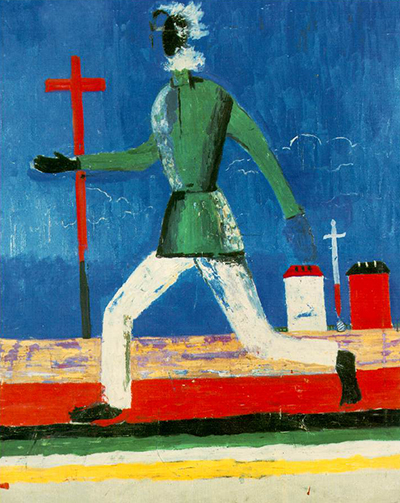
A figure in a green coat strides across bands of intense colour. One arm reaches toward a large red cross; behind the other stand two tiny buildings and another pale cross. The face is dark and indistinct, while the legs make the direction of movement unmistakable. This is Kazimir Malevich's painting often called Running Man. The Centre Pompidou catalogues the same work under its bracketed main title Sensation du danger (“Sensation of Danger”), lists L'homme qui court (“The Running Man”) and Untitled as given titles, and assigns it inventory number AM 1978-630. [1]
The museum dates the painting 1930–31, calls it oil on canvas, and gives its size as 79 × 65 cm. Older catalogues cited in the museum's bibliography have dated it around 1930 or 1933–34. A later title or date in a reproduction should therefore be read as part of this painting's catalogue history, not as proof of a separate canvas. The object number, dimensions and composition anchor the identification used on this page. [1] [2]
At a Glance
- ArtistKazimir Malevich
- Main museum title[Sensation du danger] (Sensation of Danger)
- Other recorded titlesL'homme qui court (Running Man); Untitled
- Museum date1930–31
- MediumOil on canvas
- Dimensions79 × 65 cm
- CollectionCentre Pompidou, Musée national d'art moderne, AM 1978-630
- Location at September 2026 checkListed by the owner at Centre Pompidou-Metz for Dimanche sans fin; verify before visiting
Contents
- Looking closely at the runner
- The museum's interpretation of danger
- Why the titles and dates differ
- Where can it be seen?
- A runner without a fixed viewpoint
Looking closely at the runner
The figure is almost as tall as the picture. His dark head, green upper body and long pale trousers are built from broad blocks of colour rather than detailed anatomy. One leg stretches forward while the other presses back, giving the picture a clear sense of movement. The arms form opposing diagonals: the arm on the left runs across the red cross, while the lowered arm on the right points toward the small buildings. The head has no readable facial expression. Those visible decisions make the action legible without turning the person into a portrait of someone identified by name. [1]
Bands of red, yellow, white, green and black run horizontally beneath the figure. They can be read as ground or road, but their sharp separations also recall the strips and fields of colour in Malevich's abstract work. The blue background stretches above a very low horizon. In the image, pale marks float through it near the houses and the man's body. The composition remains recognizably a figure in a landscape, yet its colour and spacing resist a conventional naturalistic setting. [1]
The crosses and the buildings complicate the scene. The tall cross at left is red and close to the runner; the smaller pale cross rises behind the structures at right. The two buildings have bright, flat walls and little sense of interior depth. The title Sensation of Danger encourages us to see the running as urgent, but the picture does not give a written story with a named place, incident or destination. The relationship among figure, crosses and architecture remains open to interpretation. [1]
The museum's interpretation of danger
The Centre Pompidou reads the figure as fleeing an ominous setting. Its object essay interprets the windowless houses as likely references to Stalinist prisons and describes a sword as a sign of threat. The essay connects that reading to the pressure on peasants and artists, and to Malevich's own detention in 1930. These are the museum's interpretive claims about the painting, not independently established identities for each depicted form. A viewer may see the small structures and crosses clearly without accepting every proposed symbolic equation. [1]
The interpretation has a historical basis in the picture's period. After the radically nonobjective paintings of his Suprematist years, Malevich returned to recognizable human figures and rural subjects in the late 1920s and early 1930s. The Pompidou describes this as a transfer of Suprematist colour and form into figurative painting. Here, the blocks of the body and the striped ground make that relationship visible. The figure is human and in motion, while many individual shapes still behave like strong independent colour forms. [1]
The existing page once treated the two small buildings as “presumably humble homes.” That identification is too certain for the available evidence. The owner's reading points in a different direction, but even its wording signals interpretation. On this page, the structures are described first as small, windowless buildings; the prison reading is then attributed to the Centre Pompidou. That distinction matters because it keeps visual evidence and historical explanation separate. [1]
Why the titles and dates differ
The Pompidou's main title is displayed in brackets, [Sensation du danger], while the same object record explicitly lists L'homme qui court and Sans titre as other titles. “Running Man” is therefore a grounded English label for the subject and an established title variant. It should not be taken as a different painting from the one numbered AM 1978-630. A 1978 Pompidou exhibition catalogue cited by the owner used L'homme qui court and dated it “around 1930.” [1] [2]
The museum's bibliography also records publications that gave 1933–34, including its 1980 collection catalogue and later catalogues. The Bibliothèque nationale de France's conventional-title notice for L'homme qui court likewise records 1933–34. The current owner record gives 1930–31. This page follows the current owning museum for its main date while making the older dating visible, rather than silently treating a discrepancy as a corrected typo. [1] [3]
Its accession history is more straightforward: the Centre Pompidou records an anonymous gift in 1978. The museum's bibliography traces appearances and publications from the 1978 Malevich exhibition onward, and cites the 2002 Nakov catalogue raisonné as PS-115. That number is reported by the owner page's bibliography; it is not a claim that the catalogue entry itself was examined for this article. [1] [2]
Where can it be seen?
At the 30 September 2026 research check, the Centre Pompidou object page listed AM 1978-630 at Centre Pompidou-Metz as part of Dimanche sans fin. Maurizio Cattelan et la collection du Centre Pompidou, scheduled on that page through 25 January 2027. The collection remains the Centre Pompidou's; the Metz listing is a dated loan or display location. Exhibition calendars and object loans can change, so visitors should use the museum's current page before travelling. [1] [4]
A runner without a fixed viewpoint
The horizontal bands invite the eye to cross the painting at much the same level as the figure’s stride. His limbs break that continuity. A leg projects into one area of colour while the upper body pulls in another direction. The small buildings have a different kind of stability, held to the ground by the edges and horizontal surface below them. These differences matter to the sensation described by the museum’s title. They give the viewer visual evidence of urgency before the scene has been assigned a particular story. [1]
The painting has also acquired a literary setting. The Pompidou’s bibliography records a reproduction under the title The Man Who Runs on a 1971 German-language edition of tales by Nikolai Leskov. That is evidence of a use of the image several decades after it was made. A cover can bring a reader to the picture with a story already in mind. The museum’s later title directs attention towards danger more generally. Both are documented ways the picture has been presented, while the accession identifies the same painting across them. [1] [2]
Frequently Asked Questions
What is the painting's official title?
The current Centre Pompidou object record gives [Sensation du danger] as its main title and L'homme qui court and Untitled as given titles. “Running Man” translates the recorded French title and describes the clearly visible figure. [1]
When was it painted?
What is its size and medium?
The Centre Pompidou records oil on canvas, 79 × 65 cm, inventory AM 1978-630. [1]
What do the houses and cross mean?
The museum interprets the windowless buildings as likely symbols of imprisonment and reads a sword as a threat. The cross and buildings are visible, but their exact symbolic meanings are interpretations rather than labels supplied on the painting. [1]
Is it on view in Paris?
Discussion
Look at the direction of the man's arms and legs. How much of the sense of danger comes from his movement?
The museum reads the small buildings as threatening. What details in the image support or complicate that reading?
Reader Insights
Which part of the picture feels most like a landscape, and which feels most abstract?
How do the red and pale crosses change your reading of the runner?
Does the title Running Man or Sensation of Danger change what you notice first?
Join the Conversation
Share a close observation or a source-backed interpretation of this specific Pompidou painting.
References
- Centre Pompidou, [Sensation du danger], AM 1978-630: owning museum's title variants, date, medium, dimensions, acquisition, object essay, bibliography and dated current-location listing. View source.
- Centre Pompidou, 1978 Malévitch exhibition catalogue record: original museum exhibition history identifying L'homme qui court; the owner object page supplies the linked bibliography's fuller date/title history. View source.
- Bibliothèque nationale de France, conventional-title notice L'homme qui court: authority record preserving the 1933–34 dating; distinguished from the current owner's 1930–31 date. View source.
- Centre Pompidou-Metz bookshop, Dimanche sans fin listing: independent host-venue confirmation of the exhibition's 2025–27 schedule, not an object-level proof of future display. View source.



