 by Tom Gurney
Tom Gurney BSc (Hons) is an art history expert with over 20 years experience
Published on June 19, 2020 / Updated on November 20, 2026
Email: tomgurney1@gmail.com / Phone: +44 7429 011000
Introduction
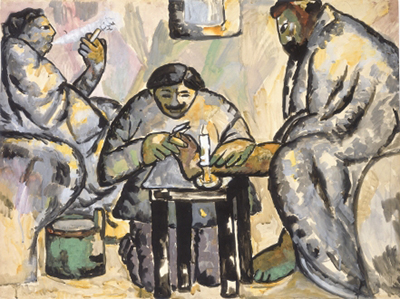
Three people sit in a bathhouse interior. At the centre, a worker bends over the raised foot of the man on the right; a third man sits at left, holding a cigarette. This is Kazimir Malevich's De likdoornsnijder, translated by its owner, the Stedelijk Museum Amsterdam, as The Corn Cutter. The museum dates the work 1911, records it as A 7654, and gives dimensions 77.7 × 103 cm. [1]
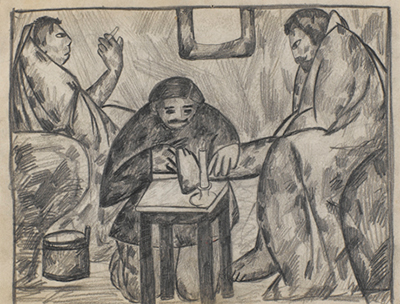
The English title is easy to misread. Here a “corn” is a hardened spot on a foot. The title names a person removing one, not someone cutting grain. The local image, with its low table, bare foot, bathhouse pail and three figures, matches the larger colour Stedelijk object. A much smaller monochrome work of the same subject is also in the museum's care, with a different accession and holding status. [1] [2]
At a Glance
- ArtistKazimir Malevich
- Museum titleDe likdoornsnijder; English translation The Corn Cutter
- Date1911
- Object numberA 7654
- Dimensions77.7 × 103 cm
- CollectionStedelijk Museum Amsterdam
- MaterialCharcoal and gouache on paper, in the NGA exhibition publication
- Distinct related workThe small The Corn Operator, 4.2001(111), also dated 1911
Contents
- What is happening in the scene?
- Why is the title confusing?
- What kind of work is it?
- Malevich before Black Square
- Collection and record limits
- The bathhouse scene in the 1990 exhibition record
What is happening in the scene?
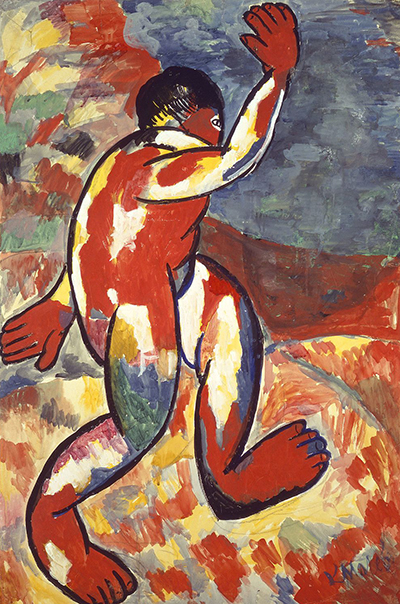
The action gathers around a foot near the centre of the picture. A crouching attendant leans over it, bringing his hands close to the toes. The client sits on the right in a loose light-coloured garment. At left, another seated man raises a cigarette. The surrounding interior contains a small framed shape high on the wall, a low stool or table and a bucket near the left edge. The museum's Dutch title identifies the attendant's task more specifically than a first glance at the picture might. [1]
Malevich paints the bodies as heavy, rounded masses. The seated client curves over the worker. The smoker's bent arm and upward-pointing cigarette make a smaller echo of the raised foot. Between these larger figures, the attendant forms a low arch. Their poses pull attention into a compact central knot, while the table's vertical legs lead the eye downward. These are observations from the reproduced composition, rather than a claim about the exact proportions of the original viewed in person. [1]
Colour adds another set of links. Greys, creams and dark outlines model the garments and limbs. The attendant's green hands and the client's green foot stand out at the very point where the work takes place. A green pail at lower left repeats that accent elsewhere in the room. The yellow and pink background patches keep the shallow interior active without describing a precise location. [1]
Why is the title confusing?
The museum calls the work De likdoornsnijder in Dutch and translates it as The Corn Cutter. In this setting “corn” means a callus or hard patch of skin on a foot. It does not mean maize or a field crop. A more immediately clear English description would be a pedicurist or corn remover in a bathhouse. Those descriptions explain the scene; the museum's translated title remains the record title used here. [1]
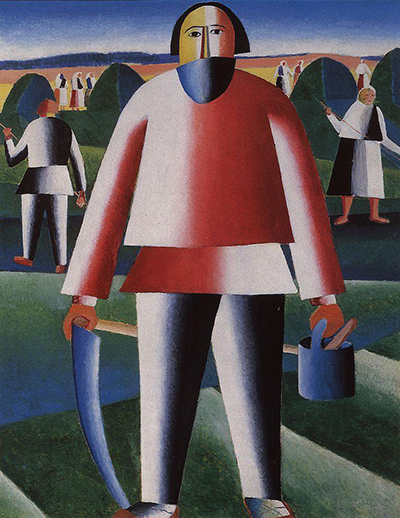
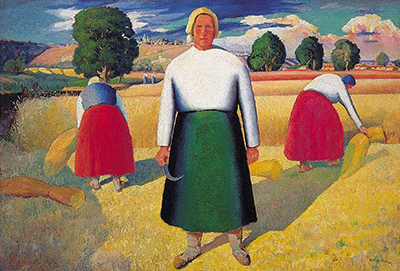
That distinction matters when navigating Malevich's other pages. Haymaking and The Reapers do show agricultural subjects. The Corn Cutter belongs to another part of his figurative work. A title-only search can easily place this picture among harvest scenes and obscure what the painted hands and foot actually show. [1]
What kind of work is it?
The museum's maker listing places this record under “Drawings.” That is a broad website category, not a material statement for this particular object. The accession-linked Stedelijk item supplies the date and measurements. The NGA publication’s caption provides the material description and its illustration ties that description to the large composition. The charcoal and gouache therefore belong to A 7654 in that publication’s account. The small monochrome work has its own record. [1] [2] [5]
At 77.7 × 103 cm, it is far larger than the related 13.4 × 17.2 cm monochrome object. Scale, colour, accession and holding credit show that these are separate objects rather than two digital files of the same sheet. The larger scene's colour and fuller modelling can be compared with the compact design of the smaller work, but the checked museum records do not establish a definitive order of execution between them beyond assigning both to 1911. [1] [2] [3]
Malevich before Black Square
The date places The Corn Cutter four years before the 1915 Black Square was shown at the 0.10 exhibition. This early work still depicts people, objects and a recognizable interior. Its simplified anatomy and emphatic outlines can nonetheless be studied as formal choices: the artist shapes the scene with strong curves and masses rather than detailed naturalism. Similarities in simplification should not be treated as proof that the bathhouse scene was designed as a direct step toward one later abstract painting. [1] [4]
Malevich's career included many changes in subject and method. The Stedelijk collection holds numerous works from those phases, including the related small study and later nonobjective compositions. Keeping the exact accession attached to each page allows readers to compare them without folding different versions together. [1] [2]
Collection and record limits
The Stedelijk credits its ownership of A 7654 to an agreement reached with the Malevich estate in 2008. That statement identifies a collection status; it is not a complete chain of ownership from 1911 to today. The source checked here does not establish the work's current gallery-room display or a verified material description. [1]
The saved website image corresponds to the colour composition linked to A 7654. The smaller monochrome composition has its own article, The Corn Operator, and should not inherit this object's dimensions or ownership note. [1] [2]
The bathhouse scene in the 1990 exhibition record
The National Gallery of Art’s teaching packet illustrates the large composition under the title Chiropodist (at the Bathhouse). Its caption records charcoal and gouache on paper, dimensions of 77.7 by 103 centimetres and a date of 1911–12. That material description belongs to the large Stedelijk work. It also explains why calling it a painting in an ordinary sense need not imply oil on canvas. The Stedelijk item gives 1911. The older exhibition caption is worth keeping alongside it because it is explicit about the support and records the date differently. [1] [5]
The packet connects the layout to Cézanne’s Card Players, particularly the seated figures arranged around a table. Here the arrangement concentrates attention on a foot and the work being done to it. The long shape across the centre and the seated figures give the eye recognizable points of balance. The relationships of size and posture shift the weight of the image towards the little meeting of hands and foot. This is one way to see what Malevich could borrow from a composition of seated figures and how much he could change by substituting a different task. [1] [5]
The same publication reports that the large work first appeared at the 1912 Donkey’s Tail exhibition in Moscow. Its exhibition account applies to the illustrated bathhouse work with the larger measurements. The Stedelijk gives the same Dutch title to the small sheet, but the packet’s exhibition claim does not establish that the small object appeared beside the larger one. [1] [2] [5]
Frequently Asked Questions
Is the picture about harvesting corn?
No. The Dutch museum title refers to cutting a foot corn. The central figure works on another person's foot in a bathhouse setting. [1]
Is this the same object as The Corn Operator?
What material did Malevich use?
Where is it held?
The Stedelijk Museum Amsterdam records the object as A 7654. The checked item does not confirm whether it is currently on view. [1]
Discussion
What tells you that this scene concerns foot care rather than grain harvest?
How do the three figures lead your eye to the central action?
Reader Insights
Locate the raised foot and the attendant’s hands.
Compare the large colour composition and the small monochrome version.
Why do the object numbers matter when two works share a Dutch title?
Join the Conversation
Share a close observation or source-backed detail about Stedelijk object A 7654.
References
- Stedelijk Museum Amsterdam, De likdoornsnijder / The Corn Cutter, A 7654: owner item for title, 1911 date, 77.7 × 103 cm dimensions, accession, holding note and visual identity. View source.
- Stedelijk Museum Amsterdam, De likdoornsnijder / The Corn Operator, 4.2001(111): separate 1911 object, 13.4 × 17.2 cm, credited as a Khardzhiev loan. View source.
- Wikimedia Commons file record for the related 1911 drawing: reproduced small composition with an explicit Stedelijk source link; used as a visual cross-check, not for medium attribution of A 7654. View source.
- The Museum of Modern Art, The Russian Avant-Garde Book, 1910–1934 exhibition brochure: documents Malevich’s December 1915 introduction of Suprematism. View source.
- National Gallery of Art, Kazimir Malevich Teaching Packet, PDF pp. 22–23: illustrated large bathhouse composition, material, date range, formal comparison and first exhibition account. View source.