 by Tom Gurney
Tom Gurney BSc (Hons) is an art history expert with over 20 years experience
Published on June 19, 2020 / Updated on November 20, 2026
Email: tomgurney1@gmail.com / Phone: +44 7429 011000
Introduction
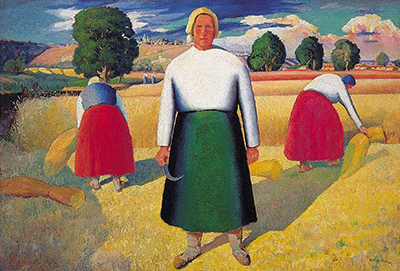
Three women stand and bend among cut grain in a bright field. The central reaper faces outward, her white blouse and dark green skirt forming the painting's largest vertical shape. She holds a curved sickle, while two women in red skirts work on either side. This is Kazimir Malevich's Women Reapers, also published as The Reapers, a late painting in the State Russian Museum, St Petersburg, inventory Ж-9450. Two independent scholarly publications reproduce the same composition as the image on this page. [1] [2]
The painting is generally dated 1928–1929 in the checked scholarship. A doctoral catalogue records a 1905 inscription, which should not be mistaken for the accepted production date. Jean-Claude Marcadé's published plate describes it as oil on wood, 71 × 102 cm. Those measurements are reported from his publication because an accessible accession page from the museum was not found for this object. [1] [2] [3]
At a Glance
- ArtistKazimir Malevich
- Published titlesWomen Reapers; The Reapers
- Date in checked scholarship1928–1929
- Earlier inscription1905, recorded by Gasper-Hulvat; not the production date followed here
- Medium and dimensionsOil on wood, 71 × 102 cm, as reported by Marcadé
- CollectionState Russian Museum, St Petersburg, Ж-9450
- Main visual elementsThree reapers, sickle, cut grain, red and green skirts, trees and distant settlement
Contents
- What is happening in the painting?
- Why does the central figure look different from the workers?
- When was Women Reapers painted?
- How have scholars interpreted the reapers?
- Which Reapers is this?
- Collection and documentation limits
- Labour across two late paintings
What is happening in the painting?
The central woman has stopped moving. Her right hand holds a sickle low against the green skirt, and her stance gives her a different tempo from the two women bending over the harvest. Marie Gasper-Hulvat describes the woman at left as turning away while bundling grain and the woman at right as laying a sheaf down. That reading fits the reproduced plate, although a still image cannot tell us what happened immediately before or after this moment. [2]
The three figures form a broad triangle. The central body is upright and near the front edge; the workers on either side bend toward the fields. Their red skirts echo one another, while the deep green central skirt anchors the composition. White blouses stand out against golden grain and blue-grey shadows. The sickle's dark curve is a small but decisive clue to the work depicted. [1] [2]
Long bands of yellow and ochre run behind the women. Trees, low buildings and a pale dome appear along the horizon. Gasper-Hulvat reads the distant dome as a church and the scene as a rural settlement. The image does not establish the name of a real village or prove that the artist painted a particular site from observation. [2]
Why does the central figure look different from the workers?
The central woman faces outward, while the other two bend over the crop. This makes her the painting's visual pause. The bright blouse sits almost as a block of white; the skirt is a single heavy field of green. The flanking red skirts create a repeated shape, but their wearers are smaller and farther back. The structure is highly deliberate even though the subject is recognizable. [1] [2]
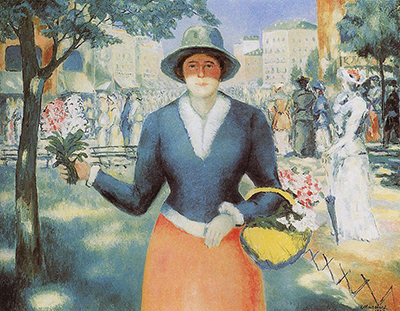
The yellow around the central head can look like hair or a covering. Gasper-Hulvat specifically notes that ambiguity and observes how it meets the pale clouds behind. It is safer to describe the visual effect than to label a precise item of dress. The scholar also identifies the women's sturdy footwear and simple clothing as signs of peasant identity, in contrast to the tailored urban clothing of Malevich's later Flower Seller. [2]
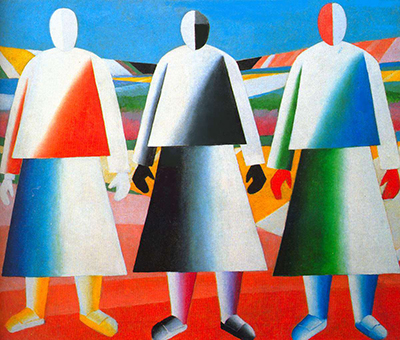
This picture has more descriptive landscape and more modelled bodies than many of Malevich's late rural paintings. Gasper-Hulvat calls Women Reapers a stylistic anomaly close to representational realism. That does not make it a simple reversal of his earlier art. The weight of the central green shape, the paired red forms and the horizontal bands still organize the canvas through colour and geometry. Compare Girls in the Fields, where similar rural dress and groupings become more sharply simplified. [2]
When was Women Reapers painted?
The two checked illustrated scholarly sources date the Russian Museum painting 1928–1929. Gasper-Hulvat's dissertation figure list adds that it is inscribed 1905. A retrospective date written on or associated with a painting is evidence about its labelling history; it is not by itself proof that the pictured object was painted in that year. This page therefore uses the late-1920s scholarly date and flags the earlier inscription. [1] [2] [3]
This matters because Malevich returned repeatedly to rural figures and peasant subjects late in his career. A date in the first decade of the century would place this composition before Black Square, while the scholarship places it after the Suprematist period. Dating changes the questions one asks about the painting: how the artist reworked recognisable subject matter after abstraction, and how contemporary viewers might have read its rural figures. [2] [3]
How have scholars interpreted the reapers?
The late-1920s date puts the painting near the beginning of Soviet agricultural collectivization. That historical setting is significant, but it does not establish a coded protest, an endorsement of policy or the artist's private intention. Gasper-Hulvat surveys competing readings, including one that called the work propaganda and another that read late peasant images as protest. She rejects treating either claim as self-evident from the picture. Her own argument is that peasant dress, tools and land carry social meaning even where a direct response to later events cannot be demonstrated. [2]
The painting's unusually readable harvest scene has invited comparison with earlier realist art. Marcadé reports Dmytro Horbachov's comparison with Mykola Pymonenko's The Reaper of 1889 and prints the two pictures together. The works both place a peasant woman and harvesting equipment in a field, yet Malevich's three-figure arrangement and broad colour shapes are different. The comparison is a scholarly proposal about visual inheritance, not proof that Malevich copied a specific picture. [1]
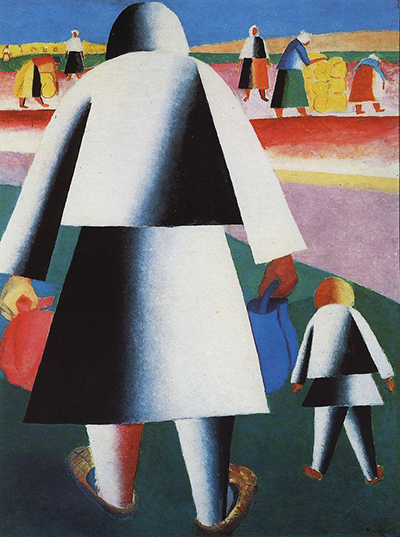
Readers may also compare Marpha and Vanka, another late harvest image, and Flower Seller, whose city subject and tailored clothing provide a useful contrast. Those comparisons illustrate a range in Malevich's late figural work; they do not establish that the pictures were made as a planned series. [2]
Which Reapers is this?
Titles alone are unreliable here. Museum Ludwig holds an early Malevich pencil drawing called Reapers, accession ML/Z 2011/028, dated 1909–1910. It is not the large three-woman oil painting reproduced on this page. The Russian Museum object's accession Ж-9450, late-1920s date and independently published colour plates identify the pictured work. [1] [2] [4]
The Russian Museum painting has appeared under both Women Reapers and The Reapers in English scholarship. This page retains the inherited short route `/reapers/` while giving the fuller identifying title, date, collection and inventory. A reader searching for “Malevich Reapers 1905” should note the earlier inscription without moving the object's production back two decades. [1] [2] [3]
Collection and documentation limits
The illustrated articles assign the painting to the State Russian Museum, St Petersburg, and Gasper-Hulvat provides its accession Ж-9450. Marcadé's caption gives oil on wood and 71 × 102 cm. A directly accessible Russian Museum item page for this accession was not located during this research pass, so this page does not claim an independently verified current display location, full provenance or conservation history. [1] [2] [3]
The high-resolution site image makes the arrangement and colour relationships visible. Its reproduction cannot establish the exact surface, pigment or sequence of paint layers. Interpretations of the head covering and distant landscape remain visual readings, not conservation findings. [1] [2]
Labour across two late paintings
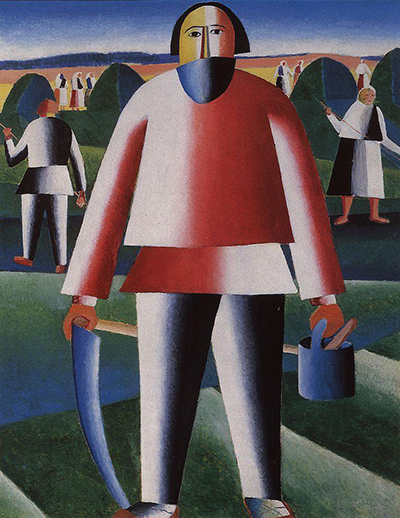
The Tretyakov’s Haymaking provides another example of how a late landscape can show work without giving every figure the same role. The museum dates that canvas to 1928–29 and describes it in relation to a separate earlier mower. Its principal figure occupies the centre and carries tools that identify his task. In Women Reapers, the contrast between the prominent upright woman and the bent workers makes the distribution of tasks visible across the field. [1] [2] [5]
The two works also differ in how the eye finds the action. In Haymaking the long scythe and pail belong to the figure the viewer is already looking at. In the reaping scene, the viewer can start with the large upright figure and then look outward towards the smaller gestures of work. Repetition in the background gives those gestures a rhythm. That difference helps account for why the central figure can seem set apart even though she belongs to the same painted landscape. [1] [2] [5]
Frequently Asked Questions
Is this work from 1905?
Where is the painting?
How many women are shown?
Is it the Museum Ludwig Reapers drawing?
No. That is a separate 1909–1910 pencil work, ML/Z 2011/028. [4]
Discussion
What makes the standing woman the visual centre of the harvest scene?
Where do the three figures repeat shapes and colours?
Reader Insights
Follow the sickle’s dark curve and compare it with the broad shapes of the skirts.
Look from the grain in front to the trees and buildings at the horizon. What changes in scale?
How does the 1905 inscription affect your reading when scholars date the painting 1928–1929?
Join the Conversation
Share a close observation or a source-backed detail about Russian Museum Ж-9450.
References
- Jean-Claude Marcadé, “Kyiv: The Capital of Modernity at the Turn of the Twentieth Century,” Harvard Ukrainian Studies 36, nos. 3–4 (2019), pp. 275–305: illustrated The Reapers plate, printed p. 279, with date, medium, dimensions and Russian Museum credit; discussion of Horbachov's Pymonenko comparison. View source.
- Marie Gasper-Hulvat, “Proletarian Credibility? Malevich’s Russian Peasant Paintings during the First Five-Year Plan,” The NEP Era 8 (2014), pp. 1–24: illustrated Women Reapers with accession Ж-9450 on p. 21; close reading on pp. 10–13; historiography on pp. 7–9. View source.
- Marie Gasper-Hulvat, Malevich’s Post-Suprematist Paintings and the Construction of History (Bryn Mawr College PhD dissertation, 2012): figure 10 identifies Women Reapers, 1928–1929, inscribed 1905, Russian Museum Ж-9450. View source.
- Museum Ludwig, Malevich press kit (2023): a separate early pencil Reapers, ML/Z 2011/028; used only for title-collision control. View source.
- Tretyakov Gallery, Haymaking, inventory 10612: separate late peasant-cycle canvas, with object images and curatorial description. View source.