 by Tom Gurney
Tom Gurney BSc (Hons) is an art history expert with over 20 years experience
Published on June 19, 2020 / Updated on November 20, 2026
Email: tomgurney1@gmail.com / Phone: +44 7429 011000
Introduction
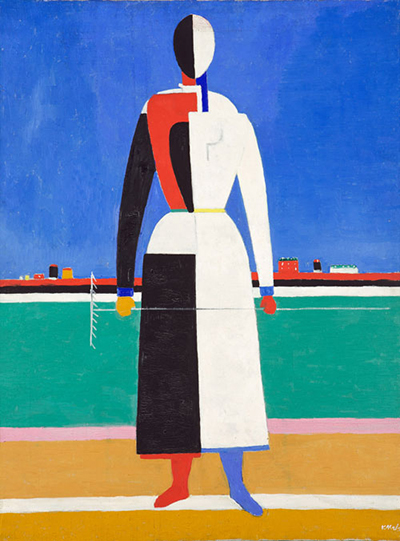
A single faceless figure stands before a blue sky and a wide green field. Her body is divided into sharply coloured pieces: a red and black upper section, a white and black skirt, and legs of different colours. A thin rake hangs from one hand. This is Kazimir Malevich's Woman with a Rake (Женщина с граблями) in the State Tretyakov Gallery, Moscow, inventory 22571. The gallery's illustrated object page matches the saved painting on this site. [1]
The Tretyakov Gallery dates the oil-on-canvas painting 1930–1931, gives its size as 99 × 74 cm, and says it acquired the work from Malevich in 1932. The painting also bears an inscription invoking Moscow, 1915, and “Suprematism in the outline of a peasant woman.” The gallery explains that this older inscription accompanied the work when it entered the collection; it does not use 1915 as the painting's production date. [1]
At a Glance
- ArtistKazimir Malevich
- Tretyakov titleЖенщина с граблями (Woman with a Rake)
- Museum date1930–1931
- Inscribed date1915, distinguished from the museum's production date
- MediumOil on canvas
- Dimensions99 × 74 cm
- CollectionState Tretyakov Gallery, Moscow, inventory 22571
- AcquisitionFrom the artist, 1932, according to the gallery
Contents
- Looking closely at the figure
- The landscape behind her
- Why does the work say 1915 if the museum dates it 1930–1931?
- A peasant image after Suprematism
- What can and cannot be inferred
- Tool, figure and setting
Looking closely at the figure
The silhouette nearly reaches from the bottom of the painting to its blue upper edge. The head is an oval split into black and white, without eyes, nose or mouth. Beneath it, a narrow red neck and a jagged sequence of red, black, white and blue shapes construct the upper body. The left arm appears almost entirely dark; the right sleeve is light. The body is recognisably human, yet its parts look like adjoining painted planes. [1]
The skirt is similarly divided. One side is black and the other white, making a strong vertical split that extends the contrast in the head. The shoes and lower legs are also asymmetrical, one red and one blue. These colours are not naturalistic descriptions of fabric or light. They establish a rhythm that moves the eye from head to feet and back through the body. [1]
The rake is exceptionally slight next to the figure. Its long handle drops from the hand at left in the image, and a few pale teeth interrupt the green field. The Tretyakov's curatorial text reads it as a deliberately conventional, almost emblematic attribute rather than a tool being used in a depicted task. We can see that the figure stands still; the image does not show her raking. The inherited page's description of an “aggressive” or “menacing” pose is not supported by the painting or the museum record. [1]
The landscape behind her
Horizontal bands divide the setting: blue sky, a thin distant strip of buildings, an expansive green field, a narrow pink line, ochre ground and a pale stripe under the feet. The gallery notes the paradox of this very smooth field, which seems almost like a modern lawn rather than a worked plot. Small buildings crowd the horizon despite the nominally rural subject. [1]
This is enough space to establish a horizon and a standing body, but little depth is described between the figure and the distant structures. The figure's lower skirt meets the green field along a strong horizontal line. The colour blocks across her body and the level ground behind her compete for attention; neither is simply background decoration. A viewer can read her as a peasant woman with a rake and also as a constructed arrangement of rectangles, curves and colour. [1] [2]
Why does the work say 1915 if the museum dates it 1930–1931?
The Tretyakov Gallery transcribes the inscription as “Москва. 1915 г. Супрематизмъ в контуре крестьянки” — roughly, “Moscow. 1915. Suprematism in the outline of a peasant woman.” It records that the painting entered the gallery with that date and explains it within Malevich's practice of dating some later figurative works as if they belonged to an earlier period. The gallery's current object date is 1930–1931. [1]
The inscription is significant even though it is not followed as the production date. It directs attention to how an abstract visual language can exist inside the outline of a person. One sees a human silhouette from a distance; closer inspection breaks it into a set of sharply related, non-naturalistic forms. This is a visual reading of the painting and the inscription, not evidence that every coloured segment corresponds to a fixed symbol. [1]
A scholarly dissertation dates Woman with a Rake 1932–1933, while recording the same 1915 inscription and Tretyakov inventory number. A 1990 National Gallery of Art teaching packet gives a broader circa 1928–1932 and an approximate 100 × 75 cm. These differences show that scholarship and earlier publications have not used one identical date or size. This page uses the owner's current 1930–1931; 99 × 74 cm record, and reports the variants rather than silently combining them. [1] [2] [3]
A peasant image after Suprematism
The gallery places the work in Malevich's so-called second peasant cycle. Its text explains that after his 1927 exhibitions in Warsaw and Berlin, some earlier rural works remained abroad. It presents that loss as a formal reason for revisiting peasant subjects, while also offering a curatorial interpretation of broader artistic reasons for his return to recognisable figures. Those explanations should not be flattened into an unverified claim that the artist was forced to paint this particular picture by state officials. [1]
In Black Square, the painted form does not present a person or landscape. Here a figure and horizon return, but the figure is composed from emphatic geometric shapes. The Tretyakov essay calls this a middle ground between a traditional image and a Suprematist sign. Its point is interpretive: the painting can be approached as both figure and formal construction. [1]
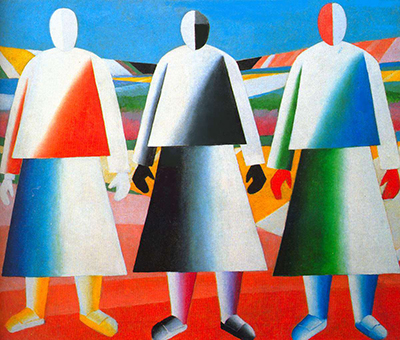
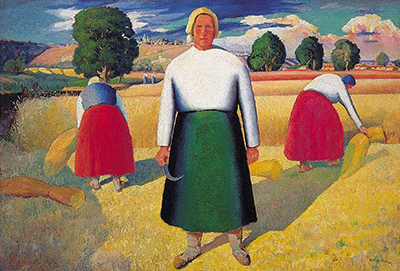
The comparison with Girls in the Fields is useful. Both works set simplified female figures against horizontal landscapes, but Woman with a Rake isolates one tall silhouette and makes the division between black and white particularly strong. Women Reapers provides a different late harvest scene, with three recognisable workers and a more descriptive field. Their shared rural theme does not establish a single commissioned series or identical date. [1] [2]
What can and cannot be inferred
The painting clearly presents an upright figure and a rake, but facial expression cannot be inferred from a head without features. Nor does the still pose prove hostility, approval of agricultural policy or a direct narrative about a named worker. The museum's reading emphasizes the deliberate ambiguity of the figure: a peasant woman, a geometric construction, perhaps even a mannequin-like form. Those are interpretive possibilities, not separate identities documented for the sitter. [1]
The gallery records purchase directly from the artist in 1932, an unusually specific acquisition fact for this group of pages. It does not prove that the canvas is currently hanging in a particular room, and this page makes no present-day display claim. The site reproduction is useful for composition and colour, but cannot establish exact pigment, paint sequence or surface texture. [1]
Tool, figure and setting
The end of the rake can be followed back towards the woman’s hands. This gives the viewer one way to locate a gesture even where the torso is divided into fields of colour. The Tretyakov reads the tool as closer to a symbolic staff than an implement shown in use. Its nearly rigid shape plays against curved parts of the body and stands apart from the horizontal boundary of the field. The museum’s interpretation addresses how the object is held within the painting. It gives the reader a specific relationship to examine rather than a reason to identify an exact action or a named occasion. [1] [3]
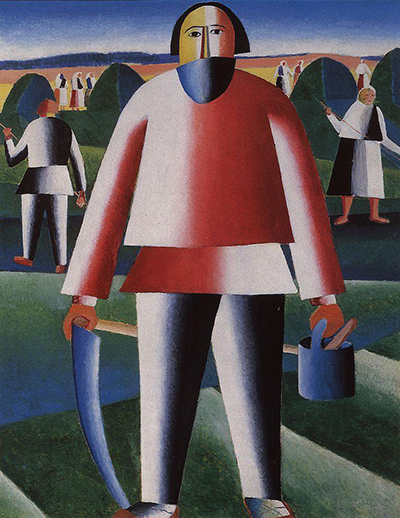
Compare the Tretyakov’s Haymaking, whose worker also has a tool that reads immediately against the land. The sickle-like curve of the scythe in that work adds a distinct direction to the upright figure. In Woman with a Rake the tool’s strong straight line is closer to the vocabulary that organizes the woman’s outline. Both paintings reintroduce figures and horizons after Malevich’s experiments with nonobjective painting. They give the tools different roles in relating a body to the surrounding field. [1] [4]
Frequently Asked Questions
When was the painting made?
The Tretyakov Gallery currently dates it 1930–1931. Its 1915 inscription is a separate historical feature of the object. [1]
Where is it held?
The State Tretyakov Gallery, Moscow, inventory 22571, records the painting and says it acquired it from Malevich in 1932. Current display is not established by the checked page. [1]
What is the medium and size?
Is the rake being used?
No action with it is depicted. It hangs beside the still figure; the museum describes its role as largely symbolic or conventional. [1]
Discussion
How does the figure remain recognisable when her face has no features?
Which coloured shapes make the strongest divisions across the body?
Reader Insights
Trace the small rake against the broad green field. Why is it easy to miss?
Compare the two differently coloured legs and the black-and-white skirt.
The museum dates the picture 1930–1931 despite its 1915 inscription. How does that change its place in Malevich’s career?
Join the Conversation
Share a close observation or a source-backed detail about Tretyakov inventory 22571.
References
- State Tretyakov Gallery, Женщина с граблями, inventory 22571: illustrated owner record, current date, medium, measurements, 1932 acquisition, 1915 inscription and curatorial discussion. View source.
- Marie Gasper-Hulvat, Malevich’s Post-Suprematist Paintings and the Construction of History (Bryn Mawr College PhD dissertation, 2012): figure list identifies Woman with a Rake, 1932–1933, inscribed 1915, Tretyakov inventory 22571; used for the published dating variant. View source.
- Paula Wisotzki and Susan Freifeld, Kazimir Malevich Teaching Packet, National Gallery of Art (1990), item 19: circa-1928–1932 date, approximate 100 × 75 cm size and discussion of the late geometric figure; used as a historical museum publication comparison. View source.
- Tretyakov Gallery, Haymaking, inventory 10612: separately illustrated late figure and landscape for comparison. View source.