


 by Tom Gurney
Tom Gurney BSc (Hons) is an art history expert with over 20 years experience
Published on June 19, 2020 / Updated on November 20, 2026
Email: tomgurney1@gmail.com / Phone: +44 7429 011000
Introduction
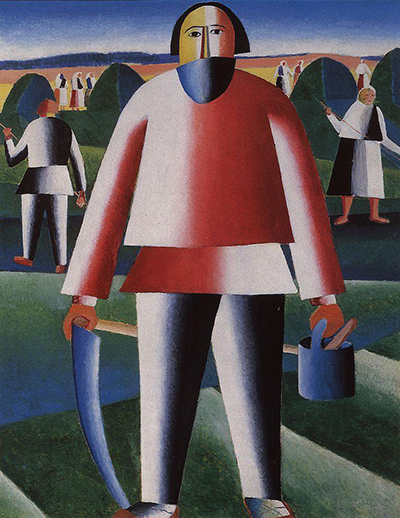
A monumental mower stands in front of a strip of green land, carrying a scythe in one hand and a blue pail in the other. Other workers and pale rows of figures occupy the field behind him. The image on this page matches Kazimir Malevich's Haymaking (На сенокосе) in the State Tretyakov Gallery, Moscow, inventory 10612. The gallery dates the oil painting 1928–1929, measures it at 86.5 × 66 cm, and records its acquisition from Malevich in 1929. [1]
The canvas carries an earlier “1909 motif” inscription. That phrase is part of the work's historical labelling, not the production date used by the museum. Tretyakov scholar Irina Vakar has described how comparison with Malevich's earlier mower painting helped distinguish this late composition from a genuinely 1909 work. The same late date and inventory appear in Marie Gasper-Hulvat's doctoral figure list. [1] [2] [3]
At a Glance
- ArtistKazimir Malevich
- Owner titleНа сенокосе (Haymaking)
- Current museum date1928–1929
- Earlier inscription“Motif 1909”; not the production date followed here
- MediumOil on canvas
- Dimensions86.5 × 66 cm
- CollectionState Tretyakov Gallery, Moscow, inventory 10612
- AcquisitionFrom the artist in 1929, according to the gallery
Contents
- What does the painting show?
- Why does it say “1909 motif”?
- The figure, the field and the colour
- What did conservation reveal?
- Where does Haymaking sit in Malevich's later work?
- Collection and documentation limits
- A figure measured against the horizon
What does the painting show?
The central figure fills almost the full height of the canvas. A rounded dark haircut frames a face split by light and shadow, and a blue-grey beard covers its lower part. The red and white tunic flares outward over dark trousers. In the left side of the image, a long scythe curves toward the ground; at the other side he holds a dark blue pail. The handle, pail and curved blade specify agricultural work without showing a stroke of mowing in progress. [1] [4]
Behind him, workers appear at different scales. One figure at left turns away; another at right reaches an arm into the scene. Much smaller pale figures stand near the distant horizon. Dark rounded trees or shrubs rise between them, and alternating green, blue and yellow ground bands lead the eye back. This is a recognizable rural setting, but not a mapped or named field in the sources checked here. [1]
The foreground worker interrupts our view of that activity. His shoulders spread almost from one side of the painting to the other, while the scythe and pail extend the body into the edges below. The face is more legible than those of many later Malevich peasants, yet its two halves and simplified beard make it deliberately constructed. The painting combines person, tool and landscape with strong geometric organization. [1] [3]
Why does it say “1909 motif”?
The Tretyakov's current object page dates Haymaking 1928–1929 and notes the inscription “мотив 1909”. It says the earlier wording accompanied the painting when it entered the gallery. The institution links the canvas to Malevich's preparation for his 1929 retrospective, when some earlier works remained abroad after exhibitions in Warsaw and Berlin. The inscription points back toward an earlier subject, but it does not establish that this physical canvas was painted in 1909. [1]
Vakar's first-person account is especially useful here. She recalls that the older Mower was already known when the later Haymaking was being reassessed, and that the wording “motif 1909” was an important clue. In the subsequent exhibition catalogue she helped prepare, the Tretyakov painting received the 1928–1929 date. Her account documents a scholarly correction, not a claim that every brushstroke's date can be determined from the inscription alone. [2]
Gasper-Hulvat lists the two works as distinct objects: the late Tretyakov Haymaking, inventory 10612, and an earlier 1912 mower painting in the Nizhny Novgorod Museum of Fine Art, Ж-343. The Tretyakov's curatorial essay calls the earlier picture a model for the later one and notes its icon and Cubist features. The relationship is art-historical comparison, not a licence to merge their dimensions, owners or painted surfaces. [1] [3]
The figure, the field and the colour
The tunic looks heavy and voluminous, but its red and white sections also read as adjacent colour shapes. Strong light and shadow cut across the face, beard and legs. The central axis of head, beard and torso intersects with the horizon behind. The Tretyakov's essay interprets that crossing in relation to Christian imagery and the peasant subject. Its interpretation is valuable, though the image alone cannot prove that Malevich intended one fixed religious message. [1]
The field is unusually expansive. Broad green spans sit under a blue sky, and darker shapes mark trees and shade. The museum contrasts this open landscape with the flatter decorative background of the earlier mower painting. The green is especially conspicuous beside the central red tunic and blue pail. Colour gives the rural subject energy while also separating the composition into almost independent zones. [1]
The owner's curatorial text connects Malevich's late ideas about colour to a distinction he made between rural and urban life. It presents the bright clothing and natural setting as part of that thinking, while the city appears as a more restrained chromatic world. This is a reading of Malevich's writings and the canvas, rather than evidence that each exact patch of pigment carries a separately documented symbolic code. [1] [2]
What did conservation reveal?
Ann Hoenigswald's National Gallery of Art conservation study discusses this very Tretyakov Haymaking as figure 12. She observed blue paint emerging through green areas of grass where Malevich scratched into a dry upper layer. The blue pail was laid over a dried red layer, with a trace of red remaining visible at its edges. These are object-specific findings about paint handling, not deductions from the site's small reproduction. [4]
Hoenigswald also describes a locally applied surface coating over the central figure's dark hair, with part of the blue sky subsequently painted across it. She treats such coatings as a way Malevich varied the appearance of his painted surface. Her study's wording leaves the exact coating material as a possibility, not a proven chemical identification for this passage, so this page does not name a definitive resin or binder. [4]
These technical observations complicate the impression of broad, simple colour. The field can appear like a single green band in a small JPEG, yet the material record includes lower blue, scratching and layered paint. The pail's edge is similarly more complex than one flat blue shape. A viewer can use the digital image to locate these areas, but a conservator's direct study provides the evidence for their construction. [4]
Where does Haymaking sit in Malevich's later work?
This painting belongs to the group commonly called Malevich's second peasant cycle. Its 1928–1929 dating places it after the nonobjective paintings associated with Black Square, while its colour contrasts and formal divisions still make the artist's earlier experiments relevant. The Tretyakov article describes the later work as renewing a figure rather than simply returning to conventional realism. [1]
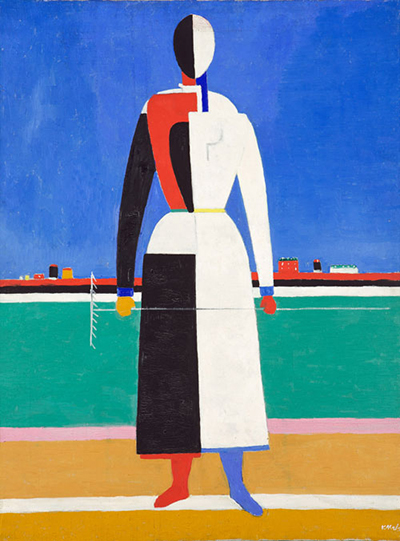
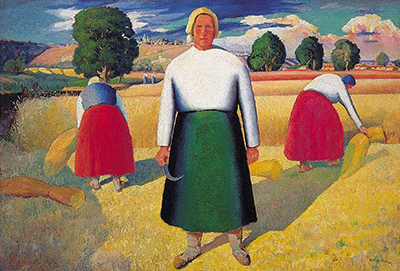
Woman with a Rake offers a useful comparison: there, a solitary peasant figure is reduced further to hard colour blocks and a slight tool; here, the beard, pail, scythe and background workers provide more narrative cues. Women Reapers is another late harvest scene, with three women and a more descriptive golden field. Shared subject matter does not mean the three canvases were conceived as one series of matching panels. [1] [3]
The political history of the late 1920s can inform interpretation, but a field scene does not automatically prove a message about collectivization or an endorsement of state agricultural policy. Gasper-Hulvat's scholarship surveys disputed political readings of Malevich's late peasants. This page separates the verified object, its visible forms and its documented paint handling from such broader arguments about intention. [3]
Collection and documentation limits
The owner says it acquired the painting from Malevich in 1929. That is a precise point in its ownership history, not a complete provenance narrative. The checked sources do not establish its current gallery-room location or on-view status. Dimensions and medium follow the current Tretyakov object page, which is more specific than older approximate dates in wider exhibition literature. [1]
An illustrated 2006 issue of The Tretyakov Gallery magazine reproduces the same composition and gives 85.8 × 65.6 cm, slightly different from the current online owner's 86.5 × 66 cm. This page follows the current accession-linked measurement in its caption and fact table; the older printed figure is retained here as a documented publication discrepancy rather than silently harmonized. The magazine plate independently confirms the saved image's exact central figure, blue pail and background workers. [1] [5]
A figure measured against the horizon
The Tretyakov’s account gives the horizon an unusually prominent place in its reading of the picture. The horizontal division crosses the long upright of the mower’s body and extends beyond him on either side. The central figure has strong vertical weight, while the ground behind him spreads laterally. This is a way to bring the returning landscape into the painting’s structure. The viewer can place the worker in a field and still perceive the arrangement as a meeting of directions across the canvas. [1]
The museum reads that meeting as a cross and relates it to its account of the peasant figure and the resemblance of the head to an icon. The interpretation is easier to assess if the viewer first follows the line of the horizon across the composition, then follows the vertical from the figure’s feet to his head. The curved blade gives a third direction, breaking the strictness of those axes. The tools and the land belong to a painted scene of work, while line and colour organize how that work is encountered. [1]
Frequently Asked Questions
Was the painting made in 1909?
Where is it held?
The State Tretyakov Gallery, Moscow, records it as inventory 10612 and says it acquired it from the artist in 1929. Current display is not established by the checked item. [1]
What is the worker holding?
Is it the earlier Mower painting?
Discussion
How does the scale of the central mower change your reading of the smaller workers?
Which colours link the figure to the field, and which separate him from it?
Reader Insights
Find the curved scythe and blue pail. What do they contribute to the still pose?
Compare the wide green bands with the red and white tunic.
Conservation found blue beneath parts of the green grass. What can a digital reproduction show, and what needs technical examination?
Join the Conversation
Share a close observation or a source-backed detail about Tretyakov inventory 10612.
References
- State Tretyakov Gallery, На сенокосе (Haymaking), inventory 10612: illustrated owner record, date, medium, dimensions, 1929 acquisition, “1909 motif” inscription and curatorial discussion. View source.
- Irina Vakar, first-person account of the Malevich exhibition and dating research, Tretyakov Gallery's Lavrus: the later painting's relationship to the 1909 inscription and catalogue redating, especially the “Exhibition” section. View source.
- Marie Gasper-Hulvat, Malevich’s Post-Suprematist Paintings and the Construction of History (Bryn Mawr College PhD dissertation, 2012): figure list distinguishes the 1928–1929 Tretyakov work, inventory 10612, from the 1912 Nizhny Novgorod mower painting. View source.
- Ann Hoenigswald, “Kazimir Malevich's Paintings: Surface and Intended Appearance,” Conservation Research 1996/1997, National Gallery of Art, pp. 115–120: direct technical discussion of Haymaking figure 12, paint layering and local surface coating. View source.
- The Tretyakov Gallery magazine, issue 2 (2006), pp. 24–25: full-colour reproduction of the exact canvas, dated 1928–1929, with an 85.8 × 65.6 cm printed measurement that differs slightly from the current online record. View source.



