 by Tom Gurney
Tom Gurney BSc (Hons) is an art history expert with over 20 years experience
Published on June 19, 2020 / Updated on November 20, 2026
Email: tomgurney1@gmail.com / Phone: +44 7429 011000
Introduction
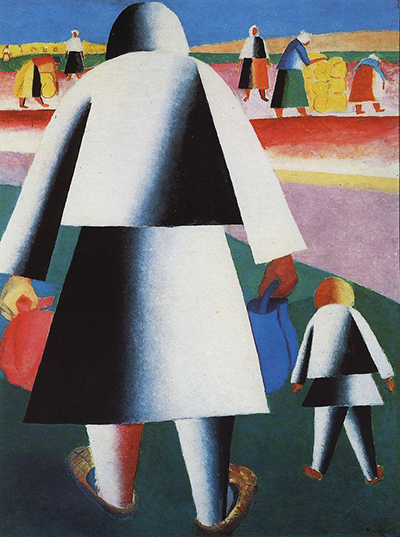
A large figure in white walks away from us, almost filling Kazimir Malevich's At Harvesting (Marfa and Vanka). Beside her, a small child strides in the same direction. Across the high horizon, other figures work among bands of yellow, red and green. The painting offers a recognizable rural subject, but the two foreground figures are built from smooth, rounded volumes and sharply divided colour. Their backs conceal their faces, so pose, scale and the relation between adult and child carry the encounter. [1]
The State Russian Museum catalogues this exact painting as 1928–1929, oil on canvas, 82 × 61 cm, inventory Ж-9492. Its illustrated record matches the saved image on this page: the dominant white-clad figure, the small figure at lower right, the striped ground and the distant workers. The site's inherited spelling “Marpha and Van'ka” differs from the museum's English title, At Harvesting (Marfa and Vanka); both refer here to the same canvas. [1]
At a Glance
- ArtistKazimir Malevich
- Museum titleAt Harvesting (Marfa and Vanka)
- Date1928–1929, as catalogued by the State Russian Museum
- MediumOil on canvas
- Dimensions82 × 61 cm
- CollectionState Russian Museum, Saint Petersburg, Ж-9492
- Visual focusA large back-turned figure and a smaller child moving toward a high horizon
Contents
- Look at the two figures
- Why does the date matter?
- Peasant subject after Suprematism
- What the sources leave open
- When the landscape takes on a surface
Look at the two figures
The adult figure dominates nearly the full height of the canvas. White sleeves extend out from a broad white upper body, while the skirt and head shift from pale to deep charcoal. The face is invisible: we look at the back of a rounded head and the body moving into the scene. Low on the right, the child repeats that back-turned pose in miniature. The smaller figure's white upper garment and darker lower clothing echo the adult's contrast, but the proportions are different enough to make their relationship visually immediate. [1]
The two figures do not occupy a flat stage. Their feet overlap broad green and dark zones in the foreground. Behind them, a red strip, paler strips and a thin high horizon break the ground into horizontal layers. Tiny workers and yellow sheaf-like forms appear above and along that boundary. The enormous near adult and tiny distant people make depth legible even as the land itself looks like painted bands. The bright blue sky is a relatively narrow field at the top, leaving the foreground bodies in control of the image. [1]
This is a painting about movement as well as scale. The adult and child are seen from behind and appear to head toward the distant activity named by the title. Their exact destination, identities beyond the title, and emotional state cannot be proved from posture alone. The composition lets a viewer infer a shared direction; it does not provide a written narrative of what happens next. [1]
Why does the date matter?
The owner dates the physical canvas 1928–1929. Art historian Aleksandra Shatskikh reports that Malevich wrote 1909–1910 on its reverse and relates it to an earlier, now lost composition known as In the Field. She distinguishes the early and late cycles of peasant subjects: the later works develop a clear horizon, striped ground and strongly shaped figures. Her account is especially useful because a date inscribed by the artist is easy to mistake for the date of execution. The museum's present catalogue date identifies this as the later canvas. [1] [2]
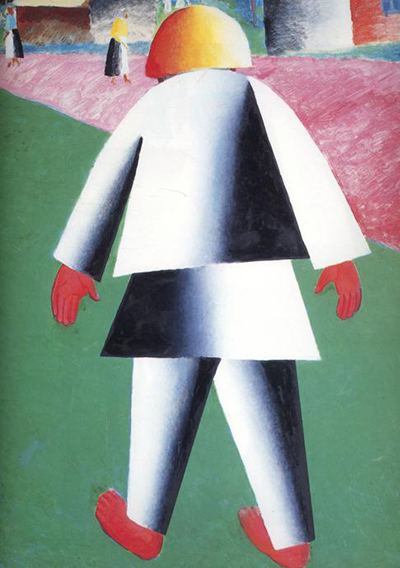
Marie E. Gasper-Hulvat also identifies Ж-9492 in her dissertation. She writes that the 1928–29 work repeats a To Harvesting composition from 1912, reproduced in a 1913 periodical before the earlier painting disappeared. She also suggests that the separate Boy (Vanka) of 1928–29 may reuse the child's detail. These are scholarly relationships among works, not grounds for presenting this canvas as the surviving original from 1912. [3]
The National Gallery of Art's technical research list likewise includes Going to the Harvest: Marfa and Vanka as an oil painting in the State Russian Museum, dated approximately 1928. This independent institutional listing uses another English translation and a slightly broader date. The Russian Museum's current object record remains the source for this page's dimensions and 1928–29 date. [1] [4]
Peasant subject after Suprematism
Malevich's earlier Suprematist work, including Black Square, removed recognizable people and landscape from the canvas. At Harvesting returns to both. Yet its near bodies are not modeled as detailed portraits. The adult's sleeves, torso and skirt read as joined volumes, while light and dark areas mark each plane. The child's figure repeats that simplified structure on a smaller scale. [1] [2]
Shatskikh argues that Malevich's late peasant paintings renew themes from his earlier art through a changed visual language. She points in particular to the striped land and figures constructed from firm, curved planes. That reading helps explain why the scene feels both figurative and geometric. It should not be converted into an absolute claim that every stripe represents a particular crop or that the people are symbols of a single political event. [2]
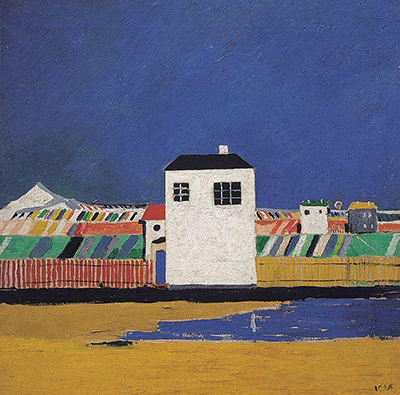
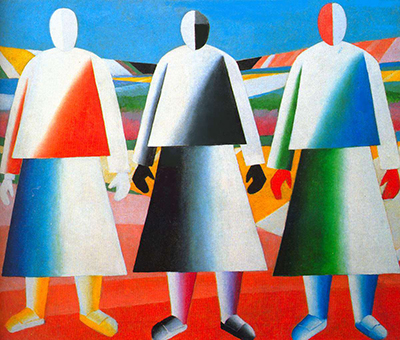
Compare Girls in the Fields, another late Russian Museum work, or Landscape with a White House. All use strong bands of colour to organize a rural scene. Here, however, a large back-turned person controls the foreground. The house painting gives that role to a building, and Girls in the Fields makes human figures part of a different grouping. These comparisons reveal recurring visual problems, not evidence that the canvases were painted as a single planned series. [1] [2]
What the sources leave open
The Russian Museum records that the painting came from Malevich's heirs in 1936 and was transferred to the USSR Ministry of Culture in 1977. Those brief notes do not amount to a complete provenance or establish where it was first shown. Its site mentions a museum room but warns that placement can change. Readers planning a visit should check the museum's current display information. [1]
The reproduced image supports observation of arrangement and broad colour, but it cannot certify the exact hue or surface texture of the original under gallery light. Claims about hidden layers or conservation findings need object-specific technical evidence. Shatskikh's and Gasper-Hulvat's accounts clarify the work's relation to earlier motifs, while the owner record anchors the physical object. [1] [2] [3]
When the landscape takes on a surface
Ann Hoenigswald’s study for the National Gallery of Art reproduces a detail of this painting in its discussion of Malevich’s late surfaces. The reproduction and caption identify it as Going to the Harvest: Marfa and Vanka. The study is useful even where a reproduction of the whole work emphasizes its broad bands of colour. A landscape may look as if it consists of simple divisions between field, sky and figures, yet those divisions remain made of paint with a surface that changes under light. [1] [4]
The technical discussion gives a different kind of evidence from the identification of a figure or a motif. The separate Boy (Vanka) has its own recorded support and has been examined in its own right. The Russian Museum specifies canvas for the larger two-figure composition. The relationship between the pictures can be studied through the shape and position of the boy while the physical evidence remains attached to each separate work. That combination is especially useful when almost identical titles or repeated figures make several records appear to belong to a single object. [1] [3] [4]
Frequently Asked Questions
Who are Marfa and Vanka?
The names occur in the museum's title. The picture shows a large adult and a smaller child walking away from the viewer; the checked sources do not establish portraits of named historical individuals. [1]
Was it painted in 1909–1910 or 1928–1929?
Is this the earlier lost To Harvesting?
Where is the painting?
It belongs to the State Russian Museum in Saint Petersburg. The museum warns that room placement may change, so its online location note is not a promise of current display. [1]
Discussion
How does the size difference between the adult and child shape your sense of space?
What do the back-turned figures allow you to see, and what do they leave unknown?
Reader Insights
Trace the repeated white and dark forms in the two foreground figures.
Where do the field bands suggest distance, and where do they remain strong painted stripes?
Compare this late peasant scene with the separate Girls in the Fields.
Join the Conversation
Share a close observation or a source-backed detail about Russian Museum Ж-9492.
References
- State Russian Museum, At Harvesting (Marfa and Vanka), Ж-9492: illustrated owner record for exact identity, date, medium, size, inventory and collection note. View source.
- Aleksandra Shatskikh, Kazimir Malevich, “Post-Suprematism”: her scholarly account of the reverse date, earlier peasant composition and late visual language; the accessible page reproduces the relevant chapter in Russian. View source.
- Marie E. Gasper-Hulvat, Malevich's Post-Suprematist Paintings and the Construction of History (PhD dissertation, Bryn Mawr College, 2012), printed p. 167 and note 298: accession Ж-9492 and relation to the lost 1912 composition. View source.
- National Gallery of Art, Conservation Research 1996/1997, works examined table: Going to the Harvest: Marfa and Vanka, approximately 1928, oil on canvas, State Russian Museum. View source.