


 by Tom Gurney
Tom Gurney BSc (Hons) is an art history expert with over 20 years experience
Published on June 19, 2020 / Updated on November 20, 2026
Email: tomgurney1@gmail.com / Phone: +44 7429 011000
Introduction
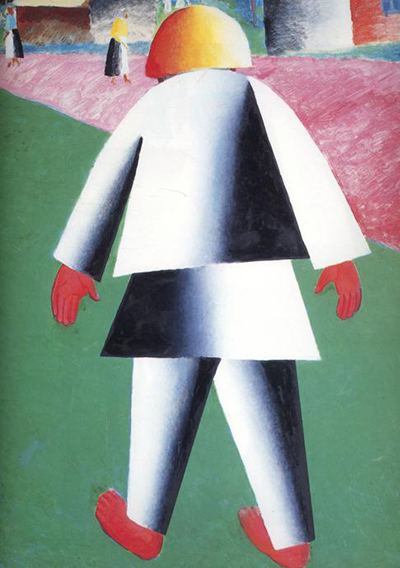
A child seen from behind fills almost the entire picture in Kazimir Malevich's Boy (Vanka). His head is a rounded orange and yellow form; his white and dark clothing divides into broad, hard-edged areas; his hands and feet are bright red. Beyond him are a green ground, a pink band and two tiny figures near buildings. The boy has no visible face. The painting asks us to read his posture and direction while noticing how deliberately his body has been constructed from colour and shape. [1]
The State Russian Museum dates the work 1928–1929, identifies oil on plywood, and gives 72 × 51.5 cm on its illustrated gallery page. The local saved image matches that museum reproduction in its figure, clothing, red hands and feet, and small background figures. A conservation study by researchers at Russia's State Research Institute for Restoration names the same work as museum inventory Ж-9486. The existing short site title “Boy” is therefore expanded to the museum's more specific Boy (Vanka) while the old URL remains in place. [1] [2]
At a Glance
- ArtistKazimir Malevich
- TitleBoy (Vanka); legacy site title Boy
- Date1928–1929, State Russian Museum
- MediumOil on plywood
- Dimensions72 × 51.5 cm on the museum gallery page
- CollectionState Russian Museum, Saint Petersburg; Ж-9486 in conservation research
- Visual focusOne back-turned child, red hands and feet, and small distant figures
Contents
- Looking at the boy
- How does it relate to Marfa and Vanka?
- A late figurative painting
- What remains uncertain?
- A small figure inside a larger story
Looking at the boy
The composition is strikingly close. The boy's head sits near the top edge and his feet almost reach the bottom. His arms hang out and down, giving the upper body a broad silhouette. White paint sweeps across the shoulders and left side, while dark grey and black divide the torso and skirt-like lower garment. The legs widen below it, each shifting from pale to dark. The red hands and shoes break the otherwise cool, pale scheme of the body. [1]
A gradient of light and dark gives the limbs a rounded appearance, yet the boundaries between them are clear. The head reads as a curved volume, the coat as overlapping planes and the legs as two long forms. This mixture of volume and flattening matters: the boy is recognizable immediately, but the painting does not depend on a detailed face or naturalistic anatomy. Since the figure is turned away, the viewer's attention moves from facial expression to stance, scale and the spaces around him. [1]
The setting is not empty. At upper left, a small figure stands near a low building; farther right, another small figure is visible against the pink land. A tall pale building and a darker vertical form occupy the right background. Their small scale makes the foreground boy seem larger still. The green field covers most of the lower background, while the pink diagonal band separates it from the blue upper zone. These distinct fields of colour organize depth without filling the landscape with conventional detail. [1]
How does it relate to Marfa and Vanka?
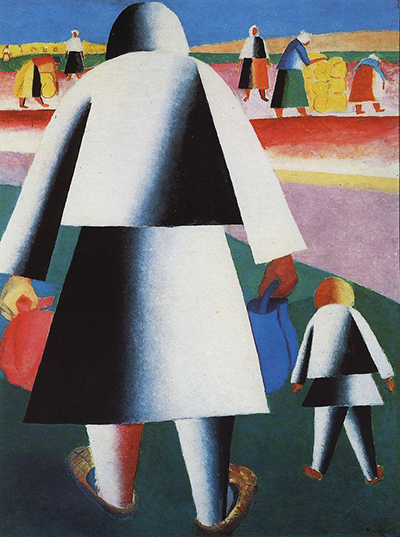
The Russian Museum's annotation explicitly links Boy (Vanka) with the separate At Harvesting (Marfa and Vanka) of the same period. That larger canvas places a small, similarly back-turned child beside a dominating adult figure. The two paintings share the child's rounded head, white and dark clothing, red accents and direction away from the viewer. Their arrangements differ: here the child owns the foreground; in At Harvesting he is a comparatively small companion to Marfa. [1] [3]
Art historian Marie E. Gasper-Hulvat suggests that Boy (Vanka) can be understood as a replication of the small boy's body in both the late At Harvesting and an earlier, now missing To Harvesting composition. She frames this as a possible relationship, not proof of the order in which the late canvases were painted. Her point adds a historical dimension to the visible resemblance: Malevich returned to an earlier motif while changing its scale and surrounding scene. [4]
The museum's annotation likewise describes the varied styles of Malevich's works after 1928 and connects some to themes of the early 1910s. It reads the late peasant images through colourful combinations and weighty rhythms of geometrized volumes. That is the museum's interpretation of the period, not evidence that this child is a portrait of a particular boy. The name Vanka belongs to the catalogue title; the checked sources do not supply a biography of a sitter. [1]
A late figurative painting
Malevich's name is closely associated with abstract Suprematism, including Black Square. This late painting has a clear human subject and a place around him. Still, the colour divisions, large planes and simplified body show a painter concerned with more than likeness. The silhouette is legible because its red extremities, bright clothing and strong dark zone are organized against the green and pink ground. [1]
The work is often dated differently in reproduced listings; the owner gallery page and the 2006 Museo Thyssen-Bornemisza exhibition site both use 1928–1929, while the museum's own account ties it to the late peasant cycle. The Spanish government's 2006 exhibition guarantee lists Boy (Vanka) on loan from the State Russian Museum, oil on plywood and 72 × 51.5 cm. That record corroborates the museum gallery's material and size without resolving every variant in later secondary catalogues. [1] [5] [6]
A conservation research poster identifies Ж-9486 and examines the ground layer of this work as part of a technical study of Malevich paintings. It reports that several late works on plywood had an artist-applied chalk ground with gypsum. Those laboratory findings belong to the physical paintings examined; they cannot be deduced by looking at a digital reproduction. The poster does not turn the entire visible white coat into evidence about pigment composition or justify claims about hidden imagery beneath this particular picture. [2]
What remains uncertain?
The museum gallery says the work entered from Malevich's heirs in 1936. That is one acquisition note, not a complete ownership history. It does not establish when the painting was first displayed. The gallery's dimensions are 72 × 51.5 cm; a few other catalogues print 72.5 cm for the height. This page follows the current museum gallery measurement and does not conceal that catalogue variation. [1] [2]
The bright red hands and feet are unmistakable in the saved reproduction. Their exact pigment, however, cannot be named from colour alone, and the emotional meaning of the child's back-turned pose is open to interpretation. The museum and scholarship support a connection to the late peasant cycle and to At Harvesting. They do not identify a specific village, a named model or a single authorised symbolic meaning. [1] [4]
A small figure inside a larger story
With the boy alone, the viewer can follow his stance from the head to the distinct red marks of hands and feet. Turning to At Harvesting changes that encounter. In the second picture, the boy’s outline can be read in relation to Marfa, the field and the title’s suggestion of an activity. The one-figure work places more emphasis on the distance between the shape of the boy and the edges around him. What looks like a supporting figure in a story can become the subject of a painting when isolated in this way. [1] [3] [4]
The two records make clear that this is also a change of object. The Russian Museum describes the harvesting composition as oil on canvas, 82 by 61 centimetres. The separate boy is smaller and recorded as oil on plywood. The difference in support matters if the paintings are consulted through a technical study. Observations based on a sample taken from the plywood panel cannot be assumed to describe the preparation beneath the canvas. [1] [2] [3]
Frequently Asked Questions
When was it made?
Is it the same work as At Harvesting?
Who was Vanka?
Where is it?
It belongs to the State Russian Museum in Saint Petersburg. The collection credit does not guarantee it is on view today; check the museum before travelling. [1]
Discussion
How does the boy's back-turned pose change what you look for in the picture?
Which colour shapes make the figure feel rounded, and which keep it flat?
Reader Insights
Look for the two tiny background figures. What happens to the scale of the foreground child?
Trace the red accents from the hands to the shoes.
Compare the boy here with the small child in At Harvesting (Marfa and Vanka).
Join the Conversation
Share a close observation or a source-backed detail about this specific Russian Museum painting.
References
- State Russian Museum, Boy (Vanka): illustrated owner gallery page, 1928–29, oil on plywood, 72 × 51.5 cm, collection note and interpretive annotation. View source.
- I. Kadikova and colleagues, “A Study of Pigments of K. Malevich's Paintings Using Scanning Electron Microscopy and X-Ray Microanalysis” (2016): State Research Institute for Restoration research poster; figure 1 identifies Russian Museum Ж-9486 and discusses sampled ground layers. View source.
- State Russian Museum, At Harvesting (Marfa and Vanka), Ж-9492: separate illustrated museum work used for the comparison. View source.
- Marie E. Gasper-Hulvat, Malevich's Post-Suprematist Paintings and the Construction of History (PhD dissertation, Bryn Mawr College, 2012), printed p. 167 n. 298: proposes the relation of the boy motif to late and earlier harvesting compositions. View source.
- Museo Thyssen-Bornemisza, Russian Avant-gardes exhibition site (2006): lists the Russian Museum loan as oil on plywood, 72 × 51.5 cm, dated 1928–29. View source.
- Spanish Official State Gazette, state guarantee for Russian Avant-gardes (2006): official loan listing for Boy (Vanka), State Russian Museum, date, medium and size. View source.



