 by Tom Gurney
Tom Gurney BSc (Hons) is an art history expert with over 20 years experience
Published on June 19, 2020 / Updated on November 20, 2026
Email: tomgurney1@gmail.com / Phone: +44 7429 011000
Introduction
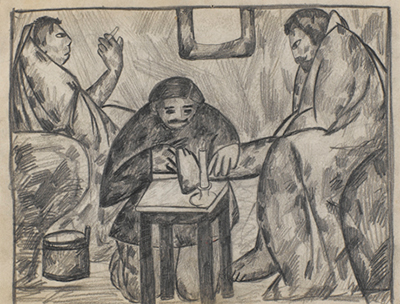
A small monochrome drawing shows a crouching worker tending the foot of a seated man. Another man smokes at the left. The Stedelijk Museum Amsterdam records this 1911 object as De likdoornsnijder, translated on its English item as The Corn Operator, accession 4.2001(111), measuring 13.4 × 17.2 cm. The museum credits it as a loan from the Khardzhiev Foundation. [1]
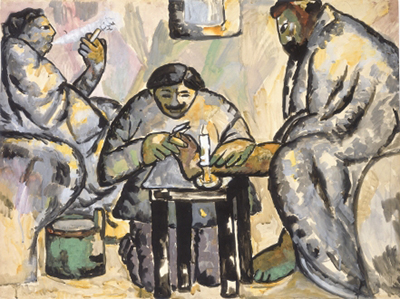
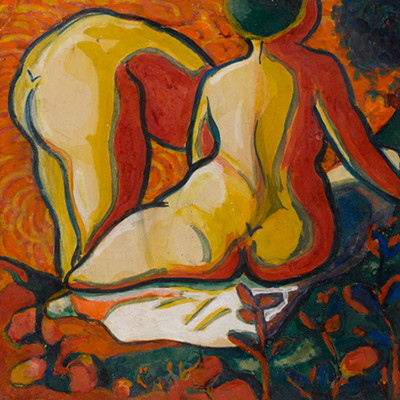
The title's “corn” is a hard spot on the foot, not grain. The saved image matches this small Stedelijk composition: the same three figures, raised foot, bucket and central attendant appear in a compact network of drawn lines. A much larger colour work of the subject also belongs to the Stedelijk collection. Its object number, size and holding note are different. [1] [2]
At a Glance
- ArtistKazimir Malevich
- Museum titleDe likdoornsnijder; English translation The Corn Operator
- Date1911
- Object number4.2001(111)
- Dimensions13.4 × 17.2 cm
- Holding creditKhardzhiev Foundation loan at the Stedelijk Museum Amsterdam
- MaterialNot stated on the owner item record checked here
- Separate colour workThe Corn Cutter, A 7654, 77.7 × 103 cm
Contents
- What does the drawing show?
- Why “Corn Operator”?
- How does it relate to the colour work?
- The Khardzhiev holding
- A figurative Malevich
- How the objects organize the two versions
What does the drawing show?
The centre figure bends low over a foot set on a small table. The client's large knees and shoulders fill the right side; the third figure sits further back at left and lifts a cigarette. A pail rests near the lower left corner. A rectangular feature above the group gives the shallow room a back wall, while dense diagonal hatching suggests shadow around the central worker. [1]
The action is clearest where hands and foot meet. Malevich surrounds that small point with broad forms: the client's knee rises on one side, and the attendant's hunched back rounds over the other. The table's straight top and legs hold the forms in place. There is little spare space in the image, despite its small physical size. [1]
Looking closely at the drawing, line direction helps distinguish the figures. Long strokes describe the left man's draped body; darker, shorter marks gather under the central attendant and around the right figure's torso. The drawing reads through tonal contrasts and repeated contours rather than the bright colour that organizes the larger work. These are visual observations from a reproduction; the checked object metadata do not specify an exact pencil, paper or mixed-media formula. [1]
Why “Corn Operator”?
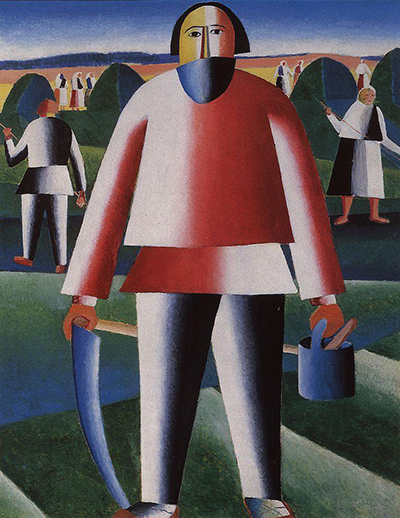
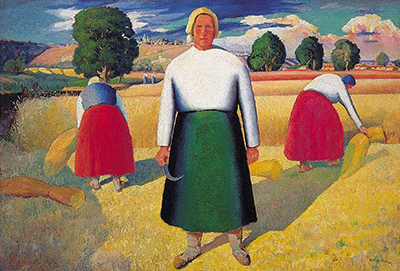
The owner uses the Dutch title De likdoornsnijder for both related objects. Its English item labels distinguish them as The Corn Operator for this small work and The Corn Cutter for the larger one. Both refer to someone treating a foot corn. The image's raised foot supports that reading. It is unrelated to Haymaking or the agricultural work in The Reapers. [1] [2]
The translated titles are useful for navigating two site articles, but title variation alone would be too weak to identify them. Here the decisive facts are the accession 4.2001(111), 13.4 × 17.2 cm measurement, Khardzhiev loan credit and visual match to the monochrome image. A catalogue or search result that mentions only De likdoornsnijder must be checked against those fields before its claims are carried onto this page. [1] [2]
How does it relate to the colour work?
The same bathhouse arrangement occurs in the large Corn Cutter: smoker at left, worker at centre and client at right. The colour version opens the background with pale and warm patches and uses green in the hands, foot and bucket. This drawing concentrates the action within a tighter field of dark lines. Comparing them helps show which elements of the scene Malevich kept stable and which he could alter with colour and scale. [1] [2]
It is tempting to call the small object a preparatory study for the large one. The two museum records checked here date both to 1911 but do not, by themselves, prove which was made first or that one was conceived only as a study for the other. “Related composition” describes the documented visual connection more carefully. Nor should the large work's measurements, collection ownership statement or proposed gouache medium be assigned to this small object. [1] [2]
The Khardzhiev holding
The Stedelijk item credits 4.2001(111) as a Khardzhiev Foundation loan. Nikolai Khardzhiev assembled a major collection and archive of Russian avant-garde material; the Stedelijk has published on the collection and its Malevich drawings. This credit explains the object's current institutional context but does not make the museum the owner or supply a complete provenance for the sheet. [1] [3]
The current display location is not established by the item information used here. A museum collection page can remain available online whether an object is on view, in storage or on loan. This article therefore gives the holding institution and accession without promising that visitors can see the sheet in a gallery today. [1]
A figurative Malevich
Dated 1911, the work precedes Black Square and Malevich's 1915 public presentation of Suprematism. The bathhouse scene is recognizably figurative: a task, a client and an observer occupy an interior. Its compressed shapes and forceful contours invite formal comparison with his changing pictorial language, but this sheet cannot be treated as a direct blueprint for the later square. [1] [4]
The pair also cautions against reducing his early career to a single style. One subject could be handled in a small tonal drawing and a far larger coloured work. Each surviving object deserves its own date, dimensions and collection identification even when a catalogue groups them under one Dutch title. [1] [2]
How the objects organize the two versions
The small table and pail are useful places to start the comparison. In the drawing, the short horizontal beneath the foot interrupts a cluster of angled marks. It gives the operation a point of stability. The pail sits at a distance, closer to the bottom edge. A viewer can move from the pail to the hands as though following the placement of things in a working room. In the colour work, a related path also passes through the green of several details, so colour joins objects that the drawing keeps distinct through line and tone. [1] [2]
The difference in size changes the task for the viewer. In the drawing, the straight table edge is short enough to take in at once. On the larger work, each broad area has room to register before the eye returns to the central gesture. The attendant remains bent low and the customer’s raised leg still anchors the action in both. The repeated arrangement is evidence of Malevich returning to the pictorial problem. It gives us a basis for reading the two works together while leaving their order open. The shared tilt of the torso also gives the viewer something to recognize before picking out differences of finish or medium. That is a more stable point of comparison than the translated titles, which describe the same occupation in different words. [1] [2]
Frequently Asked Questions
Does “corn” mean a crop here?
No. It means a hard patch of skin on a foot. The drawing shows the central attendant working on the seated figure's foot. [1]
Is this the same as The Corn Cutter?
Is the drawing definitely a preparatory study?
What is its medium?
The owner item data available in this review leave material unspecified. Its appearance can be described as monochrome drawn line without naming an unverified material. [1]
Discussion
What tells you that this scene concerns foot care rather than grain harvest?
How do the three figures lead your eye to the central action?
Reader Insights
Locate the raised foot and the attendant’s hands.
Compare the large colour composition and the small monochrome version.
Why do the object numbers matter when two works share a Dutch title?
Join the Conversation
Share a close observation or source-backed detail about Stedelijk object 4.2001(111).
References
- Stedelijk Museum Amsterdam, De likdoornsnijder / The Corn Operator, 4.2001(111): owner item for 1911, dimensions, accession, translated title, Khardzhiev loan and visual identity. View source.
- Stedelijk Museum Amsterdam, De likdoornsnijder / The Corn Cutter, A 7654: separate larger 1911 colour composition. View source.
- Stedelijk Museum Amsterdam, “Unique Malevich Drawing Discovered During Stedelijk Inventory of the Khardzhiev Collection”: institutional context for the Khardzhiev material, not a claim about the creation of this exact sheet. View source.
- The Museum of Modern Art, The Russian Avant-Garde Book, 1910–1934 exhibition brochure: documents Malevich’s December 1915 introduction of Suprematism. View source.