 by Tom Gurney
Tom Gurney BSc (Hons) is an art history expert with over 20 years experience
Published on June 19, 2020 / Updated on November 20, 2026
Email: tomgurney1@gmail.com / Phone: +44 7429 011000
Introduction
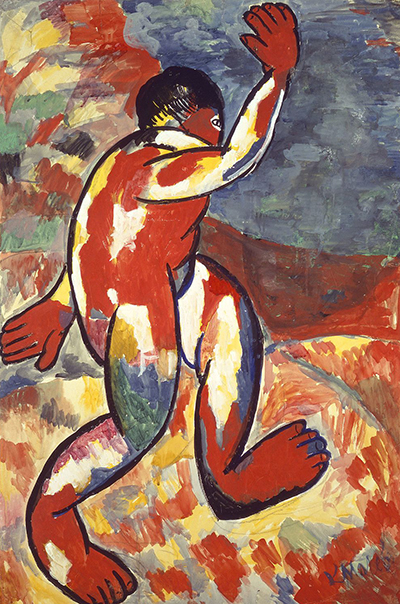
One large figure strides across a landscape of restless colour. Its raised hand and broad feet look too big for ordinary bodily proportions, and a thick dark outline makes the moving body stand out even where its reds, yellows and greens recur in the ground. Bather belongs to Kazimir Malevich's work of 1911, several years before the nonobjective squares for which he became famous. It shows how dramatically he could simplify a human body while keeping it recognizable. [1] [2]
The Stedelijk Museum in Amsterdam catalogues this object as Bader, translated as Bather, accession A 7653. It is a work on paper, described by the museum as gouache, pencil and crayon on paper. The National Gallery of Art's illustrated 1990 teaching packet also places Bather in the Stedelijk, though it describes the materials and measurements somewhat differently. Those differences are part of the documentary record, not grounds to treat the two accounts as different artworks. [1] [2]
At a Glance
- ArtistKazimir Malevich
- Museum titleBader (Bather)
- Date1911
- CollectionStedelijk Museum Amsterdam, A 7653
- Museum mediumGouache, pencil and crayon on paper
- Stedelijk dimensions110 × 74.4 × 4.6 cm, as displayed in the object record
- NGA descriptionCharcoal and gouache on paper, mounted on paper; 105 × 69 cm
Contents
- A figure built for movement
- Neo-primitivism and Malevich's early work
- Materials and measurements: why the records differ
- One figure and the space around it
A figure built for movement
The body twists as it advances. One arm reaches high, the other swings backward; bent legs and oversized feet make the stride seem both powerful and awkward. The figure is not a model of anatomy seen from one fixed viewpoint. Broad patches of red and orange mark the torso, while pale and yellow strokes interrupt the legs. The face is reduced to a few readable features. A heavy, uneven contour holds this simplified person together against the similarly active background. These are observations from the reproduction, not claims about the model's identity. [2]
The National Gallery of Art draws attention to the diagonal arrangement of arms and legs. That diagonal helps make a single pictured moment feel like continuing motion. Its teaching packet also notes faint charcoal alternatives near the calves and feet: evidence, in its account, that the apparently rough pose involved decisions and revisions. A small digital reproduction cannot make every such line equally visible, so the observation is best understood as the NGA's close reading of the original or a stronger image. [2]
Colour binds the person to the surrounding place. Reds, greens, yellows and grey-blue passages recur on both sides of the dark outline. The figure can be separated from the field at a glance, yet the marks in body and background seem made in a shared rhythm. The NGA compares this patchwork surface with Post-Impressionist approaches while treating the forceful simplification as Malevich's own experiment. Such comparisons describe visible technique; they do not establish that a particular French work was copied for this composition. [2]
Neo-primitivism and Malevich's early work
The Malevich Society places The Bather in the artist's neo-primitivist phase, emphasizing flat areas, emphatic outlines and deliberately rough-looking pigment. The term refers to a modern artist's use of forms associated with folk and vernacular art; it should be read as an art-historical label, not as a judgement that the work was naïve or unplanned. The NGA similarly calls this picture an example of Malevich's neo-primitivism. [2] [3]
The NGA also discusses connections with expressive colour and the French Post-Impressionist example. Malevich worked in an environment where artists were studying several recent approaches at once, and the same image can prompt more than one stylistic comparison. Calling Bather simply a “Fauvist painting,” as the older site copy did, loses both the work-on-paper medium and the specific neo-primitivist account in these sources. The artwork is more informative when its strong colour, simplified form and unusual movement are described directly. [1] [2] [3]
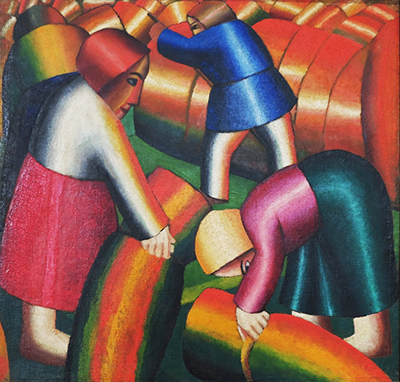
Compare Bather with Taking in the Rye, where Malevich likewise enlarges and simplifies human forms but turns to a rural group. Neither work is a Suprematist composition: the body remains a subject to be seen. In Black Square, exhibited in 1915, even that depicted body disappears. The comparison illustrates a change in pictorial language without suggesting that the later square was an inevitable goal already encoded in the 1911 bather. [2] [3]
Materials and measurements: why the records differ
The Stedelijk's current item data gives gouache, pencil and crayon on paper and 110 × 74.4 × 4.6 cm. The third dimension indicates that the museum's displayed measurement describes something with depth, but the available record does not spell out exactly how the work, mount and any frame are separated in that number. It would be unsafe to turn it into a 110 × 74.4 cm paper-sheet size without further documentation. [1]
The NGA packet gives charcoal and gouache on paper (mounted on paper), 105 × 69 cm. Gouache and paper appear in both descriptions, while the other listed drawing materials and dimensions differ. The NGA may have measured a different component or used earlier cataloguing, but neither explanation has been verified here. Readers comparing reproductions, catalogues and museum listings should preserve the source of each measurement rather than silently combining the figures. [1] [2]
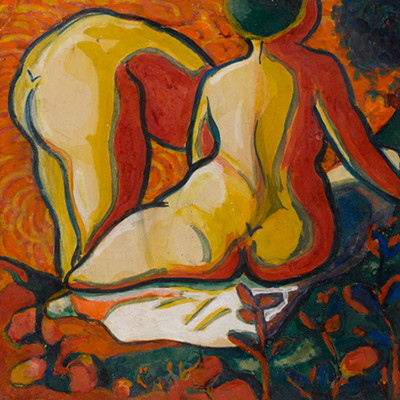
This is also why “painting” needs care. Gouache supplies opaque colour, and a viewer may reasonably call the result painterly. As an object, however, A 7653 is a large mixed-material work on paper. Its support is part of its identity. It should not be confused with an oil-on-canvas Bather inferred from the appearance of the reproduced colour, or with the site's separate Bathers Seen from Behind route. [1] [2]
One figure and the space around it
There is a noticeable distance between the loose edge of the landscape and the harder edge of the figure. The colour around the body gives us enough information to see a setting, but the figure’s broad gestures retain their own shape within it. The large foot and hand bring attention back to the silhouette whenever the eye begins to follow the ground. This balance helps explain why the figure can appear energetic even in a still image. The setting gives it room to move, while the outline gives the movement a direction. Compare the weight of the figure near the ground with the hand higher in the picture. The gesture gives the eye somewhere to continue after it has followed the larger shape of the torso. [1] [2]
The Stedelijk’s 2013 conservation supplement lists a Bather among work discussed by its paper conservation department. It uses the medium name gouache and gives 1910 in that list. The entry lacks an accession number and offers no account of how the year was chosen. Its title and material are useful context for the museum’s group of works on paper. The current accessioned item and the NGA’s illustrated record provide more precise evidence for the date of the figure discussed here. [1] [2] [4]
Frequently Asked Questions
When did Malevich make it?
Is Bather a painting or a drawing?
Why are the hands and feet so large?
Their exaggerated size strengthens the pose and its impression of movement. The NGA reads the raised and swinging arms, bent legs and large extremities together as a deliberately forceful, awkward figure. [2]
Why do the measurements disagree?
Discussion
Follow the raised arm, swinging arm and bent legs. Which shapes make the figure feel as if it is moving?
Look for colours repeated in the body and the ground. Does the outline fully separate them?
Reader Insights
Try tracing the figure's silhouette without looking at the interior marks. How does its pose change?
Compare the hands and feet with the torso. What does their size add to the action?
Notice how the paper work's strong gouache can look like a conventional painting in reproduction.
Join the Conversation
Share a close observation or a source-backed reading of this specific work.
References
- Stedelijk Museum Amsterdam, Bader (Bather), A 7653: owner object record for title, date, accession, present medium wording and displayed dimensions. View source.
- National Gallery of Art, Kazimir Malevich Teaching Packet (1990), PDF pp. 19–20: illustrated work entry, alternative medium and dimensions, analysis of pose, colour and surface. View source.
- Malevich Society, About the Artist: places The Bather in the 1911 neo-primitivist phase and describes its broad formal context. View source.
- Stedelijk Museum, 2013 Annual Report Supplements, Paper Conservation section: title-only Bather entry. View source.