


 by Tom Gurney
Tom Gurney BSc (Hons) is an art history expert with over 20 years experience
Published on June 19, 2020 / Updated on November 20, 2026
Email: tomgurney1@gmail.com / Phone: +44 7429 011000
Introduction
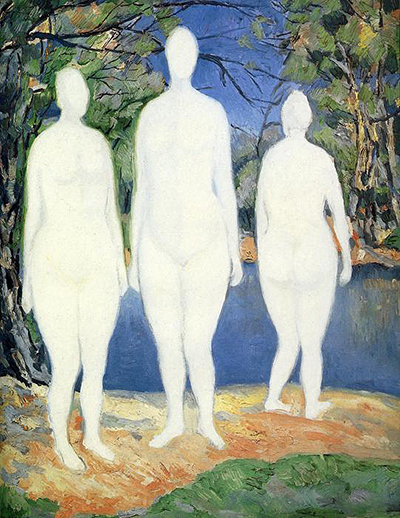
Three pale figures stand at the edge of a blue expanse, surrounded by trees and strongly coloured ground. Their faces and much of their bodies seem almost blank beside the more worked landscape. This is Kazimir Malevich's Bathers, also called Women Bathers. The State Russian Museum dates the canvas around 1930, a surprising fact because older reproductions often assign it the year 1908. The difference opens a central question of Malevich's late career: why make a picture that looks back to an earlier subject while giving it an earlier date? [1] [2]
The physical work is Russian Museum accession Ж-9481, oil on canvas, 59 × 48 centimetres. Art historian Marie E. Gasper-Hulvat identifies it as a circa-1930 painting inscribed 1908. The inscription is evidence of a date associated with the work; it does not establish that this canvas was painted in 1908. The museum's present circa-1930 cataloguing controls the date used throughout this page. [1] [2]
At a Glance
- ArtistKazimir Malevich
- Museum titleКупальщицы (Bathers)
- Also calledWomen Bathers
- Current museum dateCirca 1930
- Earlier inscription1908, as reported by Gasper-Hulvat
- MediumOil on canvas
- Dimensions59 × 48 cm
- CollectionState Russian Museum, Saint Petersburg, Ж-9481
Contents
- Looking closely at the three figures
- Why does a circa-1930 painting bear 1908?
- The bathing theme and the late figure
- One figure or three
Looking closely at the three figures
The tallest figure occupies the centre. A smaller bather stands on each side, close enough for the three bodies to form a single group. Their poses differ slightly, yet pale white surfaces make them rhyme visually. Dark foliage frames the figures, a blue area extends behind them, and warm red-orange ground lies below. The figures appear solid in outline but curiously empty in their interiors. These observations describe the reproduced painting, not an identified real location or three named sitters. [1] [2]
The contrast between figures and landscape is unusually sharp. Tree branches, foliage, water and earth carry varied strokes and stronger colour. The bodies interrupt that active environment as large light shapes. It is tempting to call them “unfinished,” as the older site copy did, but blankness can be a deliberate visual choice. The available museum record does not say Malevich abandoned the canvas, and no inspected technical study establishes that work stopped before a planned completion. The safest description is what a viewer can test: the bodies are much paler and less detailed than their setting. [1]
Their scale also matters. The centre bather is taller than the others and stands forward, but the three do not form a naturalistic portrait group. Their faces offer almost no personal information. They read as people in a landscape and as repeated vertical light forms at the same time. V. S. Turchin's art-historical account draws attention to the figures' pale presence in nature, while connecting the bathing subject to the longer tradition of Cézanne's bathers. That comparison is an interpretation of theme and form, not evidence that this exact canvas copied a specific Cézanne painting. [3]
Why does a circa-1930 painting bear 1908?
Malevich returned to figurative painting after his nonobjective Suprematist work. Several late canvases revisited earlier-looking subjects and carried dates that imply an earlier point in his career. Gasper-Hulvat examines this pattern as a construction of artistic history rather than a simple clerical error. She names Women Bathers Ж-9481 specifically: circa 1930, inscribed 1908. The date on the canvas and the date of making therefore have different roles and must not be flattened into one “1908 painting.” [2]
The distinction changes where the work sits in Malevich's career. In 1908 he was still experimenting with figurative subjects before Suprematism. Around 1930 he had already made the 1915 Black Square and the later near-white abstraction of White on White. A circa-1930 painting of bathers can be read in relation to those intervening experiments. Its bright landscape and pale bodies become a late engagement with older pictorial language, not merely an early step on a route toward abstraction. [1] [2]
What the inscription means is a further question. Gasper-Hulvat discusses Malevich's efforts to construct a chronology for his art, including late works carrying dates from much earlier years. Her argument supplies a scholarly framework for Ж-9481. It would overstate the evidence to claim the painting itself explains Malevich's private motive or that every earlier date on a late canvas served exactly the same purpose. The documented facts are the museum's circa-1930 date, the reported 1908 inscription and the work's place among other retrospectively dated paintings. [1] [2]
The bathing theme and the late figure
Bathing scenes had a long history in European painting before Malevich. Trees, water and groups of nude bodies could invite a viewer to read the landscape as a sheltered place apart from ordinary life. Turchin sees an affinity with Cézanne's treatment of bathers, while emphasizing that Malevich's figures have their own strange, almost phantom-like effect. The comparison helps describe how a traditional subject can become unfamiliar through colour, scale and reduced facial detail. [3]
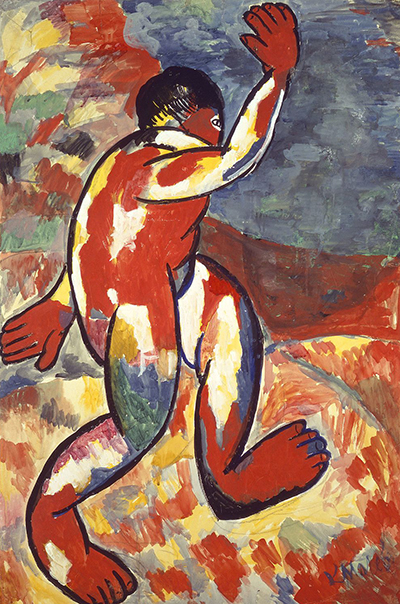
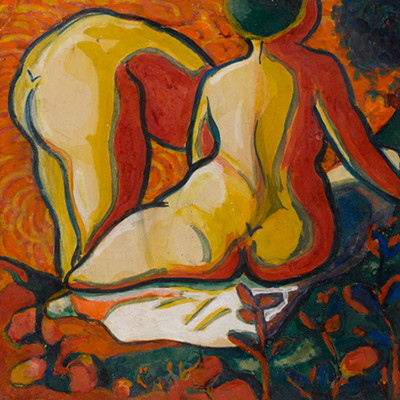
This painting should also be kept distinct from Malevich's Bather, a single moving figure from 1911 in the Stedelijk Museum. That earlier object is a large work on paper; Ж-9481 is a three-figure oil canvas catalogued circa 1930. The site's Bathers Seen from Behind route names another separate composition. Similar English titles do not make these works versions of the same physical object. [1] [2]
The Russian Museum records that Bathers entered from Malevich's heirs in 1936, with a later 1977 transfer involving the USSR Ministry of Culture. Those catalogue entries establish two points in the object's institutional history. They do not give a complete exhibition or ownership trail before the museum's present record, and they do not explain when the painting was first displayed. [1]
One figure or three
The Stedelijk’s separately catalogued Bather offers a way to see how the distribution of bodies changes the subject. Its 1911 figure is enlarged within a narrow field, so the eye settles quickly on the gesture of a single bather. In the later Russian Museum painting the viewer has to divide attention among three women. The intervals between them give each outline room to register. At the same time, the repeated bodies bring the parts of the scene together, letting the composition be read across its width. [1] [3] [4]
These arrangements make different demands of the land behind the figures. In the early work the landscape supports a dominant silhouette. In the later work, it can be followed through the gaps and around the group. This gives the small areas of open ground an important role in relating one body to the next. The contrast is also a reason to keep the 1908 inscription apart from the date of this particular canvas. A subject can recur over a career while its relationship to the surface, horizon and surrounding space changes considerably. [1] [2] [3] [4]
Frequently Asked Questions
Was Bathers painted in 1908 or around 1930?
Is the painting unfinished?
What is the work made of?
The Russian Museum catalogues Ж-9481 as oil on canvas, 59 × 48 cm. [1]
Is it the same work as Bather?
Discussion
Look first at the pale figures, then at the varied marks in the landscape. What changes when you move between them?
The museum dates the canvas around 1930, while a scholarly source reports a 1908 inscription. How does that difference change where you place the image in Malevich's career?
Reader Insights
Trace the outline of each bather. Which one appears closest to the viewer?
Compare the blue behind the bodies with the warmer ground below. How do those fields organize the scene?
Consider whether pale or unpainted-looking passages alone can tell us that a work is unfinished.
Join the Conversation
Share a close observation or a source-backed reading of this specific canvas.
References
- State Russian Museum, Women Bathers (Купальщицы), Ж-9481: owner record for current date, medium, dimensions, accession and collection-history notes. View source.
- Marie E. Gasper-Hulvat, Malevich's Post-Suprematist Paintings and the Construction of History (2012), PDF pp. 7, 14–17, fig. 3: identifies the circa-1930 Russian Museum painting as inscribed 1908 and explains retrospective dating in Malevich's late work. View source.
- V. S. Turchin, “Metamorphoses of Form in Malevich”: scholarly reading of the circa-1930 Bathers and its figure/landscape and bathing-theme context. View source.
- Stedelijk Museum, Bader, A 7653: separately accessioned single-figure comparison. View source.



