 by Tom Gurney
Tom Gurney BSc (Hons) is an art history expert with over 20 years experience
Published on June 19, 2020 / Updated on November 20, 2026
Email: tomgurney1@gmail.com / Phone: +44 7429 011000
Introduction
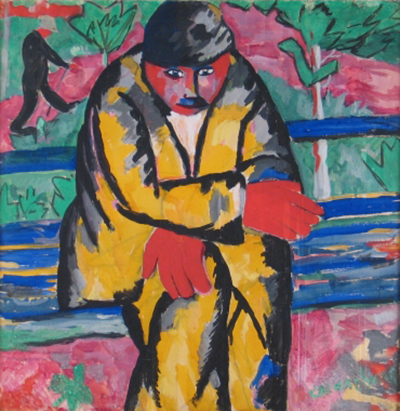
A man sits alone on a slatted bench, his yellow coat broad across the centre and a dark hat pressed over his red face. Behind him, green and red brushwork makes the park feel busy even though the figure barely moves. Kazimir Malevich's On the Boulevard is a picture of ordinary public life made emphatic through colour, heavy outlines and a deliberately awkward body. The Stedelijk Museum Amsterdam lists the work as Op de boulevard and dates it 1910. [1] [2]
This is the Stedelijk gouache, identified in later scholarship as A 7650. It is easy to mix up with another Malevich painting also called On the Boulevard: a 1903 oil canvas in the Russian Museum, showing several people along a receding park path. The image on this page is the seated-man composition, not that earlier scene. [1] [2] [3] [5]
At a Glance
- ArtistKazimir Malevich
- Museum titleOp de boulevard
- English titleOn the Boulevard
- Date used here1910, Stedelijk object page and museum conservation report
- Alternative scholarly date1911, in Gasper-Hulvat and Howard
- MediumGouache, Stedelijk 2013 report
- Exact supportNot stated on the current Stedelijk object page or in its 2013 report; Howard's older thesis says paper
- Object numberStedelijk A 7650, directly confirmed by the current item page
- Dimensions72 × 71 cm, current Stedelijk object page and Howard's earlier thesis
Contents
- A single figure in public space
- Gouache and the date question
- Two works called On the Boulevard
- Where it sits in Malevich's work
- The bench and the space around it
A single figure in public space
The bench gives this image its strongest horizontal: blue and green slats extend under and behind the man's body. His hat, coat and reddish face stand out against the darker figure or shape at the left and the broken reds and greens around him. There is enough setting to suggest a boulevard or park, but little of the street, trees or architecture is drawn precisely. The work asks us to notice the sitter and the way paint organises him, rather than identify a particular city corner. [1] [6]
The man's yellow coat takes up so much of the image that it nearly becomes an abstract patch. A dark contour separates it from the bench, while short strokes and uneven boundaries keep it from looking smoothly modelled. His arms and legs seem compressed into the seated position. The colour of his face pulls the eye upward, but its features are simplified. This is an observation about the reproduction; neither the museum listing nor the conservation report names a sitter or offers a biographical story about him. [1] [2]
Look at the relationship between the bench and body. The slats read as an object in space, yet the bright coat and surrounding colour interrupt any calm illusion of depth. The left-hand dark form, the red ground and the green strokes all compete for attention. The picture is figurative, but Malevich lets colour and outline do much of the work that detailed perspective and anatomy would normally do. [1] [6]
Gouache and the date question
The Stedelijk's 2013 paper-conservation report names On the Boulevard as gouache, 1910. This is more precise evidence for the paint than the site's inherited phrase “gouache and charcoal on paper.” The report's one-line entry does not specify support or charcoal, and the current item page categorises the work among “Drawings” without supplying a full technical description. A listing category is not, by itself, a material analysis. [1] [2]
Two scholarly sources have used 1911 for the Stedelijk work. Marie E. Gasper-Hulvat explicitly cites On the Boulevard as Stedelijk A-7650, describes the seated figure on a park bench and gives 1911. Jeremy Howard's earlier thesis also lists a 1911 Stedelijk gouache, adding “on paper” and 72 × 71 cm. The current Stedelijk object page independently confirms A 7650 and 72 × 71 cm but gives 1910, as does its 2013 report. This page follows the museum date while preserving the scholarly disagreement. The evidence reviewed here does not explain why the dates diverge. [1] [2] [3] [4]
Howard's description is a useful historical catalogue reference. Its dimensions are now corroborated by the museum's directly viewed object page; its claim of paper support remains unconfirmed by the museum text. The museum also credits this object as owned under its 2008 agreement with the Malevich estate, distinct from Khardzhiev Foundation loans on nearby Malevich pages. [1] [4]
Two works called On the Boulevard
The National Gallery of Art's 1990 teaching packet describes a 1903 On the Boulevard owned by the State Russian Museum: an oil canvas, 56 × 66 cm, with women and other figures in a park, trees and a path leading into the distance. That is a different image and a different object from the lone sitter shown here. Descriptions of the 1903 work's impressionist space, park path and several leisure figures cannot be used to explain the Stedelijk gouache. [5]
This collision is a practical reason to check title, image, museum and material together. An English title alone could lead a reader to the wrong date or the wrong painting. On this page, the yellow-coated seated man identifies the Stedelijk work; the multiple-figure park scene identifies the Russian Museum work. [1] [2] [5] [6]
Gasper-Hulvat also compares the Stedelijk composition with a later Russian Museum painting numbered Ж-9462 that contains a figure on a bench. She says the correspondences are less exact than some other early and late pairings. This is a scholarly comparison of motifs, not evidence that the two paintings are identical or that the later work is a direct copy. [3]
Where it sits in Malevich's work
The Stedelijk gouache belongs to a period in which Malevich still worked with recognisable people and places while testing how far colour and simplified form could reshape them. The figure is blunt, the colour heightened, and the scene is compact. Its subject remains legible, but the act of looking moves between identifying a seated man and following the painted patches. [1] [2] [6]
That tension helps a viewer approach Malevich's later, more radically reduced work without treating this picture as a mere prelude. The bench, coat and face are chosen shapes with their own visual force. The painting's value is in this specific encounter between an everyday subject and a forceful way of painting it. Its link to later abstraction is an interpretive comparison, not proof of a documented plan for Black Square. [1] [2]
The bench and the space around it
A seated figure gives a street scene a useful contrast of directions. The bench supplies a long edge, while the sitter’s bent legs and upright body make a compact group across it. Looking along the bench first leads from one side of the picture to the other. Looking first at the person leads instead through the head, shoulders and legs. These two paths meet in the part of the picture where the body makes contact with the seat. That point of contact matters in a composition in which the surroundings give few clues about a particular location. [1] [4] [6]
The earlier oil discussed in the NGA packet gives the same title to a different account of a public place. The later gouache makes the relation between the bench and sitter much more prominent. A reader who follows only the English title could mistake a catalogue’s reference to the oil for a record of the later work. Looking first for the seat and the concentrated figure, then checking the collection and medium, offers a firmer way of telling which picture a source describes. [1] [4] [5]
Frequently Asked Questions
When did Malevich make this work?
What is it made of?
Is it the 1903 painting in the Russian Museum?
Does the painting show a known person?
Discussion
Which parts of the man and bench do you recognise first, and which resolve only after you notice the title?
How does the yellow coat change the balance of the reds, greens and blues around the figure?
Reader Insights
Trace the bench slats through the figure. Where do they give the strongest sense of space?
Compare the sitter's face with the larger patch of his coat: how much detail does each need?
When comparing sources, keep the 1910 Stedelijk gouache separate from the 1903 Russian Museum oil painting.
Join the Conversation
Share a close observation or an object-specific source for this seated-man work.
References
- Stedelijk Museum Amsterdam, Op de boulevard, A 7650: directly viewed object page, 1910 date, 72 × 71 cm dimensions, Drawings browse category and 2008 estate-agreement ownership credit. Reviewed on 30 September 2026; no material or support specified on the item page. View source.
- Stedelijk Museum Amsterdam, Supplements Annual Report 2013, PDF p. 53: paper-conservation entry naming On the Boulevard, gouache, 1910. View source.
- Marie E. Gasper-Hulvat, Malevich's Post-Suprematist Paintings and the Construction of History, 2012, PDF p. 178, n. 303: Stedelijk A-7650, 1911 and bench-figure comparison. View source.
- Jeremy Howard, PhD thesis, plate 5.18: Stedelijk On the Boulevard, 1911, gouache on paper, 72 × 71 cm. View source.
- National Gallery of Art, Kazimir Malevich teaching packet, PDF p. 12: distinct 1903 Russian Museum oil painting with the same English title. View source.
- Wikimedia Commons, On the Boulevard (Kazimir Malevich, 1911).jpg: picture comparison linking its own reproduction to the Stedelijk object, not evidence for this site's JPEG rights. View source.