 by Tom Gurney
Tom Gurney BSc (Hons) is an art history expert with over 20 years experience
Published on June 19, 2020 / Updated on November 20, 2026
Email: tomgurney1@gmail.com / Phone: +44 7429 011000
Introduction
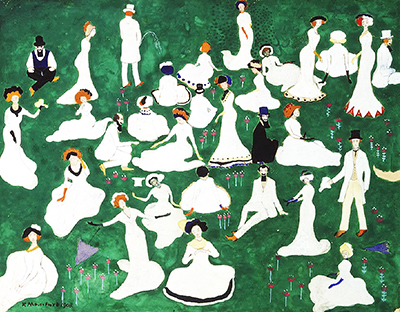
Figures in white dresses and suits rest, stand and stroll across a dark green lawn. A few black top hats punctuate the pale crowd. The saved image on the site's `/party/` route matches the State Russian Museum's 1908 work Relaxing (Society in Top Hats), accession Ж-9403. The museum records it on paper, with watercolour, gouache, ink and white pigment, measuring 23.8 × 30.2 cm. [1]
The museum's title changes how this picture is described. “Party” is a broad website label, but Relaxing directs attention to the scattered, seated and reclining figures. The museum also offers a curatorial reading of the scene as a parody of an idyllic garden gathering. That reading is attributed here, rather than presented as a literal caption for every figure. [1]
At a Glance
- ArtistKazimir Malevich
- Museum titleRelaxing (Society in Top Hats); also rendered Rest (Society in Top Hats)
- Website route`/kazimir-malevich/party/`
- Date1908
- MaterialPaper; watercolour, gouache, ink and white pigment
- Dimensions23.8 × 30.2 cm
- CollectionState Russian Museum, St Petersburg
- InventoryЖ-9403
- Recorded acquisitionFrom the artist's heirs in 1936; subsequent 1977 transfer noted by the museum
Contents
- What does the scene show?
- The museum's comic reading
- What materials are recorded?
- How does it relate to Malevich's early work?
- Collection history and limits
- How the small figures hold the scene together
What does the scene show?
The composition is a horizontal field of green. White-clad people are distributed across it without a single central table or building. Some stand near the top, others recline or sit in the middle and foreground. Their pale clothes become a pattern of separate shapes against the grass. Dark hats and black suits are much fewer, so they stand out even at small reproduction size. [1]
Small red, white and pink marks between the figures suggest flowers or garden decoration. The people vary in scale and pose. One can trace small groups, pairs and solitary bodies, yet the work does not read as a posed group portrait. It offers a social scene through repeated gestures and costumes. [1]
The picture's lower edge cuts some figures close to the frame. Near the centre, a reclining white form creates a long diagonal. Upright men and women above it answer with verticals. This mixture makes the lawn feel both open and full of activity. A viewer may call it a party, picnic or park gathering, but the source-backed object name is Relaxing (Society in Top Hats). [1]
The museum's comic reading
The Russian Museum describes an apparently idyllic, pleasurable scene and then points to a man urinating, a detail it reads as a humorous disruption. Its curatorial text interprets the work as a response to a famous painting by Édouard Manet. The museum does not name that Manet work in the online passage checked here, so this page does not supply a specific title as established fact. [1]
This interpretation helps explain why the work may feel more complicated than a cheerful white-and-green decoration. A tiny comic action interrupts the apparent elegance. It is still a reading offered by the owner, not an instruction that every viewer must see the scene as satire. The visual arrangement, the title and the museum's explanation can be considered together. [1]
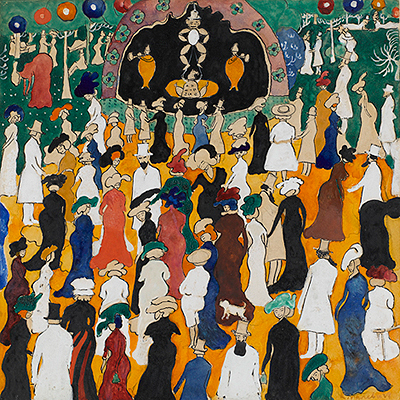
The central curatorial point should also stay with this exact object. Gallant Company in a Park is a separate Stedelijk work of roughly the same year with a much denser crowd around a dark feature. The Russian Museum's Manet and comic-detail remarks do not document that Stedelijk picture. [1] [2]
What materials are recorded?
The owner lists paper, watercolour, gouache, ink and white pigment. That combination is more specific than calling the image simply “a painting” or “an oil canvas.” Water-based colour and opaque white could create light forms over the green field, while ink provides strong dark accents; the digital photograph alone cannot establish the exact sequence or placement of each material. [1]
The work measures 23.8 × 30.2 cm. This is a relatively small horizontal sheet, even though its many people can fill a screen. The recorded format helps explain why figures are simplified and why colour contrasts carry so much of the scene. Material and dimensions here come from the accessioned museum record, not from visual inference. [1]
How does it relate to Malevich's early work?
The 1908 date places this work within Malevich's early figurative period, well before the 1915 public introduction of Suprematism. It depicts people, costume and setting, while also relying on a strong overall pattern of white shapes against green. That pattern can be compared with his later interest in organizing the picture plane, but it does not prove that this garden image was intended as a direct precursor to Black Square. [1] [3]
The Stedelijk's Gallant Company in a Park is a useful same-period comparison. Its near-square crowd fills almost every part of the field; Relaxing uses open green as an active space between its figures. These are two distinct visual solutions to social leisure, not two titles for the same physical work. [1] [2]
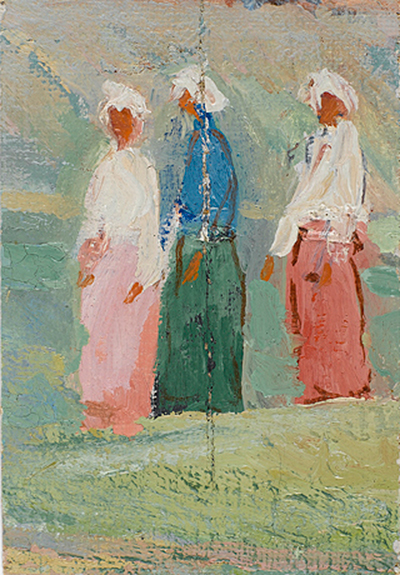
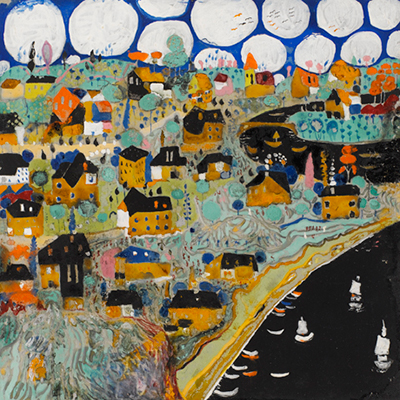
Little Village and Three Female Figures show other early uses of small surfaces and patterned colour. Their collection records supply separate dates, dimensions and media limits. Reading them alongside Relaxing can expand the picture of Malevich's early practice without merging unrelated objects. [1] [4] [5]
Collection history and limits
The Russian Museum records receipt from Malevich's heirs in 1936 and notes a 1977 transfer in its catalogue entry. Those are concrete collection-history points, not a complete provenance for the preceding 28 years. The checked object page does not establish a current gallery room or on-view status. [1]
The Russian Museum's own English page calls the work Relaxing (Society in Top Hats). Other publications use Rest (Society in Top Hats) or similar translations. The inherited short URL `/party/` and page heading remain useful for existing links; the image caption, opening and fact table give the museum title. [1] [6]
How the small figures hold the scene together
In a horizontal picture with many people, a viewer might expect one group to dominate the action. Here the white garments make it just as easy to read across the grass as to stop at an individual. The different sizes and poses give that movement several rhythms. Larger figures stay prominent near the foreground, and small upright figures farther back can feel almost like interruptions in the green. A dark hat or suit helps a viewer find a particular person again after following the paler marks across a larger area. [1]
This gives the detail discussed by the Russian Museum a peculiar place in the picture. It can at first disappear into the same pattern as the other activities on the lawn. Once the viewer has located it, it becomes easier to see the gathering as a collection of separate actions, even though many of the figures retain the appearance of an elegant outing. The work can sustain that change of attention because the visible pattern is strong enough to survive a very different interpretation of one figure. [1] [2]
Frequently Asked Questions
Is this the work previously called Party here?
Yes. The saved image on the `/party/` route matches Russian Museum Ж-9403. “Party” remains the inherited route name; Relaxing (Society in Top Hats) is the owner title. [1]
When was it made?
The Russian Museum dates it to 1908. [1]
Is it an oil painting on canvas?
No. The owner specifies paper, watercolour, gouache, ink and white pigment. [1]
What is the joke the museum describes?
Its curatorial text identifies a urinating man as a detail that undercuts the first impression of an idyllic gathering. This is the museum's interpretation of the image. [1]
Where is it held?
The State Russian Museum records it as Ж-9403. Current gallery display is not verified here. [1]
Discussion
How are the people arranged across the scene?
Which colours and shapes make this gathering distinct from the other 1908 work?
Reader Insights
Locate the strongest dark and pale contrasts.
Compare the open lawn with the densely packed crowd in the related article.
Why does the accession number matter when two works share a social subject?
Join the Conversation
Share a close observation or source-backed detail about object Ж-9403.
References
- State Russian Museum, Relaxing (Society in Top Hats), Ж-9403: illustrated owner record with 1908 date, materials, dimensions, accession, collection history and curatorial interpretation. View source.
- Stedelijk Museum Amsterdam, Gallant Company in a Park, 4.2001(165): distinct 1908 social scene. View source.
- The Museum of Modern Art, The Russian Avant-Garde Book, 1910–1934 exhibition brochure: broader chronology for Malevich's 1915 public introduction of Suprematism. View source.
- Stedelijk Museum Amsterdam, Little Village, 4.2001(168): separate 1908 small-format comparison. View source.
- Stedelijk Museum Amsterdam, Three Female Figures, 4.2001(092): separate circa-1905–06 comparison. View source.
- Malevich Society, artist overview: contextual use of the translated title Relaxing: High Society in Top Hats; the Russian Museum remains the object authority. View source.