


 by Tom Gurney
Tom Gurney BSc (Hons) is an art history expert with over 20 years experience
Published on June 19, 2020 / Updated on November 20, 2026
Email: tomgurney1@gmail.com / Phone: +44 7429 011000
Introduction
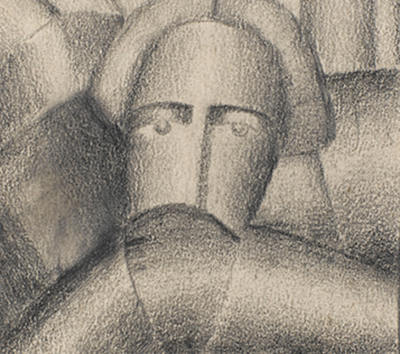
A face fills almost the entire image. Its rounded cap, dark brows, narrow nose and half-hidden mouth are built from closely worked tones rather than bright colour. Malevich’s small Head of a Peasant is easy to overlook beside his later monumental squares and figures, yet its compact scale asks for unusually close looking. The picture shown here matches the Stedelijk Museum Amsterdam’s Bubnovy valet 8. Kop van een boer, accession 4.2001(091). [1]
The museum dates the work 1912, measures it at 9.1 × 10 cm and credits it as a loan from the Khardzhiev Foundation. Its English translated title is Bubnovy Valet 8. Head of a Peasant. The item sits in the museum’s “Drawings” collection category, but the public page does not name the actual medium or support. Neither “charcoal” nor “graphite” should be silently supplied from the tonal appearance of this small reproduction. [1]
At a Glance
- ArtistKazimir Malevich
- Museum titleBubnovy valet 8. Kop van een boer
- English titleBubnovy Valet 8. Head of a Peasant
- Date1912
- Dimensions9.1 × 10 cm
- Object numberStedelijk 4.2001(091)
- CreditKhardzhiev Foundation loan
- Exact mediumNot stated on the museum item page
Contents
- The small peasant head
- The title and Jack of Diamonds
- A crop is not a cut sheet
- Looking at the early work
- The head and the still life
The small peasant head
The face is composed with a remarkable economy of contour. The cap follows a high curve around the forehead. Two eyes sit beneath a heavy horizontal brow, while a straight line of the nose divides the face. Across the lower part, broad, soft-looking forms interrupt the mouth and chin. These are visual observations; the museum’s short public record does not identify a sitter, a scene or the surrounding forms. [1]
Dense marks make the face feel sculptural. Highlights across the nose and lower forms seem to come forward, whereas the background at either side recedes into shadow. The dark shapes behind the head remain ambiguous in the cropped copy. It is tempting to call them bodies or limbs, but the evidence in this reproduction does not establish their identity. The central face is clear enough without turning every neighbouring mark into a narrative. [1]
At only about ten centimetres across, the work operates differently from a large exhibition canvas. Its contrasts need to be resolved at close range. Enlarging the low-resolution file on a screen makes the marks more visible but does not make it a high-resolution study or reveal a material that the museum has not specified. The scale belongs to the physical museum object; the pixels belong to this particular reproduction. [1]
The title and Jack of Diamonds
Bubnovy Valet is usually rendered in English as Jack of Diamonds. The State Russian Museum describes a Moscow exhibition held from December 1910 to January 1911 under that name and a subsequent artists’ association. Malevich was among the participants in the first exhibition. The name belongs to a specific avant-garde history; it is not another name for every Russian modernist artist. [2] [3]
That history helps explain why the name appears in the Stedelijk’s title. It does not prove that this individual 1912 sheet was on view at the first 1910–11 exhibition. The Russian Museum’s contextual account discusses many artists and objects; its separate record for Malevich’s Still Life identifies one of his works in the first exhibition. Neither page is an exhibition provenance for Stedelijk 4.2001(091). [1] [2] [3]
The numeral 8 is part of the Stedelijk’s catalogued title. It may invite questions about a sequence or publication, but the accessible object page does not explain what the number denotes. This article retains the museum’s wording rather than inventing a numbered series or a particular printed edition. [1]
A crop is not a cut sheet
The Stedelijk’s online image includes a pale margin around the dark rectangular design. The older image on this site is cropped more tightly. That difference is visible when the two reproductions are compared, but it is a difference between digital files. It does not demonstrate that Malevich physically cut down the original sheet or that a larger scene once surrounded this head. [1]
This distinction also limits interpretation of the shapes at the picture’s edges. Some marks continue toward the boundary of the image; in the tighter crop they can look abruptly stopped. The museum reproduction supplies more surrounding paper, yet it still does not turn those shapes into identifiable people. The strongest supported description is a head against densely marked, uncertain forms. [1]
Looking at the early work
Malevich’s career did not move in a straight line from one kind of image to another. Around 1910–12 he participated in experimental exhibitions while still making recognisable still lifes and figures. The Russian Museum’s Still Life record demonstrates his participation in the early Jack of Diamonds moment, but it is a different work, with its own date, dimensions and tempera-on-paper medium. Those facts must stay with that museum object. [2] [3]
This peasant head offers a different visual task from the later Suprematist paintings. We search its marks for a person, then notice how strongly the face is built from dark and light areas. That observation need not turn the little image into a prediction of Black Square. It gives the work its own place in a broad and changing practice: a close study of a face, with its material still awaiting an accession-specific source. [1] [3]
The head and the still life
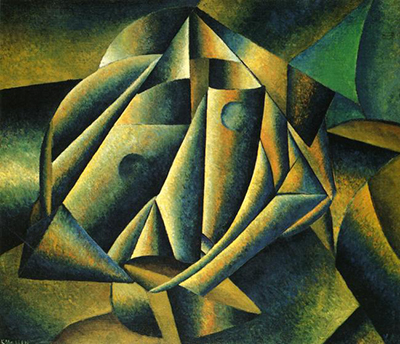
The Russian Museum’s still life offers a concrete comparison with the small Stedelijk head. In the still life, heavy contours gather fruit around a footed white vessel. The museum singles out the flattened volumes and the vigour of the colour. In the small head, the enclosed shape also holds the viewer’s eye, but the changes in tone occur over a much shorter span. Looking at the two together makes scale part of the comparison. The still life has room to spread its contours over the full width of an arrangement. The sheet makes the relation of face and background the immediate problem. [1] [3]
The Russian Museum links the vessel in its still life to Cézanne, a specific comparison grounded in an identifiable motif. A reader can trace that example without using it as a source for the head. Here the most direct evidence remains the museum photograph of the small object. The pale margin in that photograph gives the darker area around the face a second boundary. In the tighter reproduction, the dark area comes closer to the edge of the image, and the face seems to fill more of the available space. The scale in the museum record restores something the photograph alone can obscure. [1] [3]
The exhibition history works in a similar way. The Russian Museum identifies the still life among the three works Malevich showed at the first Jack of Diamonds exhibition in December 1910. That mention connects a particular object to the event. The Stedelijk date places the sheet in 1912, and its title carries the group’s name. The remaining question for the sheet is whether an exhibition list or another object-specific record can place it in a particular later presentation. [1] [2] [3]
Frequently Asked Questions
What does Bubnovy Valet mean?
Was this sheet at the first Jack of Diamonds exhibition?
What is the medium?
The Stedelijk lists the object under “Drawings” but does not specify a material or support on its public page. A more precise medium needs an accession-specific catalogue or conservation source. [1]
How large is it?
The Stedelijk gives 9.1 × 10 cm. The older site JPEG is 400 × 354 pixels and cropped more tightly than the museum’s reproduced sheet. [1]
Discussion
Which marks define the face most clearly at this very small scale?
Which surrounding marks stay ambiguous when you look closely?
Reader Insights
Follow the long central line of the nose and the curve of the cap.
Compare the dark brows with the softly toned lower face.
Keep this 1912 Stedelijk sheet distinct from the Russian Museum still life shown in the 1910–11 exhibition.
Join the Conversation
Share a close observation or a source specific to Stedelijk 4.2001(091).
References
- Stedelijk Museum Amsterdam, Bubnovy valet 8. Kop van een boer: Illustrated object 4.2001(091), 1912, 9.1 × 10 cm, translated title and Khardzhiev Foundation loan credit; item reviewed 30 September 2026. Exact medium and support are not stated. View source.
- State Russian Museum, “Jack of Diamonds” collection context: The 1910–11 exhibition, later artists’ association and Malevich’s participation in the first exhibition; not a record of this individual Stedelijk sheet. View source.
- State Russian Museum, Malevich, Still Life, Р-8176: A different c.1910 work whose owner record documents Malevich’s participation in the first Jack of Diamonds exhibition; its medium and provenance do not apply to 4.2001(091). View source.



