 by Tom Gurney
Tom Gurney BSc (Hons) is an art history expert with over 20 years experience
Published on June 19, 2020 / Updated on November 20, 2026
Email: tomgurney1@gmail.com / Phone: +44 7429 011000
Introduction
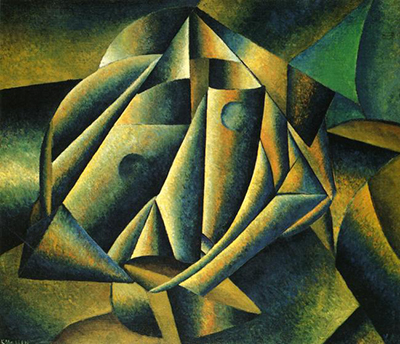
In Head of a Peasant Girl, a face is both present and difficult to hold together. Broad green, yellow and ochre planes meet rounded and sharply angled forms. The head is visible, but its features seem assembled from pieces that can also be read as independent shapes. The result asks the viewer to alternate between recognizing a person and studying how the painted parts fit. [1]
The Stedelijk Museum Amsterdam lists the work as Kop van een boerenmeisje, dates it 1912 and identifies it as A 7673. Princeton University Art Museum also identifies the painting as a 1912 Stedelijk work when discussing a later print based on it. These matching object and publication clues make the page more precise than a title alone could. The current accessible Stedelijk item does not give material or dimensions, so those details are not supplied here as settled facts. [1] [2]
At a Glance
- ArtistKazimir Malevich
- Museum titleKop van een boerenmeisje
- English titleHead of a Peasant Girl
- Date1912 in the Stedelijk record
- CollectionStedelijk Museum Amsterdam
- Object numberA 7673
- Material and sizeNot stated in the accessible current museum item
Contents
- How to look at the head
- A painting before Suprematism
- From painting to printed cover
- What the records establish
- What changes when a painted head becomes a cover?
How to look at the head
Begin with the large coloured areas before trying to identify every feature. A green plane, a curved yellowish passage and several brown shapes establish an uneven rhythm across the surface. The face is suggested by their arrangement, not enclosed by a smooth, continuous contour. One shape can appear to belong to a cheek in one reading and to the pattern of the picture in another. That shifting relation is part of the painting's visual force. [1]
The portrait format implies an individual, yet the museum title does not identify a sitter. “Peasant girl” supplies a social type, not a biography. It would be misleading to invent a name, pose, setting or story from this abstracted face. The title and the image are enough to discuss how Malevich kept a human subject present while breaking its familiar forms into coloured units. [1]
The colours are comparatively restricted. That makes the edges, overlaps and changes of direction more conspicuous. A curved passage may seem to turn away from the viewer; a flat coloured patch then pulls attention back to the painted surface. The tension between imagined volume and arranged planes gives the head more movement than a simple geometric diagram would have. This is a close reading of the reproduction, not a claim about the artist's private intention. [1]
A painting before Suprematism
The 1912 date places this image in Malevich's experiments with a recognisable subject before the radically reduced works of 1915. The face and title still matter. They allow the viewer to test whether the fragments form a head even when no single contour holds it in place. That makes the painting a useful route into his changing use of geometry without describing it as a Suprematist composition. [1] [4]
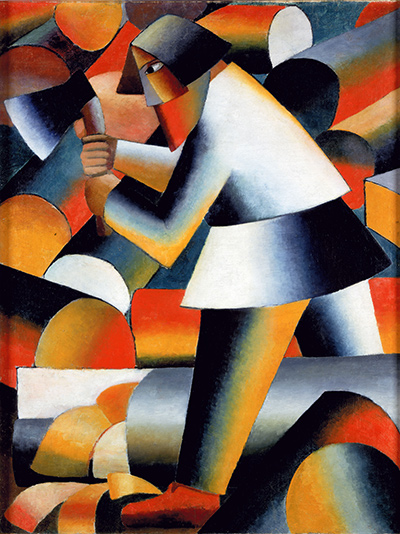
Compare the later Black Square. That canvas makes a single dark form and the surrounding light field its central event. Head of a Peasant Girl offers no equivalent single figure-ground division. Its shifting planes still repeatedly return the eye to a person. The comparison is about what the pictures make visible; it does not imply that one was merely a preparatory sketch for the other. [1] [4]
The picture is sometimes grouped under Cubo-Futurist discussions of Malevich's early work. Such a label can help orient a reader to the period, but it should not replace looking. The specific effect here is the coexistence of a human head, broken contours and an active pattern of coloured surfaces. Neither the museum entry nor the other consulted object sources provides a detailed interpretation of each plane. [1]
From painting to printed cover
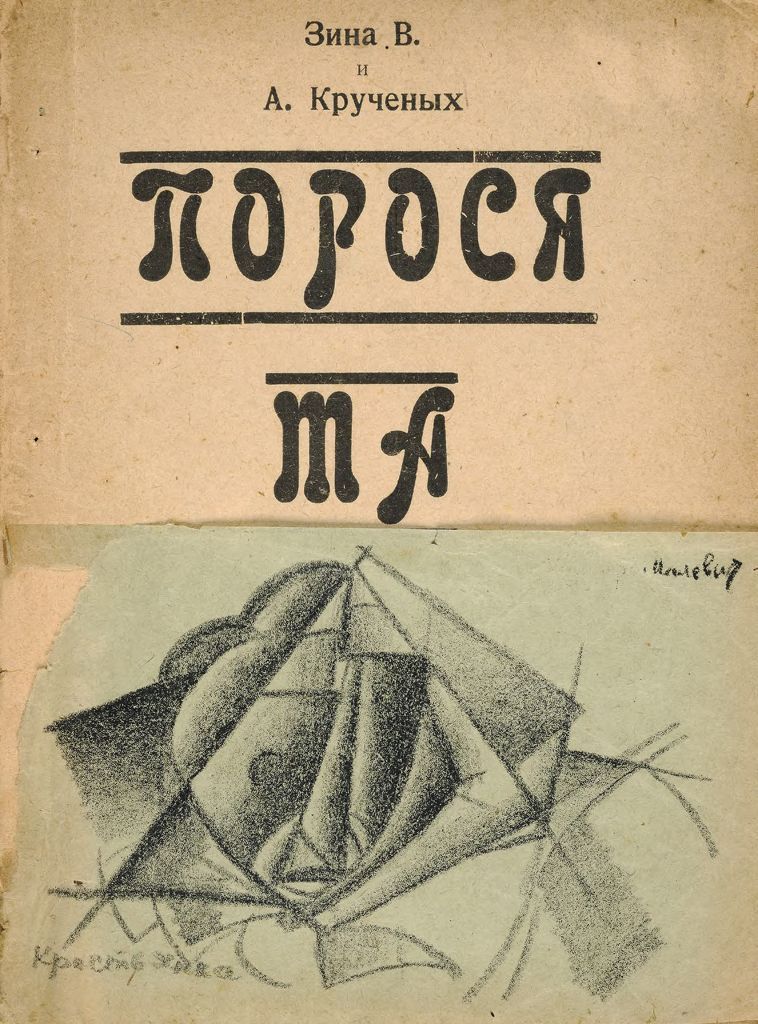
The painting had a documented second life in print. Princeton University Art Museum holds or describes the 1913 booklet Porosiata, made by Alexsei Kruchenykh and Malevich. Princeton says Malevich's cover illustration is a lithograph after his 1912 painting Head of a Peasant Girl, now at the Stedelijk. It calls that cover his first known print. That statement links the two works while keeping their media and identities separate. [2]
The print context matters because Russian avant-garde artists used inexpensive books and collaborative publications as sites of experiment. Princeton describes Porosiata in that context. A painted head could therefore travel into a small, reproducible format and reach readers who would not encounter the canvas itself. The publication does not turn the painting into an illustration made solely for the booklet: Princeton's description specifically says the cover was made after the earlier painting. [2]
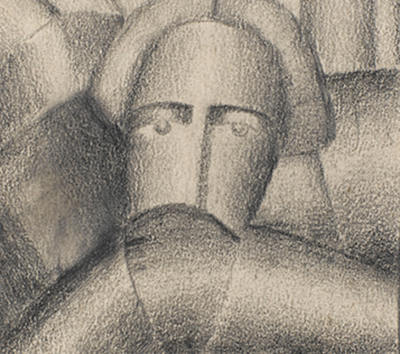
The names are easy to confuse. The Stedelijk also catalogues a much smaller work titled Kop van een boerenvrouw—“Head of a Peasant Woman”—under accession 4.2001(025) and a 1913 date. It is a separate drawing, not A 7673. Its dimensions and any material recorded for it cannot be imported into this painting's facts. The English words “girl,” “woman” and “peasant” are too broad to establish object identity on their own. [1] [3]
What the records establish
The most secure identification is the Stedelijk accession A 7673 together with its title and date. Princeton independently connects the 1912 Stedelijk painting to the 1913 lithographic cover. A Stedelijk annual report lists Head of a Peasant Girl among paintings involved in collection research or treatment, reinforcing that the painting is an object distinct from the similarly titled drawing. [1] [2] [5]
The accessible online record does not disclose a measurement, support or full acquisition history for A 7673. Published reproductions and older catalogues may supply additional figures, but they should be reconciled against the actual museum object before being printed as definitive. This page uses the facts the consulted institutions establish, leaving open the questions they do not answer. [1] [5]
What changes when a painted head becomes a cover?
Princeton’s object entry gives this image a second setting: a booklet produced in Saint Petersburg in 1913. The museum describes the lithographed cover as Malevich’s first known print. A cover is encountered before the pages inside it, so the image has a place in the order in which a reader meets text and illustration. The painting in Amsterdam can be looked at on its own. On the booklet the head becomes part of an object that can be held, turned and read. That change matters even where viewers readily recognize the surviving motif. [1] [2]
The Princeton record also explains that Malevich and the poet Aleksei Kruchenykh worked together on several projects. The booklet belongs to that documented collaboration, and Princeton notes that its text credits an eleven-year-old coauthor, Zina V. These details explain why the face on the cover belongs to a different context from the image suggested by the painting’s title. That title points towards a figure represented within the painting. The book record identifies collaborators and a publication, while the sitter’s name remains open. [1] [2]
Frequently Asked Questions
Where is the painting?
It is catalogued by the Stedelijk Museum Amsterdam as A 7673. A collection record establishes the holding, not whether it is on view on a particular day. [1]
When was it made?
Who is the girl in the title?
The consulted object records do not identify a named sitter. The title describes a peasant girl; the image supplies a faceted head rather than biographical evidence. [1]
Is the Porosiata cover the original painting?
No. Princeton describes the 1913 cover as a lithograph after the 1912 Stedelijk painting. The cover and canvas are different objects. [2]
Is this the same as Head of a Peasant Woman?
Discussion
Which shape first makes the face recognizable to you?
Where does the painted head become a pattern of separate planes?
Reader Insights
The Stedelijk identifies this 1912 painting as A 7673.
Princeton identifies a 1913 booklet cover lithograph made after this painting.
A similarly titled 1913 Stedelijk drawing is a separate object.
Join the Conversation
Share a close observation or an object-specific source for Stedelijk A 7673.
References
- Stedelijk Museum Amsterdam, Kop van een boerenmeisje, A 7673: owner record for title, 1912 date and accession; accessible item omits material and size. View source.
- Princeton University Art Museum, Porosiata, L.2013.6.8: object entry identifying the 1913 lithograph after the 1912 Stedelijk painting and its book context. View source.
- Stedelijk Museum Amsterdam, Kop van een boerenvrouw, 4.2001(025): distinct 1913 drawing with a similar title. View source.
- State Tretyakov Gallery, Black Suprematist Square (1915): separate later work used for formal comparison. View source.
- Stedelijk Museum Amsterdam, annual report supplement 2013: includes Head of a Peasant Girl, 1912 in the painting research/treatment listing. View source.