 by Tom Gurney
Tom Gurney BSc (Hons) is an art history expert with over 20 years experience
Published on June 19, 2020 / Updated on November 20, 2026
Email: tomgurney1@gmail.com / Phone: +44 7429 011000
Introduction
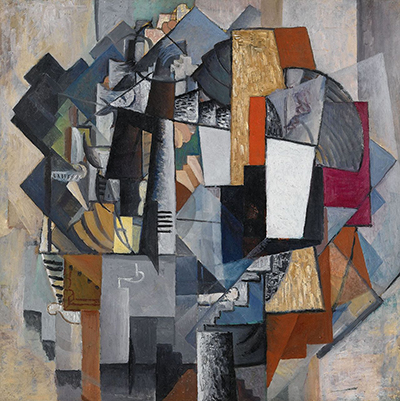
Kazimir Malevich's Desk and Room gathers angled, overlapping planes into a square canvas. A pale shape opens on the right, while blue-grey fragments and warm ochre passages press across the centre. The painting is dated 1913, and Gagosian's record for its 2011 exhibition gives its medium as oil on canvas and its dimensions as 79.5 × 79.5 cm. The site's older title, Bureau and Room, refers to this same work; Desk and Room is the title used by the later exhibition and restitution records. [1] [2]
The painting also has a history that changes how its location should be described. It was formerly associated with the Stedelijk Museum Amsterdam, but it was one of five paintings transferred to Malevich's heirs under a 2008 settlement with the City of Amsterdam. An old collection credit is therefore historical evidence, not a reliable answer to “where is it now?” The sources used for this page establish the transfer and subsequent exhibitions, but they do not establish a current owner or current public display. [2] [3] [4]
At a Glance
- ArtistKazimir Malevich
- Preferred title in later recordsDesk and Room
- Earlier site titleBureau and Room
- Date1913, as listed by Gagosian and the heirs' counsel
- MediumOil on canvas
- Size79.5 × 79.5 cm
- Collection historyFormerly associated with the Stedelijk Museum Amsterdam; transferred to Malevich's heirs in 2008
- Present locationNot established by the cited records
Contents
- What is visible in the painting?
- A Cubist room before Suprematism
- The Stedelijk and the 2008 settlement
- Why the two English titles matter
- Seeing the painting after Amsterdam
What is visible in the painting?
Start with the difference between the almost-white angular patch at the right and the denser, darker forms around it. Blue and grey planes stack across the middle, but they do not resolve into a single stable wall or piece of furniture. Ochre and brown shapes run vertically and diagonally through them, sometimes appearing in front of a darker area and sometimes seeming to recede. Thin dark lines sharpen some edges; other forms merge softly into their neighbours. These are descriptions of the reproduced surface rather than a plan of an actual room. [1]
The painting offers cues for reading a desk and an interior, as its title suggests, while making that reading unstable. No single conventional perspective leads the eye from foreground to back wall. A shape that seems like a tabletop in one pass may function as a colour plane in the next. The square outer format gives the image a firm boundary, but its interior is restless: repeated diagonals push against vertical strips, and light fragments interrupt dark ones. The tension between a named subject and fractured description is central to looking at this particular picture. [1]
The warm passages are easy to call “gold” when viewing a digital image. That word describes their appearance here; it does not establish that Malevich used metallic gold paint. Neither the Gagosian object caption nor the heirs' counsel's caption gives a pigment analysis, and a screen reproduction cannot supply one. The safest material claim is the documented oil on canvas. [1] [4]
A Cubist room before Suprematism
The 2011 Gagosian exhibition placed this 1913 work beside several of Malevich's later paintings and described his development toward nonobjective art. Desk and Room belongs to an earlier stage in that sequence. Its title still points to familiar objects and an interior, yet the composition breaks them into shifting geometric parts. This is why the picture can be discussed in relation to Cubism without saying that it depicts a fully decipherable desk in a measurable room. [1]
Two years later, in 1915, Malevich publicly presented the radically reduced shapes associated with Suprematism, including the Black Square. The contrast is useful: in Desk and Room, geometry cuts through a named subject; in Suprematism, geometry can become the subject. This is a broad comparison of forms and dates, not a claim that a particular blue or ochre plane here has a proven direct successor in an individual 1915 canvas. [1] [5]
The older version of this page treated the painting as if each visible facet could be mapped securely onto physical furniture. The title makes that an inviting exercise, but the painting does not supply a labelled diagram. Its many overlaps also make an exact “viewpoint count” impossible to prove from a reproduction. The work is most revealing when the eye moves between possible objects and the painted relationships among shapes, edges and colour. [1]

The Stedelijk and the 2008 settlement
Malevich took a group of his works to Germany in 1927. The University of Geneva's Art-Law Centre case history traces their later custody through Alexander Dorner and Hugo Häring to Amsterdam. The City of Amsterdam acquired the group from Häring in 1958; decades later Malevich's heirs disputed title. The parties settled in April 2008: five paintings went to the heirs and the remaining Malevich works stayed with the City. The case note expressly names Desk and Room among the five. It records opposing legal positions and a negotiated resolution, rather than a final court finding that should be simplified into a verdict on every earlier transfer. [2]
That history explains why older captions may identify the painting with the Stedelijk. The museum's 2005 annual report lists Desk and Room as A 7660 among paintings examined or treated that year. That historic inventory number is useful for identifying the exact canvas. It does not mean the museum still owns it after the 2008 settlement, and the annual-report line does not disclose any particular treatment result or finding about its paint layers. [2] [3]
The painting remained visible in later exhibitions. A publication by counsel for the heirs identifies Desk and Room in the Guggenheim's 2010 Malevich in Focus: 1912–1922 presentation and gives the same 1913 date, oil medium and 79.5 cm square size. Gagosian then illustrated it in Malevich and the American Legacy, held in New York in 2011 in close collaboration with the heirs. These dated appearances document loans and display at those moments. They cannot establish where the painting hangs today. [1] [4]
Why the two English titles matter
“Bureau” can mean a desk, and the legacy URL has long used Bureau and Room. The more recent exhibition, heirs' counsel and restitution sources use Desk and Room. Keeping both names on this page lets readers recognize the old URL while finding the work under the title used in those records. The shared 1913 date, square 79.5 cm oil canvas, historic Stedelijk connection and distinct composition make this a stronger identification than an English-title match alone. [1] [2] [3] [4]
The title also frames interpretation. It invites a search for a desk and a room, but the forms do not reward a simple object-by-object inventory. The light shape on the right can suggest an opening; slanting bands can suggest furniture edges; neither reading should be presented as a documented key from the artist. For this page, the visible design and the securely recorded object history carry more weight than an invented explanation of each fragment. [1]
Seeing the painting after Amsterdam
Gagosian’s 2011 exhibition record reproduces the composition as Desk and Room and places it in a show about Malevich and his American legacy. The painting’s presence there offered a way to see the experiments with overlapping furniture, lettering and fragments alongside work made later in Malevich’s career and the art placed in dialogue with it. The historical Stedelijk identifier, A 7660, remains useful for tracing older references, while the exhibition caption confirms that the painting continued to circulate under its English title after the settlement. Neither fact identifies a current owner. [1] [2] [3]
The title matters in the gallery as well as in the catalogue. Once a viewer has read the word desk, parts of the image can seem to need an explanation in terms of drawers or surfaces. But the title pairs the desk with a whole room and leaves it to the viewer to judge where one begins and the other ends. The picture offers a reason to look back and forth between the named subject and the fractured image rather than to match every line to a piece of furniture. [1]
Frequently Asked Questions
Is Bureau and Room the same painting as Desk and Room?
What is it made of, and how large is it?
Is it still at the Stedelijk Museum?
Was it shown after the settlement?
Discussion
Try following one angular edge through the painting. Where does it disappear or change direction?
The title names an interior. Which forms suggest a room to you, and which resist that reading?
Reader Insights
What changes when you look first at the light shape on the right, then at the darker centre?
Where do the warm ochre passages seem to sit in relation to the blue-grey planes?
How does the named subject compare with Malevich's later nonobjective work?
Join the Conversation
Share a close observation or a source-backed detail about this specific painting.
References
- Gagosian, Malevich and the American Legacy (2011): illustrated Desk and Room caption with date, material and size; exhibition context. View source.
- University of Geneva Art-Law Centre, “14 Artworks – Malewicz Heirs and City of Amsterdam”: custody and settlement chronology; note 26 specifically identifies Desk and Room among the five transferred paintings. View source.
- Stedelijk Museum Amsterdam, 2005 Annual Report, painting-restoration listing: historic Desk and Room entry A 7660; a pre-settlement identification, not a current collection credit. View source.
- Herrick, Feinstein LLP, The Art Newsletter, Winter 2010, p. 2: heirs' counsel identifies Desk and Room in the Guggenheim presentation and captions it as a 1913, 79.5 × 79.5 cm oil canvas. View source.
- Tretyakov Gallery Magazine, “The Revolution is Dead. Long Live the Revolution!”: museum exhibition account placing the 1915–16 0.10 show and Black Square in the turn toward nonobjective painting; used for period comparison only. View source.