


 by Tom Gurney
Tom Gurney BSc (Hons) is an art history expert with over 20 years experience
Published on June 19, 2020 / Updated on November 20, 2026
Email: tomgurney1@gmail.com / Phone: +44 7429 011000
Introduction
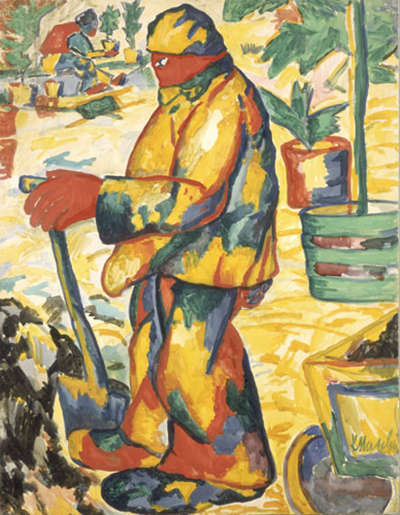
A gardener presses a spade into dark soil. His yellow clothing dominates the picture, while red hands and footwear, green shadows and blue-edged pots pull the eye around him. In Kazimir Malevich's The Gardener, a recognisable scene of work is also an exercise in emphatic shape and colour. The Stedelijk Museum Amsterdam catalogues the object as De tuinman / The Gardener, dates it 1911, and numbers it A 7652. [1] [2]
The picture belongs to Malevich's figurative work before Suprematism, but it deserves attention on its own terms. A spade, planted containers and an earth pile place the worker in a garden. Malevich makes those familiar objects sharp visual anchors, then disrupts naturalistic expectations with a near-solid yellow figure and coloured shadows. The museum's 2013 paper-conservation report calls this exact work gouache. [1] [2]
At a Glance
- ArtistKazimir Malevich
- Museum titleDe tuinman
- English titleThe Gardener
- Date1911, Stedelijk Museum record and conservation report
- MediumGouache, named in the Stedelijk's 2013 conservation report
- Exact supportNot specified in the cited museum item or report entry
- Dimensions91 × 70 cm, Stedelijk item record
- Object numberA 7652
- Holding creditStedelijk Museum Amsterdam; ownership recognised under a 2008 agreement with the Malevich estate
Contents
- Reading the working figure
- Gouache, dimensions and the museum record
- Colour, work and early Malevich
- Two different ways to show manual work
Reading the working figure
The worker fills almost the whole upright composition. His head bends toward the earth; one red hand reaches across the shaft of the spade while the other arm and broad yellow torso seem to press forward. The shovel blade disappears into dark clods at lower left. A large round container sits at right, with plants rising behind it. These are visible features of the image rather than details supplied by a narrative source. The reviewed museum record does not name a particular gardener or place. [1] [3]
Large patches of colour simplify the person without making him anonymous. A yellow cap, red face and thick sleeves make his posture immediately readable. Green, blue and dark grey areas interrupt the yellow, suggesting folds or shadow without smooth tonal modelling. His hands and feet are large in relation to the rest of the body. Rather than treating that as an error, a viewer can ask how the enlarged hands and strong spade make physical labour the main event. [1] [3]
The ground is brighter than a literal patch of turned soil would have to be. Pale yellow and cream extend around the feet and across the middle of the scene; the soil pile is almost black by comparison. That contrast gives the spade a clear destination. It also lets the worker's yellow clothing merge with the light field in places. A red outline or a green edge then restores his silhouette. The act of looking alternates between reading a person at work and following a painted network of contrasts. [1] [3]
Farther back at left there is a smaller figure-like form among the garden objects. It may represent another person, but its occupation and identity are not established by the museum evidence used here. The foreground gardener, spade and plants provide the secure account of the scene. Likewise, the small pale mark on a lower-right container should not be described as an authenticated signature on the basis of this reproduction alone. [1] [3]
Gouache, dimensions and the museum record
The Stedelijk item record gives 91 × 70 cm and A 7652. It lists the work under the Dutch title De tuinman, with The Gardener as its English translation. Its material field was blank in the reviewed capture. The museum's 2013 annual-report supplement supplies the missing paint term by naming The Gardener among gouaches handled by its paper-conservation team. The report does not state whether the particular support is paper, card or another surface. [1] [2]
At nearly a metre high, this is larger than the tiny online image may suggest. The figure's dominance and the clear spade-to-soil movement are easier to appreciate with that scale in mind. The site's inherited JPEG is only 400 pixels wide, so minute marks and surface texture should not be overread. A museum-quality view would be needed to discuss layers, underdrawing, reverses or conservation findings beyond the report's short listing. [1] [2]
The Stedelijk item also describes its holding through an ownership agreement with Malevich's estate dating from 2008. That precise credit is more informative than the old page's generic “permanent collection” phrase. It does not, by itself, establish when the work first arrived in Amsterdam, and this article does not invent a provenance chain. [1]
Colour, work and early Malevich
The simplified body and urgent colour can be understood alongside Russian neo-primitivist interest in the visible force of work and rural life. A Centre Pompidou catalogue entry about Natalia Goncharova's Bûcherons places such humble labour within the period's artistic concerns and specifically notes Malevich's neo-primitivist work from 1911. That contextual source does not assign a strict stylistic classification to The Gardener itself. It helps explain why a working figure might be a serious subject for formal experiment. [4]
The old article labelled this object “Fauvist” as though a single movement name settled its appearance. Its strong reds, yellows and greens are obvious, but colour resemblance alone cannot document direct influence or a precise working method. The painting can instead be described through what it shows: broad colour masses, dark contour, enlarged hands and a close relationship between the worker and his tool. [1] [2] [3]
The work is often approached through Malevich's later abstraction. That comparison can be illuminating, especially in the bold simplification of coat, soil and plants. Yet The Gardener is not a failed step toward Black Square. It makes the labouring body central and uses colour to make the task visually forceful. Without an artist's documented explanation for this particular gouache, claims about a planned path from this image to Suprematism remain interpretation. [1] [2]
Two different ways to show manual work
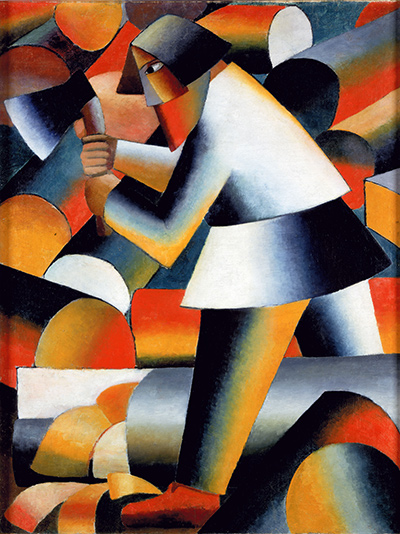
The Centre Pompidou’s entry for Natalia Goncharova’s Woodcutters places it within Russian neo-primitivism. Its account of attention to everyday labour offers a parallel to Malevich’s solitary gardener. The cutting rhythm of Goncharova’s grouped workers gives the viewer several moving bodies to follow. The gardener gives one body and its tool most of the weight. Compare the repeated directions of the axes in the one work with the direction of the spade and the bend of the gardener’s body. They give activity a visible structure in different ways. The comparison concerns separate works with distinct makers and collection histories. [1] [3] [4]
In the gardener, the yellow clothing is also a large connected area of colour. Its size helps guide the eye through the worker’s pose before the surrounding patches resolve into a setting. This gives an ordinary task considerable visual emphasis. Where the arm and spade diverge from the main silhouette, the body ceases to be a single closed form and the object it uses begins to direct the composition in its own right. [1] [3]
Frequently Asked Questions
When was it made?
What material did Malevich use?
Where is the work held?
It is catalogued by the Stedelijk Museum Amsterdam as A 7652. The item record notes ownership recognised through a 2008 agreement with the Malevich estate. [1]
Is the figure a particular named gardener?
Was it made as a study for Black Square?
Discussion
What makes the gardener's action clear before you read the title?
Which colours separate his body from the lighter ground, and which colours make them merge?
Reader Insights
Follow the spade from the red hand into the dark soil.
Compare the large foreground worker with the smaller form in the background, without assuming the second figure's identity.
Look for where dark outline makes a shape legible and where adjacent colour does the same job.
Join the Conversation
Share a close observation or a source-backed detail about this specific Stedelijk work.
References
- Stedelijk Museum Amsterdam, De tuinman / The Gardener, A 7652: item-level title, 1911, size, object number and estate-agreement credit, captured in the local Stedelijk review batch. View source.
- Stedelijk Museum Amsterdam, Supplements Annual Report 2013, PDF p. 53: paper-conservation list naming The Gardener, gouache, 1911. View source.
- Wikimedia Commons, The Gardener (Malevich, 1911).jpg: separate reproduction identifying Stedelijk A 7652, used to compare the composition; not evidence for this site's JPEG rights. View source.
- Centre Pompidou, catalogue entry for Goncharova's Bûcherons: curatorial context for Russian neo-primitivist images of work, with reference to Malevich from 1911; not an object-specific record for The Gardener. View source.



