 by Tom Gurney
Tom Gurney BSc (Hons) is an art history expert with over 20 years experience
Published on June 19, 2020 / Updated on November 20, 2026
Email: tomgurney1@gmail.com / Phone: +44 7429 011000
Introduction
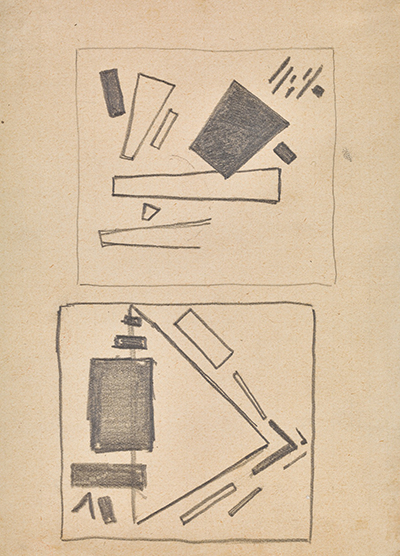
Two small outlined rectangles divide the pencil sheet known as Kazimir Malevich's Composition 11 R. Within each, shaded blocks, unfilled bars and quick strokes are arranged differently. One composition places a dark tilted quadrilateral among long horizontal elements; the other uses a large angular outline and an upright shaded rectangle. Displayed upright, the two studies invite the eye to compare how a few similar forms can produce quite different balances. [1] [2] [3]
This page's old name, Study Drawing for Suprematist Composition, describes the image but is not its strongest catalogue identity. Sotheby’s sold this illustrated sheet in 2021 as Suprematist Composition. Christie’s documented the same sheet in 2025 as Compositions 11 R, with Sotheby’s 2021 lot in the provenance. The Guggenheim's 2003 exhibition catalogue calls it Composition 11 R and reproduces the exact pair of designs. Both auction houses cite catalogue raisonné number Nakov S-75. [1] [2] [3]
At a Glance
- ArtistKazimir Malevich
- Catalogue titleComposition 11 R / Compositions 11 R
- Former site titleStudy Drawing for Suprematist Composition
- DateCirca 1915–16 in Christie’s and Guggenheim catalogues
- MediumPencil or graphite on paper
- Sheet sizeAbout 16 × 11 cm; Sotheby’s gives 16 × 11, Christie’s 11.2 × 16 cm
- Catalogue numberNakov S-75, cited by both auction houses
- Documented provenanceAnna Alexandrovna Leporskaya; Galerie Gmurzynska; private collections and 2021/2025 auction history
Contents
- Two arrangements on one sheet
- Date, names and dimensions
- Why reproductions may look rotated
- Where the eye finds weight
Two arrangements on one sheet
The upper panel in the upright reproduction is dominated by a dark oblique square near its right side. Slim pale rectangles rise and slant at left, while a horizontal outlined bar crosses the lower middle. Short dark strokes cluster at the upper right. The elements do not form a depicted object or scene; their differing weights and directions make the panel feel lively even within its hand-drawn boundary. [1] [2]
The lower panel works differently. A broad V-like outline pushes toward the right edge. A dark upright rectangle sits to the left, and a shorter dark horizontal bar lies beneath it. Smaller marks at either end complicate the implied diagonal movement. The eye may read these as two candidate arrangements, but the published records do not identify a finished painting for which either was the definitive preparatory design. “Study” can describe the exploratory appearance of the sheet without claiming a documented painting-to-drawing relationship. [1] [2] [3]
Its graphite makes light and dark through pressure and hatching rather than painted colour. Areas of open paper are as active as the filled shapes: they separate bars, let the tilted forms stand out and leave both outlined compartments visibly provisional. The faint borders also matter. They show Malevich testing each arrangement in a defined space, instead of letting the marks run indefinitely across the page. These are observations of the published image, not a claim about the artist's exact working sequence. [1] [2]
Date, names and dimensions
Christie’s gives circa 1915–16, matching the date in the Guggenheim's 2003 catalogue. Sotheby’s 2021 online lot gives no production date in its main object description, so its omission should not be treated as a contrary date. The sheet belongs to the early Suprematist period under the two dated catalogues, but neither specifies a single day or exhibition when Malevich drew it. [1] [2] [3]
The records' size figures are very close but not identical. Sotheby’s gives the sheet as 16 × 11 cm and Christie’s 11.2 × 16 cm. The reversed order reflects a different orientation of height and width; the 0.2 cm difference may be measuring precision. It is safer to print both attributed figures than silently combine them into a false exact measurement. [1] [2]
Sotheby’s notes “11 R” on the reverse. That inscription and the published title provide a more useful object identifier than the broad phrase Suprematist Composition, which Malevich and cataloguers used for many distinct works. The two auctions and the Guggenheim publication cite Nakov S-75; that reference distinguishes this sheet from other drawings in the same period. [1] [2] [3]
Why reproductions may look rotated
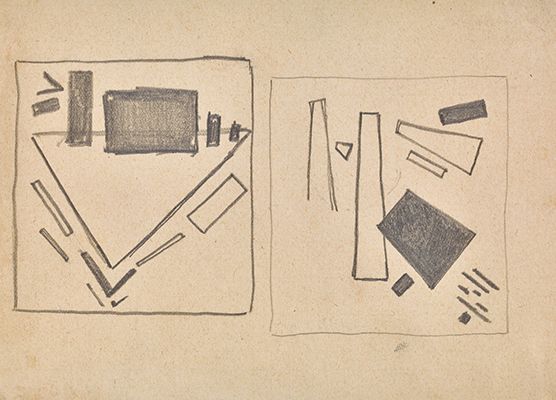
The site image and Sotheby’s photograph show the two panels one above the other. The Guggenheim's catalogue reproduces the sheet with the panels side by side. The motifs correspond when the sheet is turned, including the shaded quadrilateral, long bar and angular V. The catalogue's rotation is an image presentation choice, not evidence for two versions of the sheet or for a fixed orientation preferred by Malevich. [1] [3]
The published ownership history starts with Anna Alexandrovna Leporskaya and Galerie Gmurzynska, followed by the private-collection consignment Sotheby’s offered in 2021. Christie’s 2025 catalogue says its consignor acquired the work at that sale. It does not establish who holds the drawing now. The 2003 Guggenheim, 2006 Barcelona and 2010–11 Zurich exhibitions are documented appearances, not assertions of permanent museum ownership. [1] [2]
Where the eye finds weight
In the upper compartment of the upright image, begin with the dark tilted block and then look at the longest outlined strip. One occupies a compact area, while the other can be followed farther across the paper. The space between them has an irregular shape of its own. It narrows at some points and opens out near the edge of the compartment. Those changes give the upper design a visible rhythm on a very small sheet. [1] [2]
In the lower compartment, the angular outline encloses a larger stretch of bare paper. Tracing it from one end to the other brings the eye past the upright filled rectangle and on toward the edge. The filled rectangle remains easy to locate even when the outline commands more room. The effect depends on the contrast between the line and the weight of the shading. Viewed side by side in the Guggenheim catalogue, the same forms can be compared across the two panels. What was above or below appears to the left or right after rotation, but the relationship between dark graphite, bare paper and the edges of each compartment survives the change. [1] [2] [3]
The 2025 catalogue gives two ways to trace the image beyond the auction photographs. It cites the catalogue raisonné under S-75 and identifies page 169 of the Guggenheim exhibition catalogue as an illustrated reference. The Barcelona catalogue enters the record under a broader Spanish title for Suprematist drawings. Looking up those citations by page or catalogue number is more precise than searching only for one English wording of the title. The changing titles have been applied to the same sheet. The pictures and the linked provenance make that continuity visible. [1] [2] [3]
The records provide different kinds of access to the drawing. The auction listings establish when it was offered and how their cataloguers described it. The exhibition references establish earlier opportunities to see the sheet in a group of works. Neither listing tells a reader where to visit it today. A catalogue illustration, especially one in a different orientation, is a way to keep following the arrangement when the drawing is outside public view. [1] [2] [3]
 Kazimir Malevich.jpg)
Frequently Asked Questions
Is this one drawing or two separate works?
Was it a study for a specific finished painting?
When was it drawn?
Where is it now?
Discussion
How do the two arrangements differ in the way they use a dark rectangle and an open border?
Does turning the sheet, as in the Guggenheim catalogue, change which composition you examine first?
Reader Insights
The two designs occupy one paper sheet, not two separate objects.
The 2003 Guggenheim catalogue reproduced this same sheet sideways.
Nakov S-75 and the reverse inscription 11 R help distinguish it from other Suprematist compositions.
Join the Conversation
Share a close observation or a source-backed detail about Composition 11 R.
References
- Sotheby’s, Russian Pictures, 8 June 2021, lot 78, Suprematist Composition: exact illustrated sheet; pencil on paper, 16 × 11 cm, reverse inscription, provenance, exhibition and cited literature. View source.
- Christie’s, Compositions 11 R, lot 6526484, 10 April 2025: exact same sheet traced through the Sotheby’s 2021 lot; circa 1915–16, 11.2 × 16 cm, Nakov S-75 and additional publication history. View source.
- Matthew Drutt (ed.), Kazimir Malevich: Suprematism (Guggenheim, 2003), printed p. 169: reproduces Composition 11 R rotated sideways and dates it 1915–16. The reproduced two-panel image was checked against the saved local and auction images. View source.