Kazimir Malevich.jpg)
 by Tom Gurney
Tom Gurney BSc (Hons) is an art history expert with over 20 years experience
Published on June 19, 2020 / Updated on November 20, 2026
Email: tomgurney1@gmail.com / Phone: +44 7429 011000
Introduction
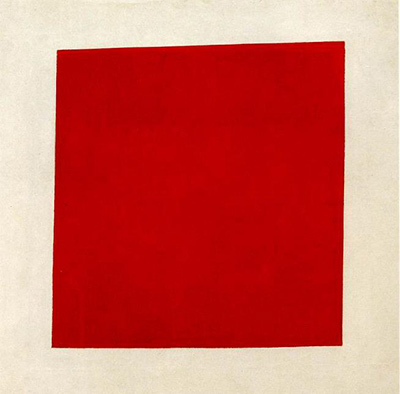
This slender Untitled (Suprematist Composition) assembles upright dark shapes on light paper. The largest element stands at the left; narrower bars rise or hover to its right, and a small dark triangle punctuates the lower-right area. The Solomon R. Guggenheim Museum identifies the sheet by accession 74.2120. Its museum-provided record dates the sheet circa 1919–1926, identifies gouache and pencil on paper, and measures 22 × 17.6 cm. [1]
The accession matters because Malevich made another Guggenheim work with exactly the same title and nearly the same dimensions. That second sheet, 74.2121, has a large tilted dark mass at the upper left and a different rhythm of thin bars. It belongs on the site's separate 1919–1926 page. Shared titles and date ranges do not make these two views of one artwork. [1] [2]
At a Glance
- ArtistKazimir Malevich
- TitleUntitled (Suprematist Composition)
- DateCirca 1919–1926
- MediumGouache and pencil on paper
- Dimensions22 × 17.6 cm
- CollectionSolomon R. Guggenheim Museum, New York
- Accession74.2120
- CreditGift, Faith and Robert Schwarz
- Distinguishing formUpright dark blocks and a small lower-right triangle
Contents
- How is this composition arranged?
- Why call it Suprematist?
- How does it differ from the other Guggenheim sheet?
- What does the date range tell us?
- The verticals and the small triangle
- From a single sheet to a sequence of drawings
How is this composition arranged?
The work is built from a compact group of verticals rather than a pictured room or landscape. The broadest dark form gives the left side weight. Several separate strokes and rectangles on the right vary in length, thickness and tone. Open areas of paper keep them from joining into a single silhouette. Near the bottom, the triangular mark gives the eye a different direction to follow. These are descriptions of the museum-provided reproduction, not proposed names for objects in a scene. [1]
The outer edge of the paper is visible, so the arrangement can be read as a small sheet rather than an endlessly extending black-and-white pattern. The forms do not create a conventional horizon or cast descriptive shadows. Differences in angle and spacing supply movement without showing a moving subject. Because the object is only 22 cm high, a large screen reproduction can also exaggerate the scale of its individual marks. [1]
Why call it Suprematist?
“Suprematist” is part of the museum-provided title. In this sheet, geometry carries the composition: dark bars and a small triangle are the main visual events. Malevich's move away from representing identifiable objects had already been marked by works such as Black Square. The later date range on this sheet places it after that 1915 breakthrough, but the record does not assign the drawing to a specific exhibition, painting project or commission. [1] [3]
Its restrained palette may seem simple in a thumbnail. At full size, the white gaps are as active as the black marks: they separate neighboring forms and prevent the tall elements from collapsing into one block. The pencil-and-gouache description also reminds us that the work is a made surface on paper. The reproduction alone cannot establish the sequence in which Malevich drew and painted each shape. [1]
How does it differ from the other Guggenheim sheet?
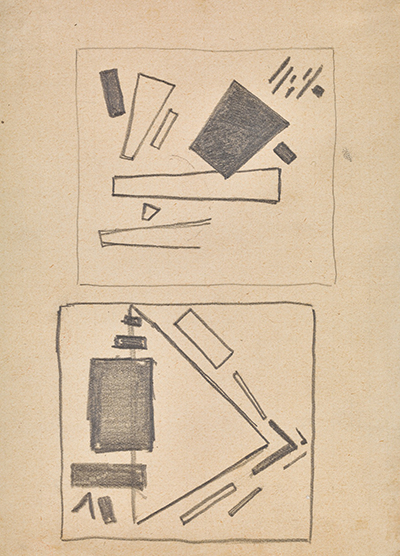
Both drawings are called Untitled (Suprematist Composition), both are dated circa 1919–1926, and both were recorded as gifts of Faith and Robert Schwarz. Yet their accession numbers are consecutive and distinct. 74.2120 is 22 × 17.6 cm; 74.2121 is 22 × 17.8 cm. The latter has a broad tilted mass and right-hand narrow bars, while this sheet concentrates its visual weight in straighter upright blocks. [1] [2]
The 0.2 cm width difference alone is not a reliable way to recognise an image online. The arrangement of forms and the accession number together make the identification secure. The shared wording is a catalogue title, not evidence that one drawing is an alternate orientation, preliminary state or copy of the other. No checked source establishes such a relationship. [1] [2]
 1919-1926 Kazimir Malevich.jpg)
What does the date range tell us?
“Circa 1919–1926” is a broad approximate range. It should not be shortened to 1919 simply because some machine-readable date fields begin with that year. The upload history of the Guggenheim-provided record preserves the fuller ca. 1919–26 wording. It also should not be presented as proof that the drawing was made throughout those years. The precise production date remains unresolved within the cited record. [1]
The verticals and the small triangle
The marks at the right give the heavier upright at the left something to work against. Each has its own margin of clear paper. Following their lower ends is one way to see how the drawing avoids settling into a row. The ends vary in position, so the group gives the eye a series of steps without providing a common baseline. The same happens at the upper ends. A line drawn through them in the imagination would keep changing its direction. The upright forms seem related without all standing at the same height. [1]
Near the lower right, the small triangle breaks with the predominant direction. Its sloping sides turn the eye back towards the almost vertical forms. Its effect depends partly on its isolation. A triangle touching the larger blocks could look like part of their silhouette. With pale paper around it, it can carry a direction of its own. That modest change of angle is easy to overlook beside the far larger dark areas. Seen at the size of the actual sheet, it offers a reason to pay attention to how little material a form needs in order to hold its place. [1]
The comparison with the other Guggenheim sheet makes this point especially clear. There a sloping edge belongs to the largest dark mass, so the inclination affects the whole image from the outset. Here the dominant marks are closer to upright and the small triangle introduces the change of direction farther from the main block. Their shared palette and similar scale make the effect of that change more apparent. The two sheets can be studied side by side without assuming they were made together. [1] [2]
From a single sheet to a sequence of drawings
Malevich’s 1920 Suprematism: 34 Drawings offers a documented example of geometric forms on paper that were intended to be seen in sequence. The Museum of Modern Art describes the book as a visual and theoretical teaching aid associated with Vitebsk. One arrangement can follow another as a reader turns a page, with changes of scale, angle and interval becoming as important as the shapes themselves. That way of looking can also help with a single drawing. Compare the interval between two upright blocks, then the much larger opening between the group and the edge of the sheet. Both distances help set the rhythm. [1] [4]
The book presents its images as prints, whereas the Guggenheim describes this object as a drawing in gouache and pencil. That distinction keeps the example in proportion. The publication demonstrates how Malevich used geometric arrangements in a teaching context during the broad period in which this drawing is dated. The object record leaves the sheet’s purpose and first owner undocumented. The book illustrates a related visual problem without identifying this sheet as one of its studies. [1] [4]
Frequently Asked Questions
Is this a painting or a drawing?
The museum-provided material line says gouache and pencil on paper. We describe it as a work on paper; its use of paint does not make it an oil painting on canvas. [1]
Is it the same object as Guggenheim 74.2121?
What is the small shape near the lower right?
It appears triangular in the reproduction. The checked record does not identify it as a depicted object or a symbol with a fixed meaning. [1]
Discussion
Which dark shape first catches your eye, and how do the white gaps guide it?
How would you distinguish this sheet from the other Guggenheim drawing with the same title?
Reader Insights
This page identifies accession 74.2120; the title alone does not identify the object.
The source describes gouache and pencil on paper, not oil on canvas.
The date is an approximate 1919–1926 range, not a single confirmed year.
Join the Conversation
Share a close observation or an object-specific source for this drawing.
References
- Guggenheim Museum-provided image and object metadata, accession 74.2120, via Wikimedia Commons: title, image, broad date, medium, dimensions, collection, accession and credit line. View source.
- Guggenheim Museum-provided image and object metadata, accession 74.2121, via Wikimedia Commons: separate-object comparison. View source.
- Solomon R. Guggenheim Museum, Kazimir Malevich: Suprematism exhibition archive: institutional context for Suprematism; it is not treated as an object record for this drawing. View source.
- Museum of Modern Art, Suprematism: 34 Drawings: date, Vitebsk and the book’s teaching context. View source.