


 by Tom Gurney
Tom Gurney BSc (Hons) is an art history expert with over 20 years experience
Published on June 19, 2020 / Updated on November 20, 2026
Email: tomgurney1@gmail.com / Phone: +44 7429 011000
Introduction
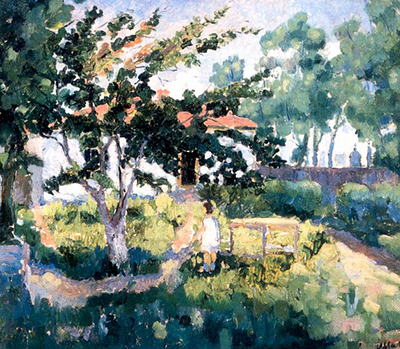
Summer Landscape looks at first like a scene from Malevich's early Impressionist years. A pale figure stands by a low fence in a garden framed by tall trees, with red roofs and a curving path beyond. Yet the illustrated catalogue of the State Russian Museum collection dates this particular canvas circa 1929. Its familiar subject and freely broken patches of green, blue and pink belong to Malevich's deliberate return to figurative and Impressionist painting late in his career. [1]
The saved image on this page matches the catalogue illustration precisely: the broad central tree, darker trunk at left, white-clad figure, low horizontal fence and descending path at the right all occupy the same positions. The match anchors the work to Russian Museum inventory Ж-9409, rather than to a similarly titled landscape or an assumed early painting. [1]
At a Glance
- ArtistKazimir Malevich
- TitleSummer Landscape (Zomerlandschap in the 2014 Dutch catalogue)
- DateCirca 1929, as catalogued in 2014
- MediumOil on canvas
- Size48.5 × 55 cm, height × width
- CollectionState Russian Museum, Saint Petersburg
- InventoryЖ-9409
- Catalogue referenceNakov F-048, transcribed in a secondary image record
Contents
- What is in the painting?
- Why is an Impressionist scene dated circa 1929?
- Collection and catalogue identity
- How the garden comes into focus
What is in the painting?
Trees occupy much of the view. Their canopies meet above a pale opening in the centre, while the large grey-brown trunk near the foreground divides the garden into contrasting patches of light and shade. A path winds across the lower edge before leading towards a brighter opening on the right. Orange and pink roof shapes break through the foliage in the distance. The small light-clothed figure and fence give the eye a human scale amid the dense plant forms. [1]
Malevich does not describe every leaf or fence rail separately. Short touches of green, blue and ochre produce a shifting surface. The eye assembles them into trees, grass and buildings as it moves around the canvas. The areas of warm roof colour and yellow-green grass sharpen the contrast with the darker foliage. These are observations of the reproduced work, rather than evidence for the precise place or sitter. [1]
The composition remains organised despite its loose handling. The large trunks stand upright, the fence runs almost horizontally, and the path bends through the foreground. Against these structural lines, the small strokes of colour give the scene its restless light. The figure does not dominate the painting; it is one element in the wider arrangement of forms and colours. [1]
Why is an Impressionist scene dated circa 1929?
Malevich's late painting did not simply continue the geometric language of Black Square and the Suprematist works. In the years after his 1927 trip to Berlin, he also made new figurative work and returned to Impressionist subjects. Evgenia Petrova's essay in the 2014 exhibition publication places a series of such works around 1928–29. It notes that Malevich sometimes inscribed late canvases with dates from the beginning of the century. The publication therefore distinguishes when a motif may have entered his thinking from when a particular canvas was made. [1]
That distinction matters here because some commercial reproductions call Summer Landscape a work of 1903. The illustrated museum-linked catalogue labels the physical canvas circa 1929 and identifies it as Ж-9409. A separate illustrated image agency gives 1928–29, a compatible approximate range. The earlier commercial date should not be presented as this object's confirmed execution date. [1] [2]
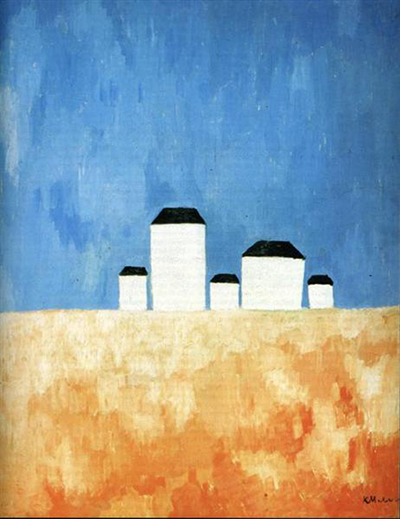
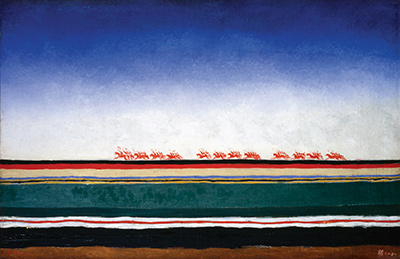
The work's traditional subject does not make it a retreat from formal experiment. Its garden is built from visible relationships among colour patches, vertical trunks and moving paths. Readers can compare those decisions with the simplified masses of Landscape with Five Houses and the more austere fields and figures of Red Cavalry, both associated with Malevich's late period. These comparisons show different ways he organised landscape; they do not imply that one picture is a preparatory study for another. [1] [3]
Collection and catalogue identity
The 2014 publication reproduces the exact work and captions it with the Russian Museum's inventory number, medium and dimensions. Its publication credits name Russian Museum contributors and describe the reproduced works as coming from that collection. A Wikimedia Commons reproduction independently transcribes Ж-9409 and Nakov F-048, but its uploaded metadata is secondary. For the measurements and approximate date above, the illustrated museum-linked catalogue is the stronger source. [1] [4]
The online Russian Museum artist listing does not currently expose an individual entry for this picture. It should not be confused with two Kandinsky paintings called Summer Landscape that do appear in the museum's online collection. Nor should a separate “Summer Landscape, 1929” entry in the museum's 2014 annual report be attached to Malevich: that entry describes a paper study made under Mikhail Matyushin. These title collisions are why the illustration and Ж-9409 number matter. [1] [5] [6]
How the garden comes into focus
The larger tree gives the picture a mass that can be recognized from a distance. Look closer and its perimeter begins to break into small marks, with passages of lighter colour opening between them. The pale figure below is then easier to see because it has a different relation to the surrounding dark areas. The painter gives the figure enough definition to suggest a person within the view, while the movement across the trees and ground still dominates the encounter. It is reasonable to describe that change of scale in the scene. The sources do not identify the figure as a specific sitter. [1] [2] [4]
The reputation of Malevich’s geometric works can make this garden seem stylistically remote from the late paintings. The illustrated retrospective catalogue gives the object’s own basis for comparison. Its date puts this loosely handled garden close to the Russian Museum’s separately accessioned Landscape with Five Houses. There a small row of buildings meets two broad painted fields. Here the outline of a tree dissolves into nearby patches of colour. Seeing the two together shows that Malevich could treat a landscape in more than one way at that point in his career. [1] [2] [3]
The names and dates also help a viewer compare images in books without confusing records. The retrospective illustration is anchored by an inventory number, medium and dimensions. Its identification has more in common with the Bridgeman image of the late canvas than with an annual-report item of similar title on paper. Those references show that the words Summer Landscape have meaning only when connected to a particular work. [1] [2] [4] [5] [6]
The scattered marks in the foreground can also be read before the tree and figure come into focus. Some light areas begin to look like sun through the garden, while others stay close in colour to places farther back. The scene gains its depth gradually as the eye compares those areas. That matters more to a reading of the picture than an exact identification of the garden. [1] [2]
Frequently Asked Questions
Was it painted in 1903 or around 1929?
What medium and size does the catalogue give?
Oil on canvas, 48.5 × 55 cm (height × width). [1]
Where is the painting?
The 2014 catalogue places it in the State Russian Museum collection under Ж-9409. The sources checked here do not establish whether it is currently on display. [1]
Who is the figure in the garden?
The sources checked here do not identify the figure. The page describes what is visible without assigning a name or relationship. [1]
Discussion
Which patches of colour make the garden readable before you identify individual objects?
How do the trunks, fence and curving path organise the scene?
Reader Insights
The illustrated 2014 catalogue dates this canvas circa 1929 despite its early-looking Impressionist style.
The inventory number Ж-9409 anchors the saved image to one Russian Museum work.
The figure is visible but is not identified by the checked sources.
Join the Conversation
Share a close observation or an object-specific source about Summer Landscape.
References
- Kazimir Malevich: De jaren van de figuratie (Drents Museum, WBOOKS and Palace Editions, 2014), preview pp. 20–23: illustrated Zomerlandschap plate on printed p. 23 gives circa 1929, oil on canvas, 48.5 × 55 cm and Ж-9409; Evgenia Petrova's accompanying essay discusses the late return to Impressionist painting and antedating. View source.
- Bridgeman Images / Fine Art Images, Summer Landscape: illustrated 1928–29 oil-on-canvas record identifying the State Russian Museum. View source.
- State Russian Museum, Landscape with Five Houses, Ж-9496: exact late landscape used for an interpretive comparison, not an identity source for Summer Landscape. View source.
- Wikimedia Commons, Malevich Summer Landscape.JPG: secondary transcription of Ж-9409 and Nakov F-048; used only as corroboration and catalogue lead. View source.
- Virtual Russian Museum, Malevich author index: scope check for the accessible online artist listing; it does not contain this painting. View source.
- State Russian Museum, 2014 annual report, p. 131: excluded same-title paper study rather than evidence for this Malevich canvas. View source.



