


 by Tom Gurney
Tom Gurney BSc (Hons) is an art history expert with over 20 years experience
Published on June 19, 2020 / Updated on November 20, 2026
Email: tomgurney1@gmail.com / Phone: +44 7429 011000
Introduction
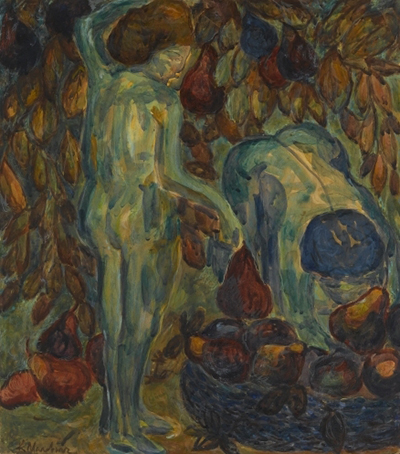
Two figures stand among hanging pears and dark foliage. The figure at left stretches upward; the one at right bends toward a cluster of fruit close to the ground. Kazimir Malevich's Two Female Nudes Gathering Pears makes their bodies part of a dense pattern of green, blue, brown and red. The Stedelijk Museum Amsterdam catalogues this composition under the Dutch title Twee naakte vrouwen peren plukkend, dates it 1909, and identifies it as object 4.2001(007). [1]
The image on this page was checked against the Stedelijk's pictured object. That matters because another small Malevich work in the same museum has a closely related pear-picking title but shows three female nudes and a child. This page concerns the larger, two-figure work. The Stedelijk's 2013 conservation report names it as gouache; the exact support is not specified in the cited museum entries. [1] [2] [3]
At a Glance
- ArtistKazimir Malevich
- Museum titleTwee naakte vrouwen peren plukkend
- English title used hereTwo Female Nudes Gathering Pears
- Date1909
- MediumGouache, Stedelijk 2013 conservation report
- Exact supportNot stated in the cited museum entries
- Dimensions66 × 60 × 3 cm, current museum item page
- Object number4.2001(007)
- Holding creditKhardzhiev Foundation loan at the Stedelijk Museum Amsterdam
Contents
- Looking at the two figures
- Gouache, size and the Khardzhiev loan
- The nearby pear-picking work is separate
- Early work and later expectations
- Reaching and looking
Looking at the two figures
The standing figure occupies the left half of the square. One arm rises into the brown-green area overhead, and the other seems to meet fruit or branches at shoulder height. The right figure bends forward, with a rounded blue-dark head and a green body echoing the vertical of the first. Neither is sharply separated from the surrounding foliage. Their outlines are present, but the colours of bodies, leaves and shadows overlap. [1]
Pears appear above, between and below them. Reddish fruit hangs against a dark canopy, while a fuller cluster sits in a blue-green bowl-like form at the lower right. Other round shapes lie near the ground. The title guides us to read these marks as pear gathering, but the physical setting is not precisely mapped. We do not need to name an orchard, forest or garden as a documented location. The visible relationship among figures, fruit and foliage is enough to describe the subject. [1]
The picture gives the standing figure a relatively clear, upright silhouette, while the bent figure nearly disappears into the surrounding colours. The eye can move from an outstretched arm to a suspended pear, then down to the dark gathering of fruit at the bottom. That movement helps organise a surface that might otherwise feel crowded. The figures do not simply occupy a background; they are woven into its colour and texture. [1]
The nude bodies are neither smooth academic studies nor carefully isolated anatomical diagrams. Broad green, blue and brown passages suggest torsos and limbs, while patches of related colour describe leaves and fruit. The repetition makes the bodies and environment visually close. This is a reading of the reproduction, not a claim that Malevich documented an allegorical meaning or painted from a particular model. [1]
Gouache, size and the Khardzhiev loan
The Stedelijk's current item page lists the object among its “Drawings” but does not specify a paint material. Its 2013 paper-conservation report names Twee naakte vrouwen peren plukkend as gouache, 1909. Together the two museum sources establish the named medium more securely than the site's old generic “painting” label. Neither entry gives the exact support; the browse category “Drawings” is not itself a complete technical description. [1] [2]
The current item page records 66 × 60 × 3 cm. The third measurement is reported as part of the museum's dimension string; without a more detailed object or framing record, it should not be interpreted as the thickness of the painted support alone. The work is substantially larger than its 400-pixel website image suggests. On screen, small colour changes may be hard to distinguish, so this article avoids close technical claims about underdrawing, paint layers or conservation treatment. [1] [2]
The museum credits the object as on loan from the Khardzhiev Foundation. A Stedelijk collection page therefore documents a work held and studied there, but does not make it a museum-owned object. That distinction is important for an all-works catalogue, especially when comparing two similarly titled Khardzhiev loans. [1] [3]
The nearby pear-picking work is separate
The Stedelijk also catalogues Drie naakte vrouwen en een kind, peren plukkend—Three Female Nudes and a Child, Gathering Pears—as 4.2001(006). It is dated 1909 but measures only 12.7 × 12.8 cm and has four human figures rather than two. The museum lists that object as another Khardzhiev loan. A shared subject and adjacent loan numbers should not collapse them into one artwork or imply a proven preparatory relationship. [1] [3]
The distinction also guards against a common image-search error. A reproduction labelled merely “pear picking” may refer to either object, or to another of Malevich's fruit subjects. Here the official Dutch title, two-figure composition, 66 × 60 × 3 cm dimension string and object number all point to 4.2001(007). The site should keep those identifiers beside the image wherever this work is listed. [1] [3]
Early work and later expectations
Viewers who know Malevich through Black Square may expect a sharp break between figures and abstraction. This 1909 work shows how a representational subject could already become a problem of colour, contour and the picture's surface. The figures remain recognisable, yet their tones mingle with pears, branches and ground. That comparison is useful, but no source examined here says this gouache was conceived as a direct study for Suprematism. [1] [2]
The old page attached a generic style label and imagined that the work was completed quickly. The museum records used here give no production diary or process sequence. A more productive question is what the image actually shows: rising and bending bodies, repeated fruit shapes, and colour moving between human figures and plants. Those observations make the work accessible without assigning motives that its documentation cannot support. [1] [2]
Reaching and looking
The gesture of picking fruit gives the viewer a reason to look from hands towards the upper parts of the composition. The bodies still carry much of the visual weight. Arms leave the main outlines and direct attention outwards, while the figures remain a pair whose poses can be compared. In a smaller reproduction it is easy to read them as two isolated silhouettes. At the size catalogued by the Stedelijk, the movement from one body to the next has more room to become apparent. That makes the distribution of open space as important as the particular subject named in the title. [1] [2]
The second pear-picking work also shows how a small change in who is present can change the larger arrangement. With three adults and a child, the Stedelijk’s other object gives the viewer more bodies to distinguish within a much smaller field. Its composition must bring more outlines into contact or proximity. The larger work has only two figures to carry the activity and therefore makes the relation between them easier to follow. Their shared subject is evidence for a useful comparison, while the museum numbers and different dimensions keep the works securely separate. [1] [3]
Frequently Asked Questions
What material did Malevich use?
Where is it held?
It is recorded at the Stedelijk Museum Amsterdam as a Khardzhiev Foundation loan, object 4.2001(007). [1]
Is this the small pear-picking work with a child?
Does the work show a known orchard or named models?
The reviewed museum entries do not identify a place or sitters. The title identifies pear gathering, and the image shows two figures among fruit and foliage. [1]
Discussion
Where do the two figures separate clearly from the fruit and foliage, and where do they nearly merge?
Which hanging or gathered pear shapes guide your eye between the figures?
Reader Insights
Compare the upright contour at left with the rounded bent pose at right.
Follow the reds in the fruit against the greens and blue-dark areas around them.
Keep this large two-figure object distinct from the museum's small work showing three women and a child.
Join the Conversation
Share a close observation or an object-specific source for this Khardzhiev loan.
References
- Stedelijk Museum Amsterdam, Twee naakte vrouwen peren plukkend, 4.2001(007): official pictured object, 1909, dimensions, English translation and Khardzhiev Foundation loan credit. The museum's English label prints “Two Females Nudes Gathering Pears”; this article uses idiomatic grammar in its own heading. View source.
- Stedelijk Museum Amsterdam, Bijlagen Jaarverslag 2013, PDF p. 53: museum paper-conservation list expressly naming this work, gouache, 1909. View source.
- Stedelijk Museum Amsterdam, Drie naakte vrouwen en een kind, peren plukkend, 4.2001(006): distinct four-figure 1909 Khardzhiev loan, 12.7 × 12.8 cm. View source.



