 by Tom Gurney
Tom Gurney BSc (Hons) is an art history expert with over 20 years experience
Published on June 19, 2020 / Updated on November 20, 2026
Email: tomgurney1@gmail.com / Phone: +44 7429 011000
Introduction
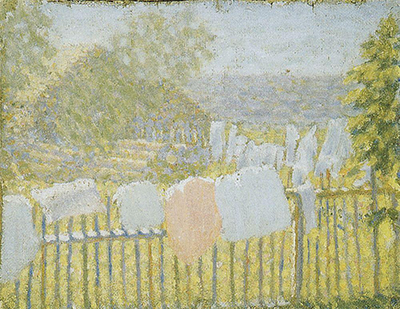
A row of pale and pink fabrics hangs over a wooden fence in Kazimir Malevich's early garden painting. The image has circulated under the name Underwear on the Fence. The museum that catalogues the exact work uses a different title: Landscape with House. Its record places the painting around 1905–06 in the Costakis Collection at MOMus, the Museum of Modern Art in Thessaloniki. That object-specific record gives the scene a firmer identity than the older site's 1903 date and descriptive title alone. [1] [2]
The picture's front row of hanging forms is immediately striking. A salmon-pink cloth interrupts larger areas of white, with more pale fabrics further back near the house. The picket fence runs across the lower half; trees frame the view, while a light sky and building recede behind the laundry. The saved site image and MOMus reproduction show the same fabric shapes, rails and tree positions, even though the two reproductions differ in colour and crop. [1]
At a Glance
- ArtistKazimir Malevich
- Museum titleLandscape with House (Τοπίο με σπίτι)
- Familiar site titleUnderwear on the Fence
- DateCirca 1905–06, according to MOMus
- MediumOil on canvas glued on hard cardboard
- Size21.2 × 27.7 cm, height × width
- CollectionMOMus Museum of Modern Art, Costakis Collection, Thessaloniki
- Museum item codeMMA.CC68
- Older collection codeC86-574, as listed by MOMus
Contents
- Looking at the fence and house
- An early work, with a corrected date
- The Costakis collection identity
- Domestic scale and the division of space
Looking at the fence and house
The fence is the painting's most regular form. Its closely spaced uprights establish a measured line across the foreground. Hanging fabric breaks that rhythm: the central pink shape is rounder and warmer than the white forms to either side, and the cloth farther back overlaps the fence and greenery. Some edges are loose rather than carefully outlined, so the light colours seem to shimmer against the darker rails. [1]
The eye moves from these foreground shapes to the small house and distant trees. The museum's title draws attention to that wider landscape rather than to a single type of garment. The image supports describing hanging laundry, but neither the museum record nor the reproduction establishes that every item is underwear. Retaining the familiar URL helps readers find the work while the article makes the catalogued title clear. [1] [2]
Colour gives the small canvas much of its effect. Yellow-green, blue-grey and pink touches suggest sunlight through foliage and over cloth. The building is partly absorbed into the same painterly surface rather than sharply separated from the garden. The museum describes Malevich's early work as moving between naturalism and Impressionism, and reads this picture as evoking memories of his years in Kursk. That is the museum's interpretation; it does not establish the address of the house or where Malevich stood to paint. [1]
An early work, with a corrected date
MOMus dates the physical painting circa 1905–06. The site's former 1903 label appears in popular reproductions, but no object-specific evidence checked here supports using it over the museum's date. Circa means approximate: the museum record does not claim a day or precise year of completion. [1] [2]
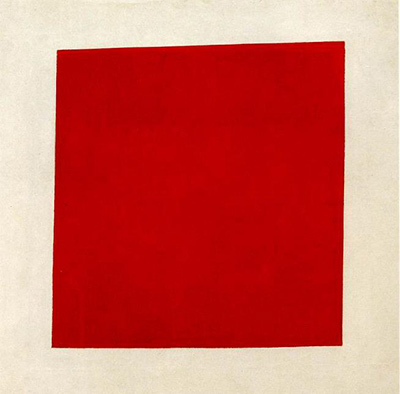
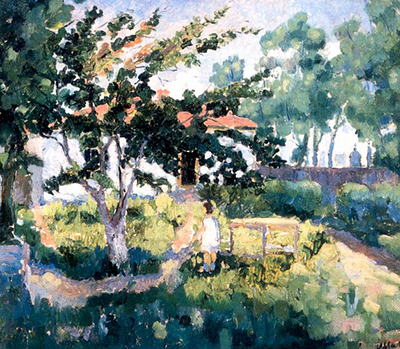
This is an early Malevich picture, made before the famous geometric works associated with Suprematism. Its subject remains recognisable, yet the loosely placed strokes already make the painted surface as noticeable as the scene. That observation should not be turned into a straight-line prediction of Black Square: the two works have distinct aims, dates and materials. For a much later return to loose landscape handling, compare Summer Landscape, catalogued by the State Russian Museum circa 1929. The similar visual language does not make the two canvases contemporaneous. [1] [3]
The Costakis collection identity
MOMus lists this work as item MMA.CC68 in its Costakis Collection. The museum records a Greek State purchase from the Costakis heirs in 2000 and also preserves older identifier C86-574. Older references that simply say “Costakis collection, Athens” cannot be treated as a current display address. The museum record now associates the painting with MOMus in Thessaloniki; it does not say whether it is on view today. [1]
The current museum title and code distinguish it from other early landscapes with houses and from works with general titles such as Landscape. They also help avoid the opposite error: searching only for “Underwear on the Fence” would miss this exact owner record, because that phrase is not the museum's title. [1] [2]
Domestic scale and the division of space
The fence also measures the distance between the viewer and the house. The nearby rails appear as a cadence of dark upright marks. Farther back, the house occupies a smaller patch and shares its light surroundings with the trees. The draped fabric bridges those two parts of the picture. Its light colour makes it stand forward, while its irregular edges break up the line that would otherwise separate the foreground from the garden. The fence provides a credible way into the scene, although the overlapping marks give the painting little need for exact architectural detail. [1] [2]
The pink fabric in the centre takes up less room than the garden. Even so, its warm colour makes it a strong point from which to begin looking. Following the nearby paler pieces leads to the horizontal fence line, which in turn carries the eye towards the edges. Moving the other way, towards the house, means passing over areas where the edges of objects are harder to follow. The repeated uprights and the mass of foliage thus offer two different ways to organize the same small canvas. One relies on intervals that can nearly be counted, while the other relies on the accumulation of patches. [1]
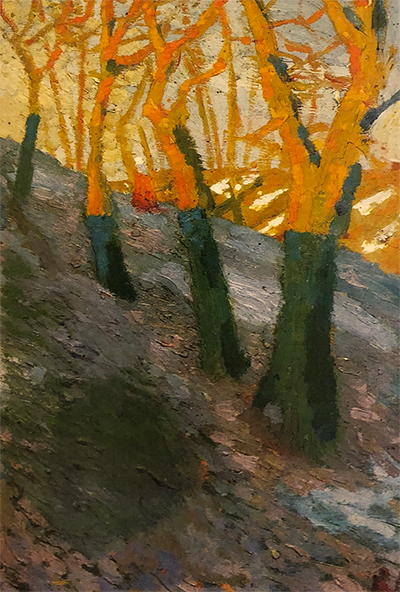
A comparison with Trees puts that arrangement in perspective. Christie’s records that other early landscape as oil on thick card, 30.8 by 19 centimetres, and dates it circa 1904. The broad sweep upwards through its tree trunks is easy to see within the narrow proportions. The MOMus landscape is shorter than it is wide, and the fence gives its foreground an extended horizontal reach. This difference concerns the shape of each picture as well as its subject. In both, the changing direction of the painted marks helps tell the viewer what belongs to the ground and what rises above it. [1] [4]
The two works also show why the material line in a catalogue can matter even for pictures of similar size. In Trees the paint is catalogued as oil on thick card. MOMus specifies canvas adhered to hard cardboard for Landscape with House. Card is part of this object, but the museum distinguishes it from the surface that bears the paint. That distinction is easy to lose when both paintings are seen at the same size on a screen. It helps keep the early landscapes separate when records describe them under short titles or without an illustration. [1] [2] [4]
Frequently Asked Questions
Is Underwear on the Fence the museum title?
When was it painted?
MOMus gives circa 1905–06. The inherited 1903 date is not supported by the checked object record. [1]
What is it painted on?
The museum describes oil on canvas glued on hard cardboard, measuring 21.2 × 27.7 cm. [1]
Where is it now?
It is catalogued in the MOMus Museum of Modern Art Costakis Collection in Thessaloniki. The accessible item does not confirm present gallery display. [1]
Discussion
How do the pale fabrics interrupt the regular uprights of the fence?
What changes when you read the museum's landscape title alongside the familiar laundry title?
Reader Insights
The owner catalogue identifies this exact image as Landscape with House, MMA.CC68.
MOMus dates the painting circa 1905–06 and describes oil on canvas glued to hard cardboard.
The checked owner record does not identify every hanging textile as underwear.
Join the Conversation
Share a close observation or an object-specific source about Landscape with House.
References
- MOMus Museum of Modern Art, Costakis Collection, Landscape with house, MMA.CC68: exact illustrated owner item; current title, maker, circa-1905–06 date, oil on canvas glued to hard cardboard, 21.2 × 27.7 cm, collection and acquisition details. View source.
- SearchCulture.gr, national aggregation of MOMus item 1263: owner-supplied bilingual title and physical metadata, with a direct source-item link and image. View source.
- Kazimir Malevich: De jaren van de figuratie (Drents Museum, WBOOKS and Palace Editions, 2014), preview p. 23: illustrated State Russian Museum Summer Landscape Ж-9409, used only for the dated comparison. View source.
- Christie’s, Trees, illustrated lot 1478621: separately identified early landscape on thick card. View source.