


Horses enter paintings as bodies in motion, partners in ceremony, instruments of war and subjects worthy of sustained attention. Their size can lend authority to a rider, while their eyes, legs and turning torsos may complicate the rider’s claim to control. A horse can carry a saint or emperor, recoil from a predator, circle a market or stand before a race. It can also face the viewer without rider, story or practical task.
This guide follows ten paintings in chronological order, from El Greco’s late-sixteenth-century image of Saint Martin to Franz Marc’s blue horses of 1911. The aim is not to assemble every celebrated equestrian picture. Instead, each work marks a distinct way in which painters made the horse meaningful through scale, pose, colour, setting and its relationship with people or other animals.
The selection belongs within the broader Paintings hub without replacing the directory of Famous Paintings or the site’s account of Painting Genres. Questions about animal imagery across media belong with Animals in Art. Here the unit is the individual painting: what the horse is doing, how the composition directs attention to it, and what changes when the animal is read as more than a rider’s support.
Saints, riders and dramatic encounter
The first two paintings use mounted figures to stage moral and sacred action. Yet neither horse is merely transport. El Greco’s long, measured animal stabilises an act of charity, while Rubens’s rearing horse amplifies a violent encounter. Their contrasting rhythms show how equestrian imagery can communicate authority through restraint or sudden force.
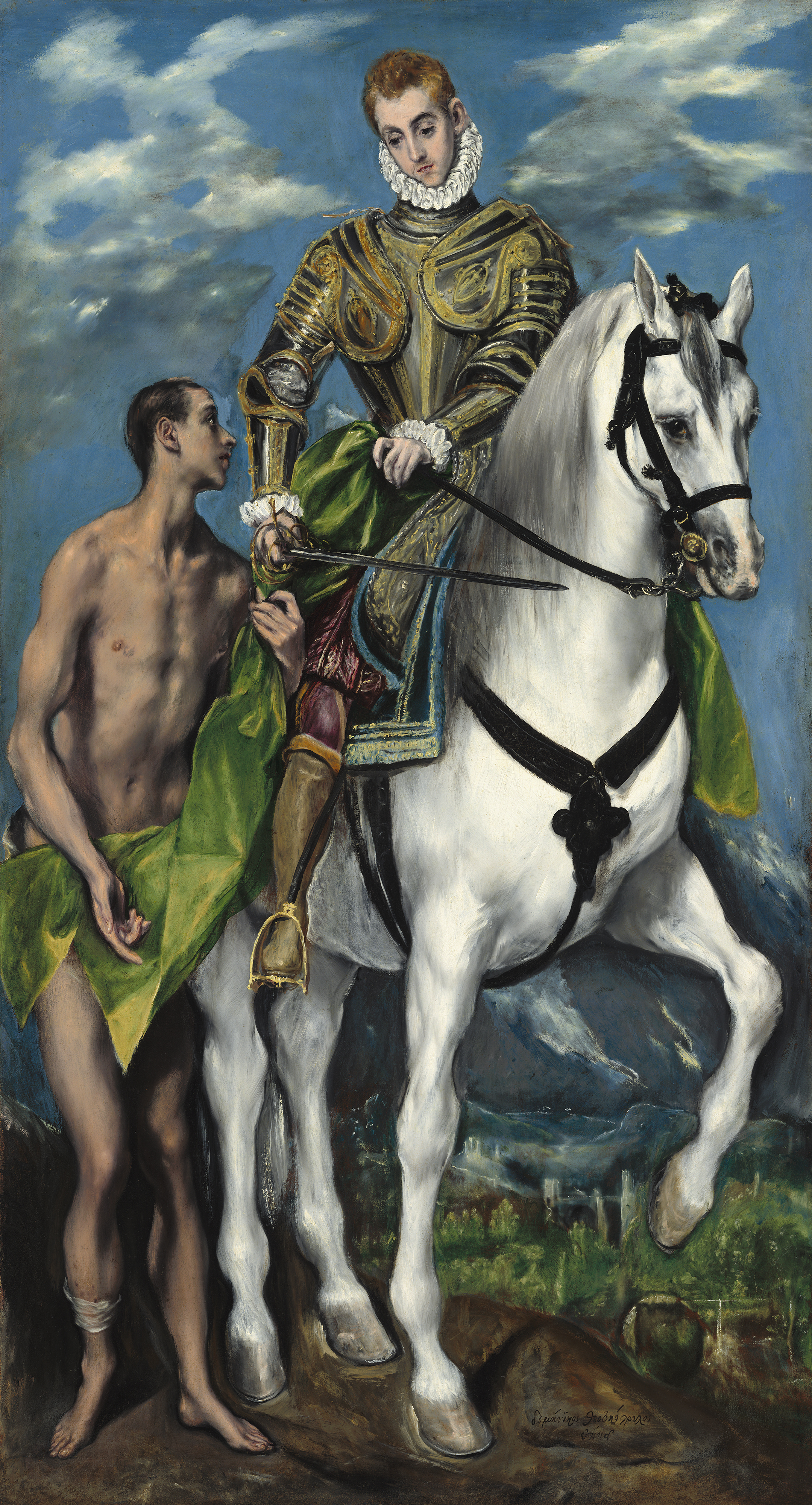
1. Saint Martin and the Beggar — El Greco, 1597–1599
In Saint Martin and the Beggar, Martin sits high on a dark horse and cuts his green cloak for the nearly naked man beside him. The horse’s long neck and slender legs extend the painting’s vertical format. Its calm stance gives the saint a stable platform, but it also widens the physical distance that Martin’s downward gesture must cross.
The National Gallery of Art records the work as an oil on canvas of 1597–99, accession 1942.9.25, measuring 193.5 by 103 centimetres.[1] The beggar’s bare body and Martin’s armour establish a sharp inequality of condition. Against it, the divided cloak becomes a visible connection. The horse contributes to that structure: it elevates Martin as a mounted soldier while its lowered head and controlled pose keep the encounter from becoming a display of speed or conquest. The result is ceremonial without being static. Explore El Greco for the artist’s wider treatment of elongated figures, compressed space and devotional subjects.
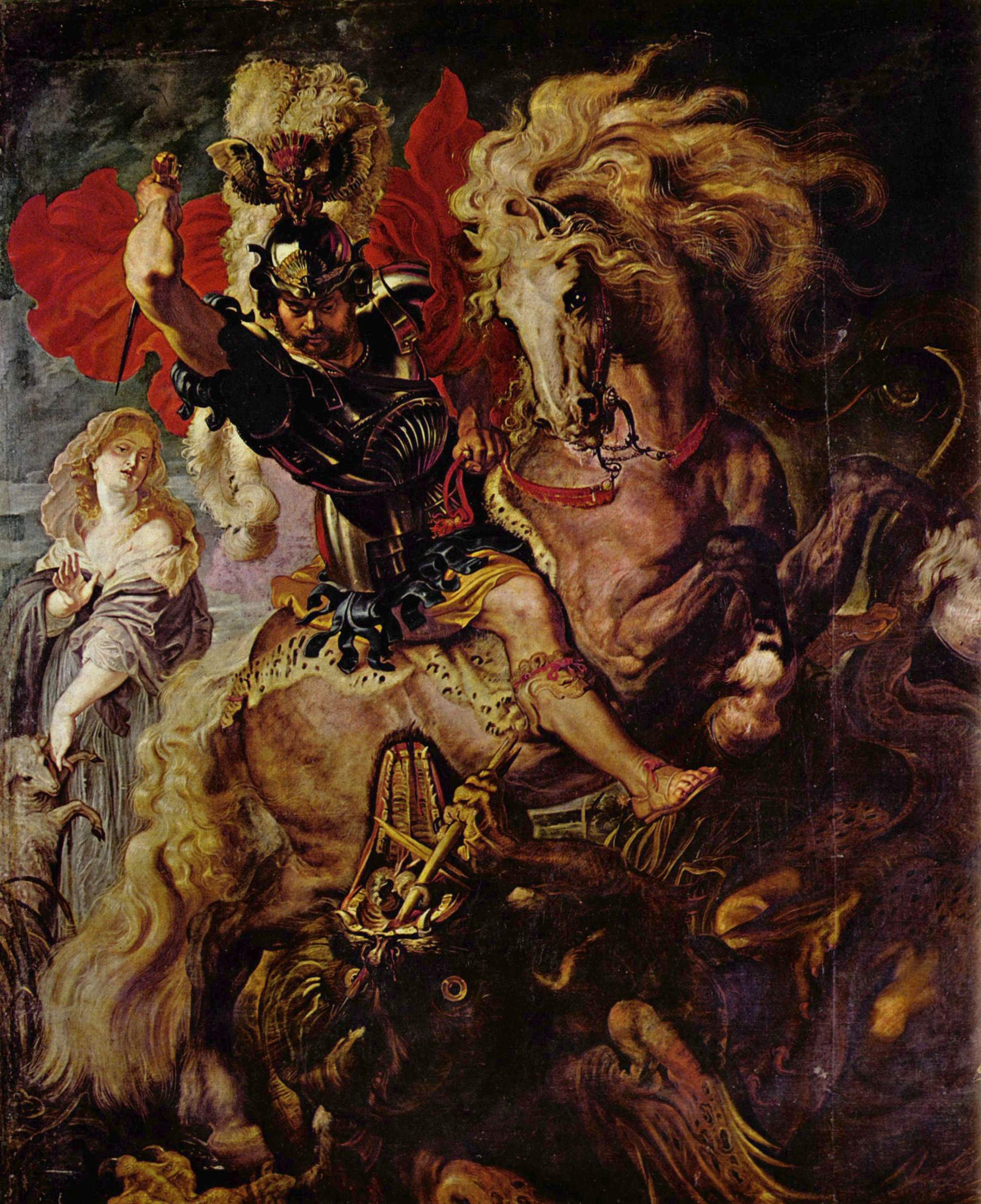
2. Saint George and the Dragon — Peter Paul Rubens, 1606–1608
Rubens turns mounted sainthood into explosive movement in Saint George and the Dragon. George raises his sword as the horse rears above the defeated creature. The animal’s arched neck, lifted forelegs and flowing mane carry the eye through the centre of the canvas. At the left, the princess and lamb offer a quieter vertical counterweight to the compressed combat.
The Museo Nacional del Prado identifies the painting as an oil on canvas of 1606–08, inventory P001644, measuring 309 by 257 centimetres.[2] The horse is essential to the scene’s unstable balance. Rider and mount appear powerful, but the rear places both above a narrow point of contact with the ground. Rubens makes triumph feel strenuous rather than effortless. The horse magnifies George’s force while exposing the physical risk on which that force depends. See Peter Paul Rubens for other large-scale histories in which bodies, drapery and diagonals turn narrative into action.
George Stubbs and the horse as principal subject
By the eighteenth century, George Stubbs could make a horse the commanding centre of a monumental canvas. The next pair removes the sacred rider altogether. One stallion confronts the viewer in splendid isolation; another horse twists beneath a predator. Together they show that close attention to equine anatomy did not limit Stubbs to one emotional register.
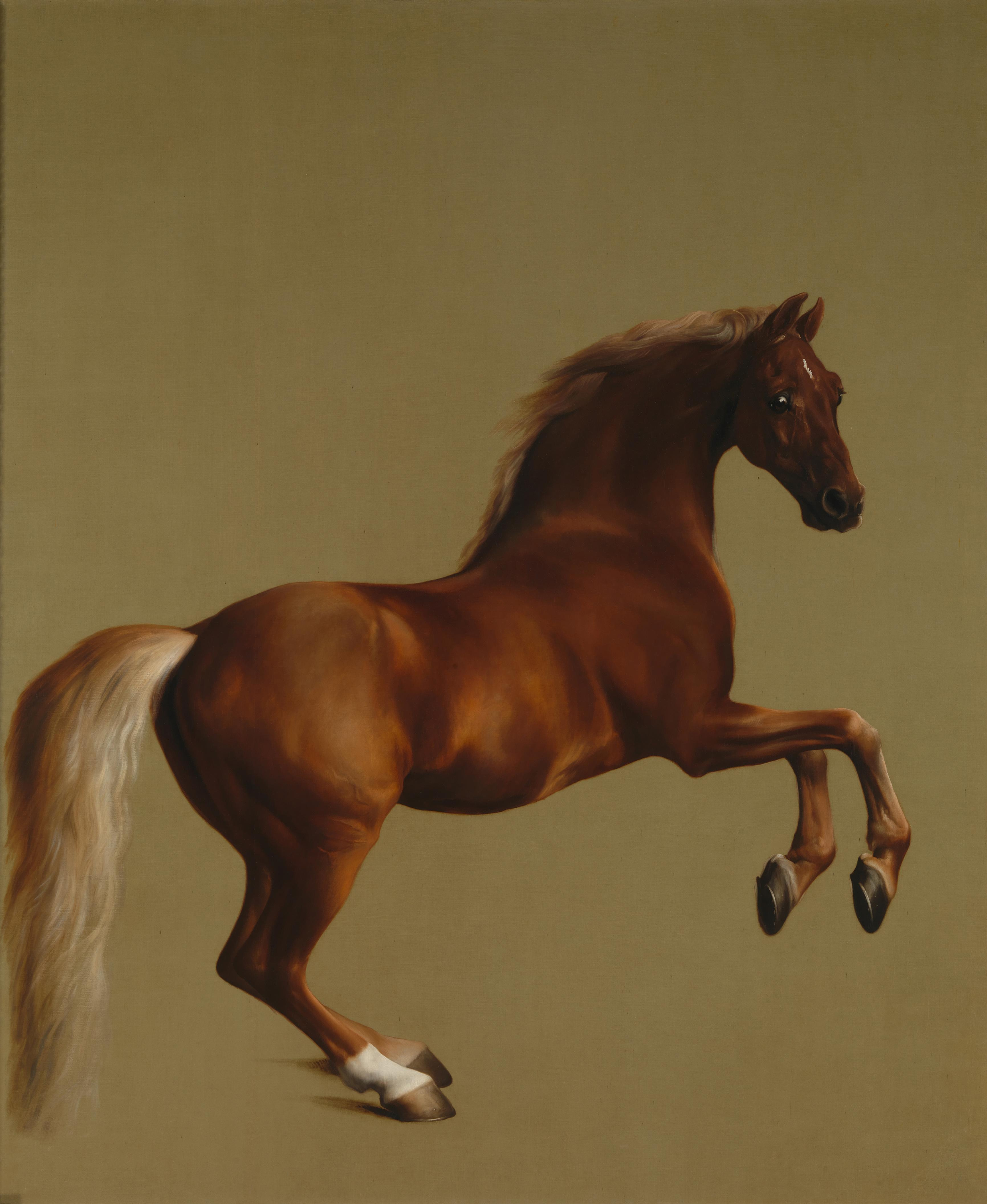
3. Whistlejacket — George Stubbs, about 1762
Whistlejacket rises against a plain, warm ground with no rider, stable or landscape to explain his presence. The chestnut stallion’s body fills the canvas. His forelegs lift, his head turns slightly, and his mane and tail articulate the movement without dissolving its clarity. The absence of narrative accessories makes posture, surface and scale carry the picture.
The National Gallery dates the oil on canvas to about 1762, records it as NG6569, and gives dimensions of 296.1 by 248 centimetres.[3] Those measurements matter to the experience: this is not a small sporting likeness enlarged in imagination but an imposing physical presence. The plain background also resists easy classification as landscape, battle scene or conventional mounted portrait. Whistlejacket’s individuality is conveyed through a particular balance of energy and control. His raised body suggests action, yet the clear silhouette lets viewers study every joint and curve. Browse George Stubbs to compare this concentrated encounter with his group, sporting and animal-conflict paintings.
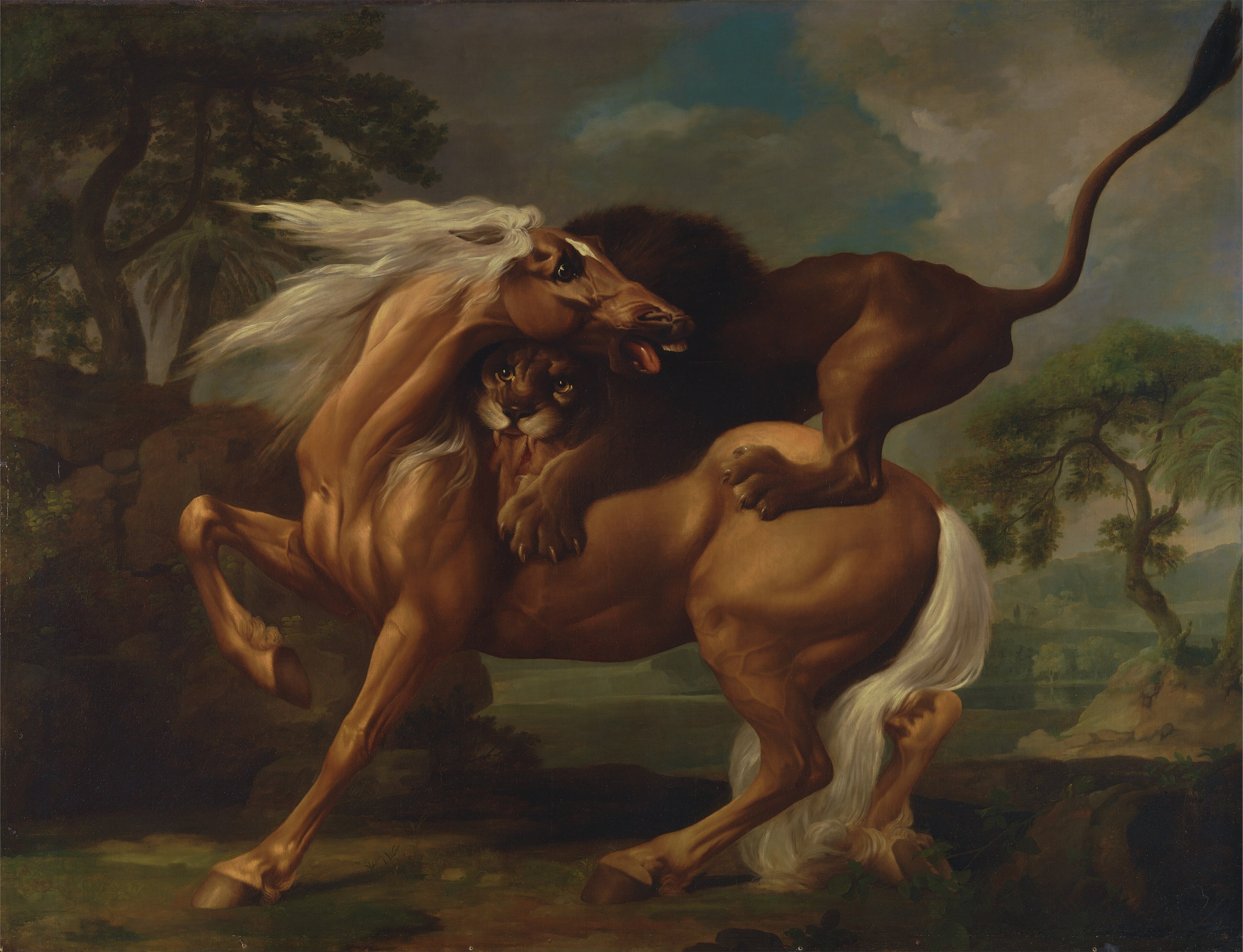
4. A Lion Attacking a Horse — George Stubbs, 1762
In A Lion Attacking a Horse, the horse’s body is again monumental, but control has vanished. A lion lands across its back as the pale animal twists its neck and opens its mouth. The diagonal collision disrupts the broad landscape, turning anatomy into the means by which terror becomes legible.
The Yale Center for British Art identifies the 1762 oil on canvas as B1977.14.71 in the Paul Mellon Collection and records dimensions of 243.8 by 332.7 centimetres.[4] The wide format allows the encounter to spread laterally, unlike Whistlejacket’s upright self-containment. Stubbs does not need a human witness to establish the stakes. The horse’s exposed flank, widened eye and strained turn answer the lion’s compact grip. Read beside the earlier canvas, this work makes the animal’s vulnerability as important as its strength. The same painter who isolated a stallion as an admired individual could also make equine form the centre of a sublime scene of danger.
Horses as political and military theatre
David and Géricault place mounted officers within public history, but their horses pull in different directions. One supports a carefully constructed image of command; the other turns and rears amid smoke, making uncertainty part of the spectacle. The contrast also connects the stable rhetoric of Neoclassical heroism to the volatility associated with Romanticism.
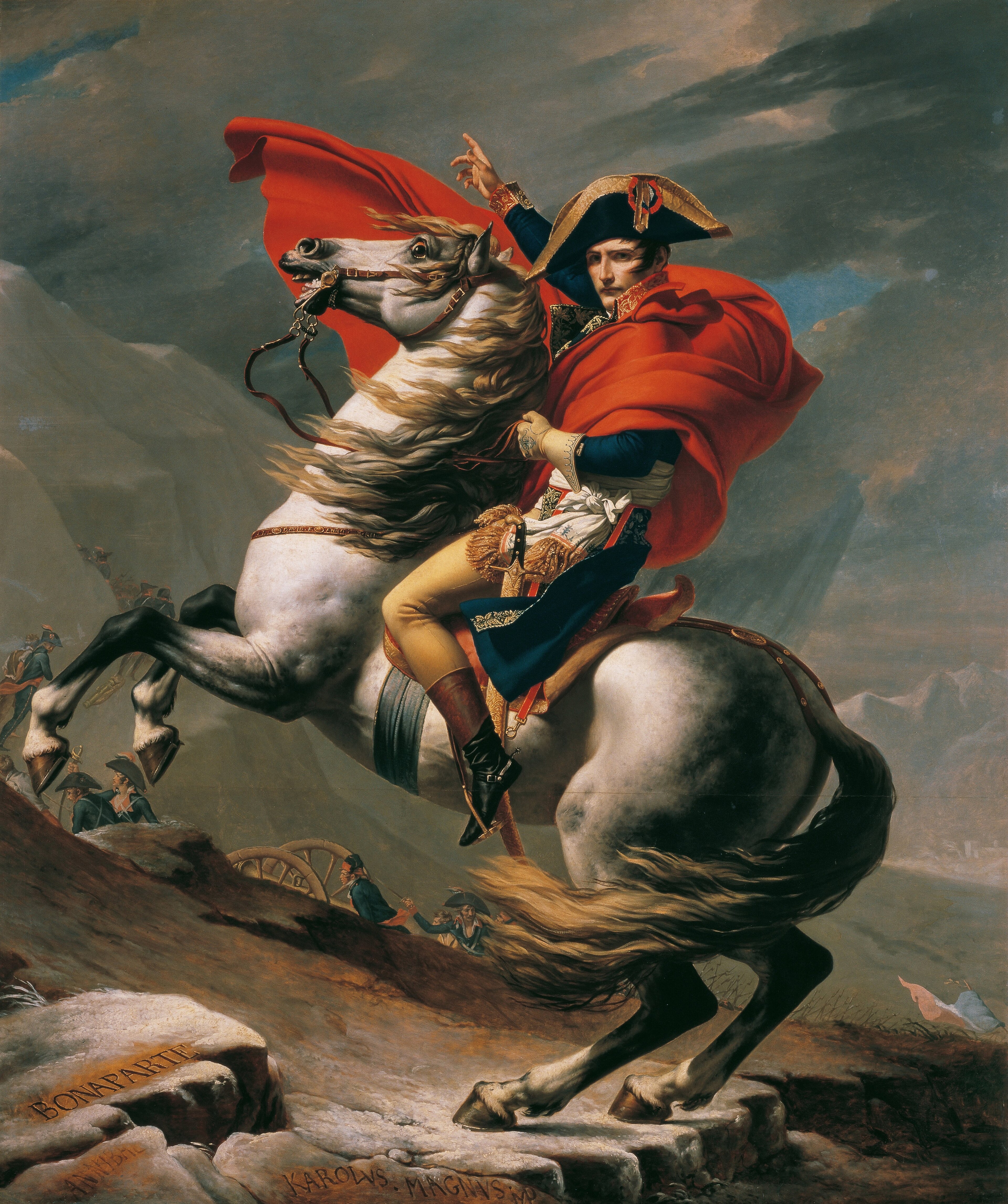
5. Napoleon at the Great St. Bernard Pass — Jacques-Louis David, 1801
In Napoleon Crossing the Alps, the general points upward while his pale horse rears and his cloak streams across the sky. Diagonals of rock, fabric and animal movement turn the ascent into a declaration. Napoleon appears composed within the turbulence: his gesture gives the landscape and mount a common direction.
The selected canvas is the exact 1801 version presented by the Belvedere as Napoleon at the Great St. Bernard Pass. It is an oil on canvas measuring 246 by 231 centimetres, owned by the Kunsthistorisches Museum as GG 2342 and displayed at the Belvedere under inventory 2089.[5] Distinguishing this version matters because David and his studio produced several related canvases. The horse should not be read as documentary proof of how the crossing occurred. Within this painting it is a pictorial engine of political authority: a difficult rear becomes the condition against which Napoleon’s composure is asserted. Visit Jacques-Louis David for portraits and histories that organise power through similarly deliberate gesture.
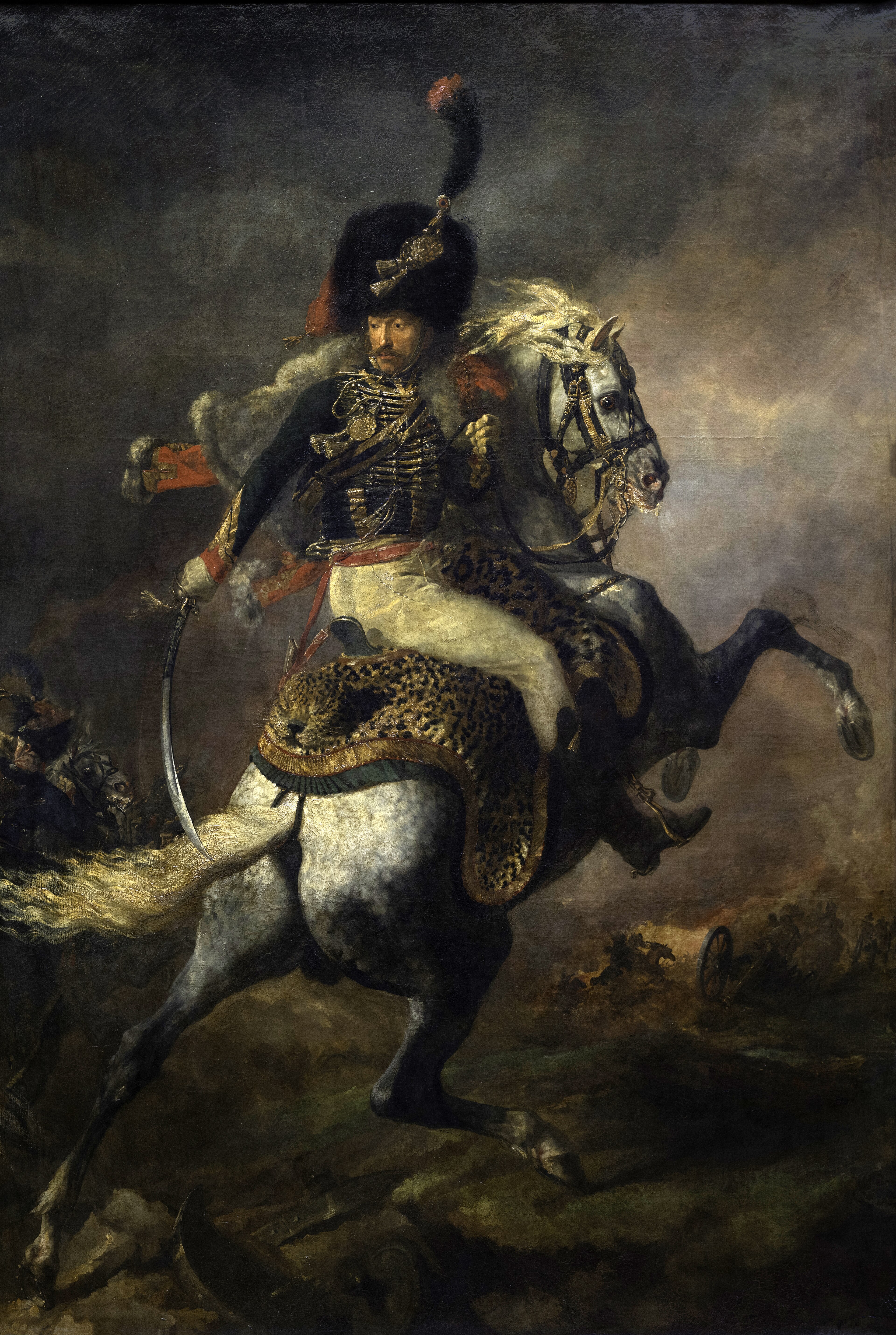
6. The Charging Chasseur — Théodore Géricault, 1812
Géricault’s Charging Chasseur replaces the upward command of David’s Napoleon with a rider twisting back towards the viewer. The officer’s horse rears across a smoky, sloping field. Its hindquarters anchor the lower canvas while its lifted head and forelegs carry the movement toward the obscured action beyond.
The Louvre’s formal title is Officier de chasseurs à cheval de la garde impériale chargeant. The museum records the 1812 oil on canvas as INV 4885, measuring 349 by 266 centimetres.[6] The established English title, The Charging Chasseur, captures the military action but not the picture’s full tension. Rider and horse do not advance along a simple horizontal path. Their opposing turns make direction difficult to settle, and smoke withholds a clear destination. The mount therefore embodies instability as much as martial energy. Explore Théodore Géricault for other works in which weight, movement and threatened balance become central expressive resources.
Market and racetrack: horses in modern public life
The next two paintings move away from singular heroes. Rosa Bonheur studies a mass of horses at a market, while Edgar Degas observes riders waiting before a race. Both turn public equestrian spaces into complex arrangements of attention. Bonheur builds collective momentum across a panoramic field; Degas suspends action and lets anticipation occupy the scene.
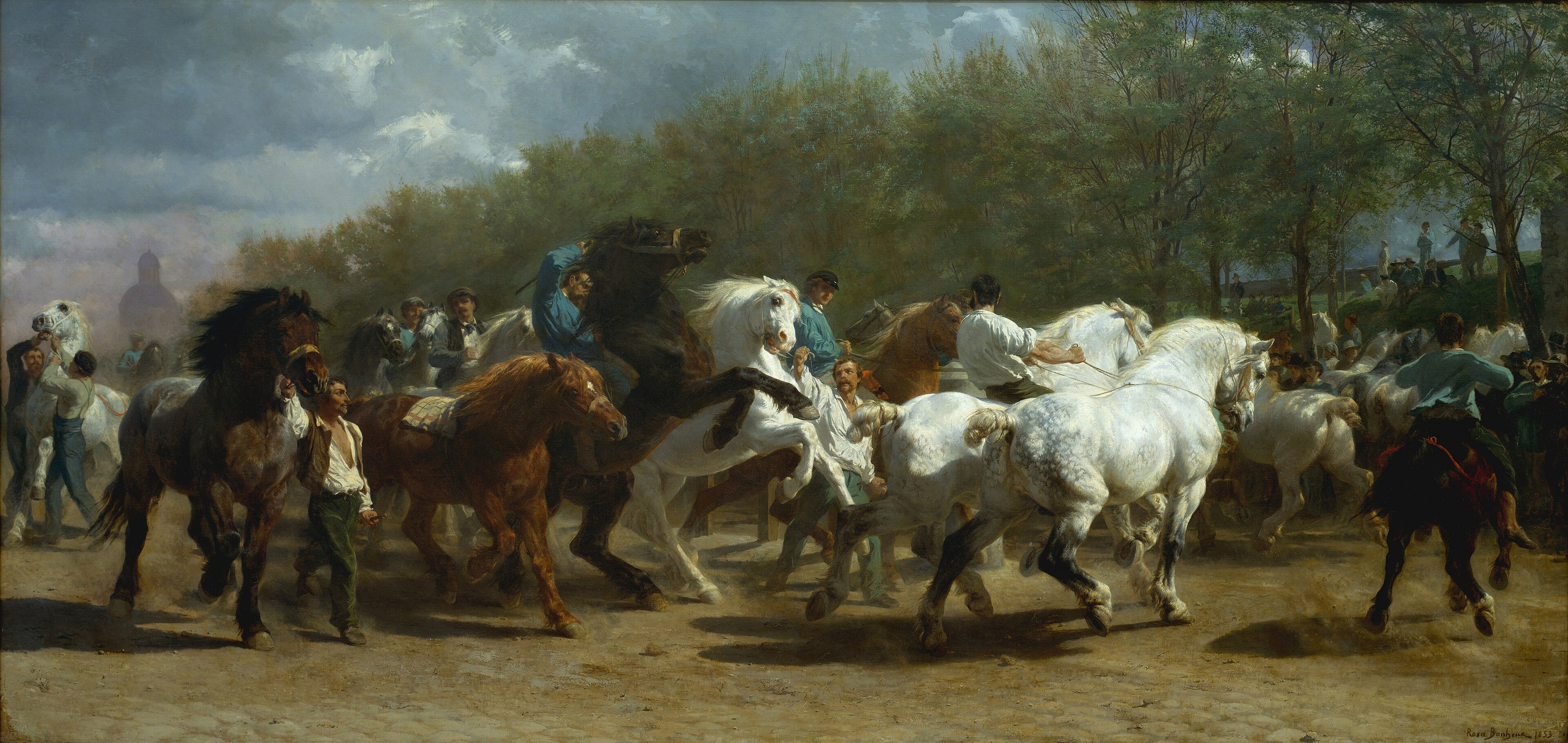
7. The Horse Fair — Rosa Bonheur, 1852–1855
The Horse Fair stretches a procession of horses and handlers across an unusually wide canvas. Some animals advance, others turn or resist, and the human figures work to channel their combined force. The repeated curves of necks and backs produce a rolling rhythm rather than a single dominant silhouette.
The Metropolitan Museum of Art records Bonheur’s oil on canvas as a work of 1852–55, accession 87.25, measuring 244.5 by 506.7 centimetres.[7] Its scale makes the market feel public and collective. No one horse stands as the sole portrait subject, yet the animals are not reduced to an anonymous pattern. Differences of colour, direction and response remain visible within the group. Bonheur balances observation with orchestration: the scene reads as a crowded event while its broad sweep guides the eye from one cluster to the next. See Rosa Bonheur for an artist whose sustained study of animals could support both precise description and ambitious exhibition painting.
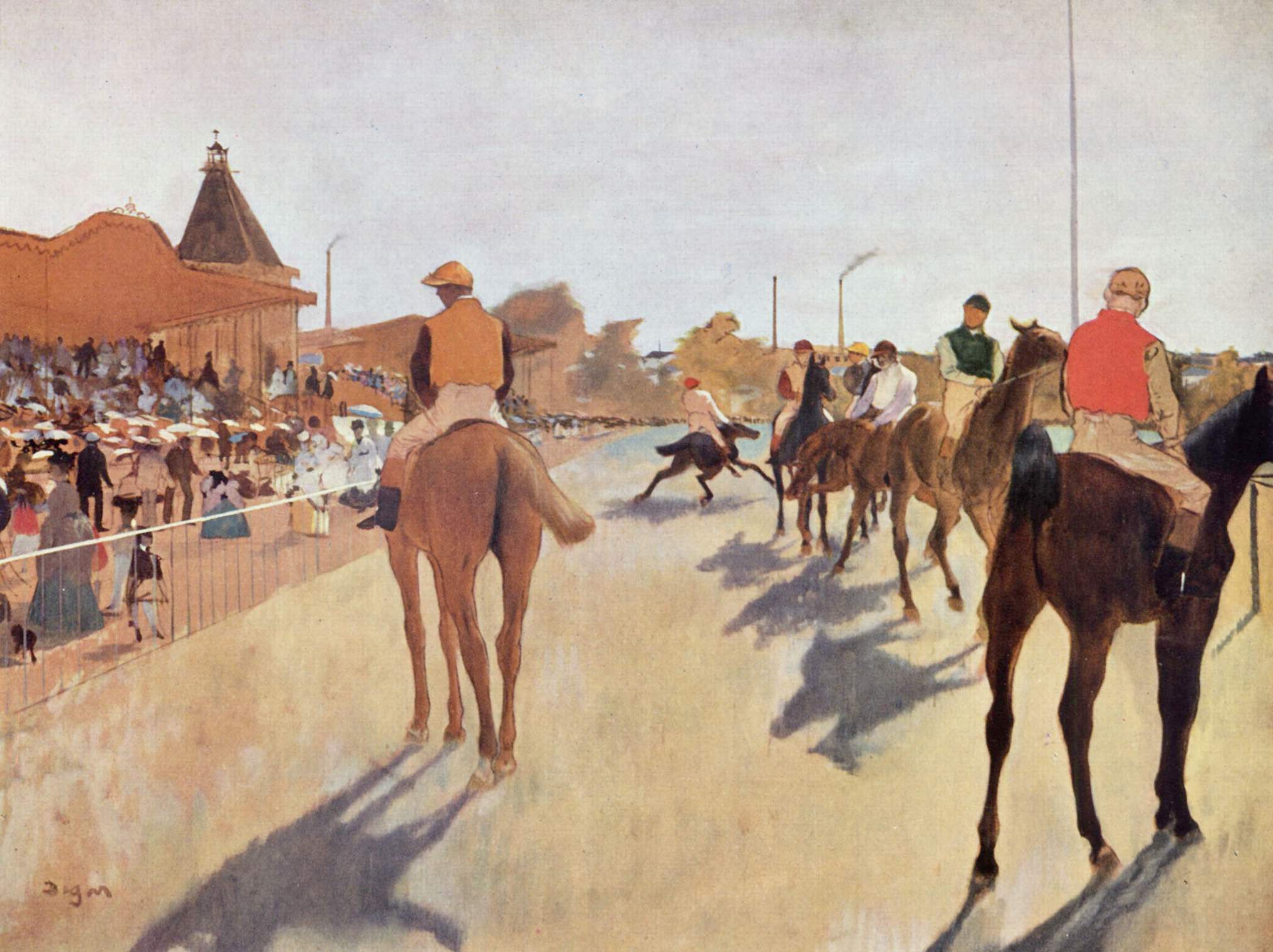
8. The Parade (Racehorses before the Tribunes) — Edgar Degas, 1866–1868
In Degas’s paintings, The Parade (Racehorses before the Tribunes) occupies the pause before competition. Jockeys sit on their mounts near the foreground, while the stands recede across the distance. The horses wait, shift and turn rather than gallop. Their contained energy gives the scene its tension.
The Musée d’Orsay records Le Défilé, known in English as The Parade (Racehorses before the Tribunes), as an oil on paper mounted on canvas of 1866–68, inventory RF 1981, measuring 46 by 61 centimetres.[8] The modest support and lateral format distinguish this modern spectacle from the monumental histories earlier in the sequence. Degas attends to spacing, cropping and the uneven line of mounted bodies. The race is understood through its preparations, not its climax. This interest in a transitory urban leisure scene places the work near the concerns of Impressionism without making the horses incidental. Visit Edgar Degas for dancers, bathers and racecourse subjects shaped by similarly oblique viewpoints.
Franz Marc and horses transformed by colour
The final pair removes rider, market and sporting event. Franz Marc makes horses sufficient subjects and reorganises their bodies through intense colour. His blues are not an attempt to reproduce ordinary coat colour. They establish pictorial relationships among animal, landscape and repeated curves, bringing the sequence into the orbit of Expressionism.
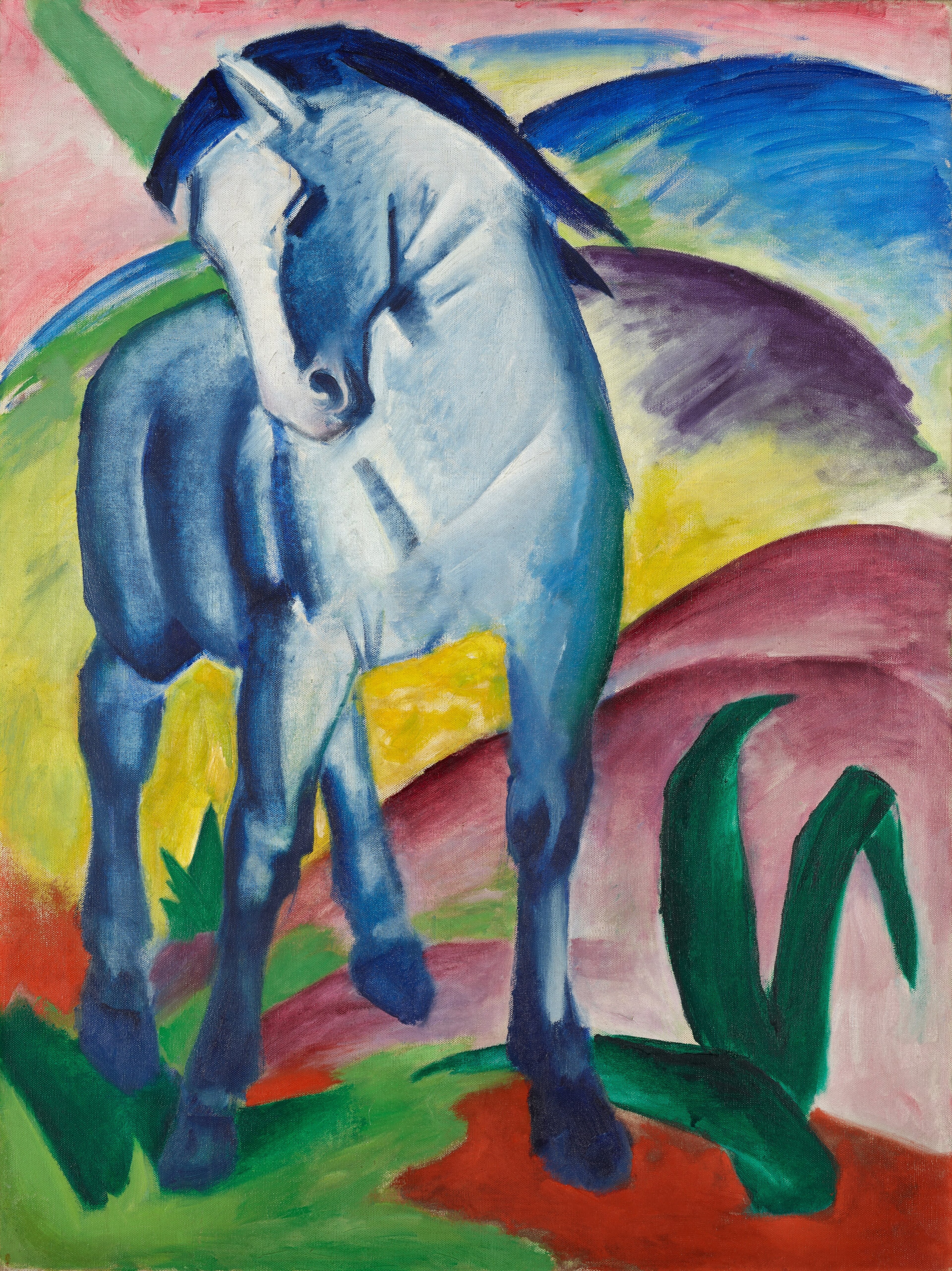
9. Blue Horse I — Franz Marc, 1911
In Blue Horse I, a single blue animal bows its head before rounded areas of red, green and yellow. The vertical canvas gives the horse room to stand as a complete figure, but its contours echo the hills behind it. Animal and landscape remain distinct while sharing a vocabulary of swelling curves.
The Lenbachhaus identifies Blaues Pferd I (Blue Horse I) as a 1911 oil on canvas, inventory G 13324, measuring 112 by 84.5 centimetres.[9] Marc’s departure from natural colour does not erase the horse’s physical character. The lowered head, planted legs and gently turning body make the animal appear quiet and self-contained. Blue concentrates attention while the surrounding bands keep that stillness active. Explore Franz Marc for other animal paintings in which colour and simplified form become means of relation rather than decorative additions.
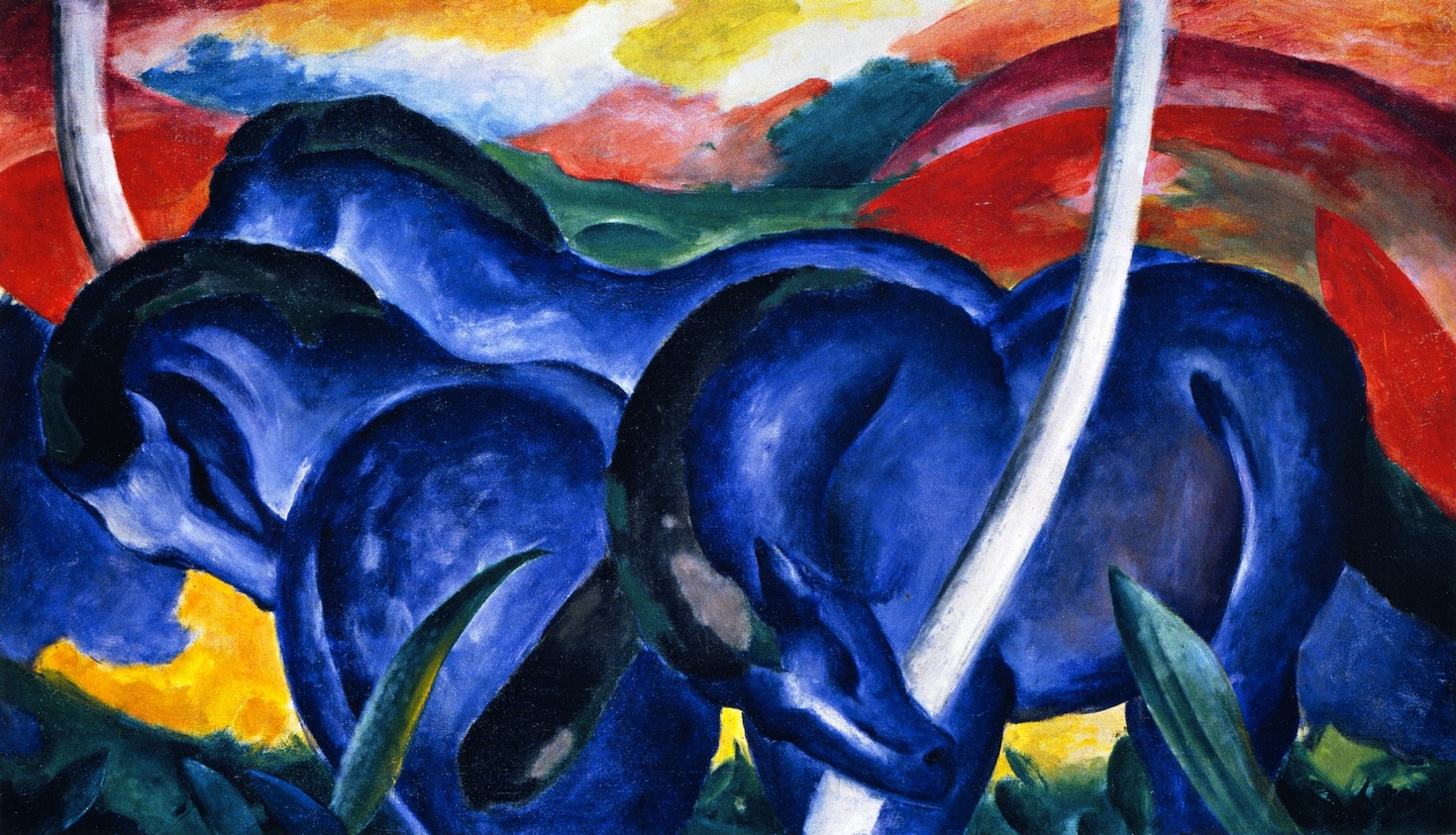
10. The Large Blue Horses — Franz Marc, 1911
The Large Blue Horses extends the solitary figure into a group. Three blue horses bend together across a red and green landscape. Their backs make a sequence of linked arcs, and their overlapping bodies turn individual anatomy into a broad rhythmic unit. The animals seem gathered rather than driven by an event outside the picture.
The Walker Art Center records Die grossen blauen Pferde (The Large Blue Horses) as a 1911 oil on canvas, accession 1942.1, measuring 105.7 by 181.1 centimetres.[10] Its horizontal width encourages comparison with the panoramic movement of Bonheur’s market, but Marc removes handlers, spectators and descriptive setting. The group is organised through colour and repetition. Read beside Blue Horse I, the work shows how one vocabulary can support two different kinds of presence: inward stillness in the single figure and communal rhythm in the trio.
How to look at horses in painting
These ten works reward questions grounded in what can be seen. Does the horse bear a rider or command the canvas alone? Is its movement directed, resisted or suspended? Do scale and viewpoint invite admiration, anxiety or close study? How do human hands, reins, weapons and gestures claim control, and where does the animal’s posture complicate that claim?
The answers resist a single story of progress. El Greco and Rubens use mounted saints differently; Stubbs can make the horse sovereign in one image and vulnerable in another. David and Géricault turn the rear into opposing accounts of command and instability. Bonheur’s market and Degas’s racetrack locate horses within modern public systems, while Marc lets colour bind animal and landscape without a human intermediary.
Horse paintings are therefore more than a catalogue of riders or breeds. They record changing pictorial decisions about agency, power, motion and attention. Beginning with the individual work keeps those decisions distinct. Comparison then reveals the durable challenge that horses offered painters: how to make a large, mobile and responsive body legible without reducing it to equipment, emblem or ornament.
Frequently Asked Questions
El Greco’s Saint Martin and the Beggar, painted in 1597–99, begins the sequence. [1]
Stubbs gives the stallion a monumental canvas without rider, stable or landscape, making the horse the commanding subject. [3]
The guide uses the 1801 canvas owned by the Kunsthistorisches Museum and displayed at the Belvedere, not another version from the series. [5]
Blue Horse I presents one self-contained figure, while The Large Blue Horses organises three animals into a horizontal rhythm. [10]
Discussion
Use the ten works as starting points for close looking at equine posture, scale, movement and relations with riders.
Share an observation about where a horse appears to support, resist or redirect the painting’s human action.
Reader Insights
Which horse’s posture most strongly determines the direction of its composition?
How does the rearing movement function differently for Rubens, Stubbs, David and Géricault?
When does a mounted horse appear to strengthen a rider’s authority, and when does it make control look uncertain?
Join the Conversation
Add your reading below, keeping observations specific and evidence clear.
References
- National Gallery of Art, “Saint Martin and the Beggar”.
- Museo Nacional del Prado, “Saint George and the Dragon”.
- The National Gallery, “Whistlejacket”.
- Yale Center for British Art, “A Lion Attacking a Horse”.
- Belvedere, permanent collection presentation including “Napoleon at the Great St. Bernard Pass”.
- Musée du Louvre, “Officier de chasseurs à cheval de la garde impériale chargeant”.
- The Metropolitan Museum of Art, “The Horse Fair”.
- Musée d’Orsay, “Le Défilé (The Parade)”.
- Lenbachhaus, “Blaues Pferd I (Blue Horse I)”.
- Walker Art Center, “Die grossen blauen Pferde (The Large Blue Horses)”.