


 by Tom Gurney
Tom Gurney BSc (Hons) is an art history expert with over 20 years experience
Published on June 19, 2020 / Updated on October 14, 2023
Email: tomgurney1@gmail.com / Phone: +44 7429 011000
El Greco's Saint Martin and the Beggar: Introduction
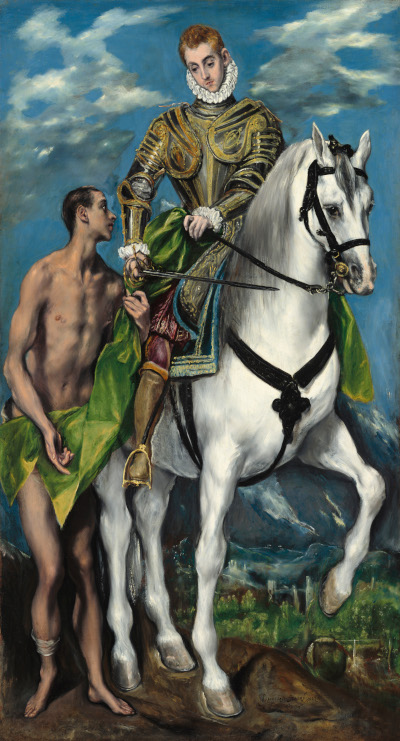
Look at the small distance between Saint Martin's hand and the beggar's. Martin grips a sword. The beggar closes his fingers around a fold of green cloth just beneath it and looks up. Martin looks down, one hand occupied with the blade and the other still holding the reins. A shift of either hand could complete the gift. El Greco holds them in place long enough for us to see how much of the picture depends on that small interval. [1]
El Greco painted this canvas between 1597 and 1599 for a side altar in the Chapel of San José in Toledo. At nearly two metres high, it makes a roadside encounter monumental. The figures and horse rise against the sky, above a glimpse of the city that worshippers knew outside the chapel. The work is now in the National Gallery of Art in Washington, DC, which also owns a smaller painting that repeats the composition. [1]
At a Glance
- ArtistEl Greco (Domenikos Theotokopoulos)
- Date1597–99
- MediumOil on canvas
- Dimensions193.5 × 103 cm
- Original settingSide altar, Chapel of San José, Toledo
- CollectionNational Gallery of Art, Washington, DC, 1942.9.25
- CreditWidener Collection [1]
This work across El Greco’s career
Martyrdom of Saint Maurice
1580–82The Burial of the Count of Orgaz
Commissioned 1586View of Toledo
c. 1599–1600Opening of the Fifth Seal
c. 1608–14View and Plan of Toledo
1610–14Contents
- The soldier's cloak and the dream
- The white horse and the low horizon
- The side altar in the Chapel of San José
- From Toledo to the Widener Collection
- What the smaller Washington painting reveals
The soldier's cloak and the dream
In the fourth-century Life of Saint Martin, Sulpicius Severus tells how Martin, a young soldier and later bishop of Tours, met a man in need at the gate of Amiens during a winter of deadly cold. The man had asked passers-by to take pity on him. Martin had already given away other clothes and was left with his military dress and his arms. Taking his sword, he divided his cloak into two equal parts. He gave half to the man at the gate and wrapped himself in the other half. Sulpicius has some onlookers laugh at what Martin is left wearing. Others see that they could have helped at far less cost to themselves. [2]
That night Martin dreamed that he saw Christ wearing the piece of cloak he had given away. In the dream Christ called attention to the gift and named the giver as Martin, who at this point in the story was preparing for baptism. Sulpicius connects the vision with Christ's teaching that what is done for the least of his brothers and sisters is done for him. The dream makes Martin's ability to see a claim on his attention, where others had seen someone they could walk past, central to the story. [2]
El Greco keeps us in the moment before anyone knows what the gift means. Two men and a horse fill the canvas, and the crowd that Sulpicius describes has vanished from the scene. The beggar's raised chin makes his look towards Martin easy to follow. A light cloth band circles his lower leg, and the green he has gathered across his hips leaves his shoulders bare. Martin wears a white ruff and armour decorated with gold, the equipment of a young nobleman a late sixteenth-century viewer could recognise. A blade suited to the armoured rider reaches from his fist towards the horse's neck. In this scene the sword has the practical work of making a cloak divisible. [1] [3]
The National Gallery of Art reads the elongated figure of the beggar as a possible anticipation of the dream. The encounter also has an immediate physical logic. The beggar needs to look sharply upwards from the roadside to meet a mounted man's gaze. His nearer hand can reach Martin's only at the lowest point of the rider's arm. El Greco lets the vision belong to the story we bring to the picture while these bodily facts give the painted encounter its urgency. [1] [2]
The white horse and the low horizon
The horse occupies most of the foreground. Its foreleg hangs above the landscape at the right, bent at the knee, while its other front hoof comes down near the bottom edge. There is a narrow strip of earth below the hoof and the beggar's feet. Together those points tell us that a man on foot and a man in the saddle are sharing the same uneven ground. Martin's head nearly reaches the top of the picture. The height between his brow and the beggar's is large enough to draw the eye along two linked diagonals, following their glances one way and returning along the green cloth. [1]
The horse's head, turned towards us, makes the impression of height bodily. The outlines of the muzzle and pointed ears are clear above the ground. Black tack runs over the white face and chest, and the reins take a diagonal across the mane. The slim sword begins close to where the reins begin, then runs at a shallower angle beneath them. For a viewer standing back, the sword and reins are visible as two separate lines because they pass in front of the horse's light coat. Closer in, the rider's duties become clearer in the different positions of his hands. His left hand holds the horse in check while his right brings the sword to the cloth. [1]
There is scarcely any townscape behind the men's upper bodies. The horizon lies low enough for the beggar's profile and Martin's face to be seen against blue and grey. The horse's lifted hoof overlaps a distant slope, and the small buildings below it give a rough measure of the depth between the roadside figures and the river valley. At the altarpiece's scale that distribution of detail matters. Seen across the chapel, the pale horse and the spread of green would hold together while the little towers softened into landscape. As the viewer came nearer, the bandage, the hand closing on the cloth and the metal fittings would emerge at their different heights. [1]
The National Gallery identifies Toledo and the Tagus in the distance. María José Martínez Ruiz and Miguel Ángel Zalama point to the Alcántara Bridge and the castle of San Servando among the features that make Toledo recognisable. In the separate View of Toledo, the crossing and the rise to the skyline demand sustained attention in their own right. Here the city has been brought down almost to hoof level. El Greco gives it yet another function in View and Plan of Toledo, where a young man holds a plan and the Hospital de Tavera stands apart from the walled city. In the Saint Martin, the low terrain gives height to the two men and brings a story set at Amiens within sight of the streets around the chapel. [1] [3] [4] [5]
The side altar in the Chapel of San José
Two men named Martín Ramírez were involved in the chapel's history. The first, a Toledo merchant who died in 1568, provided the endowment behind the foundation. The second, Martín Ramírez de Zayas, was his great-nephew, a professor of theology and the patron who signed the contract with El Greco on 9 November 1597. By that time the chapel designed by Nicolás de Vergara the Younger had been built. Its brick façade and sober classical portal gave way to a family chapel with burial places and an interior in which the paintings would have a conspicuous role. [1] [3] [6]
El Greco on video
Open the film at 2:35 on YouTube. The gallery also includes related films from museum curators.
El Greco's Most Famous Paintings
A short survey of El Greco’s paintings, including View of Toledo.
Watch on YouTubeThe commission covered three retables, the architectural structures that framed the paintings and stood above the altars. El Greco undertook the painted canvases and the structures that would hold them. The contract named the subjects for the high altar, with Saint Joseph and the Christ Child below the Coronation of the Virgin. The subjects of the side canvases are known through the installed works and their histories. Saint Martin and the Beggar stood on the Gospel side, to the left as one faced the high altar. Across from it was Madonna and Child with Saint Martina and Saint Agnes. [1] [3] [6]
The two side paintings brought the family's names into the chapel through the saints. The male Saint Martin shared a name with both the founder and the contracting patron. The companion painting included Martina, the feminine form of Martin, as well as Agnes, who bore the name of the founder's mother. Martínez Ruiz and Zalama connect these choices to the family's place in the commission. St Martin was one point of reference in a building dedicated to Joseph, whose painted figure still presides over the main altar. The regional heritage inventory describes angels scattering flowers above Joseph and the child and a view of Toledo opening around them. A viewer moving between the altars could thus find the city below Joseph and the child and, on the Gospel side, below Martin's horse. [3] [6]
The site also helps explain the shape of the canvas. An upright opening between the columns of a side retable gave the rider room to tower over the man on foot while keeping both in the same narrow field. The early arrangement placed the side altars to either side of the principal one. Martínez Ruiz and Zalama trace a later relocation towards the centre of the chapel when family tombs were installed. The relationship of the side paintings to the high altar consequently belongs to the history of the room as well as to the history of each picture. The museum canvas invites a close inspection of the cloak and sword that a visitor to the chapel would first have registered within a framed ensemble. [1] [3]
From Toledo to the Widener Collection
The chapel's two side paintings left together in the early twentieth century. The National Gallery dates their passage through the Paris dealers Boussod, Valadon & Co. to 1906 in its provenance for Saint Martin and the Beggar. It also gives 1906 as the year in which the American collector Peter A. B. Widener acquired the painting. Martínez Ruiz and Zalama, working from the firm's stock books, report that both paintings entered the dealer's stock on 17 October 1907 and that the firm recorded their sale to Widener on 26 October 1909. The sources agree on the route through Paris and into the Widener collection and give different dates for its stages. [1] [3]
The sale provoked debates in the Spanish press and parliament in 1907 over what should happen when private owners sold works that had long formed part of a city's artistic heritage. Correspondence examined by Martínez Ruiz and Zalama shows that the Spanish government explored recovering the pictures through its embassy in Paris. The attempt failed. The National Gallery records an exhibition loan in New York in 1915. The Saint Martin entered the national collection in Washington in 1942 through the Widener gift. Both side canvases are now in that collection. The main altar canvases remain in Toledo, where they give some idea of how much of El Greco's work at San José depended on a visitor's view of several pictures at once. [1] [3] [6]
What the smaller Washington painting reveals
The second Washington Saint Martin and the Beggar, accession 1937.1.84, is dated 1600–14. Its original painted surface is 99.5 by 55 centimetres, roughly half the height of the San José canvas. The National Gallery's collection page credits it to “Greek 16th Century” and lists El Greco as a related artist. It entered the museum with the Andrew W. Mellon Collection in 1937. The two canvases can be recognised by the same steep difference in height between the men, the raised foreleg of the horse and the gathering of cloth near the sword. In the smaller picture a brighter blue sky and more continuous outlines around the figures give the same arrangement a different finish. [7]
Conservator Susanna P. Griswold set out to determine how the two pictures were related. A modello would be a small painting made in preparation for the larger one. A ricordo records a design already worked out. A finished surface can leave these functions hard to distinguish, since both kinds of painting can look quite complete. Griswold compared X-rays and microscopic cross sections of the paint layers and looked for decisions in the making of the larger picture that the maker of the second might already have known. [8]
Among the clearest examples lies across the horse's breast. The X-rays of the large canvas show that the black strap originally sat a little higher. Griswold found that it was moved while the white paint of the horse was still wet. A ridge of paint formed as the brush passed over the lead white in the final position of the strap. She also found evidence of a lower initial position for the index finger of Martin's left hand. The X-rays of the small version showed no comparable adjustments. Its maker sketched the neck strap, rein and sword onto the reddish preparation and repeated the harness in its final position from the start. [8]
A small sample near the metal joining the bit and rein offered a different kind of evidence. In the altarpiece Griswold counted nine, possibly ten layers in the sample. Above traces of a white ground and the reddish imprimatura, or tinted preparation, lay grey, light blue and green paint, followed by further layers that included the white of the horse and grey associated with the bridle. In a comparable spot in the smaller painting the sample had a white layer and a grey layer above the preparation. The surface gives a similar impression at that point. Underneath it, the layers of the larger painting preserve part of the process of fitting horse, sky, cloth and tack together. [8]
Griswold drew her conclusion from the radiographs and the local samples together. Exact matching points were unavailable for some samples, and blue saddlecloth from the smaller canvas was unavailable for a direct comparison. The strongest evidence for sequence is the conjunction of simpler layers in sampled passages with the smaller painting's repetition of choices the altarpiece shows El Greco making as he worked. This makes the Washington repetition a ricordo of an established design. Griswold treated the painter's identity as a separate question. Her study discussed the possibility of touches by El Greco in a painting she associated with his workshop, with the extent of any participation unresolved. The distinction between a design and the hands that carried it out recurs across El Greco's style and technique. Here it can be seen in the placement of a single strap, a line settled in wet paint on the Toledo canvas and set down in its final position on the smaller one. [7] [8]
Browse the artworks
Browse the paintings covered in this collection and related works in museum catalogues. Some are by El Greco’s workshop or were formerly attributed to him.
| Name | Date | Medium |
|---|---|---|
| View of Toledo | Around 1599–1600 | Oil on canvas |
| Adoration of the Shepherds | 1612–14 | Oil on canvas |
| Laocoön | About 1610–14 | Oil on canvas |
| The Tears of Saint Peter | 1587–96, Museo del Greco dating | Oil on canvas |
| The Holy Family with Saint Anne | About 1595 | Oil on canvas |
| The Holy Trinity | 1577–79 | Oil on canvas |
| The Burial of the Count of Orgaz | 1586–88, the conventional range | Oil on canvas |
| Disrobing of Christ | 1577–79 | Oil on canvas |
| Opening of the Fifth Seal | About 1608–14 | Oil on canvas |
| Saint Martin and the Beggar | 1597–99 | Oil on canvas |
| Martyrdom of Saint Maurice | 1580–82 | Oil on canvas |
| Adoration of the Name of Jesus | 1577–79 | Oil on canvas |
| Saint Peter in Penitence (Bowes Museum) | 1580s | Oil on canvas |
| Christ Carrying the Cross | Around 1577–87 | Oil on canvas |
| Crucifixion | 1597–1600 | Oil on canvas |
| Resurrection | 1597–1600 | Oil on canvas |
| Immaculate Conception | About 1608–13 | Oil on canvas |
| Annunciation | 1597–1600 | Oil on canvas |
| Coronation of the Virgin | 1591–92 | Oil on canvas |
| Lady in a Fur Wrap | About 1580–88 | Oil on canvas |
| Baptism of Christ | Around 1608–14, with further work in the early 1620s according to Walter Liedtke. The foundation dates the painting to around 1614. | Oil on canvas |
| Portrait of an Old Man (Possible Self-Portrait) | About 1595–1600 | Oil on canvas |
| Adoration of the Kings | 1565–67, Benaki Museum dating | Tempera on wood |
| Mary Magdalene in Penitence | About 1585–90, tentatively dated by the Museu del Cau Ferrat | Oil on canvas |
| Saint Sebastian | About 1577 in the cathedral centenary catalogue | Oil on canvas |
| Portrait of Cardinal Fernando Nino de Guevara | About 1600 | Oil on canvas |
| Penitent Magdalene | About 1576–77 | Oil on canvas |
| The Nobleman with his Hand on his Chest | About 1580 | Oil on canvas |
| Saint Peter and Saint Paul | 1590–1600 | Oil on canvas |
| Pentecost | Circa 1600 | Oil on canvas |
| The Fable | About 1580 | Oil on canvas |
| Pietà | 1580–90 | Oil on canvas |
| View and Plan of Toledo | 1610–1614, according to the Museo del Greco | Oil on canvas |
| Assumption of the Virgin | 1577–79, with 1577 in the Greek inscription | Oil on canvas |
| The Annunciation (1609) | Late Tavera period. The owner dates the canvas to 1614. Factum gives 1608–1613 in its initial recording account. | Oil on canvas |
| The Agony in the Garden of Gethsemane | 1590s | Oil on canvas |
| Portrait of Jorge Manuel Theotocópuli | Circa 1600–05 | Oil on canvas |
| Dormition of the Virgin | About 1565–66, according to the National Gallery of Greece | Tempera on wood |
| Saint Louis | 1585–90 | Oil on canvas |
| Ecstasy of St Francis of Assisi (1580) | About 1577–80 in the Vatican Museums’ account. The Diocesan Museum gives 1575–80. | Oil on canvas |
| Saint Francis of Assisi in Ecstasy, after El Greco | Seventeenth century | Oil on canvas |
| Christ Driving the Money Changers from the Temple | Probably before 1570 | Oil on wood |
| The Entombment of Christ | Circa 1568–70, Venice | Mixed technique on wood |
| Nativity | 1603–05 | Oil on canvas |
| Portrait of a Gentleman | About 1586 | Oil on canvas |
| Coronation of the Virgin (Illescas) | 1603–05 | Oil on canvas |
| A Boy Blowing on an Ember to Light a Candle (El Soplón) | About 1570–72 | Oil on canvas |
| The Feast in the House of Simon | About 1608–14 | Oil on canvas |
| Concert of Angels | About 1608–14 | Oil on canvas |
| Healing of the Man Born Blind | Around 1570 in Dresden’s printed collection guide | Mixed technique on wood |
| Fray Hortensio Félix Paravicino | 1609 | Oil on canvas |
| Purification of the Temple | Circa 1600 | Oil on canvas |
| Portrait of Vincenzo Anastagi | Circa 1575 | Oil on canvas |
| Saint Paul (Almadrones) | 1608–14 | Oil on canvas |
| Head of Christ | About 1579–86 | Oil on canvas |
| Last Supper | About 1567–68, Venice | Tempera on wood |
| Saint John the Evangelist (Prado Museum, Madrid) | About 1605 | Oil on canvas |
| Disrobing of Christ (Lyon, Half Painting Version) | About 1581–86 | Oil on canvas |
| The Dream of Philip II | 1577–79 | Oil on canvas |
| Portrait of a Sculptor | About 1577–80, 2019 exhibition dating | Oil on canvas |
| Saint Bernard | 1577–79 | Oil on canvas |
| Saint Benedict | 1577–79 | Oil on canvas |
| Portrait of Jerónimo de Cevallos | 1613, as catalogued by the Prado | Oil on canvas |
| The Flight into Egypt | About 1570 | Oil on wood |
| Saint Anthony of Padua | About 1580 | Oil on canvas |
| Portrait of a Doctor | 1582–85 | Oil on canvas |
| The Veil of Saint Veronica | 1586–95 | Oil on canvas |
| An Elderly Gentleman | About 1587–1600 | Oil on canvas |
| Saints Andrew and Francis | About 1595 | Oil on canvas |
| The Holy Family with Saint Anne and the Infant Saint John | Around 1600 in the Prado catalogue. The Balaguer record gives 1595–1600. | Oil on canvas |
| The Virgin Mary | 1595–1600 | Oil on canvas |
| Portrait of a Gentleman (1600-1605) | About 1600–05 | Oil on canvas |
| Portrait of a Young Gentleman | 1600–05 | Oil on canvas |
| John the Baptist and Saint John the Evangelist | 1600–10 | Oil on canvas |
| Portrait of a Friar | 1600–50 | Oil on canvas |
| Saint Thomas (Almadrones) | 1608–14 | Oil on canvas |
| Christ the Saviour (Almadrones) | 1608–14 | Oil on canvas |
| An Apostle (Prado P000814) | 1608–14 | Oil on canvas |
| Saint James (Almadrones) | 1608–14 | Oil on canvas |
| Julián Romero and his Patron Saint | 1612–18 | Oil on canvas |
| Allegory of the Camaldolese Order | Around 1600, Instituto Valencia de Don Juan dating | Oil on canvas |
| Saint Joseph and the Christ Child | 1597–99 | Oil on canvas |
| Saint Ildefonsus | Around 1600 according to the Prado's proposal, 1603–05 in Hadjinicolaou and Ficonofue | Oil on canvas |
| Saint Augustine | About 1585–1602, as listed in the 2014 exhibition study | Oil on canvas |
| Portrait of Diego de Covarrubias y Leyva | Circa 1600 | Oil on canvas |
| Saint Bernardino of Siena | 1603 in the Prado catalogue. The Museo del Greco object page lists 1602. | Oil on canvas |
| Portrait of Cardinal Tavera | About 1609 in the foundation's account, circa 1610 in its image heading | Oil on canvas |
| Visitation | About 1610–14 | Oil on canvas |
| Portrait of Francisco de Pisa | Circa 1610–14 | Oil on canvas |
| Saint Lawrence's Vision of the Madonna and Child (Apparition of the Virgin to St. Lawrence) | 1578–80 in the 2021 heritage decree | Oil on canvas |
| Christ on the Cross | Probably 1570s, assigned to El Greco’s Italian period in the sale literature | Oil on canvas |
| Portrait of Charles de Guise | 1572, as dated in the painted book | Oil on canvas |
| Portrait of Giulio Clovio | 1571–72, according to Capodimonte | Oil on canvas |
| Mount Sinai | About 1570–72 | Mixed technique on wood |
| Modena Triptych | 1567–1568, as dated by the Galleria Estense and the national catalogue | Tempera on wood |
| Saint Luke Painting the Virgin | 1560–67, Benaki Museum dating | Mixed technique on wood |
| Saint Ildefonso (Washington) | 1603–14 | Oil on canvas |
| Saint Martin and the Beggar (smaller Washington version) | 1600–14 | Oil on canvas |
| The Holy Family with Saint Anne and the Infant John the Baptist (Washington) | About 1595–1600 | Oil on canvas |
| The Adoration of the Name of Jesus (London panel) | Late 1570s | Oil on wood |
| Christ Driving the Traders from the Temple (London) | About 1600 | Oil on canvas |
| Saint Francis Receiving the Stigmata (Baltimore) | 1585–90 | Oil on canvas |
| Saint Luke (Almadrones, Indianapolis) | About 1610–14 | Oil on canvas |
| Saint Matthew (Almadrones, Indianapolis) | About 1610–14 | Oil on canvas |
| Saint Simon (Almadrones, Indianapolis) | About 1610–14 | Oil on canvas |
| The Tears of Saint Peter (Hospital de Tavera) | About 1605 | Oil on canvas Catalogue. |
Discussion
Look again at the images and ideas explored in El Greco's Saint Martin and the Beggar. These editorial prompts invite your observations.
Reader Insights
Which detail of the sword, hands or cloth makes Martin’s decision clearest to you?
Compare the two Washington versions. What difference would you spot without knowing what the X-rays and paint samples revealed?
Join the Conversation
Share a detail, comparison or question about El Greco's Saint Martin and the Beggar below.
References
- National Gallery of Art, Saint Martin and the Beggar, El Greco, 1942.9.25, collection record and provenance View source.
- Sulpicius Severus, On the Life of St. Martin, chapters 2–3 and 9, translated by Alexander Roberts View source.
- María José Martínez Ruiz and Miguel Ángel Zalama, El patrimonio al cuidado de sus depredadores, in El Greco en su IV Centenario (2016), pp. 281–300 (in Spanish) View source.
- The Metropolitan Museum of Art, View of Toledo, 29.100.6, collection record View source.
- Museo del Greco, Vista y plano de Toledo, CE00014, CER.es collection record (in Spanish) View source.
- Portal de Cultura de Castilla-La Mancha, Capilla de San José de Toledo, heritage inventory (in Spanish) View source.
- National Gallery of Art, Saint Martin and the Beggar, Greek 16th Century, 1937.1.84, collection record and provenance View source.
- Susanna P. Griswold, Two Paintings by El Greco, Saint Martin and the Beggar, in Studies in the History of Art 41 (1993), pp. 132–155 View source.







