


 by Tom Gurney
Tom Gurney BSc (Hons) is an art history expert with over 20 years experience
Published on June 19, 2020 / Updated on October 14, 2023
Email: tomgurney1@gmail.com / Phone: +44 7429 011000
El Greco Quotes: Introduction
El Greco told Cardinal Alessandro Farnese that he had been sent away “through no fault of mine”. Writing from Rome on 6 July 1572, he asked to know why he had been dismissed from the cardinal’s household. Less than two years earlier, the manuscript illuminator Giulio Clovio had written to the same cardinal to recommend the painter and find him a room. The two letters preserve different voices at either end of a patronage relationship. In Toledo, El Greco’s words took other forms. He put his name and Cretan origin on an altarpiece, used a painted map to explain why he moved a building in a view of the city and argued for painting in the margins of a book on architecture. [1] [2] [3] [4] [5]
At a Glance
- “Through no fault of mine”El Greco protests his dismissal in an Italian letter to Cardinal Farnese, 6 July 1572. [1]
- “A young man from Candia, a pupil of Titian”Giulio Clovio recommends El Greco to Farnese in an Italian letter, 16 November 1570. [2]
- “Cretan”El Greco identifies himself in a Greek inscription on The Assumption of the Virgin that bears the date 1577. [3]
- “In the form of a model”The Spanish inscription on View and Plan of Toledo explains the presentation of the Hospital Tavera. [4]
- “What it is for a painter to see”El Greco weighs what words can convey about vision in handwritten notes in his copy of Vitruvius. [5]
Contents
- El Greco’s appeal to Cardinal Farnese, 1572
- Giulio Clovio introduces a young painter, 1570
- A Cretan name on a Toledo altarpiece, 1577
- Why move a hospital? The words on the Toledo plan
- Reading Vitruvius with a painter’s eye
- What did El Greco say about Michelangelo?
El Greco’s appeal to Cardinal Farnese, 1572
The Italian phrase “senza colpa mia”, “through no fault of mine”, belongs to a sentence in which El Greco argues that he deserved better treatment. He says that Count Ludovico Tedesco, the cardinal’s household officer, had dismissed him shortly after Farnese’s departure, claiming to act on the cardinal’s orders. The address directs the letter to Farnese at Caprarola. El Greco appeals to a man who could have heard about the matter through his own officer and whose version of events he needed to understand. [1]
The painter recalls that the cardinal had called him into his service and praises Farnese for taking talented people into his household. He presents himself as ready to obey and ends by affirming his continuing loyalty. In the middle of these courtesies he asks what warranted the humiliation, says that the charge is false and offers to clear himself. The letter gives his side of the dispute. It leaves the grounds for the cardinal’s decision unknown. The biography follows what the records can establish about El Greco’s independent work in Rome after the dismissal. [1] [2]
The final lines matter for dating the incident. The text ends with 6 July 1572 and the name “Domenico Teotocopuli”. The secretary’s docket also gives 6 July and identifies the correspondent as a painter. The letter is now in the State Archive of Parma, as is Clovio’s earlier recommendation. Their addresses and signatures preserve two moments when the artists needed something from the same patron. [1] [2]
Giulio Clovio introduces a young painter, 1570
On 16 November 1570 Clovio described the new arrival in Rome as “un giovane Candiotto, discepolo di Titiano”, “a young man from Candia, a pupil of Titian”. Candia, now Heraklion, placed him geographically. Titian’s name placed him in the company of painters a cardinal in Rome would know. This is Clovio’s description in a recommendation. The precise nature of El Greco’s connection with Titian, including whether he served a formal apprenticeship, remains uncertain. [2]
Clovio’s example of the young man’s ability was a self-portrait which, he wrote, had astonished Rome’s painters. Clovio asked Farnese to arrange a room upstairs in the Palazzo Farnese while El Greco settled in. The scale of the request is part of the letter’s persuasion. The cardinal could help a promising painter through his existing household, and Clovio would consider himself obliged in return. The self-portrait’s present whereabouts are unknown. In the surviving portrait of Clovio, El Greco shows the illuminator holding open the book he made for Farnese. The book identifies Clovio by the skill that had earned him a place with the patron to whom he wrote. [2]
The two letters give Ludovico a role in securing and withdrawing access. Clovio proposes that Farnese ask his household officer to assign the room. El Greco later identifies the officer as the man who told him to leave. A request for somewhere to stay thus opens a small window onto the practical workings of patronage. An introduction got the painter into the house. The patron’s favour and the decisions communicated by his staff governed how long he could stay. [1] [2]
A Cretan name on a Toledo altarpiece, 1577
Look at the lower right of The Assumption of the Virgin and the artist’s name appears on what looks like a slip of paper. The inscription is painted on the canvas. According to the Art Institute of Chicago’s translation from the Greek, it names Domenikos Theotokopoulos, identifies him as “Cretan” and says that he displayed the work in 1577. The museum dates the painting to 1577–79. The year in the inscription marks the statement El Greco chose to include on the canvas. The larger altarpiece belongs to a commission that took shape over more than one year. [3]
The canvas stood at the centre of the lower tier of the high altar at the Cistercian convent of Santo Domingo el Antiguo in Toledo, with The Holy Trinity above. Mary rises at the centre, and the apostles below respond to her departure with lifted heads and moving hands. At the edge of this crowded scene the slip identifies the person responsible for the work. Clovio had described him by his city and a painter with whom he was associated. Here El Greco gives his own name and place of origin in Greek on a major public work in Spain. [2] [3]
Why move a hospital? The words on the Toledo plan
A young man at the right of View and Plan of Toledo holds up a map that can be read alongside the city behind him. The Museo del Greco transcribes an accompanying note in which the writer says it was necessary to show the Hospital of Juan Tavera “en forma de modelo”, “in the form of a model”. In its usual position the building would have covered the Bisagra Gate, and its dome would have risen too prominently in relation to the city. Once the painter had moved the hospital, he chose to show its front. The note directs the viewer to the plan for the building’s relationship to the city. [4]
The hospital appears on a bank of cloud in front of Toledo, where its façade can be seen clearly. A viewer can pick it out, find the gate farther back and consult the map for the arrangement the painter has adjusted. The projected view and the plan do jobs that a single view could hardly perform together. The picture can keep the distinctive appearance of a building, show the gate that would have been obscured and still provide a way to place the hospital in relation to Toledo. The note accompanies the map inside the painting, so the choice of viewpoint remains legible to viewers long after the city’s appearance changed. [4]
A second note concerns the Virgin bringing a chasuble, or priestly vestment, to Saint Ildefonso. To explain the size of the heavenly figures, the writer compares them to lights “vistas de lexos”, “seen from far away”, that can look large even when they are small. Both paragraphs guide a viewer who might otherwise ask why parts of the scene seem to sit at the wrong scale or distance. The first describes a decision about what the city view should make visible. The second appeals to an ordinary experience of looking in order to explain a scene in the sky. In each case the inscription gives the viewer something specific to test against the image. [4]
Reading Vitruvius with a painter’s eye
El Greco’s copy of Vitruvius is the 1556 Italian edition translated and annotated by Daniele Barbaro, now in the Biblioteca Nacional de España. In the margins of the edition’s preface, El Greco says that he considers “la ymitacion de colores”, “the imitation of colours”, the greatest difficulty. He goes on to explain that the painter must fool knowledgeable viewers by producing convincing appearances. El Greco wrote the words in the course of reading a work devoted to architecture. In the same volume he challenged the privileges Barbaro accorded to architecture and made a case for the reach of his own profession. [5] [6]
Elsewhere in the same volume he wonders whether he could put into words “lo ques el ver del Pintor”, “what it is for a painter to see”. The phrase occurs in an argument about what painters can judge. El Greco says that painting imitates all kinds of things and calls particular attention to form and colour. The variety of things a painter needs to observe is part of the difficulty of describing the painter’s faculty of seeing. That ambition fits the range of subjects within the Toledo panorama itself, where a building on a cloud, a city on a hillside and a group of luminous figures call for different ways of depicting what appears before the eye. [4] [5]
The point about imitation can also be tested on a portrait. José Riello discusses El Greco’s likeness of Cardinal Juan Pardo de Tavera, who died long before it was painted. Riello argues that the painter used a death mask that Alonso Berruguete had taken to prepare the effigy for the cardinal’s tomb. A cast offered a record of the face. Colour could give that face a complexion and make the sitter seem present to the viewer. For more on the means by which El Greco made those effects, see Style and Technique. [5] [6]
What did El Greco say about Michelangelo?
In Arte de la pintura, published in 1649, the painter Francisco Pacheco recalled asking El Greco in Toledo in 1611 which was harder, drawing or colouring. According to Pacheco, El Greco answered that colouring was harder. Pacheco goes on to report that El Greco thought Michelangelo was a good man who “didn’t know how to paint”. Pacheco calls Michelangelo the father of painting in the same sentence. Elsewhere on the page he holds up Michelangelo as the artist he would follow in drawing the nude. Those judgements help explain why he considered the conversation worth retelling. [7]
The physician Giulio Mancini tells a different story in his early seventeenth-century Considerazioni sulla pittura. While discussing objections to the figures in Michelangelo’s Last Judgement, Mancini says that El Greco offered to repaint the fresco with greater decorum if it were taken down, and claimed that his version would be at least as accomplished. Mancini links the remark to El Greco’s departure for Spain. His account was written decades after the supposed incident. The dismissal letter and the records of El Greco’s continued work in Rome leave the cause of his eventual departure open. Pacheco says he took part in the 1611 exchange. Mancini recounts something he understood to have happened earlier, in another city and in a debate over a particular work. [1] [2] [7]
The margin of El Greco’s Vitruvius also preserves a more specific assessment of Michelangelo. In a note on his knowledge of architecture, El Greco credits him with a great command of drawing the human body. This was precisely where Pacheco admired him. The remarks become clearer when read beside the question each speaker was addressing. Recording what a painter can do with the human form in a book on architecture, weighing drawing against colouring in conversation and judging the suitability of a fresco for a chapel all put different demands on the same set of skills. [2] [5] [7]
Browse the artworks
Browse the paintings covered in this collection and related works in museum catalogues. Some are by El Greco’s workshop or were formerly attributed to him.
| Name | Date | Medium |
|---|---|---|
| View of Toledo | Around 1599–1600 | Oil on canvas |
| Adoration of the Shepherds | 1612–14 | Oil on canvas |
| Laocoön | About 1610–14 | Oil on canvas |
| The Tears of Saint Peter | 1587–96, Museo del Greco dating | Oil on canvas |
| The Holy Family with Saint Anne | About 1595 | Oil on canvas |
| The Holy Trinity | 1577–79 | Oil on canvas |
| The Burial of the Count of Orgaz | 1586–88, the conventional range | Oil on canvas |
| Disrobing of Christ | 1577–79 | Oil on canvas |
| Opening of the Fifth Seal | About 1608–14 | Oil on canvas |
| Saint Martin and the Beggar | 1597–99 | Oil on canvas |
| Martyrdom of Saint Maurice | 1580–82 | Oil on canvas |
| Adoration of the Name of Jesus | 1577–79 | Oil on canvas |
| Saint Peter in Penitence (Bowes Museum) | 1580s | Oil on canvas |
| Christ Carrying the Cross | Around 1577–87 | Oil on canvas |
| Crucifixion | 1597–1600 | Oil on canvas |
| Resurrection | 1597–1600 | Oil on canvas |
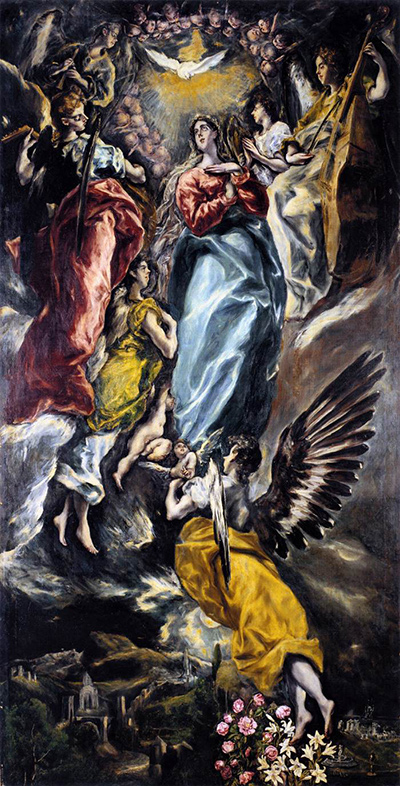
| Immaculate Conception | About 1608–13 | Oil on canvas |
| Annunciation | 1597–1600 | Oil on canvas |
| Coronation of the Virgin | 1591–92 | Oil on canvas |
| Lady in a Fur Wrap | About 1580–88 | Oil on canvas |
| Baptism of Christ | Around 1608–14, with further work in the early 1620s according to Walter Liedtke. The foundation dates the painting to around 1614. | Oil on canvas |
| Portrait of an Old Man (Possible Self-Portrait) | About 1595–1600 | Oil on canvas |
| Adoration of the Kings | 1565–67, Benaki Museum dating | Tempera on wood |
| Mary Magdalene in Penitence | About 1585–90, tentatively dated by the Museu del Cau Ferrat | Oil on canvas |
| Saint Sebastian | About 1577 in the cathedral centenary catalogue | Oil on canvas |
| Portrait of Cardinal Fernando Nino de Guevara | About 1600 | Oil on canvas |
| Penitent Magdalene | About 1576–77 | Oil on canvas |
| The Nobleman with his Hand on his Chest | About 1580 | Oil on canvas |
| Saint Peter and Saint Paul | 1590–1600 | Oil on canvas |
| Pentecost | Circa 1600 | Oil on canvas |
| The Fable | About 1580 | Oil on canvas |
| Pietà | 1580–90 | Oil on canvas |
| View and Plan of Toledo | 1610–1614, according to the Museo del Greco | Oil on canvas |
| Assumption of the Virgin | 1577–79, with 1577 in the Greek inscription | Oil on canvas |
| The Annunciation (1609) | Late Tavera period. The owner dates the canvas to 1614. Factum gives 1608–1613 in its initial recording account. | Oil on canvas |
| The Agony in the Garden of Gethsemane | 1590s | Oil on canvas |
| Portrait of Jorge Manuel Theotocópuli | Circa 1600–05 | Oil on canvas |
| Dormition of the Virgin | About 1565–66, according to the National Gallery of Greece | Tempera on wood |
| Saint Louis | 1585–90 | Oil on canvas |
| Ecstasy of St Francis of Assisi (1580) | About 1577–80 in the Vatican Museums’ account. The Diocesan Museum gives 1575–80. | Oil on canvas |
| Saint Francis of Assisi in Ecstasy, after El Greco | Seventeenth century | Oil on canvas |
| Christ Driving the Money Changers from the Temple | Probably before 1570 | Oil on wood |
| The Entombment of Christ | Circa 1568–70, Venice | Mixed technique on wood |
| Nativity | 1603–05 | Oil on canvas |
| Portrait of a Gentleman | About 1586 | Oil on canvas |
| Coronation of the Virgin (Illescas) | 1603–05 | Oil on canvas |
| A Boy Blowing on an Ember to Light a Candle (El Soplón) | About 1570–72 | Oil on canvas |
| The Feast in the House of Simon | About 1608–14 | Oil on canvas |
| Concert of Angels | About 1608–14 | Oil on canvas |
| Healing of the Man Born Blind | Around 1570 in Dresden’s printed collection guide | Mixed technique on wood |
| Fray Hortensio Félix Paravicino | 1609 | Oil on canvas |
| Purification of the Temple | Circa 1600 | Oil on canvas |
| Portrait of Vincenzo Anastagi | Circa 1575 | Oil on canvas |
| Saint Paul (Almadrones) | 1608–14 | Oil on canvas |
| Head of Christ | About 1579–86 | Oil on canvas |
| Last Supper | About 1567–68, Venice | Tempera on wood |
| Saint John the Evangelist (Prado Museum, Madrid) | About 1605 | Oil on canvas |
| Disrobing of Christ (Lyon, Half Painting Version) | About 1581–86 | Oil on canvas |
| The Dream of Philip II | 1577–79 | Oil on canvas |
| Portrait of a Sculptor | About 1577–80, 2019 exhibition dating | Oil on canvas |
| Saint Bernard | 1577–79 | Oil on canvas |
| Saint Benedict | 1577–79 | Oil on canvas |
| Portrait of Jerónimo de Cevallos | 1613, as catalogued by the Prado | Oil on canvas |
| The Flight into Egypt | About 1570 | Oil on wood |
| Saint Anthony of Padua | About 1580 | Oil on canvas |
| Portrait of a Doctor | 1582–85 | Oil on canvas |
| The Veil of Saint Veronica | 1586–95 | Oil on canvas |
| An Elderly Gentleman | About 1587–1600 | Oil on canvas |
| Saints Andrew and Francis | About 1595 | Oil on canvas |
| The Holy Family with Saint Anne and the Infant Saint John | Around 1600 in the Prado catalogue. The Balaguer record gives 1595–1600. | Oil on canvas |
| The Virgin Mary | 1595–1600 | Oil on canvas |
| Portrait of a Gentleman (1600-1605) | About 1600–05 | Oil on canvas |
| Portrait of a Young Gentleman | 1600–05 | Oil on canvas |
| John the Baptist and Saint John the Evangelist | 1600–10 | Oil on canvas |
| Portrait of a Friar | 1600–50 | Oil on canvas |
| Saint Thomas (Almadrones) | 1608–14 | Oil on canvas |
| Christ the Saviour (Almadrones) | 1608–14 | Oil on canvas |
| An Apostle (Prado P000814) | 1608–14 | Oil on canvas |
| Saint James (Almadrones) | 1608–14 | Oil on canvas |
| Julián Romero and his Patron Saint | 1612–18 | Oil on canvas |
| Allegory of the Camaldolese Order | Around 1600, Instituto Valencia de Don Juan dating | Oil on canvas |
| Saint Joseph and the Christ Child | 1597–99 | Oil on canvas |
| Saint Ildefonsus | Around 1600 according to the Prado's proposal, 1603–05 in Hadjinicolaou and Ficonofue | Oil on canvas |
| Saint Augustine | About 1585–1602, as listed in the 2014 exhibition study | Oil on canvas |
| Portrait of Diego de Covarrubias y Leyva | Circa 1600 | Oil on canvas |
| Saint Bernardino of Siena | 1603 in the Prado catalogue. The Museo del Greco object page lists 1602. | Oil on canvas |
| Portrait of Cardinal Tavera | About 1609 in the foundation's account, circa 1610 in its image heading | Oil on canvas |
| Visitation | About 1610–14 | Oil on canvas |
| Portrait of Francisco de Pisa | Circa 1610–14 | Oil on canvas |
| Saint Lawrence's Vision of the Madonna and Child (Apparition of the Virgin to St. Lawrence) | 1578–80 in the 2021 heritage decree | Oil on canvas |
| Christ on the Cross | Probably 1570s, assigned to El Greco’s Italian period in the sale literature | Oil on canvas |
| Portrait of Charles de Guise | 1572, as dated in the painted book | Oil on canvas |
| Portrait of Giulio Clovio | 1571–72, according to Capodimonte | Oil on canvas |
| Mount Sinai | About 1570–72 | Mixed technique on wood |
| Modena Triptych | 1567–1568, as dated by the Galleria Estense and the national catalogue | Tempera on wood |
| Saint Luke Painting the Virgin | 1560–67, Benaki Museum dating | Mixed technique on wood |
| Saint Ildefonso (Washington) | 1603–14 | Oil on canvas |
| Saint Martin and the Beggar (smaller Washington version) | 1600–14 | Oil on canvas |
| The Holy Family with Saint Anne and the Infant John the Baptist (Washington) | About 1595–1600 | Oil on canvas |
| The Adoration of the Name of Jesus (London panel) | Late 1570s | Oil on wood |
| Christ Driving the Traders from the Temple (London) | About 1600 | Oil on canvas |
| Saint Francis Receiving the Stigmata (Baltimore) | 1585–90 | Oil on canvas |
| Saint Luke (Almadrones, Indianapolis) | About 1610–14 | Oil on canvas |
| Saint Matthew (Almadrones, Indianapolis) | About 1610–14 | Oil on canvas |
| Saint Simon (Almadrones, Indianapolis) | About 1610–14 | Oil on canvas |
| The Tears of Saint Peter (Hospital de Tavera) | About 1605 | Oil on canvas Catalogue. |
Discussion
Look again at the images and ideas explored in El Greco Quotes. These editorial prompts invite your observations.
Reader Insights
Read Clovio’s recommendation alongside El Greco’s letter to Farnese. What can each letter tell you about the artist’s relationship with his patron?
Which detail of View and Plan of Toledo makes more sense after reading El Greco’s inscription?
Join the Conversation
Share a detail, comparison or question about El Greco Quotes below.
References
- Almudena Pérez de Tudela, Una carta inédita de El Greco al Cardenal Alessandro Farnesio, Archivo Español de Arte 73, 2000, pp. 267–268. Spanish with the letter transcribed in Italian, dated 6 July 1572 in the letter and docket. View source.
- Guido Checchi, Roma 1572, la “fiammata mistica” di Anthonie Blocklandt, El Greco e Giovanni de’ Vecchi, University of Bologna, 2017. Italian. See pp. 56–59 for Mancini’s account and Clovio’s letter, p. 69 for the guild record and the Anastagi portrait, and pp. 135–137 for the portrait of Clovio. View source.
- Art Institute of Chicago, The Assumption of the Virgin, 1906.99. English, with the museum’s translation of the Greek inscription. View source.
- Museo del Greco, Vista y plano de Toledo. Spanish, with both passages from the inscription. View source.
- Javier Docampo and José Riello, eds., La biblioteca del Greco, Museo Nacional del Prado, 2014. Spanish. See Riello’s notes 100, 104 and 106 on pp. 64–65 for the transcriptions, citing Fernando Marías and Agustín Bustamante, Las ideas artísticas de El Greco, 1981, and catalogue entry 22 for the annotated volume, Biblioteca Nacional de España R/33475. The note on colour is in the proem, pp. 8–9 in the 1556 edition. View source.
- José Riello, Mímesis de la muerte, Alonso Berruguete, El Greco y los retratos del cardenal Tavera, Archivo Español de Arte 95, 2022, pp. 47–66. Spanish. See pp. 59–61 for the marginal note on colour and the discussion of painted likeness. View source.
- Francisco Pacheco, Arte de la pintura, Seville, 1649, book II, p. 242, Getty Research Institute copy. Spanish. View source.







