


 by Tom Gurney
Tom Gurney BSc (Hons) is an art history expert with over 20 years experience
Published on June 19, 2020 / Updated on October 14, 2023
Email: tomgurney1@gmail.com / Phone: +44 7429 011000
An Elderly Gentleman by El Greco: Introduction
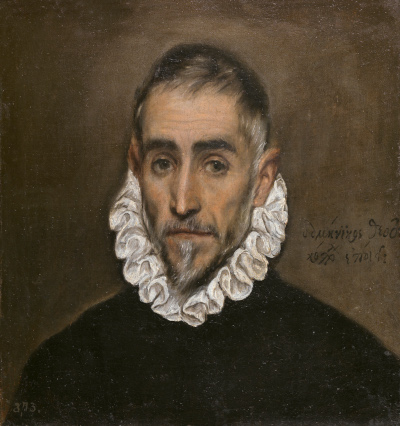
The grey point of the man's beard hangs over the brightest part of the collar. To either side, folds of white linen climb towards his ears, leaving his narrow face between them. The folds have crisp turns and dark hollows. The much softer light across the man's forehead and cheeks draws the eye up to his gaze. El Greco gives these passages nearly the whole task of making the sitter present in a canvas just 46 centimetres high. [1]
The Museo Nacional del Prado dates An Elderly Gentleman to about 1587–1600. It is a short bust of an unidentified man, recorded in the Spanish royal collection by 1666. A Greek signature gives the painter's name, and a number low on the canvas belongs to the work's later history in the museum. The record of the painting is more detailed than the record of the person it depicts. [1]
At a Glance
- ArtistEl Greco (Doménikos Theotokópoulos)
- TitleAn Elderly Gentleman (Caballero anciano)
- DateAbout 1587–1600
- MediumOil on canvas
- Dimensions46 × 43 cm (height × width)
- CollectionMuseo Nacional del Prado, Madrid, P000806 [1]
This work across El Greco’s career
The Disrobing of Christ
1577–79The Assumption of the Virgin
1577–79Martyrdom of Saint Maurice
1580–82The Burial of the Count of Orgaz
Commissioned 1586An Elderly Gentleman (current article)
About 1587–1600View of Toledo
c. 1599–1600Contents
- How the collar frames the face
- A brown wash and a red ground
- Two marks and a palace inventory
- Three portraits for comparison
How the collar frames the face
The shoulders spread from the collar to the lower sides of the canvas, forming a single expanse of dark clothing. Above them the ear on the viewer's right breaks the outline with a little warm colour. The collar turns up directly beneath it. On the viewer's left the linen opens into a series of broader loops by the cheek. Each fold takes the light on a narrow lip, and the shadow within the loop carries some of the brown and grey tones that appear in the face. The collar is the lightest thing in the picture, but its individual strokes keep leading back towards the head. [1]
Follow the edge of the collar down to the chin. Here the strokes that describe linen are broad enough to distinguish from the fine lines of the beard. The grey hairs catch light in small groups against its brown shadows. Near the mouth the beard and moustache part just enough to reveal the line of the lips, which retains a little warmth. A similar change of scale occurs farther up. The light on the nose is slim and intermittent, while the large area of the forehead is established by gentler changes of tone. The face seems close because its smallest details are still available to the eye. [1]
The eyes sit at slightly different levels, and the bridge of the nose descends on a slight slant. The fringe, nose and point of the beard make a line that changes direction as it passes down the head. This gives the front-facing pose some movement even though both shoulders are at rest. Look at the brow on one side and then the other. A fuller area of shadow under one eyebrow gives the two eyes a different degree of definition. The effect is built into the placement of the features and the edges of the paint. [1]
A brown wash and a red ground
In the Prado's catalogue, Leticia Ruiz Gómez describes a thin brown wash over a red ground, with ochre worked into the area behind the head and above the shoulders. A ground is the prepared layer on which the visible painting is built. Here the brown is thin enough to let that preparation contribute to its colour. The lighter area around the head is broadest near the softer outline of the fringe. A few strands are distinct. Elsewhere the transition from hair to background is so gradual that the rounded shape of the head registers before its edge does. [1]
Ruiz Gómez also discusses an X-radiograph in which the paint appears sparingly applied. A small amount of colour can suffice to indicate a ridge of bone, a fold under the eye or a tuft of hair, particularly when the layers below already supply a middle tone. The whitest crests of the collar use the same economy of placement in a different way. The longest strokes turn with the loops, and short marks in between give the linen places to fold back into shadow. [1]
The catalogue records small losses in the background and some older retouching in the hair and face. In 1980 Javier Carrión cleaned the canvas after a lining by José Gómez Manso, removing oxidised varnish and addressing some cloudy areas associated with the lining. The lining had reinforced the fabric where there were cuts along the edges. The treatment history helps explain why the surface can show both deliberate soft transitions and slight irregularities. The catalogue distinguishes those conditions from El Greco's use of the underlying red and the thin brown paint. [1]
Two marks and a palace inventory
The earliest known record places the painting in the entrance room to the Galería del Cierzo at Madrid's Real Alcázar. Listed as number 476 in 1666, it was described as a small portrait by El Greco in a white frame. Ruiz Gómez also traces it in the 1686 and 1701 Alcázar inventories. The room and frame belong to its documented life in the royal collection. Its first owner and the reason it was commissioned remain unknown. [1]
The painting was recorded in the studio of Vicente López, first painter to the court, in 1839, and the Prado displayed it that year. Its 1843 inventory places it on the stairs in the southern part of the museum. Look at the lower left of the canvas and the small grey number 373 is still discernible. The catalogue identifies it with the Prado's numbering between 1843 and 1858. On the right side of the image, above the sitter's left shoulder, the darker writing is El Greco's Greek signature. The number and the signature connect the object to different moments, one in its making and the other in its museum history. [1]
The Prado's 1902 El Greco exhibition listed the canvas in the Great Hall as number 238, with the same dimensions the museum gives today. In his 1908 book Manuel B. Cossío also recorded it as a signed portrait of an unknown gentleman. A later proposal to identify the sitter through a resemblance to another royal-collection portrait lacked enough evidence to carry the name over. The generic title has endured through the painting's increasingly detailed catalogue history. [1] [2] [3]
Three portraits for comparison
In El Greco's Portrait of a Gentleman, the Prado's P000813 of about 1586, the figure has room to turn his shoulders across a canvas measuring 67 × 55 cm. The sitter's slender moustache and goatee stand out in dark strokes against the skin. The Prado describes white paint built up in some of the folds of his collar and fine touches of orange and pink around the features. Here the much larger passage of black clothing makes the face and collar a smaller part of the whole painting. In P000806, those same areas are much closer to the canvas edges. The difference is easy to feel by comparing how far the eye moves from the lower point of each collar to the bottom of the picture. [1] [4]
A third Prado canvas, P000810, is also titled Portrait of a Gentleman. It dates from about 1600–05 and measures 64 × 51 cm. The sitter's wide, closely pleated ruff rises almost against his cheeks and casts a shadow where it meets his beard. Ruiz Gómez describes the reddish preparation showing through the collar in places, where it helps model the pleats. In the elderly man's portrait the collar opens in smaller loops, and the pointed beard briefly obscures them at the centre. The difference in the linen is especially clear at the lower edge, where the heavy fringe of the larger ruff sits well below the chin. [1]
The Metropolitan Museum of Art's Portrait of an Old Man, 24.197.1, is a separate canvas of about 1595–1600. Its small scale and direct gaze make it a close comparison. The Met notes that its dark grey ground shows through the thinly brushed features and treats the traditional identification as a possible self-portrait. The Prado man's hair covers more of his head, and his simpler black clothing puts the brightest contrast directly around the neck. In Madrid, the path from the collar to the eyes, along the narrow planes of the face, offers a way into a portrait whose sitter remains anonymous. [1] [5]
Browse the artworks
Browse the paintings covered in this collection and related works in museum catalogues. Some are by El Greco’s workshop or were formerly attributed to him.
| Name | Date | Medium |
|---|---|---|
| View of Toledo | Around 1599–1600 | Oil on canvas |
| Adoration of the Shepherds | 1612–14 | Oil on canvas |
| Laocoön | About 1610–14 | Oil on canvas |
| The Tears of Saint Peter | 1587–96, Museo del Greco dating | Oil on canvas |
| The Holy Family with Saint Anne | About 1595 | Oil on canvas |
| The Holy Trinity | 1577–79 | Oil on canvas |
| The Burial of the Count of Orgaz | 1586–88, the conventional range | Oil on canvas |
| Disrobing of Christ | 1577–79 | Oil on canvas |
| Opening of the Fifth Seal | About 1608–14 | Oil on canvas |
| Saint Martin and the Beggar | 1597–99 | Oil on canvas |
| Martyrdom of Saint Maurice | 1580–82 | Oil on canvas |
| Adoration of the Name of Jesus | 1577–79 | Oil on canvas |
| Saint Peter in Penitence (Bowes Museum) | 1580s | Oil on canvas |
| Christ Carrying the Cross | Around 1577–87 | Oil on canvas |
| Crucifixion | 1597–1600 | Oil on canvas |
| Resurrection | 1597–1600 | Oil on canvas |
| Immaculate Conception | About 1608–13 | Oil on canvas |
| Annunciation | 1597–1600 | Oil on canvas |
| Coronation of the Virgin | 1591–92 | Oil on canvas |
| Lady in a Fur Wrap | About 1580–88 | Oil on canvas |
| Baptism of Christ | Around 1608–14, with further work in the early 1620s according to Walter Liedtke. The foundation dates the painting to around 1614. | Oil on canvas |
| Portrait of an Old Man (Possible Self-Portrait) | About 1595–1600 | Oil on canvas |
| Adoration of the Kings | 1565–67, Benaki Museum dating | Tempera on wood |
| Mary Magdalene in Penitence | About 1585–90, tentatively dated by the Museu del Cau Ferrat | Oil on canvas |
| Saint Sebastian | About 1577 in the cathedral centenary catalogue | Oil on canvas |
| Portrait of Cardinal Fernando Nino de Guevara | About 1600 | Oil on canvas |
| Penitent Magdalene | About 1576–77 | Oil on canvas |
| The Nobleman with his Hand on his Chest | About 1580 | Oil on canvas |
| Saint Peter and Saint Paul | 1590–1600 | Oil on canvas |
| Pentecost | Circa 1600 | Oil on canvas |
| The Fable | About 1580 | Oil on canvas |
| Pietà | 1580–90 | Oil on canvas |
| View and Plan of Toledo | 1610–1614, according to the Museo del Greco | Oil on canvas |
| Assumption of the Virgin | 1577–79, with 1577 in the Greek inscription | Oil on canvas |
| The Annunciation (1609) | Late Tavera period. The owner dates the canvas to 1614. Factum gives 1608–1613 in its initial recording account. | Oil on canvas |
| The Agony in the Garden of Gethsemane | 1590s | Oil on canvas |
| Portrait of Jorge Manuel Theotocópuli | Circa 1600–05 | Oil on canvas |
| Dormition of the Virgin | About 1565–66, according to the National Gallery of Greece | Tempera on wood |
| Saint Louis | 1585–90 | Oil on canvas |
| Ecstasy of St Francis of Assisi (1580) | About 1577–80 in the Vatican Museums’ account. The Diocesan Museum gives 1575–80. | Oil on canvas |
| Saint Francis of Assisi in Ecstasy, after El Greco | Seventeenth century | Oil on canvas |
| Christ Driving the Money Changers from the Temple | Probably before 1570 | Oil on wood |
| The Entombment of Christ | Circa 1568–70, Venice | Mixed technique on wood |
| Nativity | 1603–05 | Oil on canvas |
| Portrait of a Gentleman | About 1586 | Oil on canvas |
| Coronation of the Virgin (Illescas) | 1603–05 | Oil on canvas |
| A Boy Blowing on an Ember to Light a Candle (El Soplón) | About 1570–72 | Oil on canvas |
| The Feast in the House of Simon | About 1608–14 | Oil on canvas |
| Concert of Angels | About 1608–14 | Oil on canvas |
| Healing of the Man Born Blind | Around 1570 in Dresden’s printed collection guide | Mixed technique on wood |
| Fray Hortensio Félix Paravicino | 1609 | Oil on canvas |
| Purification of the Temple | Circa 1600 | Oil on canvas |
| Portrait of Vincenzo Anastagi | Circa 1575 | Oil on canvas |
| Saint Paul (Almadrones) | 1608–14 | Oil on canvas |
| Head of Christ | About 1579–86 | Oil on canvas |
| Last Supper | About 1567–68, Venice | Tempera on wood |
| Saint John the Evangelist (Prado Museum, Madrid) | About 1605 | Oil on canvas |
| Disrobing of Christ (Lyon, Half Painting Version) | About 1581–86 | Oil on canvas |
| The Dream of Philip II | 1577–79 | Oil on canvas |
| Portrait of a Sculptor | About 1577–80, 2019 exhibition dating | Oil on canvas |
| Saint Bernard | 1577–79 | Oil on canvas |
| Saint Benedict | 1577–79 | Oil on canvas |
| Portrait of Jerónimo de Cevallos | 1613, as catalogued by the Prado | Oil on canvas |
| The Flight into Egypt | About 1570 | Oil on wood |
| Saint Anthony of Padua | About 1580 | Oil on canvas |
| Portrait of a Doctor | 1582–85 | Oil on canvas |
| The Veil of Saint Veronica | 1586–95 | Oil on canvas |
| An Elderly Gentleman | About 1587–1600 | Oil on canvas |
| Saints Andrew and Francis | About 1595 | Oil on canvas |
| The Holy Family with Saint Anne and the Infant Saint John | Around 1600 in the Prado catalogue. The Balaguer record gives 1595–1600. | Oil on canvas |
| The Virgin Mary | 1595–1600 | Oil on canvas |
| Portrait of a Gentleman (1600-1605) | About 1600–05 | Oil on canvas |
| Portrait of a Young Gentleman | 1600–05 | Oil on canvas |
| John the Baptist and Saint John the Evangelist | 1600–10 | Oil on canvas |
| Portrait of a Friar | 1600–50 | Oil on canvas |
| Saint Thomas (Almadrones) | 1608–14 | Oil on canvas |
| Christ the Saviour (Almadrones) | 1608–14 | Oil on canvas |
| An Apostle (Prado P000814) | 1608–14 | Oil on canvas |
| Saint James (Almadrones) | 1608–14 | Oil on canvas |
| Julián Romero and his Patron Saint | 1612–18 | Oil on canvas |
| Allegory of the Camaldolese Order | Around 1600, Instituto Valencia de Don Juan dating | Oil on canvas |
| Saint Joseph and the Christ Child | 1597–99 | Oil on canvas |
| Saint Ildefonsus | Around 1600 according to the Prado's proposal, 1603–05 in Hadjinicolaou and Ficonofue | Oil on canvas |
| Saint Augustine | About 1585–1602, as listed in the 2014 exhibition study | Oil on canvas |
| Portrait of Diego de Covarrubias y Leyva | Circa 1600 | Oil on canvas |
| Saint Bernardino of Siena | 1603 in the Prado catalogue. The Museo del Greco object page lists 1602. | Oil on canvas |
| Portrait of Cardinal Tavera | About 1609 in the foundation's account, circa 1610 in its image heading | Oil on canvas |
| Visitation | About 1610–14 | Oil on canvas |
| Portrait of Francisco de Pisa | Circa 1610–14 | Oil on canvas |
| Saint Lawrence's Vision of the Madonna and Child (Apparition of the Virgin to St. Lawrence) | 1578–80 in the 2021 heritage decree | Oil on canvas |
| Christ on the Cross | Probably 1570s, assigned to El Greco’s Italian period in the sale literature | Oil on canvas |
| Portrait of Charles de Guise | 1572, as dated in the painted book | Oil on canvas |
| Portrait of Giulio Clovio | 1571–72, according to Capodimonte | Oil on canvas |
| Mount Sinai | About 1570–72 | Mixed technique on wood |
| Modena Triptych | 1567–1568, as dated by the Galleria Estense and the national catalogue | Tempera on wood |
| Saint Luke Painting the Virgin | 1560–67, Benaki Museum dating | Mixed technique on wood |
| Saint Ildefonso (Washington) | 1603–14 | Oil on canvas |
| Saint Martin and the Beggar (smaller Washington version) | 1600–14 | Oil on canvas |
| The Holy Family with Saint Anne and the Infant John the Baptist (Washington) | About 1595–1600 | Oil on canvas |
| The Adoration of the Name of Jesus (London panel) | Late 1570s | Oil on wood |
| Christ Driving the Traders from the Temple (London) | About 1600 | Oil on canvas |
| Saint Francis Receiving the Stigmata (Baltimore) | 1585–90 | Oil on canvas |
| Saint Luke (Almadrones, Indianapolis) | About 1610–14 | Oil on canvas |
| Saint Matthew (Almadrones, Indianapolis) | About 1610–14 | Oil on canvas |
| Saint Simon (Almadrones, Indianapolis) | About 1610–14 | Oil on canvas |
| The Tears of Saint Peter (Hospital de Tavera) | About 1605 | Oil on canvas Catalogue. |
Discussion
Look again at the images and ideas explored in An Elderly Gentleman by El Greco. These editorial prompts invite your observations.
Reader Insights
Pick out two points where the collar catches the light. How do those folds bring your eye back towards the face?
Find the grey number and the painted signature. Which is easier to see against the brown ground?
Join the Conversation
Share a detail, comparison or question about An Elderly Gentleman by El Greco below.
References
- Leticia Ruiz Gómez, El Greco en el Museo Nacional del Prado. Catálogo razonado, Museo Nacional del Prado, 2007, cat. 31, pp. 198–201 and cat. 33, pp. 205–207 View source.
- Museo Nacional del Prado, Catálogo ilustrado de la exposición de El Greco, 1902, no. 238 View source.
- Manuel B. Cossío, El Greco, 1908, cat. no. 74 View source.
- Museo Nacional del Prado, Portrait of a Gentleman, P000813 View source.
- The Metropolitan Museum of Art, Portrait of an Old Man, 24.197.1 View source.







