


 by Tom Gurney
Tom Gurney BSc (Hons) is an art history expert with over 20 years experience
Published on June 19, 2020 / Updated on October 14, 2023
Email: tomgurney1@gmail.com / Phone: +44 7429 011000
El Greco Biography: Introduction
In December 1566, a painter named Domenikos Theotokopoulos asked the Venetian authorities in Candia, Crete, for permission to offer one of his pictures by lottery. Two colleagues had put substantial prices on the gold-ground icon, which depicted the Passion of Christ. Less than two years later his name reappeared in the same administration's records, this time in an order concerning drawings he had sent from Venice. The two documents catch El Greco, as he would come to be known, at the point of leaving an established career. By 1577 he was working in Toledo on two commissions that demanded a different scale of painting and a different way of doing business. His journey can be traced through the people who appraised his work, found him lodging, contracted him to furnish churches and carried on his affairs when he died. [1] [2]
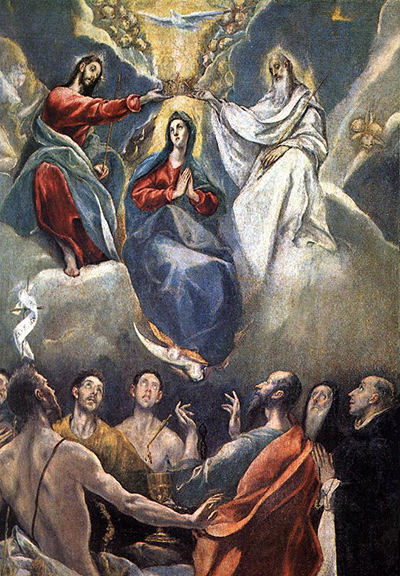
The Coronation of the Virgin from the Talavera la Vieja altarpiece, now at the Real Monasterio de Santa María de Guadalupe.
At a Glance
- NameDomenikos Theotokopoulos, known as El Greco, meaning ‘the Greek’. [2] [3]
- Life1541–1614. He grew up in Venetian-ruled Crete and died in Toledo on 7 April 1614. [1] [2] [3]
- CareerDocumented in Venice by August 1568, in Rome by November 1570 and at work in Toledo in 1577. [1] [2] [3]
- ProfessionPainter of icons, portraits and devotional pictures, and designer and supplier of altarpieces. His son Jorge Manuel became a painter and architect and took responsibility for the estate. [2] [3]
El Greco in context
Titian
c. 1488/90–1576Giulio Clovio
1498–1578Alonso Sánchez Coello
c. 1531/32–1588El Greco
1541–1614Dormition of the Virgin
c. 1565–66Modena Triptych
1567–68The Disrobing of Christ
1577–79The Assumption of the Virgin
1577–79The Holy Trinity
1577–79Martyrdom of Saint Maurice
1580–82The Burial of the Count of Orgaz
Commissioned 1586View of Toledo
c. 1599–1600Opening of the Fifth Seal
c. 1608–14View and Plan of Toledo
1610–14Contents
- Candia and the business of making icons
- Venice and the reach of Titian's name
- Rome, from the Farnese household to an independent practice
- The first commissions in Toledo
- Santo Tomé and the Burial of the Lord of Orgaz
- The mature Toledo workshop
- Tavera, death and the estate
- Dispersal and the changing reputation
Candia and the business of making icons
Theotokopoulos was born on Crete in 1541. Candia, now Heraklion, is the conventional birthplace in museum chronologies and the city in which the early professional record places him. It was the capital of Venetian Crete and a centre for the manufacture and export of icons. A document from 1563 already calls him a master. On 6 June 1566, in a separate record of a Candia property sale, the notary copied out the painter’s signature as a witness. It describes him explicitly as a master painter. The December petition gives a more detailed view of him actually doing business as a painter. His teacher and the details of his apprenticeship remain uncertain. [1] [2] [3]
The petition and the decision recorded on 26 and 27 December 1566 describe a Passion icon painted against gold and a proposed sale by lottery. The priest and painter John De Frossego estimated its value at 80 ducats. George Klontzas, another Cretan painter, put it at 70. Their different estimates are useful because they show painters acting as experts in the valuation of a colleague's work, a procedure that would also matter much later in Spain. The document names a subject and a surface and establishes what El Greco did with the picture. The surviving description is too general to identify an extant panel securely. [1]
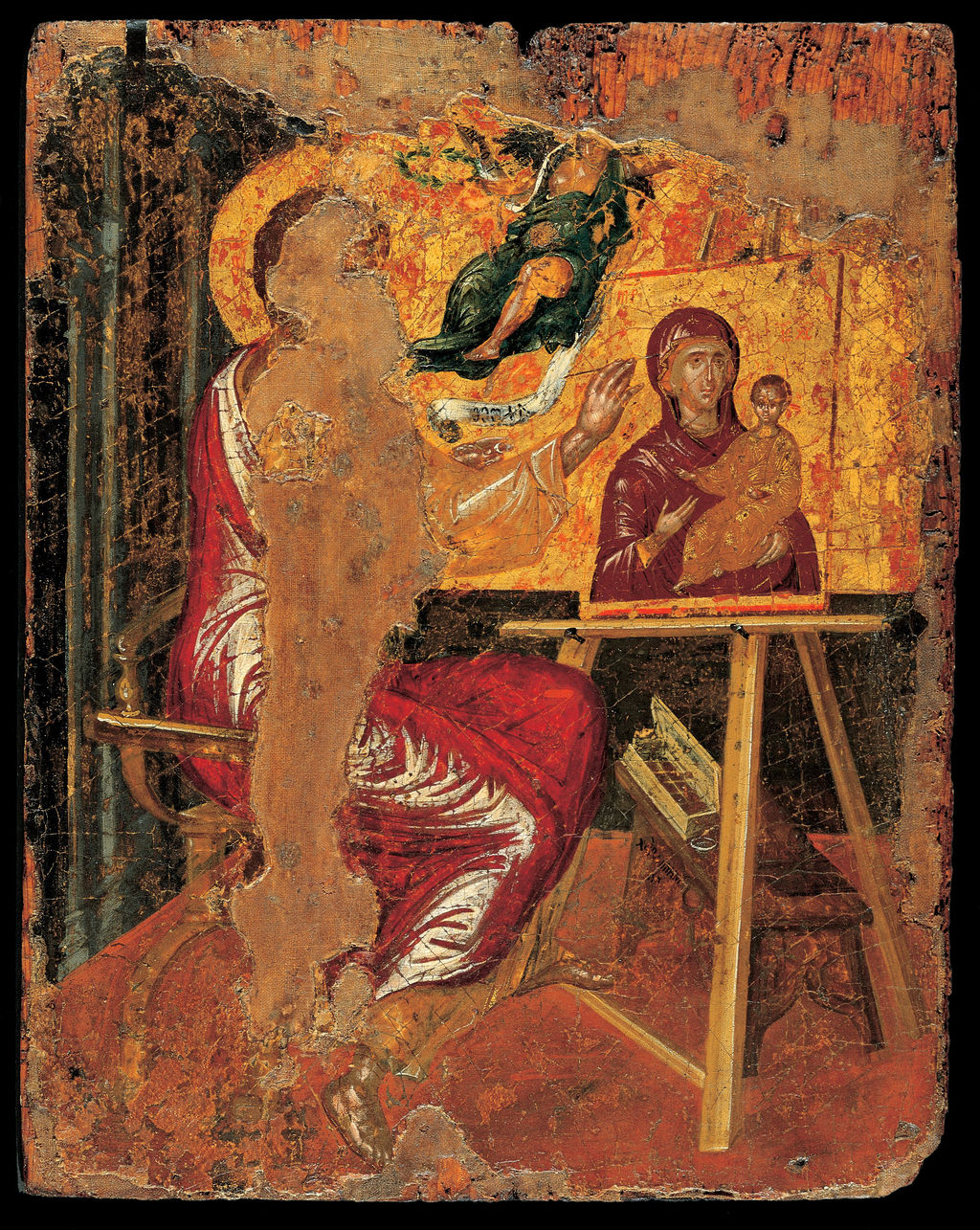
The signed Dormition of the Virgin, now in the Church of the Dormition on Syros, and the Benaki Museum's Saint Luke Painting the Virgin give the early documents a material counterpart. In the latter, Luke works at an image of the Virgin and Child of the type known as the Hodegetria, in which Mary indicates Christ with her hand. The small painting thus contains an icon being made. The space and illumination around Luke allow the painter to treat the making of the image in a different way from the sacred image itself. The picture suggests how much stylistic choice a painter working within that tradition already had. [2] [4]
A document of 12 July 1567 concerns El Greco's elder brother Manoussos and a dispute with the head of the Candia painters' guild over objects belonging to the guild. The scholar who published the record, Maria Constantoudaki, suggested that Manoussos could have been acting for his brother after the painter's departure. The order of 18 August 1568 offers firmer ground. It required Manolis Dacypris to hand over designs sent by El Greco from Venice to their intended recipient, the Candia cartographer Tzortzis Sideros. The sequence makes 1567 a plausible year for the move. The 1568 order also establishes that goods and professional contacts still passed between El Greco and his home city after he settled abroad. The nature and intended use of the designs remain open. [1] [3]
Four stages of El Greco’s career
These periods group related developments; painting, travel and local work overlap across their boundaries.
Painting icons on Crete
El Greco trained as a painter of icons in Candia, now Heraklion. In the signed Benaki panel he shows Saint Luke raising his brush towards an icon of the Virgin and Child. [4]
Portable paintings and Roman connections
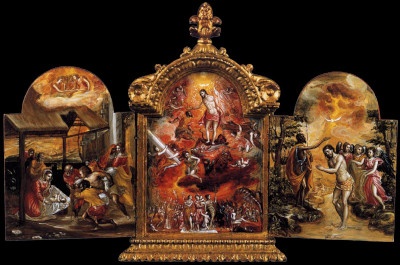
El Greco used small supports to develop compositions shaped by Italian prints and painting. From Rome, Giulio Clovio recommended him to Cardinal Alessandro Farnese in a letter dated November 1570. [5] [6]
Paintings made for a place
The commissions for Toledo Cathedral and Santo Domingo el Antiguo called for canvases on a new scale. At Santo Domingo, the Trinity stood directly above the Assumption on the high altar. [11] [10]

Painting for chapels and a growing workshop
In the late work, figures and gestures could be painted on a scale that filled a chapel. The Vision of Saint John belonged to an altarpiece for the Hospital of Saint John the Baptist. [19]

Venice and the reach of Titian's name
El Greco had arrived in Venice with experience of selling religious pictures. The move put him in a city where painters including Titian, Tintoretto and Jacopo Bassano offered a wide range of approaches to oil painting. The National Gallery of Art's early Christ Cleansing the Temple shows the scale of the problems he chose to take on there. The small picture accommodates a crowd, abruptly turned figures, scattered goods and a receding architectural setting. He revisited the subject in later years. The early version makes sense in the career of an artist adding a new kind of narrative painting to the work he had already learned to do. [2]
The Modena Triptych offers a second point of comparison. Its three hinged panels carry scenes on both sides. Opening and closing it changes the subjects visible together, so its form mattered to the person handling it. The Italian catalogue sets the work in the Venetian phase of his career. Its small scale and portable structure show that experimenting with Italian figure arrangements was compatible with continuing to produce objects for close devotional use. Both the triptych and the early Washington picture give some sense of the painting a prospective patron could have encountered before El Greco was given a church wall or altar to fill. [2] [5]
The closest contemporary evidence for a personal connection with Titian comes from a letter written after El Greco reached Rome. Giulio Clovio introduced him to Cardinal Alessandro Farnese as a young man from Candia and a pupil of Titian. A recommendation could draw on a respected artist's name to make an unfamiliar painter legible to a patron. The Venetian qualities of El Greco's work give the association substance. A formal apprenticeship in Titian's workshop remains undocumented. Clovio's choice of words shows how a painter already trained in Crete was presented to a new employer in Italy. [2] [6]
Rome, from the Farnese household to an independent practice
Giulio Clovio's recommendation
On 16 November 1570 Clovio wrote to Farnese asking him to provide temporary lodging in the Palazzo Farnese. He singled out El Greco's skill in portraiture, citing a self-portrait that he said had astonished painters in Rome. The request was framed as a modest one. Clovio suggested that the cardinal instruct his household officer to arrange an upstairs room until the painter could make better arrangements. A place in this household put El Greco in contact with artists, collectors and learned men on terms very different from a sale in Candia. The self-portrait served as evidence of ability in the letter. Its whereabouts and appearance remain uncertain. [6]
In El Greco's Portrait of Giulio Clovio, now in Naples, Clovio holds open his own Farnese Hours. The book, made for the cardinal and now in the Morgan Library, identifies a particular accomplishment of the sitter as a manuscript illuminator. The same setting brought El Greco into contact with the antiquarian Fulvio Orsini, the Farnese librarian and a collector of his work. Orsini's inventory preserves traces of a group of paintings, including small portraits described as works on copper. Several are now untraced. The surviving Clovio portrait thus belongs to a network that the documentary record can show more fully than the paintings alone. [3] [6]
A dismissal, a letter and a guild entry
El Greco's own letter to Farnese, dated 6 July 1572 in Rome, makes it possible to follow the change in his circumstances from the painter's side. He reported that the household officer, Count Ludovico Tedesco, had dismissed him in the cardinal's name. El Greco asserted that he had given no cause, asked to be told the reason and offered to answer the charge he supposed lay behind the decision. He ended by affirming his service to the house. The letter shows him making a case for his honour before the person with power to reverse the decision. Farnese's reasons remain unknown. [7]
The physician and art writer Giulio Mancini, writing around 1620, recounts a separate episode in which El Greco supposedly offered to replace Michelangelo's Last Judgement with a version more suitable for the Sistine Chapel. Mancini connected the remark with the painter's departure for Spain. The account was written decades after the Rome years. The surviving 1572 letter gives no account of such a confrontation, and the painter's Roman career continued after his dismissal. The episode is part of the early reception of El Greco as a combative artist. The recommendation and complaint in the surviving letters provide dated evidence of his dealings with the Farnese household. [6] [7]
The Roman painters' guild records place him on a more independent professional footing later in 1572. He appears in them as ‘Dominico Greco’, described as a painter, with dues of two scudi. Readings of the same payment entry differ by a month. Ioanna Goniotaki transcribes the date as 18 September, while Elisa Camboni, writing for the Accademia Nazionale di San Luca, reads 18 October. Either reading places the payment within a few months of his protest to Farnese. The record is evidence of professional registration under his own name in Rome, where he continued to find work. [7] [8]
One surviving result is the full-length portrait of Vincenzo Anastagi, a Knight of Malta appointed sergeant major of Rome's Castel Sant'Angelo in 1575. The Frick Collection considers the appointment a likely occasion for the painting. Anastagi stands in armour, with his helmet on the floor, in a canvas nearly two metres high. The scale and format show how far the commissions of the Italian years ranged, from privately handled panels and small likenesses to a portrait that could mark a military appointment. The exact circumstances of the request are less certain than the sitter, the office and the surviving painting. [9]
The first commissions in Toledo
Two institutions, two kinds of work
The records place El Greco in Toledo in 1577. The city's cathedral and the Cistercian convent of Santo Domingo el Antiguo offered different kinds of employment, linked by members of the cathedral clergy. Don Diego de Castilla, dean of the cathedral, commissioned the convent altarpieces for a church funded in part through the bequest of Doña María de Silva, a Portuguese former attendant of Empress Isabel. The National Gallery of Art's chronology puts an agreement for the project in Rome in 1576. The Toledo instrument published by Francisco de Borja de San Román and the Art Institute of Chicago's commission history establish the project's formal Spanish phase in 1577. The distinction matters because a connection made in Italy could precede the practical business of securing the work and carrying it out in Toledo. [2] [10] [11]
The Santo Domingo work was a series of paintings for the high altar and two side altars. In the high retable, the Assumption of the Virgin occupied the main opening below the Holy Trinity, with saints in side compartments. The tombs of Doña María and Don Diego lay before the high altar. The artists and tradesmen responsible for the carpentry and other elements had to produce a structure suited to the sanctuary. El Greco supplied designs as well as paintings, and the documentary record includes arrangements with other masters. This was work that depended on the measurements and sequence of an installation. The ensemble was in place by September 1579. On the paper depicted at the bottom of the Assumption, El Greco called himself Cretan in Greek and gave the year 1577. The inscription and the installation date refer to different stages of the undertaking. [10] [11]
The cathedral commissioned the Disrobing of Christ, known in Spain as El Expolio, for its sacristy. Here the record includes interim payments and a dispute over the value of a particular painting. In 1579 the appointed valuers came to widely different conclusions. El Greco's side valued the picture at 900 ducats, while the cathedral's came in at roughly 227. The cathedral's representatives also objected to features of the image, including the presence of the women beside Christ and the position of some of the surrounding heads above his. The painting still shows those figures. The dispute makes visible two kinds of judgement over which a patron could claim authority, the value of the labour and the suitability of the image for a particular setting. [12]
A painting for Philip II
Philip II's commission of the Martyrdom of Saint Maurice gave El Greco access to a much larger building enterprise at San Lorenzo de El Escorial. Documentary evidence shows payments in 1580 and his personal delivery of the large canvas on 16 November 1582. Painted in Toledo, it brings the officers of the Theban Legion into the foreground as they consider the choice facing them. The executions take place farther back. This organisation gives unusual weight to the collective decision that leads to the martyrdom. The intended setting in the basilica placed the painting within an established devotional use. [13]
The appraisal and payment proceeded even though the painting failed to satisfy the king. The parties' valuers disagreed and a third, the painter Romolo Cincinnato, was called in. The agreed valuation was 800 ducats. El Greco received the remaining 300 in April 1583. A painting by Cincinnato was subsequently supplied for the altar. Writing later in his history of the monastery, the Hieronymite friar José de Sigüenza associated the king's dissatisfaction with the painting's devotional effect. His account supplies a voice from within the institution. It is possible to follow the settlement and replacement in the records while leaving the king's precise reaction to individual pictorial features open. [13]
Santo Tomé and the Burial of the Lord of Orgaz
Several years after the cathedral commission, the priest Andrés Núñez de Madrid commissioned El Greco to make a picture for the parish church of Santo Tomé. The subject was the burial of Gonzalo Ruiz de Toledo, Lord of Orgaz, remembered as a benefactor of the church. According to the local miracle tradition, Saints Augustine and Stephen came to lay him in his grave. The authorisation was given in 1584. The detailed agreement with the painter, transcribed by San Román, was executed on 18 March 1586. It described the placement by the epitaph, the funeral rites and the intervention of the saints. A parishioner standing at the burial site could see the painted ceremony in relation to the memorial that identified the man being buried. [10]
El Greco on video
Watch TheHistoryOfArt’s painting survey, then explore El Greco’s work with museum curators.
El Greco's Most Famous Paintings
A short survey of El Greco’s paintings, including View of Toledo.
Watch on YouTubeThe Burial of the Count of Orgaz, as the painting is conventionally titled in English, gives that account the outward forms of a sixteenth-century Toledo funeral. The line of witnesses belongs visually to the city of the painter's patrons. Above them, an angel carries the soul towards Christ. Viewers have long tried to name individual mourners and have identified the child at the front as Jorge Manuel, El Greco's son. Those identifications are readings of the image with varying degrees of support. The instruction to depict the burial and the saints is in the written commission. [10]
Accounts of the painting's cost record several events. The first appraisal set the value at 1,200 ducats and a second put it at 1,600. A judgement of 30 May 1588 set the payment at 1,200, followed by a written settlement on 20 June. The sequence matters because an appraisal proposed by one set of valuers could differ from the enforceable price, even after the picture was finished. Santo Tomé and El Escorial involved different authorities, and different procedures determined their final payments. The parish picture remained where its memorial function could still be understood. [10] [13]
The mature Toledo workshop
Altarpieces for Madrid, Toledo and Illescas
By the mid-1580s El Greco appears to have had a workshop equipped to undertake more than painting. The later contracts show what that could mean in practice. The person promising the finished altarpiece might have to supply its design, arrange for the structure and sculpture, coordinate the work with an existing building and meet the costs ahead of the last instalment. The customer could be a parish, the officers of a charitable institution or the administrators of an endowment. El Greco's later career involved overlapping agreements with each kind of patron. [2] [10]
In 1596 the Council of Castile contracted with him to produce the altarpiece for the Augustinian college of Doña María de Aragón in Madrid. Records in the Archivo General de Simancas show him dealing with the revenues that were supposed to pay for it. In February 1598 the Crown provisionally attached revenues from the foundress's estate to cover an overdue 1,000 ducats. The record concerns a payment due under the contract. A number of surviving canvases have been associated with the finished altarpiece, including the Prado's Annunciation. Surviving financing documents fix a stage in the commission with an exact date. The arrangement of the pictures in the original structure is a separate question of reconstruction. [2] [14]
On 9 November 1597 El Greco was commissioned to work for the Chapel of San José in Toledo, a private foundation. Its agreement overlapped with the Madrid undertaking. Saint Martin and the Beggar, now in Washington, was made for one of the chapel’s side altars. Martin's act of dividing his cloak occurs above an abbreviated Toledo skyline. The painting left the chapel in the early twentieth century. Its installation history makes it possible to relate a museum picture of a mounted saint to its intended function in a particular building. [2] [15]
In 1603 El Greco took on work for the Hospital de la Caridad at Illescas. The archive preserves the licence and contract material, and the undertaking included the structure of the retable as well as paintings. A subsequent dispute over the appraisal and payment ran into 1608. A workshop capable of delivering an ensemble could take commissions beyond the city, but it also had to carry the cost of work while its representatives pursued payment. The documentary record of the dispute shows why a commission's value and the cash actually available to the workshop could differ for an extended period. [2] [16]
Family, assistants and other work
Jorge Manuel, conventionally dated as born in 1578, was El Greco's son by Jerónima de las Cuevas, whose name also appears in the sources as Gerónima. The painter identifies both of them in his last known power of attorney. The document and the son's later record provide more detail about Jorge Manuel's responsibilities than about his mother's life. The portrait traditionally identified as Jorge Manuel and the proposed likeness at the front of the Burial belong to the history of how later viewers have tried to recognise him. His later work as an architect and the records of his father's estate establish a professional identity beyond those likenesses. A document preserved by Toledo’s municipal archive records El Greco acting as guarantor for his son, expressly described as an architect, on work at the city hall. In that instance the son held a commission of his own and the father provided the financial guarantee. [3] [10] [16] [17]
The painter and theorist Francisco Pacheco visited El Greco in Toledo in 1611. In Arte de la pintura, published in 1649, he recalled seeing clay figures the artist used in his work and small oil versions of his compositions, which Jorge Manuel showed him. The account records a practice within a working studio through the eyes of a visiting painter. Conservation research has since helped to distinguish small compositions that preserve signs of development from more straightforward repetitions. A change visible beneath one painting's surface can establish that someone reconsidered the design while making it. It takes comparison with other evidence to connect such a change to a particular painter. Versions of the same subject can therefore carry different attributions. [18]
Portraits and the intellectual life of the city
Around 1600 El Greco painted the likeness catalogued by the Metropolitan Museum of Art as Cardinal Fernando Niño de Guevara. The portrait's richly appointed chair, red robes and eyeglasses help place the sitting within the visual culture of office. Walter Liedtke argues for the traditional identification partly on the strength of a 1632 inventory made for Pedro Lasso, which lists the named cardinal and inquisitor seated in a chair among the family's portraits. The precise circumstances of the sitting remain open. The inventory is evidence of how a portrait of that description was identified and held a generation later. [19]
View of Toledo and the separate View and Plan of Toledo show another side of El Greco's relation to the city. In the wide panorama, the figure at the right presents a plan, and an inscription explains why the Hospital of Saint John the Baptist has been presented as a model at some distance from its usual surroundings. In that arrangement the building will neither conceal a city gate nor dominate the place it is meant to help identify. The evidence is unusual because a painted text actually explains a choice about the arrangement of a real place. In the smaller view in New York, El Greco also adjusted the positions and prominence of buildings. That canvas gives the viewer a different encounter with Toledo, and the circumstances of its commission or original ownership remain uncertain. [19] [20]
El Greco's papers and books also connect the working painter with debates about art. Surviving annotated volumes include an edition of Vitruvius's treatise on architecture in Daniele Barbaro's Italian translation and a copy of Giorgio Vasari's Lives. Their margins contain responses to passages about painting and architecture, sometimes questioning a judgement or weighing one kind of artistic achievement against another. The annotations let readers examine individual arguments to which the painter returned. His access to books and prints, documented in the inventories, is a further connection between the learned world he had encountered in Rome and the daily work of the later studio in Toledo. [21]
Tavera, death and the estate
In November 1608 Pedro Salazar de Mendoza, administrator of the Hospital of Saint John the Baptist outside Toledo's walls, gave El Greco his last major commission. Salazar had already employed him to make a wooden tabernacle for the high altar in 1595. Thirteen years later the commission extended to three retables. The institution is often called the Hospital Tavera after its founder, Cardinal Juan Pardo de Tavera. The work included both the paintings and the structures that would hold them. From the nave a visitor approached them past Cardinal Tavera’s marble tomb in the crossing, carved by Alonso Berruguete. The subject of the central picture, the Baptism of Christ, was appropriate to its dedication. The two side altars were associated with the Annunciation and a vision from the Apocalypse. The term ‘Tavera commission’ consequently refers to more than one canvas, and the contract marks the start of an undertaking that continued beyond El Greco's lifetime. [2] [19]
The large painting known as the Opening of the Fifth Seal, now at the Metropolitan Museum, survives with its top cut away. Saint John witnesses the scene drawn from Revelation, in which souls awaiting justice receive white robes. The loss of canvas leaves the original upper composition open to reconstruction. In a separate branch of the project, the Santander Annunciation and the Athens Concert of the Angels survive from what was once one composition. Later documentation helps recover the intended relationships. Jorge Manuel was involved with the work after his father's death, and a contract signed by Félix Castello on 23 April 1635 names the Baptism for the main altar and the Annunciation and apocalyptic vision for the side altars. The document records arrangements for completing the project decades after the original commission. The surviving fragments record the different physical histories of its paintings. [19] [22]
On 31 March 1614 El Greco, confined to bed by illness, gave Jorge Manuel the authority to make a will on his behalf. He named his son as his universal heir. The Toledo archive preserves the power, in which the painter says he had discussed his wishes with Jorge Manuel, and catalogues the documents that followed. El Greco died in Toledo on 7 April. His funeral took him to Santo Domingo el Antiguo, where he had arranged for burial. Nearly four decades after he first worked for the convent, his own funeral was held in the church he had helped to furnish. [10] [16]
On 12 April 1614 Jorge Manuel began the process of inventorying his father’s possessions. It was a legal record, compiled while the future of the household and workshop was being settled. A second account, from 1621, recorded property Jorge Manuel brought to his second marriage. The documents differ in their descriptions and levels of detail. The first groups architecture books together, for example, while the later list makes it possible to identify further titles, some of which may have been added after the father's death. An inventory can show which kinds of equipment, pictures and books were in the household at a given date. Identifying a particular surviving canvas requires more. Two entries on a common subject might refer to more than one version, and a short description usually cannot show who carried out every part of the work. [16] [19] [21]
A separate commission shows how responsibility for a work could pass from father to son. El Greco undertook an altarpiece for the chapel of Isabel de Oballe in the church of San Vicente in Toledo. In March 1615 Jorge Manuel told the city authorities that the retable was in place and that the work required of his father had been completed. He asked for what was owed. Alejandro del Pozo Maté has published evidence of a subsequent request from Jorge Manuel for payment for his own work on the chapel. The two requests document the son’s continuing obligations and claims. They leave the extent of his intervention in the finished ensemble open. [17] [23]
Dispersal and the changing reputation
El Greco's work remained in churches and collections after his death, where viewers could judge different parts of his output according to different tastes. Antonio Palomino's early eighteenth-century account gave an unfavourable assessment of his later manner. In nineteenth-century France, painters and critics including Édouard Manet and Zacharie Astruc helped to draw attention to qualities of touch and colour they admired. El Greco's highly individual manner shaped both judgements, and the change in reception had consequences for what collectors and institutions were willing to acquire and show. [2]
The Assumption provides a traceable example. It left Santo Domingo around 1830, was exhibited at the Prado in 1902 and passed through the Paris dealer Durand-Ruel before entering the Art Institute of Chicago in 1906. The Prado's 1902 exhibition brought together an artist's work for public comparison even as individual paintings were moving into new collections. Manuel B. Cossío's 1908 book and catalogue helped make El Greco's career a subject of sustained study. His emphasis on Spanish mysticism became influential. The evidence of the artist's early Cretan work, his Roman patronage and his marginal notes has since given scholars a wider basis for interpreting the choices he made in Toledo. [2] [11] [21] [24]
Exhibitions can recover connections that disappear when a painting leaves its original setting. In 2014 the Metropolitan Museum and the Hispanic Society of America brought their El Greco holdings together in New York, with the Frick presenting its paintings at the same time. That gathering made it possible to compare periods and genres across collections in one city. In 2025 the Prado temporarily brought together eight of the nine paintings made for Santo Domingo el Antiguo. The reunion recovered a different connection, between works made to be seen together at the beginning of the Toledo career. The paintings now dispersed among collections preserve parts of a life spent learning to work across cities, institutions and scales. [25] [26]
Browse the artworks
Browse the paintings covered in this collection and related works in museum catalogues. Some are by El Greco’s workshop or were formerly attributed to him.
| Name | Date | Medium |
|---|---|---|
| View of Toledo | Around 1599–1600 | Oil on canvas |
| Adoration of the Shepherds | 1612–14 | Oil on canvas |
| Laocoön | About 1610–14 | Oil on canvas |
| The Tears of Saint Peter | 1587–96, Museo del Greco dating | Oil on canvas |
| The Holy Family with Saint Anne | About 1595 | Oil on canvas |
| The Holy Trinity | 1577–79 | Oil on canvas |
| The Burial of the Count of Orgaz | 1586–88, the conventional range | Oil on canvas |
| Disrobing of Christ | 1577–79 | Oil on canvas |
| Opening of the Fifth Seal | About 1608–14 | Oil on canvas |
| Saint Martin and the Beggar | 1597–99 | Oil on canvas |
| Martyrdom of Saint Maurice | 1580–82 | Oil on canvas |
| Adoration of the Name of Jesus | 1577–79 | Oil on canvas |
| Saint Peter in Penitence (Bowes Museum) | 1580s | Oil on canvas |
| Christ Carrying the Cross | Around 1577–87 | Oil on canvas |
| Crucifixion | 1597–1600 | Oil on canvas |
| Resurrection | 1597–1600 | Oil on canvas |
| Immaculate Conception | About 1608–13 | Oil on canvas |
| Annunciation | 1597–1600 | Oil on canvas |
| Coronation of the Virgin | 1591–92 | Oil on canvas |
| Lady in a Fur Wrap | About 1580–88 | Oil on canvas |
| Baptism of Christ | Around 1608–14, with further work in the early 1620s according to Walter Liedtke. The foundation dates the painting to around 1614. | Oil on canvas |
| Portrait of an Old Man (Possible Self-Portrait) | About 1595–1600 | Oil on canvas |
| Adoration of the Kings | 1565–67, Benaki Museum dating | Tempera on wood |
| Mary Magdalene in Penitence | About 1585–90, tentatively dated by the Museu del Cau Ferrat | Oil on canvas |
| Saint Sebastian | About 1577 in the cathedral centenary catalogue | Oil on canvas |
| Portrait of Cardinal Fernando Nino de Guevara | About 1600 | Oil on canvas |
| Penitent Magdalene | About 1576–77 | Oil on canvas |
| The Nobleman with his Hand on his Chest | About 1580 | Oil on canvas |
| Saint Peter and Saint Paul | 1590–1600 | Oil on canvas |
| Pentecost | Circa 1600 | Oil on canvas |
| The Fable | About 1580 | Oil on canvas |
| Pietà | 1580–90 | Oil on canvas |
| View and Plan of Toledo | 1610–1614, according to the Museo del Greco | Oil on canvas |
| Assumption of the Virgin | 1577–79, with 1577 in the Greek inscription | Oil on canvas |
| The Annunciation (1609) | Late Tavera period. The owner dates the canvas to 1614. Factum gives 1608–1613 in its initial recording account. | Oil on canvas |
| The Agony in the Garden of Gethsemane | 1590s | Oil on canvas |
| Portrait of Jorge Manuel Theotocópuli | Circa 1600–05 | Oil on canvas |
| Dormition of the Virgin | About 1565–66, according to the National Gallery of Greece | Tempera on wood |
| Saint Louis | 1585–90 | Oil on canvas |
| Ecstasy of St Francis of Assisi (1580) | About 1577–80 in the Vatican Museums’ account. The Diocesan Museum gives 1575–80. | Oil on canvas |
| Saint Francis of Assisi in Ecstasy, after El Greco | Seventeenth century | Oil on canvas |
| Christ Driving the Money Changers from the Temple | Probably before 1570 | Oil on wood |
| The Entombment of Christ | Circa 1568–70, Venice | Mixed technique on wood |
| Nativity | 1603–05 | Oil on canvas |
| Portrait of a Gentleman | About 1586 | Oil on canvas |
| Coronation of the Virgin (Illescas) | 1603–05 | Oil on canvas |
| A Boy Blowing on an Ember to Light a Candle (El Soplón) | About 1570–72 | Oil on canvas |
| The Feast in the House of Simon | About 1608–14 | Oil on canvas |
| Concert of Angels | About 1608–14 | Oil on canvas |
| Healing of the Man Born Blind | Around 1570 in Dresden’s printed collection guide | Mixed technique on wood |
| Fray Hortensio Félix Paravicino | 1609 | Oil on canvas |
| Purification of the Temple | Circa 1600 | Oil on canvas |
| Portrait of Vincenzo Anastagi | Circa 1575 | Oil on canvas |
| Saint Paul (Almadrones) | 1608–14 | Oil on canvas |
| Head of Christ | About 1579–86 | Oil on canvas |
| Last Supper | About 1567–68, Venice | Tempera on wood |
| Saint John the Evangelist (Prado Museum, Madrid) | About 1605 | Oil on canvas |
| Disrobing of Christ (Lyon, Half Painting Version) | About 1581–86 | Oil on canvas |
| The Dream of Philip II | 1577–79 | Oil on canvas |
| Portrait of a Sculptor | About 1577–80, 2019 exhibition dating | Oil on canvas |
| Saint Bernard | 1577–79 | Oil on canvas |
| Saint Benedict | 1577–79 | Oil on canvas |
| Portrait of Jerónimo de Cevallos | 1613, as catalogued by the Prado | Oil on canvas |
| The Flight into Egypt | About 1570 | Oil on wood |
| Saint Anthony of Padua | About 1580 | Oil on canvas |
| Portrait of a Doctor | 1582–85 | Oil on canvas |
| The Veil of Saint Veronica | 1586–95 | Oil on canvas |
| An Elderly Gentleman | About 1587–1600 | Oil on canvas |
| Saints Andrew and Francis | About 1595 | Oil on canvas |
| The Holy Family with Saint Anne and the Infant Saint John | Around 1600 in the Prado catalogue. The Balaguer record gives 1595–1600. | Oil on canvas |
| The Virgin Mary | 1595–1600 | Oil on canvas |
| Portrait of a Gentleman (1600-1605) | About 1600–05 | Oil on canvas |
| Portrait of a Young Gentleman | 1600–05 | Oil on canvas |
| John the Baptist and Saint John the Evangelist | 1600–10 | Oil on canvas |
| Portrait of a Friar | 1600–50 | Oil on canvas |
| Saint Thomas (Almadrones) | 1608–14 | Oil on canvas |
| Christ the Saviour (Almadrones) | 1608–14 | Oil on canvas |
| An Apostle (Prado P000814) | 1608–14 | Oil on canvas |
| Saint James (Almadrones) | 1608–14 | Oil on canvas |
| Julián Romero and his Patron Saint | 1612–18 | Oil on canvas |
| Allegory of the Camaldolese Order | Around 1600, Instituto Valencia de Don Juan dating | Oil on canvas |
| Saint Joseph and the Christ Child | 1597–99 | Oil on canvas |
| Saint Ildefonsus | Around 1600 according to the Prado's proposal, 1603–05 in Hadjinicolaou and Ficonofue | Oil on canvas |
| Saint Augustine | About 1585–1602, as listed in the 2014 exhibition study | Oil on canvas |
| Portrait of Diego de Covarrubias y Leyva | Circa 1600 | Oil on canvas |
| Saint Bernardino of Siena | 1603 in the Prado catalogue. The Museo del Greco object page lists 1602. | Oil on canvas |
| Portrait of Cardinal Tavera | About 1609 in the foundation's account, circa 1610 in its image heading | Oil on canvas |
| Visitation | About 1610–14 | Oil on canvas |
| Portrait of Francisco de Pisa | Circa 1610–14 | Oil on canvas |
| Saint Lawrence's Vision of the Madonna and Child (Apparition of the Virgin to St. Lawrence) | 1578–80 in the 2021 heritage decree | Oil on canvas |
| Christ on the Cross | Probably 1570s, assigned to El Greco’s Italian period in the sale literature | Oil on canvas |
| Portrait of Charles de Guise | 1572, as dated in the painted book | Oil on canvas |
| Portrait of Giulio Clovio | 1571–72, according to Capodimonte | Oil on canvas |
| Mount Sinai | About 1570–72 | Mixed technique on wood |
| Modena Triptych | 1567–1568, as dated by the Galleria Estense and the national catalogue | Tempera on wood |
| Saint Luke Painting the Virgin | 1560–67, Benaki Museum dating | Mixed technique on wood |
| Saint Ildefonso (Washington) | 1603–14 | Oil on canvas |
| Saint Martin and the Beggar (smaller Washington version) | 1600–14 | Oil on canvas |
| The Holy Family with Saint Anne and the Infant John the Baptist (Washington) | About 1595–1600 | Oil on canvas |
| The Adoration of the Name of Jesus (London panel) | Late 1570s | Oil on wood |
| Christ Driving the Traders from the Temple (London) | About 1600 | Oil on canvas |
| Saint Francis Receiving the Stigmata (Baltimore) | 1585–90 | Oil on canvas |
| Saint Luke (Almadrones, Indianapolis) | About 1610–14 | Oil on canvas |
| Saint Matthew (Almadrones, Indianapolis) | About 1610–14 | Oil on canvas |
| Saint Simon (Almadrones, Indianapolis) | About 1610–14 | Oil on canvas |
| The Tears of Saint Peter (Hospital de Tavera) | About 1605 | Oil on canvas Catalogue. |
Discussion
Look again at the images and ideas explored in El Greco Biography. These editorial prompts invite your observations.
Reader Insights
Choose one of the archival dates from Candia or Rome. What does the document establish about El Greco’s work, and what part of the story remains open?
Compare the jobs at Santo Domingo and Santo Tomé. How did the place and the people who paid for each work shape what El Greco was asked to do?
Join the Conversation
Share a detail, comparison or question about El Greco Biography below.
References
- Maria Constantoudaki-Kitromilides, Domenikos Theotokopoulos (El Greco) from Candia to Venice, unpublished documents (1566–1568) View source.
- Jonathan Brown and Richard G. Mann, Spanish Paintings of the Fifteenth through Nineteenth Centuries, National Gallery of Art systematic catalogue View source.
- Vatican Museums, El Greco, biographical chronology View source.
- Benaki Museum, Saint Luke Painting the Virgin View source.
- Italian General Catalogue of Cultural Heritage, Modena Triptych View source.
- Guido Checchi, Roma 1572, la “fiammata mistica” di Anthonie Blocklandt, El Greco e Giovanni de’ Vecchi, University of Bologna View source.
- Ioanna Goniotaki, Locating El Greco in Late Sixteenth-Century Rome, Art and Learning, Rivalry and Patronage, Birkbeck, University of London View source.
- Elisa Camboni, 18 ottobre 1572, El Greco e l’iscrizione all’Università dei pittori, Accademia Nazionale di San Luca View source.
- The Frick Collection, Men in Armor, El Greco and Pulzone Face to Face View source.
- Francisco de Borja de San Román, El Greco en Toledo, historical study and transcribed documents View source.
- The Art Institute of Chicago, The Assumption of the Virgin, installation and ownership histories View source.
- Robert Francis Swain, Introibo ad Altare Dei, El Greco’s Espolio in the Context of Church and State in Post-Tridentine Spain View source.
- Agustín Bustamante García, El Greco y El Escorial, de Felipe II a Felipe IV View source.
- Archivo General de Simancas, El Greco en Simancas, el retablo de doña María de Aragón View source.
- National Gallery of Art, Saint Martin and the Beggar View source.
- Archivo Histórico Provincial de Toledo, El Greco y su época en los Archivos de Castilla-La Mancha View source.
- Archivo Municipal de Toledo, Siete documentos, including the city hall guarantee and the Oballe agreement View source.
- Susanna P. Griswold, Two Paintings by El Greco, Saint Martin and the Beggar, Analysis and Comparison View source.
- Walter Liedtke, Three Paintings by El Greco, Metropolitan Museum Journal 50 View source.
- Museo del Greco, Vista y plano de Toledo, with transcription of the inscription View source.
- Javier Docampo and José Riello, eds., La biblioteca del Greco, Museo Nacional del Prado View source.
- Factum Foundation, El Greco's Annunciation for the Hospital Tavera View source.
- Alejandro del Pozo Maté, Nuevos documentos sobre algunos pintores toledanos del primer tercio del siglo XVII View source.
- Manuel B. Cossío, El Greco, 1908 View source.
- The Metropolitan Museum of Art, El Greco in New York, 2014–15 View source.
- Fundación Amigos del Museo del Prado, El Greco, Santo Domingo el Antiguo, 2025 View source.





