


 by Tom Gurney
Tom Gurney BSc (Hons) is an art history expert with over 20 years experience
Published on June 19, 2020 / Updated on October 14, 2023
Email: tomgurney1@gmail.com / Phone: +44 7429 011000
Saint Joseph and the Christ Child by El Greco: Introduction
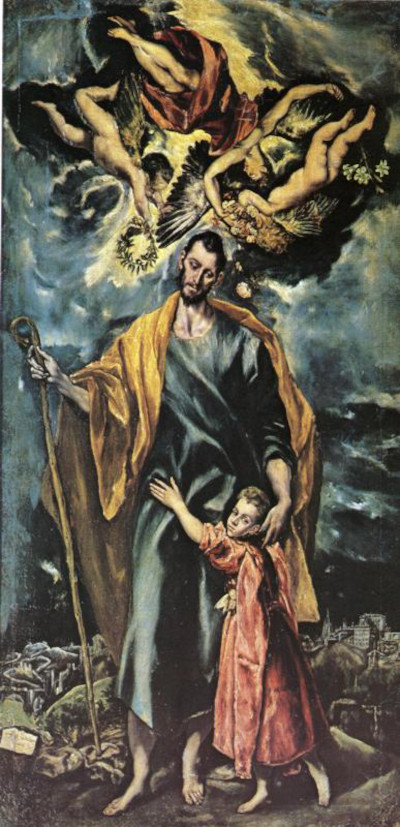
The Christ Child reaches across Joseph’s blue tunic and spreads his fingers over a fold. Joseph’s left hand comes down beside the boy’s head, while his right holds a long staff that reaches nearly to the ground. Their feet are on a rocky rise above Toledo. Joseph lowers his face towards the Child, whose eyes turn out towards the viewer. Above them three angels descend with flowers and a wreath. El Greco makes the act of protection clear through the hands and faces before the eye travels up to the activity in the sky. [1]
This is the tall canvas El Greco painted for the high altarpiece of the Chapel of San José in Toledo between 1597 and 1599. It still occupies the centre of that altarpiece, beneath the separate Coronation of the Virgin. Two other pictures were made for the side altars and are now in Washington. The low skyline and the strong sweep from the figures’ feet to the angels make the most sense when the canvas is seen as the centre of this original arrangement. [1] [2] [3]
At a Glance
- ArtistEl Greco (Doménikos Theotokópoulos)
- Date1597–99
- MediumOil on canvas
- Dimensions289 × 147 cm (height × width)
- LocationHigh altarpiece, Chapel of San José, Toledo, private collection [1] [2] [3]
This work across El Greco’s career
Martyrdom of Saint Maurice
1580–82The Burial of the Count of Orgaz
Commissioned 1586View of Toledo
c. 1599–1600Opening of the Fifth Seal
c. 1608–14View and Plan of Toledo
1610–14Contents
- The two figures on the path
- Flowers, plants and the low horizon
- Who commissioned the altarpieces
- Looking up at the high altar
- The two lateral altars
The two figures on the path
Joseph takes up most of the width of the canvas. The yellow mantle hangs from one shoulder and crosses behind the other, framing the blue tunic and the small head above it. His hand is level with the open sky on the side where the staff rises. The rounded top of the staff sits near the edge of the canvas, and the shaft stays visible almost to the ground. At the centre, Joseph’s body leans a little towards the Child. The staff’s straighter line makes the tilt of Joseph’s body easier to see. [1]
The Child’s red garment makes the smaller figure legible against Joseph’s much darker blue. Light catches the boy’s sleeve where the arm bends away from his body, and the bare forearm runs diagonally across Joseph’s hip. The head tilts the other way. Joseph’s fingers curve alongside it, close to the boy’s shoulder. Below the folds of red and blue, the two sets of bare feet are close together on the uneven ground. Joseph’s foothold is broad and steady, while the boy’s feet fall at an angle beneath his turned body. The way the Child leans into Joseph gives the pair the appearance of having paused in the middle of a walk. [1]
El Greco gives Joseph the strength and bearing of a man in his prime. Fernando Marías connects that treatment with late sixteenth-century writing about Joseph, including works by the Toledan Alonso de Villegas and the Carmelite Jerónimo Gracián. Their accounts give weight to Joseph’s role as guardian and to the affection between him and Jesus. Marías also relates the curved staff to descriptions of Joseph as a shepherd and pilgrim. These comparisons illuminate the form El Greco gave to Joseph’s care. In the painting itself, that care is visible in the fall of a hand and the position of a child against an adult’s body. [1] [4]
El Greco used a smaller gesture for Joseph in the Virgin and Child at the Hospital de Tavera, where Mary and the Child are shown with Saint Anne and Joseph. There Joseph’s hand reaches from the edge of the group to touch Jesus’s foot, while the infant grasps Mary’s fingers and Saint Anne touches his head. At San José, the connection between the two figures has to carry across a much taller field. Joseph’s yellow and blue garments surround the Child’s red and make their closeness visible even where the precise meeting of fingers and cloth is harder to see. [1] [5]
Flowers, plants and the low horizon
The angels occupy the space just above Joseph’s head. Their limbs and wings cross in several directions. A length of reddish cloth descends from the upper edge, and a pale wing opens towards the dark blue at the side. The National Gallery of Greece catalogue identifies lilies and roses among the flowers and a laurel wreath held ready above Joseph. Pale blooms extend towards the edge of the picture at the upper right, while touches of pink descend closer to Joseph’s shoulder. The wreath’s rounded shape stands out more distinctly on the other side of his head. The group has a downward direction, led by the arms that bring the flowers and wreath close to the figures below. [1] [2] [4]
Small plants also emerge between the stones around the base of Joseph’s staff. The leaves and stems are low and close to the brown and green of the ground. On the other side the land opens beyond the Child and a row of buildings rises in the distance. The foreground plants establish the surface on which the two figures stand, and the much smaller buildings give us a measure of the drop beyond them. El Greco can then place Joseph’s upper body and the angels against a large expanse of sky without losing the sense of solid ground underfoot. [1] [4]
The city occupies narrow stretches of the horizon on either side of the figures. Walter Liedtke compared the divided skyline with the Metropolitan Museum of Art’s View of Toledo, 29.100.6. In both, he identifies motifs including the cathedral tower and the Alcázar in arrangements that depart from the actual view. Liedtke proposed that the Met canvas, or a version of it, may have furnished motifs for the chapel pictures. The visible correspondence allows the comparison even while the sequence remains open. In the Met’s work the city and its hillside occupy the heart of the picture. In the chapel canvas the skyline forms a low band behind the bodies, with a dark gap between the buildings and the brighter activity above Joseph. [1] [6] [7]
Who commissioned the altarpieces
The chapel owes its foundation to the endowment of the Toledo merchant Martín Ramírez. His earlier plans had involved providing a home and church for Teresa of Ávila’s Carmelite nuns. After the nuns moved, his heirs pursued a family chapel, with Diego Ortiz de la Fuente overseeing the building designed by Nicolás de Vergara the Younger. The chapel had a funerary purpose. The inscription on the grave of Diego and his wife Francisca Ramírez records that they endowed two priests to serve at its annual observances. The family thus had a place to commemorate its dead through worship and burial. The chapel was consecrated in 1594, while some work on the building continued afterwards. [2] [4]
The Martín Ramírez who commissioned El Greco was Dr Martín Ramírez de Zayas, the merchant’s great-nephew and a priest and professor of theology. The notarial deed of 9 November 1597 describes him as patron and head chaplain of the foundation endowed by the deceased merchant of the same name. It specifies three gilded wooden altarpieces with paintings. Saint Joseph was to occupy the principal canvas, with the Coronation of the Virgin above. The agreement sets the feast of the Virgin in August 1598 as the target for the altarpieces to be finished and installed, with valuation by appointed experts. This was an agreement for an ensemble of painted canvases and architectural surrounds. [4] [8] [9]
The records deal with money after the original deadline. An agreement of 13 December 1599 records a valuation of 31,328 reales and settles the dispute over the amount. A receipt for 5,500 reales followed the next day, and another survives from March 1601. The December settlement names Juan Sánchez de Soria as notary, and arrangements for paying sums due included Juan Sánchez Cota and Francisco de Medina, the linen merchant owed money by the painter. The two men named Martín Ramírez have different roles throughout this story. One endowed the chapel, while the other acted as its governing patron and head chaplain, agreed the commission and dealt with the painter over payments. The family’s devotional and burial arrangements give a wider purpose to that transaction. [4] [8] [9]
Looking up at the high altar
The tall canvas occupies the principal opening between columns. Above it the architecture has a distinct upper compartment for the Coronation of the Virgin. Gold surrounds both canvases and carries the eye from one to the other. The lower painting has its own act of crowning, with Joseph still waiting beneath the wreath. In the upper painting Christ and God the Father bring a crown towards Mary under the light of the Holy Spirit. The two gestures can be read in succession when looking up at the altar, and each belongs to a separate painting. [1] [2] [4]
Marías describes the central altar as the focus reached after the eye has taken in the pictures on the side walls. Within the central canvas there is a comparable progression. The diagonal of the Child’s arm and the broad areas of red and blue register from below, then the staff and Joseph’s height lead upwards. The strip of Toledo gives the lower scene depth without taking up the space needed for that movement. When the viewer raises their eyes again, the white and yellow in the clouds at the top of the central painting lead towards the smaller canvas above. [1] [4]
The two lateral altars
On the Gospel side was Saint Martin and the Beggar, now National Gallery of Art 1942.9.25. On the Epistle side was the separate Madonna and Child with Saint Martina and Saint Agnes, now 1942.9.26. Martin lowers his head from the height of a white horse as he divides his cloak with a man at the roadside. A low stretch of Toledo appears behind them and gives the side painting a link with the landscape at the high altar. Across the chapel, Mary looks down towards the Child, above the two saints. Agnes holds a lamb and Martina appears beside a lion. El Greco placed those recognisable forms at different heights, as he placed Joseph’s staff, the Child and the flowers in the central canvas. [1] [4] [10] [11]
Marías links the chapel’s saints with the feasts named in its foundation arrangements, which included Martin, Martina and Agnes. He also associates them with the devotions of the Ramírez family. The signed commission describes the subjects for the high altar in more detail than those of the side altars, and the paintings show how the arrangement developed. In particular, Marías reads the reference to two virgin saints in the contract alongside the two female saints in the finished lateral canvas. The Coronation above Joseph has a group of male saints below the heavenly scene. The contract and the ensemble record different stages in the choice of subjects. [1] [4] [8]
The original side canvases were sold in 1906. Both passed to Peter A. B. Widener that year and entered the National Gallery of Art in 1942 with the Widener Collection. Copies occupy the side altars in Toledo. The high altarpiece still holds its two originals, so the line of sight from Joseph and the Child to the angels and on to the Coronation can still be followed in the setting for which El Greco made them. [2] [4] [10] [11]
Browse the artworks
Browse the paintings covered in this collection and related works in museum catalogues. Some are by El Greco’s workshop or were formerly attributed to him.
| Name | Date | Medium |
|---|---|---|
| View of Toledo | Around 1599–1600 | Oil on canvas |
| Adoration of the Shepherds | 1612–14 | Oil on canvas |
| Laocoön | About 1610–14 | Oil on canvas |
| The Tears of Saint Peter | 1587–96, Museo del Greco dating | Oil on canvas |
| The Holy Family with Saint Anne | About 1595 | Oil on canvas |
| The Holy Trinity | 1577–79 | Oil on canvas |
| The Burial of the Count of Orgaz | 1586–88, the conventional range | Oil on canvas |
| Disrobing of Christ | 1577–79 | Oil on canvas |
| Opening of the Fifth Seal | About 1608–14 | Oil on canvas |
| Saint Martin and the Beggar | 1597–99 | Oil on canvas |
| Martyrdom of Saint Maurice | 1580–82 | Oil on canvas |
| Adoration of the Name of Jesus | 1577–79 | Oil on canvas |
| Saint Peter in Penitence (Bowes Museum) | 1580s | Oil on canvas |
| Christ Carrying the Cross | Around 1577–87 | Oil on canvas |
| Crucifixion | 1597–1600 | Oil on canvas |
| Resurrection | 1597–1600 | Oil on canvas |
| Immaculate Conception | About 1608–13 | Oil on canvas |
| Annunciation | 1597–1600 | Oil on canvas |
| Coronation of the Virgin | 1591–92 | Oil on canvas |
| Lady in a Fur Wrap | About 1580–88 | Oil on canvas |
| Baptism of Christ | Around 1608–14, with further work in the early 1620s according to Walter Liedtke. The foundation dates the painting to around 1614. | Oil on canvas |
| Portrait of an Old Man (Possible Self-Portrait) | About 1595–1600 | Oil on canvas |
| Adoration of the Kings | 1565–67, Benaki Museum dating | Tempera on wood |
| Mary Magdalene in Penitence | About 1585–90, tentatively dated by the Museu del Cau Ferrat | Oil on canvas |
| Saint Sebastian | About 1577 in the cathedral centenary catalogue | Oil on canvas |
| Portrait of Cardinal Fernando Nino de Guevara | About 1600 | Oil on canvas |
| Penitent Magdalene | About 1576–77 | Oil on canvas |
| The Nobleman with his Hand on his Chest | About 1580 | Oil on canvas |
| Saint Peter and Saint Paul | 1590–1600 | Oil on canvas |
| Pentecost | Circa 1600 | Oil on canvas |
| The Fable | About 1580 | Oil on canvas |
| Pietà | 1580–90 | Oil on canvas |
| View and Plan of Toledo | 1610–1614, according to the Museo del Greco | Oil on canvas |
| Assumption of the Virgin | 1577–79, with 1577 in the Greek inscription | Oil on canvas |
| The Annunciation (1609) | Late Tavera period. The owner dates the canvas to 1614. Factum gives 1608–1613 in its initial recording account. | Oil on canvas |
| The Agony in the Garden of Gethsemane | 1590s | Oil on canvas |
| Portrait of Jorge Manuel Theotocópuli | Circa 1600–05 | Oil on canvas |
| Dormition of the Virgin | About 1565–66, according to the National Gallery of Greece | Tempera on wood |
| Saint Louis | 1585–90 | Oil on canvas |
| Ecstasy of St Francis of Assisi (1580) | About 1577–80 in the Vatican Museums’ account. The Diocesan Museum gives 1575–80. | Oil on canvas |
| Saint Francis of Assisi in Ecstasy, after El Greco | Seventeenth century | Oil on canvas |
| Christ Driving the Money Changers from the Temple | Probably before 1570 | Oil on wood |
| The Entombment of Christ | Circa 1568–70, Venice | Mixed technique on wood |
| Nativity | 1603–05 | Oil on canvas |
| Portrait of a Gentleman | About 1586 | Oil on canvas |
| Coronation of the Virgin (Illescas) | 1603–05 | Oil on canvas |
| A Boy Blowing on an Ember to Light a Candle (El Soplón) | About 1570–72 | Oil on canvas |
| The Feast in the House of Simon | About 1608–14 | Oil on canvas |
| Concert of Angels | About 1608–14 | Oil on canvas |
| Healing of the Man Born Blind | Around 1570 in Dresden’s printed collection guide | Mixed technique on wood |
| Fray Hortensio Félix Paravicino | 1609 | Oil on canvas |
| Purification of the Temple | Circa 1600 | Oil on canvas |
| Portrait of Vincenzo Anastagi | Circa 1575 | Oil on canvas |
| Saint Paul (Almadrones) | 1608–14 | Oil on canvas |
| Head of Christ | About 1579–86 | Oil on canvas |
| Last Supper | About 1567–68, Venice | Tempera on wood |
| Saint John the Evangelist (Prado Museum, Madrid) | About 1605 | Oil on canvas |
| Disrobing of Christ (Lyon, Half Painting Version) | About 1581–86 | Oil on canvas |
| The Dream of Philip II | 1577–79 | Oil on canvas |
| Portrait of a Sculptor | About 1577–80, 2019 exhibition dating | Oil on canvas |
| Saint Bernard | 1577–79 | Oil on canvas |
| Saint Benedict | 1577–79 | Oil on canvas |
| Portrait of Jerónimo de Cevallos | 1613, as catalogued by the Prado | Oil on canvas |
| The Flight into Egypt | About 1570 | Oil on wood |
| Saint Anthony of Padua | About 1580 | Oil on canvas |
| Portrait of a Doctor | 1582–85 | Oil on canvas |
| The Veil of Saint Veronica | 1586–95 | Oil on canvas |
| An Elderly Gentleman | About 1587–1600 | Oil on canvas |
| Saints Andrew and Francis | About 1595 | Oil on canvas |
| The Holy Family with Saint Anne and the Infant Saint John | Around 1600 in the Prado catalogue. The Balaguer record gives 1595–1600. | Oil on canvas |
| The Virgin Mary | 1595–1600 | Oil on canvas |
| Portrait of a Gentleman (1600-1605) | About 1600–05 | Oil on canvas |
| Portrait of a Young Gentleman | 1600–05 | Oil on canvas |
| John the Baptist and Saint John the Evangelist | 1600–10 | Oil on canvas |
| Portrait of a Friar | 1600–50 | Oil on canvas |
| Saint Thomas (Almadrones) | 1608–14 | Oil on canvas |
| Christ the Saviour (Almadrones) | 1608–14 | Oil on canvas |
| An Apostle (Prado P000814) | 1608–14 | Oil on canvas |
| Saint James (Almadrones) | 1608–14 | Oil on canvas |
| Julián Romero and his Patron Saint | 1612–18 | Oil on canvas |
| Allegory of the Camaldolese Order | Around 1600, Instituto Valencia de Don Juan dating | Oil on canvas |
| Saint Joseph and the Christ Child | 1597–99 | Oil on canvas |
| Saint Ildefonsus | Around 1600 according to the Prado's proposal, 1603–05 in Hadjinicolaou and Ficonofue | Oil on canvas |
| Saint Augustine | About 1585–1602, as listed in the 2014 exhibition study | Oil on canvas |
| Portrait of Diego de Covarrubias y Leyva | Circa 1600 | Oil on canvas |
| Saint Bernardino of Siena | 1603 in the Prado catalogue. The Museo del Greco object page lists 1602. | Oil on canvas |
| Portrait of Cardinal Tavera | About 1609 in the foundation's account, circa 1610 in its image heading | Oil on canvas |
| Visitation | About 1610–14 | Oil on canvas |
| Portrait of Francisco de Pisa | Circa 1610–14 | Oil on canvas |
| Saint Lawrence's Vision of the Madonna and Child (Apparition of the Virgin to St. Lawrence) | 1578–80 in the 2021 heritage decree | Oil on canvas |
| Christ on the Cross | Probably 1570s, assigned to El Greco’s Italian period in the sale literature | Oil on canvas |
| Portrait of Charles de Guise | 1572, as dated in the painted book | Oil on canvas |
| Portrait of Giulio Clovio | 1571–72, according to Capodimonte | Oil on canvas |
| Mount Sinai | About 1570–72 | Mixed technique on wood |
| Modena Triptych | 1567–1568, as dated by the Galleria Estense and the national catalogue | Tempera on wood |
| Saint Luke Painting the Virgin | 1560–67, Benaki Museum dating | Mixed technique on wood |
| Saint Ildefonso (Washington) | 1603–14 | Oil on canvas |
| Saint Martin and the Beggar (smaller Washington version) | 1600–14 | Oil on canvas |
| The Holy Family with Saint Anne and the Infant John the Baptist (Washington) | About 1595–1600 | Oil on canvas |
| The Adoration of the Name of Jesus (London panel) | Late 1570s | Oil on wood |
| Christ Driving the Traders from the Temple (London) | About 1600 | Oil on canvas |
| Saint Francis Receiving the Stigmata (Baltimore) | 1585–90 | Oil on canvas |
| Saint Luke (Almadrones, Indianapolis) | About 1610–14 | Oil on canvas |
| Saint Matthew (Almadrones, Indianapolis) | About 1610–14 | Oil on canvas |
| Saint Simon (Almadrones, Indianapolis) | About 1610–14 | Oil on canvas |
| The Tears of Saint Peter (Hospital de Tavera) | About 1605 | Oil on canvas Catalogue. |
Discussion
Look again at the images and ideas explored in Saint Joseph and the Christ Child by El Greco. These editorial prompts invite your observations.
Reader Insights
Trace the path from the Child’s feet to the angels. Which parts of the composition suggest looking up from the floor of the chapel?
Compare the low view of Toledo with the Metropolitan painting. How does the city serve each composition?
Join the Conversation
Share a detail, comparison or question about Saint Joseph and the Christ Child by El Greco below.
References
- Marina Lambraki-Plaka, ed., A Tribute to El Greco for the 400th Anniversary of His Death, National Gallery of Greece, San José section, PDF pp. 84–94 View source.
- Portal de Cultura de Castilla-La Mancha, Capilla de San José de Toledo, protected heritage catalogue and movable works View source.
- Fundación Universitaria Española, Ficonofue 1112, José, san, con el niño Jesús View source.
- Fernando Marías, El Greco among Conversos. The Case of the Chapel of Saint Joseph, especially pp. 15–37 and notes 25 and 71–77 View source.
- Fundación Casa Ducal de Medinaceli, La Sagrada Familia con Santa Ana, Hospital de Tavera View source.
- Walter Liedtke, Three Paintings by El Greco, Metropolitan Museum Journal 50, 2015, pp. 14–15 and notes 4–5 View source.
- The Metropolitan Museum of Art, View of Toledo, 29.100.6 View source.
- María Eugenia Alguacil Martín and Carlos Mas González, El Greco y su entorno en el Archivo Histórico Provincial de Toledo, Archivo Secreto 6, docs. 23, 28, 29 and 35 View source.
- Archivo Histórico Provincial de Toledo, El Greco y su época en los Archivos de Castilla-La Mancha, San José chapel commission and associated records View source.
- National Gallery of Art, Saint Martin and the Beggar, 1942.9.25 View source.
- National Gallery of Art, Madonna and Child with Saint Martina and Saint Agnes, 1942.9.26 View source.







