


 by Tom Gurney
Tom Gurney BSc (Hons) is an art history expert with over 20 years experience
Published on June 19, 2020 / Updated on October 14, 2023
Email: tomgurney1@gmail.com / Phone: +44 7429 011000
The Nobleman with his Hand on his Chest: Introduction
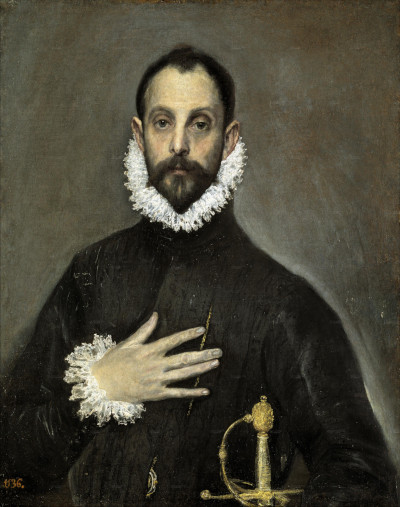
A pale hand opens across a black doublet. Above it, a white ruff follows the line of the sitter's pointed beard. Below, near the right edge, the gold hilt of a sword catches the light. The space between these details is almost entirely taken up by the man's dark clothes. The hand holds that space together. Its fingers run across the chest towards the sword, while the white cuff takes the eye back up to the collar and the composed face above it. [1] [2]
El Greco painted this gentleman around 1580, during his early years in Spain. The man meets our gaze and gives his right hand an unusually prominent place in the portrait. The name by which the painting is now known describes the pose. The sitter's identity remains unresolved, and the gesture has had several readings over the course of the painting's history. [1] [2]
At a Glance
- ArtistEl Greco (Doménikos Theotokópoulos)
- TitleThe Nobleman with his Hand on his Chest
- DateAbout 1580
- MediumOil on canvas
- Dimensions81.8 × 66.1 cm [3]
- CollectionMuseo Nacional del Prado, Madrid, P000809
- SitterUnidentified [1] [2]
This work across El Greco’s career
The Disrobing of Christ
1577–79The Assumption of the Virgin
1577–79The Holy Trinity
1577–79Martyrdom of Saint Maurice
1580–82The Burial of the Count of Orgaz
Commissioned 1586Contents
- The hand and the sword
- The shoulder against the grey
- What the restoration brought into view
- What the gesture might mean
- How the portrait became familiar
- Three other ways of meeting a sitter
The hand and the sword
The gentleman's fingers differ in their positions and in the way they catch the light. The middle and ring fingers lie close together. The little finger drops away, leaving a thin opening of black cloth between it and the rest of the hand. The thumb rises and turns towards the base of the neck. Along the knuckles and fingertips the light has a cooler, greyer quality than the warmer colour at the palm. The firm drawing of the hand gives the viewer time to notice both its weight against the doublet and the delicate separation of the fingers. [2]
There are two kinds of white in the costume. Short, crowded strokes break up the ruff into loops and small shadows. Low around the wrist, the lace splays into finer points against the sleeve. The round collar sets off the planes of the face and the pointed beard, while the restless edge of the cuff makes the wrist seem particularly alive. Above the collar, one eye appears more deeply shadowed and the nose and mouth have small shifts in alignment. Ruiz Gómez notes the importance of such asymmetries. They make the steady frontal gaze an encounter with a particular face. [2]
A thin chain appears near the hand and disappears into the doublet, with part of a pendant visible lower down. The sword fitting, by comparison, has room to catch the eye. Thin bars of gold turn around the grip, and little points of light collect on the pommel and the guard. Ruiz Gómez identifies it as a type of late sixteenth-century sword with curving bars protecting the hand. Its hilt sits unusually high, and the left hand is hidden. She suggests that the sitter may be presenting the sword by holding its sheathed blade. The picture leaves the action below the frame open. [2]
The shoulder against the grey
The background is a soft grey warmed in places by the reddish-brown preparation below the paint. The stronger darks of the coat stand out against it. Along the shoulder on the viewer's right, a thin light edge picks up the slope of the material. The slope turns down into a sleeve that occupies much of the lower corner. It gives some depth to a pose that can look flatly frontal at a glance. The sword participates in the turn as well. One arm of the guard sits on a slight angle, changing the shape of its bright silhouette over the sleeve. [2]
This small difference in tone has a history. In her Prado catalogue, Ruiz Gómez discusses an 1858 treatment that lined, cleaned and retouched the canvas. She considers it likely that the background was painted over during that intervention or somewhat later. Old photographs reproduced in her entry show the dress as well as the backdrop changing over time. In the photographs by Jean Laurent and Lacoste, the buttons and parts of the silhouette look stronger. The reproduction published by Aureliano de Beruete in 1914 already shows a lighter background and a less emphatic pattern on the clothing. Viewers at different points in the painting's history had different evidence in front of them. [2]
What the restoration brought into view
The Prado conservator Rafael Alonso removed widespread overpaint from the background and costume in 1996. The pearl-grey background and the turn of the sitter's left shoulder became easier to see. The treated painting was presented to the public that December. Alonso's report, read out during a parliamentary hearing in 1999, describes uncovering fills of different ages as well as small losses and cracks. Ruiz Gómez records that the paint adheres well to the canvas and that the surface bears wear from earlier treatments. The surface we see today includes original paint, losses and repairs. [1] [2] [4]
The changes extended to the fabric itself. The Prado's X-ray shows where the lower edge was trimmed, cutting through part of the sword guard. The margins were later enlarged. Ruiz Gómez distinguishes the smaller original fabric from the present canvas with its additions. The sword still seems to continue beyond the lower edge, and the history of that edge gives a concrete reason to be cautious about reconstructing the full gesture of the hidden hand. [2]
The white Greek signature became a separate point of debate. Alonso reported that the letters he examined lay over black paint that he regarded as later work and that part of the inscription extended into an enlarged area. He retained traces and reduced their visibility with a transparent grey application. Ruiz Gómez recounts that several specialists had accepted the inscription and sees the surviving traces as evidence that a signature in capitals once existed, with earlier cleaning and retouching altering it. The Prado continues to catalogue the portrait as a work by El Greco. The issue concerns the history of the inscription visible before the treatment. [2] [4]
El Greco on video
Open the film at 2:15 on YouTube. The gallery also includes related films from museum curators.
El Greco's Most Famous Paintings
A short survey of El Greco’s paintings, including View of Toledo.
Watch on YouTubeWhat the gesture might mean
The hand across the breast had a place in religious painting. Ruiz Gómez points to El Greco's Christ in The Disrobing of Christ as one example. In 1931, Jean Cassou read the gentleman's pose as a sign of contrition and connected it to the language of repentance in Ignatius of Loyola's Spiritual Exercises. Francisco Márquez Villanueva later drew attention to literary examples of men placing a hand over the left side of the chest as a pledge of honour. The pose can carry either form of earnestness. The portrait gives its viewer the hand, the dress and the sword, leaving the circumstances of the gesture open. [2]
Proposals for the man's name take the discussion further. An influential suggestion identified him as a Marquis of Montemayor. Ruiz Gómez recounts how David Davies proposed the third marquis, Juan de Silva y de Ribera, who held office at the Alcázar in Toledo. An earlier version of the argument treated the left arm as missing or impaired. The restored contour of the left sleeve undermined that particular clue. The hand itself is outside the area made visible by the pose and framing. The case for a named sitter has to rest on more than the presence or absence of that part of the body. [2]
The writer Miguel de Cervantes was also proposed, on the basis of a verbal self-description whose references to a broad forehead, moustache and pointed features could suit many men. A self-portrait hypothesis likewise depended on comparing the face with figures that had themselves been identified tentatively. The chain and pendant are easier to locate than to identify and expose too little detail to establish an order or office. The most direct evidence is still the costume, bearing and sword of a gentleman portrayed in keeping with the conventions of his time. [2]
How the portrait became familiar
The portrait is traced to the Quinta of the Duke of Arco, an estate that entered the Royal Collection and was inventoried in 1745. The later royal inventory registers it under El Greco. The Prado documents it in storage in 1834 as a portrait of a gentleman with a sword. By 1843 it was hanging on the museum's south stairway. The same details that help us follow the picture now, especially its costume and sword, also helped earlier owners distinguish it in a collection. The surviving records tell us how the picture was described and where it was kept. [2]
In the nineteenth century Spanish painters including Mariano Fortuny, Darío de Regoyos and Santiago Rusiñol made copies or versions. A drawing in the Museu del Cau Ferrat shows the imaginative use to which the portrait could be put. In 1897 Ramon Pichot drew Rusiñol himself in the guise of El Greco's gentleman. Picasso also used that resemblance in a sheet of sketches from 1899–1900. A pose devised for an unknown sixteenth-century man could now be put on by a recognisable contemporary. These works belong to the period when the Catalan modernistes championed El Greco, and they make that act of looking and borrowing quite tangible. [2] [5] [6]
The painting was included in the Prado's first El Greco exhibition in 1902. Ruiz Gómez traces a parallel change in the language of criticism around this period. Pío Baroja saw a figure sunk in a sorrowful inner world, and Manuel Bartolomé Cossío linked the young man with an ideal of chivalry. For these writers, the anonymous gentleman could be seen as a representative of a culture. Their readings belong to a period when many viewers knew the figure against a darker background. [2]
Three other ways of meeting a sitter
In the Prado's An Elderly Gentleman, P000806, a short bust brings the face close. The thin white collar and pale touches along the temples have to do much of the work of setting the head apart from a brownish background. The crop removes the space in which a hand, sword or pendant might have appeared. It gives the unequal eyes and the slight deviation of the nose a role comparable to the extended hand in the Nobleman. Both sitters meet a viewer directly, and the amount of body El Greco chooses to show changes the encounter. [2]
The Met's Portrait of Cardinal Fernando Niño de Guevara, 29.100.5, gives the figure space down to the floor. Spectacles frame the cardinal's direct gaze, the strong red robes fall in angular folds, and his left hand tenses against the arm of the chair. The chair and floor position the sitter within a room and the robes announce an office. The hands are still among the most expressive parts of the painting. In the Prado portrait one hand makes contact with the sitter's chest. In the Met portrait the chair gives his fingers something to grasp. [7]
In Glasgow Museums' Lady in a Fur Wrap, PC.18, an oil on canvas of about 1580–88, a translucent veil and broad swath of fur enclose the face in close view. Glasgow currently credits Alonso Sánchez Coello. The portrait was long displayed under El Greco's name, and a joint investigation by Glasgow Museums, the University of Glasgow and the Prado found that it was prepared with a light-grey priming. The researchers compared that buried layer with the reddish-brown preparations typical of El Greco. In the Nobleman, the warm preparation contributes to the colour of the visible grey background. The two portraits deserve a close look at dress and colour, down to the level of how each canvas was prepared. [2] [8] [9]
Browse the artworks
Browse the paintings covered in this collection and related works in museum catalogues. Some are by El Greco’s workshop or were formerly attributed to him.
| Name | Date | Medium |
|---|---|---|
| View of Toledo | Around 1599–1600 | Oil on canvas |
| Adoration of the Shepherds | 1612–14 | Oil on canvas |
| Laocoön | About 1610–14 | Oil on canvas |
| The Tears of Saint Peter | 1587–96, Museo del Greco dating | Oil on canvas |
| The Holy Family with Saint Anne | About 1595 | Oil on canvas |
| The Holy Trinity | 1577–79 | Oil on canvas |
| The Burial of the Count of Orgaz | 1586–88, the conventional range | Oil on canvas |
| Disrobing of Christ | 1577–79 | Oil on canvas |
| Opening of the Fifth Seal | About 1608–14 | Oil on canvas |
| Saint Martin and the Beggar | 1597–99 | Oil on canvas |
| Martyrdom of Saint Maurice | 1580–82 | Oil on canvas |
| Adoration of the Name of Jesus | 1577–79 | Oil on canvas |
| Saint Peter in Penitence (Bowes Museum) | 1580s | Oil on canvas |
| Christ Carrying the Cross | Around 1577–87 | Oil on canvas |
| Crucifixion | 1597–1600 | Oil on canvas |
| Resurrection | 1597–1600 | Oil on canvas |
| Immaculate Conception | About 1608–13 | Oil on canvas |
| Annunciation | 1597–1600 | Oil on canvas |
| Coronation of the Virgin | 1591–92 | Oil on canvas |
| Lady in a Fur Wrap | About 1580–88 | Oil on canvas |
| Baptism of Christ | Around 1608–14, with further work in the early 1620s according to Walter Liedtke. The foundation dates the painting to around 1614. | Oil on canvas |
| Portrait of an Old Man (Possible Self-Portrait) | About 1595–1600 | Oil on canvas |
| Adoration of the Kings | 1565–67, Benaki Museum dating | Tempera on wood |
| Mary Magdalene in Penitence | About 1585–90, tentatively dated by the Museu del Cau Ferrat | Oil on canvas |
| Saint Sebastian | About 1577 in the cathedral centenary catalogue | Oil on canvas |
| Portrait of Cardinal Fernando Nino de Guevara | About 1600 | Oil on canvas |
| Penitent Magdalene | About 1576–77 | Oil on canvas |
| The Nobleman with his Hand on his Chest | About 1580 | Oil on canvas |
| Saint Peter and Saint Paul | 1590–1600 | Oil on canvas |
| Pentecost | Circa 1600 | Oil on canvas |
| The Fable | About 1580 | Oil on canvas |
| Pietà | 1580–90 | Oil on canvas |
| View and Plan of Toledo | 1610–1614, according to the Museo del Greco | Oil on canvas |
| Assumption of the Virgin | 1577–79, with 1577 in the Greek inscription | Oil on canvas |
| The Annunciation (1609) | Late Tavera period. The owner dates the canvas to 1614. Factum gives 1608–1613 in its initial recording account. | Oil on canvas |
| The Agony in the Garden of Gethsemane | 1590s | Oil on canvas |
| Portrait of Jorge Manuel Theotocópuli | Circa 1600–05 | Oil on canvas |
| Dormition of the Virgin | About 1565–66, according to the National Gallery of Greece | Tempera on wood |
| Saint Louis | 1585–90 | Oil on canvas |
| Ecstasy of St Francis of Assisi (1580) | About 1577–80 in the Vatican Museums’ account. The Diocesan Museum gives 1575–80. | Oil on canvas |
| Saint Francis of Assisi in Ecstasy, after El Greco | Seventeenth century | Oil on canvas |
| Christ Driving the Money Changers from the Temple | Probably before 1570 | Oil on wood |
| The Entombment of Christ | Circa 1568–70, Venice | Mixed technique on wood |
| Nativity | 1603–05 | Oil on canvas |
| Portrait of a Gentleman | About 1586 | Oil on canvas |
| Coronation of the Virgin (Illescas) | 1603–05 | Oil on canvas |
| A Boy Blowing on an Ember to Light a Candle (El Soplón) | About 1570–72 | Oil on canvas |
| The Feast in the House of Simon | About 1608–14 | Oil on canvas |
| Concert of Angels | About 1608–14 | Oil on canvas |
| Healing of the Man Born Blind | Around 1570 in Dresden’s printed collection guide | Mixed technique on wood |
| Fray Hortensio Félix Paravicino | 1609 | Oil on canvas |
| Purification of the Temple | Circa 1600 | Oil on canvas |
| Portrait of Vincenzo Anastagi | Circa 1575 | Oil on canvas |
| Saint Paul (Almadrones) | 1608–14 | Oil on canvas |
| Head of Christ | About 1579–86 | Oil on canvas |
| Last Supper | About 1567–68, Venice | Tempera on wood |
| Saint John the Evangelist (Prado Museum, Madrid) | About 1605 | Oil on canvas |
| Disrobing of Christ (Lyon, Half Painting Version) | About 1581–86 | Oil on canvas |
| The Dream of Philip II | 1577–79 | Oil on canvas |
| Portrait of a Sculptor | About 1577–80, 2019 exhibition dating | Oil on canvas |
| Saint Bernard | 1577–79 | Oil on canvas |
| Saint Benedict | 1577–79 | Oil on canvas |
| Portrait of Jerónimo de Cevallos | 1613, as catalogued by the Prado | Oil on canvas |
| The Flight into Egypt | About 1570 | Oil on wood |
| Saint Anthony of Padua | About 1580 | Oil on canvas |
| Portrait of a Doctor | 1582–85 | Oil on canvas |
| The Veil of Saint Veronica | 1586–95 | Oil on canvas |
| An Elderly Gentleman | About 1587–1600 | Oil on canvas |
| Saints Andrew and Francis | About 1595 | Oil on canvas |
| The Holy Family with Saint Anne and the Infant Saint John | Around 1600 in the Prado catalogue. The Balaguer record gives 1595–1600. | Oil on canvas |
| The Virgin Mary | 1595–1600 | Oil on canvas |
| Portrait of a Gentleman (1600-1605) | About 1600–05 | Oil on canvas |
| Portrait of a Young Gentleman | 1600–05 | Oil on canvas |
| John the Baptist and Saint John the Evangelist | 1600–10 | Oil on canvas |
| Portrait of a Friar | 1600–50 | Oil on canvas |
| Saint Thomas (Almadrones) | 1608–14 | Oil on canvas |
| Christ the Saviour (Almadrones) | 1608–14 | Oil on canvas |
| An Apostle (Prado P000814) | 1608–14 | Oil on canvas |
| Saint James (Almadrones) | 1608–14 | Oil on canvas |
| Julián Romero and his Patron Saint | 1612–18 | Oil on canvas |
| Allegory of the Camaldolese Order | Around 1600, Instituto Valencia de Don Juan dating | Oil on canvas |
| Saint Joseph and the Christ Child | 1597–99 | Oil on canvas |
| Saint Ildefonsus | Around 1600 according to the Prado's proposal, 1603–05 in Hadjinicolaou and Ficonofue | Oil on canvas |
| Saint Augustine | About 1585–1602, as listed in the 2014 exhibition study | Oil on canvas |
| Portrait of Diego de Covarrubias y Leyva | Circa 1600 | Oil on canvas |
| Saint Bernardino of Siena | 1603 in the Prado catalogue. The Museo del Greco object page lists 1602. | Oil on canvas |
| Portrait of Cardinal Tavera | About 1609 in the foundation's account, circa 1610 in its image heading | Oil on canvas |
| Visitation | About 1610–14 | Oil on canvas |
| Portrait of Francisco de Pisa | Circa 1610–14 | Oil on canvas |
| Saint Lawrence's Vision of the Madonna and Child (Apparition of the Virgin to St. Lawrence) | 1578–80 in the 2021 heritage decree | Oil on canvas |
| Christ on the Cross | Probably 1570s, assigned to El Greco’s Italian period in the sale literature | Oil on canvas |
| Portrait of Charles de Guise | 1572, as dated in the painted book | Oil on canvas |
| Portrait of Giulio Clovio | 1571–72, according to Capodimonte | Oil on canvas |
| Mount Sinai | About 1570–72 | Mixed technique on wood |
| Modena Triptych | 1567–1568, as dated by the Galleria Estense and the national catalogue | Tempera on wood |
| Saint Luke Painting the Virgin | 1560–67, Benaki Museum dating | Mixed technique on wood |
| Saint Ildefonso (Washington) | 1603–14 | Oil on canvas |
| Saint Martin and the Beggar (smaller Washington version) | 1600–14 | Oil on canvas |
| The Holy Family with Saint Anne and the Infant John the Baptist (Washington) | About 1595–1600 | Oil on canvas |
| The Adoration of the Name of Jesus (London panel) | Late 1570s | Oil on wood |
| Christ Driving the Traders from the Temple (London) | About 1600 | Oil on canvas |
| Saint Francis Receiving the Stigmata (Baltimore) | 1585–90 | Oil on canvas |
| Saint Luke (Almadrones, Indianapolis) | About 1610–14 | Oil on canvas |
| Saint Matthew (Almadrones, Indianapolis) | About 1610–14 | Oil on canvas |
| Saint Simon (Almadrones, Indianapolis) | About 1610–14 | Oil on canvas |
| The Tears of Saint Peter (Hospital de Tavera) | About 1605 | Oil on canvas Catalogue. |
Discussion
Look again at the images and ideas explored in The Nobleman with his Hand on his Chest. These editorial prompts invite your observations.
Reader Insights
Look at the line where the black shoulder meets the grey. Which part of the sitter’s body becomes easier to see there?
Follow the hand from the cuff to the fingertips, then look at the sword. How does the light change between the two?
Join the Conversation
Share a detail, comparison or question about The Nobleman with his Hand on his Chest below.
References
- Fundación Princesa de Asturias, FascinArte en El Prado, ‘El retrato antes de la foto’, p. 7, Museo Nacional del Prado P000809 (in Spanish) View source.
- Leticia Ruiz Gómez, El Greco en el Museo Nacional del Prado. Catálogo razonado, Museo Nacional del Prado, 2007, nos. 28 and 31, pp. 182–188 and 198–201 (in Spanish) View source.
- Museo Nacional del Prado, El Museo del Prado en Jerez, work no. 5, published dimensions for the portrait (in Spanish) View source.
- Congreso de los Diputados, 21 April 1999, no. 668, pp. 19394 and 19400–19401, including the reading of Prado conservator Rafael Alonso's report (in Spanish) View source.
- Museus de Sitges, Ramon Pichot's portrait of Santiago Rusiñol as El Greco's gentleman, 1897, Museu del Cau Ferrat (in Spanish) View source.
- Museus de Sitges, Rusiñol vist per Picasso, exhibition and loan list (in Spanish) View source.
- The Metropolitan Museum of Art, Cardinal Fernando Niño de Guevara (1541–1609), 29.100.5 View source.
- Glasgow Museums, Lady in a Fur Wrap, Alonso Sánchez Coello, PC.18 View source.
- University of Glasgow, ‘Results of research on Spanish masterpiece Lady in a Fur Wrap announced’, 2019 View source.







