


 by Tom Gurney
Tom Gurney BSc (Hons) is an art history expert with over 20 years experience
Published on June 19, 2020 / Updated on October 14, 2023
Email: tomgurney1@gmail.com / Phone: +44 7429 011000
Allegory of the Camaldolese Order by El Greco: Introduction
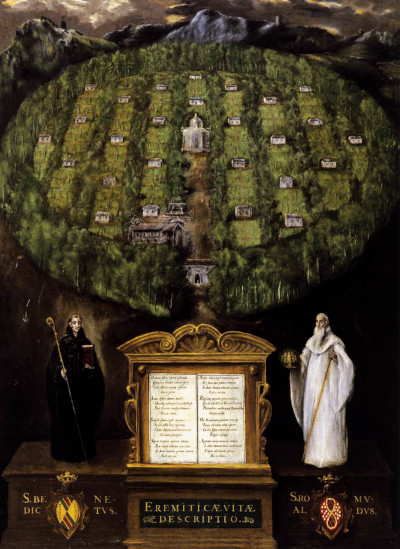
A green enclosure fills most of the picture. Within it, small houses stand in rows on either side of a path. The path leads uphill from a gate to a pale, domed chapel. Lower down, two saints stand beside an open book in a carved surround, and the one in white holds a miniature of the enclosure. The same set of buildings can be seen at the scale of a model in his hand and at the scale of a landscape behind him. [1] [2]
This is the canvas in the Instituto Valencia de Don Juan in Madrid. The Instituto dates it to around 1600 and traces it to the collection of Pedro Laso de la Vega, the first Count of Los Arcos. The painting sets out the arrangement of a Camaldolese hermitage, where monks live in individual cells and gather for prayer. The organisation of the houses tells us as much about the life of the order as the saints’ gestures and the book below. [1] [2] [3]
At a Glance
- ArtistEl Greco (Doménikos Theotokópoulos), as catalogued by the Instituto Valencia de Don Juan [1]
- DateAround 1600, Instituto Valencia de Don Juan dating [1]
- MediumOil on canvas [4]
- CollectionInstituto Valencia de Don Juan, Madrid [1] [4]
- FiguresSaint Benedict and Saint Romuald [2] [4]
- Related workA separate version at the Museo del Patriarca, Valencia [2]
This work across El Greco’s career
Martyrdom of Saint Maurice
1580–82The Burial of the Count of Orgaz
Commissioned 1586View of Toledo
c. 1599–1600Allegory of the Camaldolese Order (current article)
Around 1600, Instituto Valencia de Don Juan dating [1]Opening of the Fifth Seal
c. 1608–14View and Plan of Toledo
1610–14Contents
- Through the Gate and up to the Chapel
- The Founders and the Book
- A Proposal to Establish the Order in Spain
- What the Valencia Version Changes
- How El Greco Shows a Place
Through the Gate and up to the Chapel
The buildings look small enough to count. Their pale façades catch the light between patches of green. There is room to see the roofs and part of the walls together, as if one had climbed well above the valley to take in the whole enclosure at once. The path gives that broad view a direction. It runs from a shadowy opening in the trees, past the buildings near the entrance, through a gap between the rows and up to the chapel. Near the middle of the painting the dome catches a little more light than the houses around it. [2]
The outer ring appears as an ellipse in the picture. Trees stand along it like a screen with uneven edges. Their collective shape holds the rows of houses inside and lets the surrounding mountains keep their much less regular outlines. Juan Calduch Cervera, writing for the Museo del Greco, reads the painted enclosure as an idealised map. He draws attention to the staggered cells and gardens and compares the domed, centrally planned building to the form of Palladio’s Villa Rotonda as published in his architectural treatise. That is a comparison of building types. The convent takes its shape in the picture from the planned relation of the houses, chapel and entry. [2]
This elevated view gives the doors, gardens and paths equal importance. From the ground, the nearer buildings and trees would hide much of what lies behind them. From overhead, the relation between one cell and the next can be read across the picture. The painter keeps the walls and roofs visible from an angle, so the settlement still looks inhabited. Only the interior of the circle is repeated and measured in this way. Above it, sharp mountains and strips of light in the sky make the place feel remote. [2]
The Founders and the Book
Benedict stands on the left in a black habit with a crozier. Romuald stands across from him in white. The Latin lettering along the front names them, in groups of letters set to either side of their shields. Between them, the open book catches the light inside its elaborate surround. The central inscription beneath it describes the eremitical life, a life centred on the retreat of the hermit. The book and figures direct our attention to how the community lives, while the landscape shows the places where that life would be carried on. [2] [4] [5]
Below the ring of trees El Greco changes the direction of the view. We can see down onto the roofs above, but the saints, shields and lettering face forward with very little tilt. The carved outline around the book appears almost level with the viewer, even while the church seems far uphill. This change makes the inscription and the arrangement of the enclosure legible in a single picture. It is also what lets Romuald carry a view that seems, quite naturally, to float behind him on a much larger scale. [2] [5]
Romuald’s small model is hard to pick out at first. It sits on his raised hand against the dark, just beyond the white sleeve. The ring takes up so little room there that it can be seen as a single object before we look back up at the spread of houses. Calduch connects the device with images in which a founder or patron carries a model of a building. Here the model belongs to the man identified as the Camaldolese founder, and the book and inscription beside him give the settlement a purpose. The movement from model to enclosure is also a movement from a founder’s hand to the scale of an entire community. [2] [5]
The community at Camaldoli in Italy traces its Sacred Hermitage to Romuald, who it says founded it around 1025 with a church and five hermit cells. The monks follow the Rule of Saint Benedict. Their account explains how the solitary time in a cell fits within a community that has shared prayer, rules and a prior. In El Greco’s picture the spaces between the houses have the same importance as the paths that link them. They give the hermits room to live apart. The chapel gives them somewhere to come together. [2] [3]
A Proposal to Establish the Order in Spain
In 1597 the Benedictine friar Juan de Castañiza petitioned Philip II for permission to establish the Camaldolese in Spain. The same year saw the publication in Madrid of his Historia de San Romualdo. The title presents the founder’s life as a model of living in solitude. Cameron Quade links both painted versions to that campaign. An ideal community laid out in a single view could show a potential supporter how the form of religious life described in the text might occupy a piece of land. [5] [6]
The commission for the Madrid painting also has a more immediate connection to the people named by its arms. The Instituto records Pedro Laso’s ownership. The iconographic archive of the Fundación Universitaria Española identifies him as the patron. Quade associates the two shields with Pedro Laso and his wife Mariana de Mendoza and interprets them as evidence that the picture was made for the couple. The ownership is documented by the Instituto, and the arms give the commission argument a basis in the object itself. The precise circumstances in which the versions were ordered remain open. [1] [4] [5]
What the Valencia Version Changes
A separate picture of the same composition belongs to the Museo del Patriarca in Valencia. The Museo Nacional de Escultura catalogued it for an exhibition as a work of 1606–10. Its reproduction shows the ordered enclosure and the same opposition of the saints’ dark and light habits. The area around the book has a different architectural framing, with an upper point above the scrolls. The rows of dwellings still occupy most of the picture, and the white figure still holds a small form that directs the eye back to the landscape. [2] [7]
One of the clearest differences is at the foot of the pictures. The Museo del Greco bulletin observes that the Valencia version lacks the lower part that carries the names, shields and central description in Madrid. Calduch proposes that its framing and heraldry reflect changes made for Juan de Ribera, the Patriarch of Valencia. The visible differences give the two pictures distinct histories. The Valencia catalogue’s later dating also shows why the 1597 petition is most useful as context for the subject and for the proposed commission. [2] [5] [7]
How El Greco Shows a Place
El Greco had already treated the relation between landscape and religious life in the view on the back of the Modena Triptych. The independent Mount Sinai in Heraklion also makes the monastery visible from above. Its buildings sit within a terrain of steep paths and peaks. The Camaldolese enclosure gives each house a place within an even pattern. The buildings fill a surface the eye can survey, while the uneven country around them keeps the arrangement from becoming a diagram by itself. [2] [8]
In View and Plan of Toledo, a young man holds a map beside the painted city. El Greco lifts the Tavera Hospital into the air and explains in the inscription that he moved it so key features of the hospital and the city could both be seen. In the Madrid allegory, the model and the large enclosure show the same imagined settlement from a similar angle. The Toledo painting gives a reader a plan and a view of a known city. The allegory offers a way to picture a religious community. For more on the painter’s move to Spain and the circles in which he worked, see the biography of El Greco. [2] [5] [9]
Browse the artworks
Browse the paintings covered in this collection and related works in museum catalogues. Some are by El Greco’s workshop or were formerly attributed to him.
| Name | Date | Medium |
|---|---|---|
| View of Toledo | Around 1599–1600 | Oil on canvas |
| Adoration of the Shepherds | 1612–14 | Oil on canvas |
| Laocoön | About 1610–14 | Oil on canvas |
| The Tears of Saint Peter | 1587–96, Museo del Greco dating | Oil on canvas |
| The Holy Family with Saint Anne | About 1595 | Oil on canvas |
| The Holy Trinity | 1577–79 | Oil on canvas |
| The Burial of the Count of Orgaz | 1586–88, the conventional range | Oil on canvas |
| Disrobing of Christ | 1577–79 | Oil on canvas |
| Opening of the Fifth Seal | About 1608–14 | Oil on canvas |
| Saint Martin and the Beggar | 1597–99 | Oil on canvas |
| Martyrdom of Saint Maurice | 1580–82 | Oil on canvas |
| Adoration of the Name of Jesus | 1577–79 | Oil on canvas |
| Saint Peter in Penitence (Bowes Museum) | 1580s | Oil on canvas |
| Christ Carrying the Cross | Around 1577–87 | Oil on canvas |
| Crucifixion | 1597–1600 | Oil on canvas |
| Resurrection | 1597–1600 | Oil on canvas |
| Immaculate Conception | About 1608–13 | Oil on canvas |
| Annunciation | 1597–1600 | Oil on canvas |
| Coronation of the Virgin | 1591–92 | Oil on canvas |
| Lady in a Fur Wrap | About 1580–88 | Oil on canvas |
| Baptism of Christ | Around 1608–14, with further work in the early 1620s according to Walter Liedtke. The foundation dates the painting to around 1614. | Oil on canvas |
| Portrait of an Old Man (Possible Self-Portrait) | About 1595–1600 | Oil on canvas |
| Adoration of the Kings | 1565–67, Benaki Museum dating | Tempera on wood |
| Mary Magdalene in Penitence | About 1585–90, tentatively dated by the Museu del Cau Ferrat | Oil on canvas |
| Saint Sebastian | About 1577 in the cathedral centenary catalogue | Oil on canvas |
| Portrait of Cardinal Fernando Nino de Guevara | About 1600 | Oil on canvas |
| Penitent Magdalene | About 1576–77 | Oil on canvas |
| The Nobleman with his Hand on his Chest | About 1580 | Oil on canvas |
| Saint Peter and Saint Paul | 1590–1600 | Oil on canvas |
| Pentecost | Circa 1600 | Oil on canvas |
| The Fable | About 1580 | Oil on canvas |
| Pietà | 1580–90 | Oil on canvas |
| View and Plan of Toledo | 1610–1614, according to the Museo del Greco | Oil on canvas |
| Assumption of the Virgin | 1577–79, with 1577 in the Greek inscription | Oil on canvas |
| The Annunciation (1609) | Late Tavera period. The owner dates the canvas to 1614. Factum gives 1608–1613 in its initial recording account. | Oil on canvas |
| The Agony in the Garden of Gethsemane | 1590s | Oil on canvas |
| Portrait of Jorge Manuel Theotocópuli | Circa 1600–05 | Oil on canvas |
| Dormition of the Virgin | About 1565–66, according to the National Gallery of Greece | Tempera on wood |
| Saint Louis | 1585–90 | Oil on canvas |
| Ecstasy of St Francis of Assisi (1580) | About 1577–80 in the Vatican Museums’ account. The Diocesan Museum gives 1575–80. | Oil on canvas |
| Saint Francis of Assisi in Ecstasy, after El Greco | Seventeenth century | Oil on canvas |
| Christ Driving the Money Changers from the Temple | Probably before 1570 | Oil on wood |
| The Entombment of Christ | Circa 1568–70, Venice | Mixed technique on wood |
| Nativity | 1603–05 | Oil on canvas |
| Portrait of a Gentleman | About 1586 | Oil on canvas |
| Coronation of the Virgin (Illescas) | 1603–05 | Oil on canvas |
| A Boy Blowing on an Ember to Light a Candle (El Soplón) | About 1570–72 | Oil on canvas |
| The Feast in the House of Simon | About 1608–14 | Oil on canvas |
| Concert of Angels | About 1608–14 | Oil on canvas |
| Healing of the Man Born Blind | Around 1570 in Dresden’s printed collection guide | Mixed technique on wood |
| Fray Hortensio Félix Paravicino | 1609 | Oil on canvas |
| Purification of the Temple | Circa 1600 | Oil on canvas |
| Portrait of Vincenzo Anastagi | Circa 1575 | Oil on canvas |
| Saint Paul (Almadrones) | 1608–14 | Oil on canvas |
| Head of Christ | About 1579–86 | Oil on canvas |
| Last Supper | About 1567–68, Venice | Tempera on wood |
| Saint John the Evangelist (Prado Museum, Madrid) | About 1605 | Oil on canvas |
| Disrobing of Christ (Lyon, Half Painting Version) | About 1581–86 | Oil on canvas |
| The Dream of Philip II | 1577–79 | Oil on canvas |
| Portrait of a Sculptor | About 1577–80, 2019 exhibition dating | Oil on canvas |
| Saint Bernard | 1577–79 | Oil on canvas |
| Saint Benedict | 1577–79 | Oil on canvas |
| Portrait of Jerónimo de Cevallos | 1613, as catalogued by the Prado | Oil on canvas |
| The Flight into Egypt | About 1570 | Oil on wood |
| Saint Anthony of Padua | About 1580 | Oil on canvas |
| Portrait of a Doctor | 1582–85 | Oil on canvas |
| The Veil of Saint Veronica | 1586–95 | Oil on canvas |
| An Elderly Gentleman | About 1587–1600 | Oil on canvas |
| Saints Andrew and Francis | About 1595 | Oil on canvas |
| The Holy Family with Saint Anne and the Infant Saint John | Around 1600 in the Prado catalogue. The Balaguer record gives 1595–1600. | Oil on canvas |
| The Virgin Mary | 1595–1600 | Oil on canvas |
| Portrait of a Gentleman (1600-1605) | About 1600–05 | Oil on canvas |
| Portrait of a Young Gentleman | 1600–05 | Oil on canvas |
| John the Baptist and Saint John the Evangelist | 1600–10 | Oil on canvas |
| Portrait of a Friar | 1600–50 | Oil on canvas |
| Saint Thomas (Almadrones) | 1608–14 | Oil on canvas |
| Christ the Saviour (Almadrones) | 1608–14 | Oil on canvas |
| An Apostle (Prado P000814) | 1608–14 | Oil on canvas |
| Saint James (Almadrones) | 1608–14 | Oil on canvas |
| Julián Romero and his Patron Saint | 1612–18 | Oil on canvas |
| Allegory of the Camaldolese Order | Around 1600, Instituto Valencia de Don Juan dating | Oil on canvas |
| Saint Joseph and the Christ Child | 1597–99 | Oil on canvas |
| Saint Ildefonsus | Around 1600 according to the Prado's proposal, 1603–05 in Hadjinicolaou and Ficonofue | Oil on canvas |
| Saint Augustine | About 1585–1602, as listed in the 2014 exhibition study | Oil on canvas |
| Portrait of Diego de Covarrubias y Leyva | Circa 1600 | Oil on canvas |
| Saint Bernardino of Siena | 1603 in the Prado catalogue. The Museo del Greco object page lists 1602. | Oil on canvas |
| Portrait of Cardinal Tavera | About 1609 in the foundation's account, circa 1610 in its image heading | Oil on canvas |
| Visitation | About 1610–14 | Oil on canvas |
| Portrait of Francisco de Pisa | Circa 1610–14 | Oil on canvas |
| Saint Lawrence's Vision of the Madonna and Child (Apparition of the Virgin to St. Lawrence) | 1578–80 in the 2021 heritage decree | Oil on canvas |
| Christ on the Cross | Probably 1570s, assigned to El Greco’s Italian period in the sale literature | Oil on canvas |
| Portrait of Charles de Guise | 1572, as dated in the painted book | Oil on canvas |
| Portrait of Giulio Clovio | 1571–72, according to Capodimonte | Oil on canvas |
| Mount Sinai | About 1570–72 | Mixed technique on wood |
| Modena Triptych | 1567–1568, as dated by the Galleria Estense and the national catalogue | Tempera on wood |
| Saint Luke Painting the Virgin | 1560–67, Benaki Museum dating | Mixed technique on wood |
| Saint Ildefonso (Washington) | 1603–14 | Oil on canvas |
| Saint Martin and the Beggar (smaller Washington version) | 1600–14 | Oil on canvas |
| The Holy Family with Saint Anne and the Infant John the Baptist (Washington) | About 1595–1600 | Oil on canvas |
| The Adoration of the Name of Jesus (London panel) | Late 1570s | Oil on wood |
| Christ Driving the Traders from the Temple (London) | About 1600 | Oil on canvas |
| Saint Francis Receiving the Stigmata (Baltimore) | 1585–90 | Oil on canvas |
| Saint Luke (Almadrones, Indianapolis) | About 1610–14 | Oil on canvas |
| Saint Matthew (Almadrones, Indianapolis) | About 1610–14 | Oil on canvas |
| Saint Simon (Almadrones, Indianapolis) | About 1610–14 | Oil on canvas |
| The Tears of Saint Peter (Hospital de Tavera) | About 1605 | Oil on canvas Catalogue. |
Discussion
Look again at the images and ideas explored in Allegory of the Camaldolese Order by El Greco. These editorial prompts invite your observations.
Reader Insights
Trace a path from one of the cells to the chapel. Which details of the layout let you imagine living there alone and gathering with others?
Compare the model in Romuald’s hand with the enclosure behind him. Which features can you recognise at both scales?
Join the Conversation
Share a detail, comparison or question about Allegory of the Camaldolese Order by El Greco below.
References
- Instituto Valencia de Don Juan, Painting collection View source.
- Juan Calduch Cervera, El Greco. Pintor de mapas (I), Museo del Greco bulletin 11, pp. 26–31 View source.
- Comunità di Camaldoli, Sacro Eremo, history, plan and community View source.
- Fundación Universitaria Española, Fichero Iconográfico, Alegoría de la orden de los Camaldulenses, record 6075 View source.
- Cameron E. Quade, A Reexamination of El Greco’s View and Plan of Toledo as a Question of Sources and Patronage, University of Wisconsin–Milwaukee, 2019, pp. 16–19 and figs. 9–12 View source.
- Biblioteca Digital de Madrid, catalogue of Juan de Castañiza’s Historia de S. Romualdo, Madrid, 1597 View source.
- Museo Nacional de Escultura, Tiempos de melancolía, entry 47, p. 159, Valencia version View source.
- Historical Museum of Crete, El Greco collection, View of Mt. Sinai and the Monastery of St. Catherine View source.
- Museo del Greco, View and Plan of Toledo, CE00014, object record and translated inscription View source.







