


 by Tom Gurney
Tom Gurney BSc (Hons) is an art history expert with over 20 years experience
Published on June 19, 2020 / Updated on October 14, 2023
Email: tomgurney1@gmail.com / Phone: +44 7429 011000
The Penitent Mary Magdalene by El Greco: Introduction
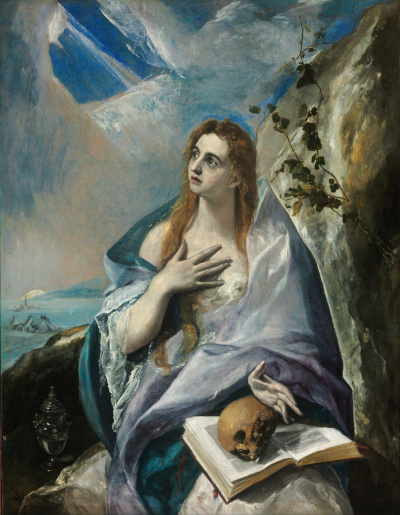
A skull rests on an open book, just beneath the Magdalene's outstretched hand. Her other hand lies across her chest. Her head turns above both gestures towards a wedge of blue at the upper left, where pale bands of light break through the clouds. The landscape reaches much farther than the small ledge on which she sits. A slope and a strip of distant water can be seen to her left, and a slab of rock rises close behind her on the right. El Greco makes the opening in the sky feel far away while the book and skull remain near enough for the fingers almost to touch. [1]
The Museum of Fine Arts in Budapest dates this Penitent Mary Magdalene to about 1576–77. It is a tall canvas with enough space for the blue and violet drapery to spread from the figure into the rocky foreground. The objects here matter to the reading of the picture, but their shapes register in a particular order. The eye can begin with the pale turned pages, follow the curve of the skull to the opened hand, and then rise past the hand on the chest to the face. The Magdalene's look gives that route a direction which takes it beyond the things laid out in front of her. [1]
At a Glance
- ArtistEl Greco (Doménikos Theotokópoulos) [1]
- TitleThe Penitent Mary Magdalene (Bűnbánó Magdolna) [1]
- DateAbout 1576–77 [1]
- MediumOil on canvas [1]
- Dimensions156.5 × 121 cm (height × width) [1]
- CollectionMuseum of Fine Arts, Budapest, inventory 5640 [1]
This work across El Greco’s career
Modena Triptych
1567–68Penitent Magdalene (current article)
About 1576–77 [1]The Disrobing of Christ
1577–79The Assumption of the Virgin
1577–79The Holy Trinity
1577–79Martyrdom of Saint Maurice
1580–82Contents
- From the open page to the sky
- A figure held between rock and cloud
- Titian and the history of the subject
- The Magdalene at Sitges and Peter in Toledo
- Looking at the painting in Budapest
From the open page to the sky
The book lies diagonally across a flat rock at the bottom right. A band of cream paint gives the near block of pages its thickness, and the sheet on top bends where it meets the binding. The skull overhangs the open spread. One hollow catches our attention because it is much darker than either the light bone or the paper under it. The two objects give the foreground its clearest edges and its strongest contrast at a small scale. A little higher up, the pale fingers move across a fold of violet cloth. The uneven spacing of those fingers helps carry the eye from familiar objects to a less easily named movement of the hand. [1]
Axel Vécsey, writing for the Budapest museum, reads the skull as an emblem of mortality and imagines that it has just rolled away from the open hand. The picture makes that motion plausible through the distance between the bone and the tips of the fingers. It also leaves the book in the position of an object somebody could consult. Its open pages face upwards, and the Magdalene's head has turned to another part of the picture. The skull and book allow the viewer to picture an interval of reading and meditation before the moment in which El Greco shows her. [1]
Below and across from the book, an ornate vessel stands in a pocket of shadow. Its dark body emerges in short touches of light on the edges and at the lid. Jars for ointment recur in paintings of the Magdalene. Here our attention can move from a nearly hidden object of that kind to a white page that is immediately visible, then up across the robe and the lit shoulder. El Greco uses two small objects set at either side of the figure to vary the pace at which the details become apparent. [1] [2]
A figure held between rock and cloud
The Magdalene's hair descends in separate locks across the pale area of her shoulder. It catches a little of the warmth seen at her wrist and above the edges of the blue mantle. The cloth itself is broad on the viewer's right and thinner where it gathers near her other arm. Across the lap, folds change from violet to pale grey and take on a stronger blue again near the bottom of the canvas. Those shifts give us a way to read the pressure of the body beneath the cloth and to follow the direction of the turned head. [1]
Above the shoulder the rock lifts in a diagonal that roughly parallels the turn of her face. A strand of ivy winds across its surface, with tiny dark leaves spaced in uneven groups. Vécsey connects the plant with eternal life. Its upward growth can be followed in the painting without seeing every leaf. The vine is most visible near the light rock, and disappears as it travels towards the corner. Across from it, the top of the sky is interrupted by a few strong bands of blue and white. The band nearest her face traces almost the same direction as her gaze. The colour and the slightly raised chin draw the sky into the action. [1]
El Greco on video
Open the film at 0:25 on YouTube. The gallery also includes related films from museum curators.
El Greco's Most Famous Paintings
A short survey of El Greco’s paintings, including View of Toledo.
Watch on YouTubeBelow that opening, a cold light extends out over the low shore. The mountains and water reduce to gentle changes in tone, and the greens of the ivy are clearer against the rock than anything to be seen in the far distance. The near stones can support a book and the weight of a seated figure. The distant terrain occupies a much thinner strip of the painting and supplies a sense of how far there is to look. That change of scale puts her solitude into the landscape. [1]
Titian and the history of the subject
The Budapest museum relates the image to Titian's treatments of the penitent saint. In the Palatine Gallery's Penitent Magdalene, dated 1531–35, Titian brings the upward gaze and long loose hair close to the viewer. The Uffizi notes a signature on the neck of the ointment jar. The jar occupies a low corner and the warm face and hair fill much of the canvas. El Greco places a similar upward turn within a larger field that includes the full spread of the cloak and the distance beyond the rock. The close view of the face remains essential, but the book and skull let the eye see what surrounded the saint before her attention shifted. [1] [2]
The association of a penitent woman, long hair and ointment has a history in Western Christian interpretation. A modern Vatican decree distinguishes Mary of Magdala, to whom Christ appears after the Resurrection, from the sister of Martha and the woman whose sins are forgiven. The older association helps explain why an ointment vessel appears in a painting of the Magdalene. Vécsey interprets the scene in Budapest as a moment of conversion in the wilderness. The light, skull and movement of her hands make the image appropriate to that reading. They also give a viewer actions to follow within a painted moment rather than carrying the reader through the whole of a story. [1] [2] [3]
The Magdalene at Sitges and Peter in Toledo
The signed Penitent Magdalene with the Cross in the Museu Cau Ferrat, inventory 32,004, uses a different grouping. The red cloak encloses much of the figure, and the skull sits close to the crucifix. The museum's María Margarita Cuyàs describes her attention as meditative and points out the hand she extends towards the skull. In Budapest the book provides a wider ledge for the skull, the robe opens into a longer stretch of blue and violet folds, and the figure's eyes travel higher. The gesture towards a nearby object has a place in both pictures. The big differences in colour and in where the viewer follows the gaze make the two works easy to distinguish. [1] [4]
In the Toledo Museo del Greco's Tears of Saint Peter, CE00056, the saint's joined hands gather the action against his chest and his head tilts upwards. The museum associates his gesture with the denial of Christ and the remorse that followed. The Budapest Magdalene holds her hands apart, giving her room to keep one close to herself and extending the other towards the instruments of meditation. Peter's compact pair of hands and the Magdalene's separated gestures offer two ways of seeing a response that has no visible speaker. A viewer reads its direction through the face, then returns to the posture and the objects near it. [1] [5]
Looking at the painting in Budapest
The canvas has a particular place in the Hungarian reception of El Greco. The Grand Palais exhibition dossier records it as a gift from the collector Marcell Nemes in 1921. The same dossier lists it in the 2019–20 Paris retrospective, with its Budapest inventory number. The current museum record gives the canvas height as 156.5 centimetres, slightly more precise than the 157 centimetres used in the exhibition dossier. [1] [6]
Art historian Dominika Sodics illustrates it in her study of the painter Aurél Bernáth, who recalled admiring the Budapest work in 1919. In the account Sodics reconstructs, Bernáth reconsidered El Greco as his own approach to painting changed. The early Magdalene retained its hold even as he came to value some of El Greco's other works less. That recognition was grounded in a particular canvas. The open page, the fingers and the view across the sea are rendered with just enough clarity for the strong colours and strange light to remain attached to things one can recognise. The painting keeps the material world close at the point when the saint's attention has moved farthest from it. [1] [7]
Browse the artworks
Browse the paintings covered in this collection and related works in museum catalogues. Some are by El Greco’s workshop or were formerly attributed to him.
| Name | Date | Medium |
|---|---|---|
| View of Toledo | Around 1599–1600 | Oil on canvas |
| Adoration of the Shepherds | 1612–14 | Oil on canvas |
| Laocoön | About 1610–14 | Oil on canvas |
| The Tears of Saint Peter | 1587–96, Museo del Greco dating | Oil on canvas |
| The Holy Family with Saint Anne | About 1595 | Oil on canvas |
| The Holy Trinity | 1577–79 | Oil on canvas |
| The Burial of the Count of Orgaz | 1586–88, the conventional range | Oil on canvas |
| Disrobing of Christ | 1577–79 | Oil on canvas |
| Opening of the Fifth Seal | About 1608–14 | Oil on canvas |
| Saint Martin and the Beggar | 1597–99 | Oil on canvas |
| Martyrdom of Saint Maurice | 1580–82 | Oil on canvas |
| Adoration of the Name of Jesus | 1577–79 | Oil on canvas |
| Saint Peter in Penitence (Bowes Museum) | 1580s | Oil on canvas |
| Christ Carrying the Cross | Around 1577–87 | Oil on canvas |
| Crucifixion | 1597–1600 | Oil on canvas |
| Resurrection | 1597–1600 | Oil on canvas |
| Immaculate Conception | About 1608–13 | Oil on canvas |
| Annunciation | 1597–1600 | Oil on canvas |
| Coronation of the Virgin | 1591–92 | Oil on canvas |
| Lady in a Fur Wrap | About 1580–88 | Oil on canvas |
| Baptism of Christ | Around 1608–14, with further work in the early 1620s according to Walter Liedtke. The foundation dates the painting to around 1614. | Oil on canvas |
| Portrait of an Old Man (Possible Self-Portrait) | About 1595–1600 | Oil on canvas |
| Adoration of the Kings | 1565–67, Benaki Museum dating | Tempera on wood |
| Mary Magdalene in Penitence | About 1585–90, tentatively dated by the Museu del Cau Ferrat | Oil on canvas |
| Saint Sebastian | About 1577 in the cathedral centenary catalogue | Oil on canvas |
| Portrait of Cardinal Fernando Nino de Guevara | About 1600 | Oil on canvas |
| Penitent Magdalene | About 1576–77 | Oil on canvas |
| The Nobleman with his Hand on his Chest | About 1580 | Oil on canvas |
| Saint Peter and Saint Paul | 1590–1600 | Oil on canvas |
| Pentecost | Circa 1600 | Oil on canvas |
| The Fable | About 1580 | Oil on canvas |
| Pietà | 1580–90 | Oil on canvas |
| View and Plan of Toledo | 1610–1614, according to the Museo del Greco | Oil on canvas |
| Assumption of the Virgin | 1577–79, with 1577 in the Greek inscription | Oil on canvas |
| The Annunciation (1609) | Late Tavera period. The owner dates the canvas to 1614. Factum gives 1608–1613 in its initial recording account. | Oil on canvas |
| The Agony in the Garden of Gethsemane | 1590s | Oil on canvas |
| Portrait of Jorge Manuel Theotocópuli | Circa 1600–05 | Oil on canvas |
| Dormition of the Virgin | About 1565–66, according to the National Gallery of Greece | Tempera on wood |
| Saint Louis | 1585–90 | Oil on canvas |
| Ecstasy of St Francis of Assisi (1580) | About 1577–80 in the Vatican Museums’ account. The Diocesan Museum gives 1575–80. | Oil on canvas |
| Saint Francis of Assisi in Ecstasy, after El Greco | Seventeenth century | Oil on canvas |
| Christ Driving the Money Changers from the Temple | Probably before 1570 | Oil on wood |
| The Entombment of Christ | Circa 1568–70, Venice | Mixed technique on wood |
| Nativity | 1603–05 | Oil on canvas |
| Portrait of a Gentleman | About 1586 | Oil on canvas |
| Coronation of the Virgin (Illescas) | 1603–05 | Oil on canvas |
| A Boy Blowing on an Ember to Light a Candle (El Soplón) | About 1570–72 | Oil on canvas |
| The Feast in the House of Simon | About 1608–14 | Oil on canvas |
| Concert of Angels | About 1608–14 | Oil on canvas |
| Healing of the Man Born Blind | Around 1570 in Dresden’s printed collection guide | Mixed technique on wood |
| Fray Hortensio Félix Paravicino | 1609 | Oil on canvas |
| Purification of the Temple | Circa 1600 | Oil on canvas |
| Portrait of Vincenzo Anastagi | Circa 1575 | Oil on canvas |
| Saint Paul (Almadrones) | 1608–14 | Oil on canvas |
| Head of Christ | About 1579–86 | Oil on canvas |
| Last Supper | About 1567–68, Venice | Tempera on wood |
| Saint John the Evangelist (Prado Museum, Madrid) | About 1605 | Oil on canvas |
| Disrobing of Christ (Lyon, Half Painting Version) | About 1581–86 | Oil on canvas |
| The Dream of Philip II | 1577–79 | Oil on canvas |
| Portrait of a Sculptor | About 1577–80, 2019 exhibition dating | Oil on canvas |
| Saint Bernard | 1577–79 | Oil on canvas |
| Saint Benedict | 1577–79 | Oil on canvas |
| Portrait of Jerónimo de Cevallos | 1613, as catalogued by the Prado | Oil on canvas |
| The Flight into Egypt | About 1570 | Oil on wood |
| Saint Anthony of Padua | About 1580 | Oil on canvas |
| Portrait of a Doctor | 1582–85 | Oil on canvas |
| The Veil of Saint Veronica | 1586–95 | Oil on canvas |
| An Elderly Gentleman | About 1587–1600 | Oil on canvas |
| Saints Andrew and Francis | About 1595 | Oil on canvas |
| The Holy Family with Saint Anne and the Infant Saint John | Around 1600 in the Prado catalogue. The Balaguer record gives 1595–1600. | Oil on canvas |
| The Virgin Mary | 1595–1600 | Oil on canvas |
| Portrait of a Gentleman (1600-1605) | About 1600–05 | Oil on canvas |
| Portrait of a Young Gentleman | 1600–05 | Oil on canvas |
| John the Baptist and Saint John the Evangelist | 1600–10 | Oil on canvas |
| Portrait of a Friar | 1600–50 | Oil on canvas |
| Saint Thomas (Almadrones) | 1608–14 | Oil on canvas |
| Christ the Saviour (Almadrones) | 1608–14 | Oil on canvas |
| An Apostle (Prado P000814) | 1608–14 | Oil on canvas |
| Saint James (Almadrones) | 1608–14 | Oil on canvas |
| Julián Romero and his Patron Saint | 1612–18 | Oil on canvas |
| Allegory of the Camaldolese Order | Around 1600, Instituto Valencia de Don Juan dating | Oil on canvas |
| Saint Joseph and the Christ Child | 1597–99 | Oil on canvas |
| Saint Ildefonsus | Around 1600 according to the Prado's proposal, 1603–05 in Hadjinicolaou and Ficonofue | Oil on canvas |
| Saint Augustine | About 1585–1602, as listed in the 2014 exhibition study | Oil on canvas |
| Portrait of Diego de Covarrubias y Leyva | Circa 1600 | Oil on canvas |
| Saint Bernardino of Siena | 1603 in the Prado catalogue. The Museo del Greco object page lists 1602. | Oil on canvas |
| Portrait of Cardinal Tavera | About 1609 in the foundation's account, circa 1610 in its image heading | Oil on canvas |
| Visitation | About 1610–14 | Oil on canvas |
| Portrait of Francisco de Pisa | Circa 1610–14 | Oil on canvas |
| Saint Lawrence's Vision of the Madonna and Child (Apparition of the Virgin to St. Lawrence) | 1578–80 in the 2021 heritage decree | Oil on canvas |
| Christ on the Cross | Probably 1570s, assigned to El Greco’s Italian period in the sale literature | Oil on canvas |
| Portrait of Charles de Guise | 1572, as dated in the painted book | Oil on canvas |
| Portrait of Giulio Clovio | 1571–72, according to Capodimonte | Oil on canvas |
| Mount Sinai | About 1570–72 | Mixed technique on wood |
| Modena Triptych | 1567–1568, as dated by the Galleria Estense and the national catalogue | Tempera on wood |
| Saint Luke Painting the Virgin | 1560–67, Benaki Museum dating | Mixed technique on wood |
| Saint Ildefonso (Washington) | 1603–14 | Oil on canvas |
| Saint Martin and the Beggar (smaller Washington version) | 1600–14 | Oil on canvas |
| The Holy Family with Saint Anne and the Infant John the Baptist (Washington) | About 1595–1600 | Oil on canvas |
| The Adoration of the Name of Jesus (London panel) | Late 1570s | Oil on wood |
| Christ Driving the Traders from the Temple (London) | About 1600 | Oil on canvas |
| Saint Francis Receiving the Stigmata (Baltimore) | 1585–90 | Oil on canvas |
| Saint Luke (Almadrones, Indianapolis) | About 1610–14 | Oil on canvas |
| Saint Matthew (Almadrones, Indianapolis) | About 1610–14 | Oil on canvas |
| Saint Simon (Almadrones, Indianapolis) | About 1610–14 | Oil on canvas |
| The Tears of Saint Peter (Hospital de Tavera) | About 1605 | Oil on canvas Catalogue. |
Discussion
Look again at the images and ideas explored in The Penitent Mary Magdalene by El Greco. These editorial prompts invite your observations.
Reader Insights
Start at the open book and look up towards the sky. Which colours or edges lead you towards the opening?
Compare the Budapest and Sitges figures. How does the change in the position of the hands and gaze affect what you notice first?
Join the Conversation
Share a detail, comparison or question about The Penitent Mary Magdalene by El Greco below.
References
- Museum of Fine Arts, Budapest, The Penitent Mary Magdalene, inventory 5640, with commentary by Axel Vécsey View source.
- Uffizi Galleries, Titian, The Penitent Magdalene, Palatine Gallery, Pitti Palace, 1912 no. 67 View source.
- Congregation for Divine Worship and the Discipline of the Sacraments, decree on Saints Martha, Mary and Lazarus, 26 January 2021 View source.
- Museus de Sitges, Penitent Magdalene with the Cross, Museu Cau Ferrat 32,004, record by María Margarita Cuyàs View source.
- Museo del Greco, Las lágrimas de San Pedro, CE00056 View source.
- Grand Palais, Louvre and Art Institute of Chicago, Greco, 2019 exhibition dossier, pp. 23 and 72 View source.
- Dominika Sodics, Ars Hungarica 49 no. 3, 2023, pp. 323–324 and fig. 8 View source.







