


 by Tom Gurney
Tom Gurney BSc (Hons) is an art history expert with over 20 years experience
Published on June 19, 2020 / Updated on October 14, 2023
Email: tomgurney1@gmail.com / Phone: +44 7429 011000
El Greco’s Coronation of the Virgin: Introduction
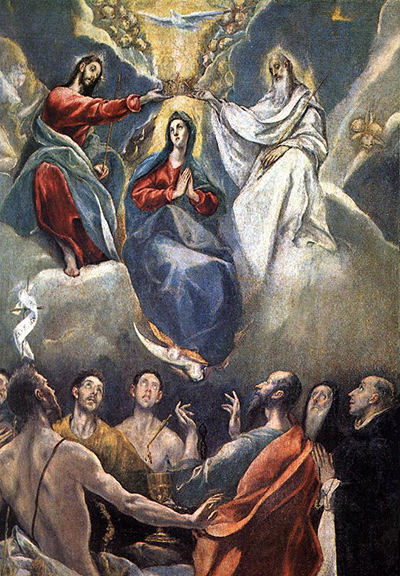
An arm in red reaches across the sky towards a crown. A second arm, emerging from a sleeve almost white, meets it above Mary’s head. Below her, a bare-backed figure turns so sharply that we see the line of his shoulder before his face. He and the other witnesses look up. Their heads run across the lower edge of the painting, while the clouds above them gather around Mary and the two figures who are about to crown her. Follow those upward glances and the coronation takes place at the end of a movement that begins among bodies much closer to our own level. [1]
El Greco painted this vertical canvas in 1591–92 for the Rosary confraternity’s altarpiece in Talavera la Vieja. The picture, now at the Real Monasterio de Santa María de Guadalupe, stood above a sculpted image of the Virgin in the parish church. It is a little over a metre high. Its place in the altarpiece gave that relatively compact surface the task of showing an event high in heaven, as seen by a company of saints. [1] [2] [3]
At a Glance
- ArtistEl Greco (Doménikos Theotokópoulos) [1] [2]
- TitleThe Coronation of the Virgin (Coronación de la Virgen), Talavera la Vieja version [2] [3]
- Date1591–92 [1]
- MediumOil on canvas [1] [3]
- Dimensions105 × 80 cm (height × width) [1] [3]
- Original settingRosary altarpiece, parish church of San Andrés, Talavera la Vieja [1] [4] [5]
- CustodianReal Monasterio de Santa María de Guadalupe, Cáceres. Inventory 181, listed under the Archdiocese of Toledo on deposit at the monastery in 2014. [2] [3]
This work across El Greco’s career
The Disrobing of Christ
1577–79The Assumption of the Virgin
1577–79Martyrdom of Saint Maurice
1580–82The Burial of the Count of Orgaz
Commissioned 1586View of Toledo
c. 1599–1600Contents
- From the witnesses to the crown
- A painted scene above a carved Virgin
- From Talavera la Vieja to Guadalupe
- The vault at Illescas and the Prado’s near-square canvas
- What the parishioner saw above the altar
From the witnesses to the crown
The saints fill the width of the foreground. At the left a man shows us his back, turning his head towards the light. Two younger faces beyond him tilt upwards at slightly different angles. Across from them, hands emerge from sloping sleeves and point into the space between the groups. The orange-red fabric worn by the figure nearest to us on the right makes his turn especially easy to follow. Some of the witnesses lean forwards while others stand almost in profile. Taken together, their movements open the composition at the centre, just where the bank of cloud starts to lift. [1] [4]
Ramos Rubio identifies Saint John the Baptist and Saint John the Evangelist among these witnesses, the latter with a chalice. The partly bare youth is identified as Saint Sebastian. The contract names these saints and also asks for Saint Anthony and Saint Dominic with the rosary. It leaves the inclusion of further saints to the painter’s judgement. Ramos Rubio identifies Saint Paul and Saint Francis of Paola beyond the named requirements. From the church floor, a worshipper might have recognised an attribute or a habit. The shared upward glance can be read even when the small details are difficult to make out. [4]
Mary’s blue mantle makes an almost continuous shape from her bowed knees to the veil that surrounds her face. A small crescent curves under her. The red sleeves and joined hands make a compact centre within the blue. Christ and God the Father sit in clouds to either side. Their extended arms converge just above Mary’s head, and the light behind her makes the little crown legible between the two hands. Higher still, the pale dove flies across the brightest part of the opening, representing the Holy Spirit. Mary’s head, the crown and the dove lie close to the picture’s vertical axis, while the larger figures and clouds spread out to either side. [1]
Colour keeps that nearly symmetrical arrangement alive. Christ’s red sleeve projects into a dark patch of sky, while the Father’s pale drapery continues down into a broad white cloud. Below Christ, a tiny pale musician faces towards the witnesses. As Leticia Ruiz Gómez observes, the figure links the zone of angels with the people looking on below. Its small size makes the interval between the lower faces and the upper group feel deeper. Across that interval the paint moves from flesh, folds and distinct profiles into clouds whose contours alternately dissolve into shadow and catch the light. [1]
A painted scene above a carved Virgin
On 14 February 1591 El Greco undertook to provide the altarpiece before the Toledo notary Blas Hurtado. Lucas Sánchez, the Rosary confraternity’s steward, and the priest Hernando Márquez acted for the confraternity. In the clauses published by José Antonio Ramos Rubio, the commission included a carved Virgin of the Rosary for the centre, with gilding and painted decoration, as well as the architecture, carving and finish of the structure. El Greco was responsible for supplying the assembled work. The price was 300 ducats and the confraternity was to pay for transporting it. The agreement specified 25 July 1591 as the deadline. The catalogue dates the painting 1591–92. Luis Alberto Pérez Velarde places the commission in the period when El Greco’s workshop began to offer clients complete retables, from their architecture to the final gilding. [1] [4] [5]
The sculpted Virgin gave the confraternity an image in the body of the retable. Above her, the painted Virgin sat on clouds while two figures raised a crown. For a viewer who had already lifted their eyes from the sculpture, the witnesses at the bottom of the canvas extended that act of looking. The picture’s vertical shape leaves enough room for the saints to register as a distinct company and for Mary to appear high above their heads. The movement that begins with the worshipper’s gaze therefore has a counterpart inside the painting. [1] [4]
Ramos Rubio describes the Rosary retable as a side altarpiece on the Epistle side of the church. In his account of its later arrangement, the Coronation occupied the central upper compartment. The other paintings and the sculpture had their own compartments. The surviving Saint Peter and Saint Andrew are valuable evidence of that ensemble, even as the written specification and the later record leave questions about the other subjects and their exact positions. Seen together, the three canvases preserve two of the formats that the retable brought together. Peter and Andrew occupy narrow, full-length canvases designed for single standing figures. The Coronation is wider, with enough room for the witnesses at the foot of the canvas to turn towards one another as well as look up. [2] [4] [6]
From Talavera la Vieja to Guadalupe
The retable suffered losses in the Spanish Civil War. Ramos Rubio records the loss of the carved Virgin and some of the paintings, and describes the three surviving canvases as having been kept in the parish house after restoration in 1927. The Valdecañas reservoir inundated Talavera la Vieja in the 1960s. By then the paintings had entered a new phase of their history. The Museo de Santa Cruz in Toledo held them on deposit for decades. A contemporary report of the agreement signed on 13 May 1994 records the decision to transfer the Coronation, Saint Peter and Saint Andrew to Guadalupe. The monastery now identifies all three together in its collection account. [2] [4] [6] [7]
The later appearance of the name Santa Cruz has a separate explanation. A 2014 order granted a state guarantee for the exhibition El Griego de Toledo at that museum. Number 22 in its schedule gives the exact dimensions and inventory number 181 for the Talavera Coronation. The same entry identifies the Archdiocese of Toledo as lender and names the monastery at Guadalupe as the place of deposit. The order thus records a temporary journey back to a museum that had once housed the canvas for a much longer period. [2] [3] [6] [7]
The vault at Illescas and the Prado’s near-square canvas
The later Coronation of the Virgin at Illescas belongs to the sanctuary of the Hospital de la Caridad, commissioned in 1603 and completed in 1605 according to its foundation. The 2016 state loan record identifies it as inventory 3 and gives its dimensions as 163 × 220 centimetres. Its broad oval belonged in the vault of the main chapel. From below, the curves of drapery and cloud carry the eye round the edge and bring it back into the company around the crown. The figures occupy much of the oval’s depth. The Talavera canvas, intended for an upper compartment in an upright retable, gives the viewer a longer passage from the lower faces to Mary’s throne. [1] [8] [9]
The Prado’s Coronation (P002645) is a third object, an almost square oil on canvas measuring 99 × 101 centimetres and dating from around 1592. Ruiz Gómez reads its composition in close relation to the Talavera work and notes both the enlarged crescent and the absence of the lower assembly. The space beneath Mary therefore belongs more fully to the clouds. This also changes the role of the musician, which is much less emphatic in the Prado version. A viewer looking for the back and twisting shoulder that open the scene in the Talavera canvas instead meets the crescent and underside of the cloud bank. [1] [10]
Ruiz Gómez discusses older proposals that the Prado canvas was a preparatory study for Talavera, as well as José Álvarez Lopera’s judgement that it was a repetition by El Greco. The Prado’s X-ray showed no sign of the exploratory changes that the first proposal would lead one to expect. Ruiz Gómez saw evidence of collaboration in uneven passages, including the musician and Mary’s face. The 2007 catalogue and the Prado’s 2018 loan record both credit El Greco and workshop. The original destination of that square canvas is still uncertain, which makes the documentation of the Rosary retable especially useful for understanding the upright design. [1] [10]
What the parishioner saw above the altar
El Greco had worked on a grander scale for the high altar of Santo Domingo el Antiguo in Toledo. The Art Institute of Chicago’s Assumption of the Virgin, painted in 1577–79, filled the central position in the lower storey of that structure, with the Prado’s Holy Trinity above it. In Chicago’s painting the apostles gathered at the tomb watch Mary rise. The arrangement at Santo Domingo invited the eye to continue upwards from a large painting into a second canvas, where the Father supports Christ’s body. At Talavera, El Greco brought the ascent of the eye into a single upper canvas, above the carved figure in the retable. [1] [4] [11]
That difference of scale and setting gives a reason to linger over the Talavera witnesses. At just over a metre high, the painting leaves a narrow strip for their faces and shoulders. Their gestures are large enough to connect the lower edge to the clouds, yet varied enough that we can follow one figure at a time. Start with the turning man at the left, then pick out the two upturned faces beside him. The eye has travelled a long way by the time it reaches the two hands holding the crown. [1] [4]
Browse the artworks
Browse the paintings covered in this collection and related works in museum catalogues. Some are by El Greco’s workshop or were formerly attributed to him.
| Name | Date | Medium |
|---|---|---|
| View of Toledo | Around 1599–1600 | Oil on canvas |
| Adoration of the Shepherds | 1612–14 | Oil on canvas |
| Laocoön | About 1610–14 | Oil on canvas |
| The Tears of Saint Peter | 1587–96, Museo del Greco dating | Oil on canvas |
| The Holy Family with Saint Anne | About 1595 | Oil on canvas |
| The Holy Trinity | 1577–79 | Oil on canvas |
| The Burial of the Count of Orgaz | 1586–88, the conventional range | Oil on canvas |
| Disrobing of Christ | 1577–79 | Oil on canvas |
| Opening of the Fifth Seal | About 1608–14 | Oil on canvas |
| Saint Martin and the Beggar | 1597–99 | Oil on canvas |
| Martyrdom of Saint Maurice | 1580–82 | Oil on canvas |
| Adoration of the Name of Jesus | 1577–79 | Oil on canvas |
| Saint Peter in Penitence (Bowes Museum) | 1580s | Oil on canvas |
| Christ Carrying the Cross | Around 1577–87 | Oil on canvas |
| Crucifixion | 1597–1600 | Oil on canvas |
| Resurrection | 1597–1600 | Oil on canvas |
| Immaculate Conception | About 1608–13 | Oil on canvas |
| Annunciation | 1597–1600 | Oil on canvas |
| Coronation of the Virgin | 1591–92 | Oil on canvas |
| Lady in a Fur Wrap | About 1580–88 | Oil on canvas |
| Baptism of Christ | Around 1608–14, with further work in the early 1620s according to Walter Liedtke. The foundation dates the painting to around 1614. | Oil on canvas |
| Portrait of an Old Man (Possible Self-Portrait) | About 1595–1600 | Oil on canvas |
| Adoration of the Kings | 1565–67, Benaki Museum dating | Tempera on wood |
| Mary Magdalene in Penitence | About 1585–90, tentatively dated by the Museu del Cau Ferrat | Oil on canvas |
| Saint Sebastian | About 1577 in the cathedral centenary catalogue | Oil on canvas |
| Portrait of Cardinal Fernando Nino de Guevara | About 1600 | Oil on canvas |
| Penitent Magdalene | About 1576–77 | Oil on canvas |
| The Nobleman with his Hand on his Chest | About 1580 | Oil on canvas |
| Saint Peter and Saint Paul | 1590–1600 | Oil on canvas |
| Pentecost | Circa 1600 | Oil on canvas |
| The Fable | About 1580 | Oil on canvas |
| Pietà | 1580–90 | Oil on canvas |
| View and Plan of Toledo | 1610–1614, according to the Museo del Greco | Oil on canvas |
| Assumption of the Virgin | 1577–79, with 1577 in the Greek inscription | Oil on canvas |
| The Annunciation (1609) | Late Tavera period. The owner dates the canvas to 1614. Factum gives 1608–1613 in its initial recording account. | Oil on canvas |
| The Agony in the Garden of Gethsemane | 1590s | Oil on canvas |
| Portrait of Jorge Manuel Theotocópuli | Circa 1600–05 | Oil on canvas |
| Dormition of the Virgin | About 1565–66, according to the National Gallery of Greece | Tempera on wood |
| Saint Louis | 1585–90 | Oil on canvas |
| Ecstasy of St Francis of Assisi (1580) | About 1577–80 in the Vatican Museums’ account. The Diocesan Museum gives 1575–80. | Oil on canvas |
| Saint Francis of Assisi in Ecstasy, after El Greco | Seventeenth century | Oil on canvas |
| Christ Driving the Money Changers from the Temple | Probably before 1570 | Oil on wood |
| The Entombment of Christ | Circa 1568–70, Venice | Mixed technique on wood |
| Nativity | 1603–05 | Oil on canvas |
| Portrait of a Gentleman | About 1586 | Oil on canvas |
| Coronation of the Virgin (Illescas) | 1603–05 | Oil on canvas |
| A Boy Blowing on an Ember to Light a Candle (El Soplón) | About 1570–72 | Oil on canvas |
| The Feast in the House of Simon | About 1608–14 | Oil on canvas |
| Concert of Angels | About 1608–14 | Oil on canvas |
| Healing of the Man Born Blind | Around 1570 in Dresden’s printed collection guide | Mixed technique on wood |
| Fray Hortensio Félix Paravicino | 1609 | Oil on canvas |
| Purification of the Temple | Circa 1600 | Oil on canvas |
| Portrait of Vincenzo Anastagi | Circa 1575 | Oil on canvas |
| Saint Paul (Almadrones) | 1608–14 | Oil on canvas |
| Head of Christ | About 1579–86 | Oil on canvas |
| Last Supper | About 1567–68, Venice | Tempera on wood |
| Saint John the Evangelist (Prado Museum, Madrid) | About 1605 | Oil on canvas |
| Disrobing of Christ (Lyon, Half Painting Version) | About 1581–86 | Oil on canvas |
| The Dream of Philip II | 1577–79 | Oil on canvas |
| Portrait of a Sculptor | About 1577–80, 2019 exhibition dating | Oil on canvas |
| Saint Bernard | 1577–79 | Oil on canvas |
| Saint Benedict | 1577–79 | Oil on canvas |
| Portrait of Jerónimo de Cevallos | 1613, as catalogued by the Prado | Oil on canvas |
| The Flight into Egypt | About 1570 | Oil on wood |
| Saint Anthony of Padua | About 1580 | Oil on canvas |
| Portrait of a Doctor | 1582–85 | Oil on canvas |
| The Veil of Saint Veronica | 1586–95 | Oil on canvas |
| An Elderly Gentleman | About 1587–1600 | Oil on canvas |
| Saints Andrew and Francis | About 1595 | Oil on canvas |
| The Holy Family with Saint Anne and the Infant Saint John | Around 1600 in the Prado catalogue. The Balaguer record gives 1595–1600. | Oil on canvas |
| The Virgin Mary | 1595–1600 | Oil on canvas |
| Portrait of a Gentleman (1600-1605) | About 1600–05 | Oil on canvas |
| Portrait of a Young Gentleman | 1600–05 | Oil on canvas |
| John the Baptist and Saint John the Evangelist | 1600–10 | Oil on canvas |
| Portrait of a Friar | 1600–50 | Oil on canvas |
| Saint Thomas (Almadrones) | 1608–14 | Oil on canvas |
| Christ the Saviour (Almadrones) | 1608–14 | Oil on canvas |
| An Apostle (Prado P000814) | 1608–14 | Oil on canvas |
| Saint James (Almadrones) | 1608–14 | Oil on canvas |
| Julián Romero and his Patron Saint | 1612–18 | Oil on canvas |
| Allegory of the Camaldolese Order | Around 1600, Instituto Valencia de Don Juan dating | Oil on canvas |
| Saint Joseph and the Christ Child | 1597–99 | Oil on canvas |
| Saint Ildefonsus | Around 1600 according to the Prado's proposal, 1603–05 in Hadjinicolaou and Ficonofue | Oil on canvas |
| Saint Augustine | About 1585–1602, as listed in the 2014 exhibition study | Oil on canvas |
| Portrait of Diego de Covarrubias y Leyva | Circa 1600 | Oil on canvas |
| Saint Bernardino of Siena | 1603 in the Prado catalogue. The Museo del Greco object page lists 1602. | Oil on canvas |
| Portrait of Cardinal Tavera | About 1609 in the foundation's account, circa 1610 in its image heading | Oil on canvas |
| Visitation | About 1610–14 | Oil on canvas |
| Portrait of Francisco de Pisa | Circa 1610–14 | Oil on canvas |
| Saint Lawrence's Vision of the Madonna and Child (Apparition of the Virgin to St. Lawrence) | 1578–80 in the 2021 heritage decree | Oil on canvas |
| Christ on the Cross | Probably 1570s, assigned to El Greco’s Italian period in the sale literature | Oil on canvas |
| Portrait of Charles de Guise | 1572, as dated in the painted book | Oil on canvas |
| Portrait of Giulio Clovio | 1571–72, according to Capodimonte | Oil on canvas |
| Mount Sinai | About 1570–72 | Mixed technique on wood |
| Modena Triptych | 1567–1568, as dated by the Galleria Estense and the national catalogue | Tempera on wood |
| Saint Luke Painting the Virgin | 1560–67, Benaki Museum dating | Mixed technique on wood |
| Saint Ildefonso (Washington) | 1603–14 | Oil on canvas |
| Saint Martin and the Beggar (smaller Washington version) | 1600–14 | Oil on canvas |
| The Holy Family with Saint Anne and the Infant John the Baptist (Washington) | About 1595–1600 | Oil on canvas |
| The Adoration of the Name of Jesus (London panel) | Late 1570s | Oil on wood |
| Christ Driving the Traders from the Temple (London) | About 1600 | Oil on canvas |
| Saint Francis Receiving the Stigmata (Baltimore) | 1585–90 | Oil on canvas |
| Saint Luke (Almadrones, Indianapolis) | About 1610–14 | Oil on canvas |
| Saint Matthew (Almadrones, Indianapolis) | About 1610–14 | Oil on canvas |
| Saint Simon (Almadrones, Indianapolis) | About 1610–14 | Oil on canvas |
| The Tears of Saint Peter (Hospital de Tavera) | About 1605 | Oil on canvas Catalogue. |
Discussion
Look again at the images and ideas explored in El Greco’s Coronation of the Virgin. These editorial prompts invite your observations.
Reader Insights
Follow one witness’s line of sight to the crown. Does it meet the light directly or take you through the clouds and the angels first?
Imagine looking up from the carved Virgin below the painting. Which of the lower figures would you notice first?
Join the Conversation
Share a detail, comparison or question about El Greco’s Coronation of the Virgin below.
References
- Leticia Ruiz Gómez, El Greco en el Museo Nacional del Prado, 2007, catalogue no. 7, pp. 66–69 and fig. 47, and no. 3, pp. 48–49 View source.
- Real Monasterio de Santa María de Guadalupe, Pinturas, El Greco en Guadalupe View source.
- Boletín Oficial del Estado, El Griego de Toledo exhibition guarantee, 2014, annex no. 22 View source.
- José Antonio Ramos Rubio, El retablo de El Greco en la iglesia parroquial de Talavera la Vieja, contract extracts and study View source.
- Luis Alberto Pérez Velarde, El pintor toledano Antón Pizarro, 2020, p. 171 View source.
- María del Rosario Gutiérrez Marcos, Recorrido por las fuentes historiográficas rehabilitadoras de la tierra del Greco, pp. 47–48 View source.
- Servimedia, report on the agreement to transfer the three paintings to Guadalupe, 13 May 1994 View source.
- Fundación Hospital Nuestra Señora de la Caridad, El Greco in Illescas View source.
- Boletín Oficial del Estado, Grecos de La Caridad de Illescas exhibition guarantee, 2016, annex no. 3 View source.
- Museo Nacional del Prado, Memoria de actividades 2018, p. 362, P002645 View source.
- Art Institute of Chicago, The Assumption of the Virgin, 1906.99, and its setting at Santo Domingo el Antiguo View source.







