


 by Tom Gurney
Tom Gurney BSc (Hons) is an art history expert with over 20 years experience
Published on June 19, 2020 / Updated on October 14, 2023
Email: tomgurney1@gmail.com / Phone: +44 7429 011000
Martyrdom of Saint Maurice by El Greco: Introduction
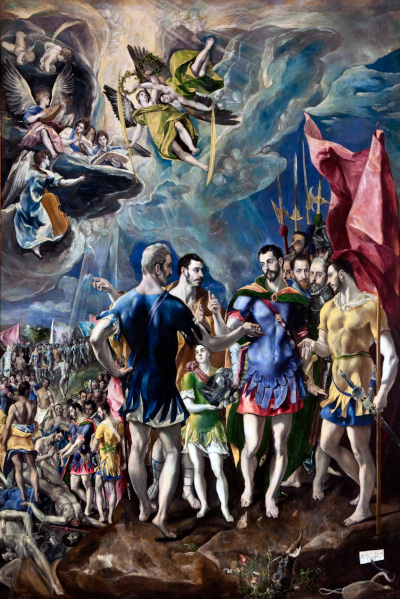
A soldier in blue armour turns towards his companions and opens his hand. The bearded officer opposite inclines his head, his breastplate catching the light. At the left, a nearly naked prisoner kneels before a man holding a sword. Above them, angels come through the clouds with palms and crowns. El Greco gives the greatest space to the officers among whom the decision to face death takes shape. The smaller figures make that decision visible a second time, through the bodies of the men who carry it out. [1] [2]
Philip II commissioned the painting for a side altar in the basilica of San Lorenzo de El Escorial. El Greco delivered it in November 1582 and received the balance of the agreed valuation the following April. The altar ultimately received another painting of Saint Maurice by Rómulo Cincinnato. The story of the commission involves a king's dissatisfaction, a substantial payment and a practical question about how a picture nearly four and a half metres tall would speak to someone standing below it. [2] [3] [4]
At a Glance
- ArtistDomenikos Theotokopoulos, known as El Greco
- Spanish titleEl martirio de San Mauricio y la Legión Tebana
- Date1580–82
- MediumOil on canvas
- Dimensions445 × 294 cm as recorded in the 1999 state loan guarantee [4]
- CollectionPatrimonio Nacional, Royal Monastery of San Lorenzo de El Escorial
- Inventory number100 14707 in the 1999 state loan guarantee [4]
- Original commissionPhilip II, for the altar of Saint Maurice and his companions in the monastery basilica
This work across El Greco’s career
Modena Triptych
1567–68The Disrobing of Christ
1577–79The Assumption of the Virgin
1577–79The Holy Trinity
1577–79The Burial of the Count of Orgaz
Commissioned 1586Contents
- The officers on the rise
- What the men have decided
- Down the slope and into the clouds
- Philip II's commission and the cost of the painting
- What Sigüenza said about the painting
- The 2026 restoration
The officers on the rise
The blue-clad figure with his back to us stands with one hand at his hip and the other extended into the group. Follow his arm and it leads to Maurice, the black-bearded officer whose blue cuirass catches the light in patches across his chest. A green cloak lies over his shoulders and a red garment shows beneath the strips of the armour. He inclines his head towards the extended hand. At the right, the officer in yellow turns his face towards Maurice, his weight on one leg and his hand down near the staff. The three men make a loose circle, open just wide enough for us to see the hands between them. [1] [2]
El Greco has left room for differences of bearing within that circle. The officer with his back turned stands firmly and bends his elbow sharply. Maurice's bare legs are close together and his head tips forward. The man in yellow holds himself straighter. The turn of his neck carries his attention across the space between their faces. A younger, smaller figure in green and yellow holds a helmet just below the adults' hands. His face emerges from a narrow gap, giving the viewer another line of sight into the exchange. Even the spare opening between the legs of the two blue figures matters. It admits light into a part of the picture that could have become a wall of armour. [1] [2]
At the right edge a red standard rises above the officer in yellow. Light strikes the folds, turning the raised fabric pink along the ridges, while the part behind the officer drops into a dark red. The spears behind the other men are thinner and more nearly upright. They let us count successive rows of heads before the space opens into sky. On the left the ground falls away and exposes another company. A soldier's shoulder, a glint of yellow or a point of steel that reads immediately on the rise becomes a much smaller mark in the distance. The change in scale makes the retreat of the ground abrupt. [1] [2]
The faces and the equipment also bring different times together. Here is a story set in the Roman Empire, told through a mixture of antique-looking cuirasses, bare legs and weapons that could have been familiar to a sixteenth-century viewer. Some of the heads have the particularity of portraits. Alessandro Farnese, Duke of Parma, and Emanuele Filiberto, Duke of Savoy, are among the men proposed as possible models. Marías reviews several competing identifications. The distinctive faces suggest how a viewer at Philip II’s court might have read the ancient legend through the appearance of soldiers of their own day. Near the bottom right, in a quieter patch of ground, the painter gives us a name that can be read. A serpent holds the small pale slip carrying his signature in Greek. [1] [2]
What the men have decided
In the fifth-century Passion of the Martyrs of Agaunum, Eucherius of Lyon tells of a legion called the Thebans, summoned from the East to serve the Roman emperor Maximian. Ordered to take part in the persecution of Christians, the soldiers refuse. They halt at Agaunum, in what is now the Swiss Valais. The emperor orders every tenth man killed and repeats the punishment when the survivors still refuse to obey. Maurice, Exuperius and Candidus urge the others to hold firm. The officers' message to the emperor makes a distinction between service in his army and obedience in matters of faith. In the final slaughter, the legion allows itself to be killed. [5]
Eucherius wrote generations after the events he describes. His account explains the sanctity of a place and the devotion paid to its martyrs. It belongs to the literature of saints' lives, where speeches can make the meaning of a death explicit. Later accounts also connect the refusal with a demand for sacrifice to pagan gods. Fernando Marías sets El Greco's composition alongside several versions that were available by the sixteenth century, including Alonso de Villegas's Flos sanctorum. Eucherius gives us the structure of the legend. The precise text used for the Escorial commission remains uncertain. [2] [5]
The men in the foreground could be listening to an exhortation of the kind Eucherius gives to the officers. El Greco leaves the moment loose enough to suggest a decision being shared. Maurice is the officer at the centre of their attention. The figure seen from behind has much of the open space for gesture. The standard bearer stays close enough to hear. Along the small heads behind them, the act of holding firm could pass from the leaders to the ranks. The painting's physical arrangement gives us time for that thought before the eye goes down to the deaths. [1] [2] [5]
Down the slope and into the clouds
From the rocks at the officers' feet, look left to the pale limbs of men already killed. Above them an executioner stands nearly bare-backed. Farther in, a kneeling man lowers his head. The sword and bent neck compress the motion of the scene into a narrow space, while ranks of tiny figures climb away behind them. The press of heads and pikes makes visible something the fewer, much larger figures at the right could only imply, the number of people who must meet the same fate. The dead at the front of this smaller episode bring the result of the execution almost to the bottom edge of the canvas. [1] [2]
El Greco also places figures in more than one part of the story. Marías points to the recurrence of faces and colours, especially in the company close to Maurice. Watch for the smaller blue and yellow garments near the executions after looking at the brightly clad officers above. The echoes make it possible to read the episodes as successive without a frame between them. There is some room to differ over which man reappears at each point. The repeated colours, the change in scale and the exposed bodies do the work of carrying the eye from the council to the executions. [1] [2]
The clouds make a second connection. The opening at the upper left contains a group of angels making music among the clouds, with others swooping down towards the centre. One turns far enough for the lower legs to come up as the torso pitches forward. Long palms make fine strokes across the dense movement of wings and cloth. Delicate shafts of light connect the upper gathering with figures below. The yellow cloth of the nearest descending angel catches the eye before those slender marks are clear. The angels offer the promised reward of martyrdom, and their downward movement carries that promise back into the part of the painting occupied by the soldiers. [1] [2]
El Greco on video
Open the film at 3:05 on YouTube. The gallery also includes related films from museum curators.
El Greco's Most Famous Paintings
A short survey of El Greco’s paintings, including View of Toledo.
Watch on YouTubePhilip II's commission and the cost of the painting
The choice of Maurice belonged to the monastery's programme of altars dedicated to saints. The royal collection connects him with the Order of the Golden Fleece, the chivalric order whose patron he was. In this setting, the story of a soldier's obligations could carry a particular charge. In Toledo the painter was already handling large commissions for churches. The king's letter of 25 April 1580 shows what this particular project required. It tells the prior and the officers responsible for the building that El Greco had been given measurements and needed money and fine colours to proceed. Philip singles out ultramarine blue among the pigments that the monastery should supply if stocks permitted. [2] [6]
The letter makes for a revealing comparison with the finished armour. Blue is spread across the broad back near the centre, then gathered into tighter lights on the surface of Maurice's cuirass. Higher up, touches of blue mark places where the clouds thin or the sky breaks through. The royal letter identifies an expensive material the painter asked for. The visible blues have several jobs, and identifying the pigment in each passage would require examination of the paint itself. In the foreground, the different ways light falls on the two blue figures help us read which way each of them turns. [1] [2]
The accounts reconstructed by Marías record two instalments of 200 ducats in 1580, the first collected on El Greco's behalf by Francesco Prevoste. On 16 November 1582 the artist brought the finished painting from Toledo and received another 100 ducats. The final valuation waited. Philip had been in Portugal and returned to El Escorial in the spring of 1583. The two valuers initially failed to agree, and the Italian painter Rómulo Cincinnato intervened as arbiter. The painting was valued at 800 ducats. The remaining 300 were paid on 26 April 1583. [2] [3]
The sum sharpens the question of suitability. The finished canvas and its value were recognised in the transaction. The space above the altar was a separate decision. While El Greco was working in Toledo, the carpenter Antón Germán had contracted in 1581 to make the wooden altarpiece intended to frame the picture. A work such as this had to occupy a space that other craftspeople were preparing at the same time. El Greco's earlier commission for the Disrobing of Christ had also made the intended setting consequential. In Toledo Cathedral the objections concerned the visible treatment of a Gospel episode. At El Escorial the surviving accounts speak most clearly about the handling of the money, while a later chronicle supplies the often-repeated judgement of the picture. [2] [3] [7]
What Sigüenza said about the painting
Fray José de Sigüenza's Historia de la Orden de San Jerónimo, published in 1605, discusses the canvas in the seventeenth discourse of the third part, in a survey of the monastery’s paintings. Sigüenza says the picture failed to please the king, using the words “no le contentó a Su Majestad”. His next words acknowledge that others saw great skill in it, and he registers the excellence of work the painter was making in Toledo. A little later Sigüenza invokes Juan Fernández de Navarrete, known as El Mudo, in making his own case that an image of a saint should encourage the person before it to pray. [2] [3] [8]
That passage is the voice of a Hieronymite chronicler writing years after the events. The short sentence about the king records the outcome as Sigüenza understood it. The longer discussion establishes the chronicler's own criteria for religious painting. Marías connects his remarks with a question of decorum, the fitness of a picture for its sacred subject and intended place. For this particular altar, clarity about who was suffering and why would have shaped what a worshipper took from the image. El Greco gives that worshipper an extended encounter with the men, and the most readily visible part of the canvas asks for attention to their conversation. The execution demands a longer look. [1] [2] [3] [8]
Cincinnato, the same painter who helped settle the valuation, supplied another version for the altar. Bustamante places the new commission in April 1583. The date in the payment record is 31 August 1584, when Cincinnato delivered his painting and received 550 ducats. In Cincinnato's painting the martyrdom occupies more of the composition and a pagan statue supplies a visible cause for the soldiers' refusal. The document describes a canvas nineteen and a half Castilian feet high and ten and a half wide. Its rounded top also changed the outline of the opening that the painting could fill. Bustamante observes that the replacement was taller and a little narrower than the size recorded for El Greco's painting at the time. Those dimensions show that the monastery was working out how a large painted history would fit into a particular architectural frame. [2] [3]
El Greco's painting stayed at El Escorial. Marías identifies the Sacristía de Capas by the choir as its probable early location, and Bustamante cites the later chronicler Francisco de los Santos for its move from there to the Old Church by 1657. In the longer span of El Greco's career, the Escorial assignment came during his establishment in Toledo. The royal collection also holds his Adoration of the Name of Jesus, which sets a gathering of people below a vision and uses brilliantly lit clouds to link what happens overhead with what happens on earth. In the Adoration, eyes and upturned faces in the lower company direct attention to the letters of Christ’s name. In the Martyrdom, the principal figures look towards one another, and the links to the angels are carried across the distance by slender rays of light. [2] [3] [4] [9]
The composition also had a life outside the monastery. A canvas about a metre and a half tall at the Museum of Fine Arts, Houston, is catalogued as a work by El Greco's son, Jorge Manuel Theotocopoulos. Fernando Marías discusses it alongside a separate painting in Bucharest. Both are part of the later history of the design. In following the 1580 commission and its destination, the painting to look for is the monumental canvas held by Patrimonio Nacional. [2] [4] [10]
The 2026 restoration
The Chapter Rooms at the monastery housed the painting before it was moved to Madrid's Galería de las Colecciones Reales in February 2026 for treatment. The scale of the canvas made the move an operation in itself. Patrimonio Nacional announced that the gallery would show the painting temporarily after treatment and that it would then return to the monastery. [6]
Patrimonio Nacional's programme for the 20 October 2026 discussion with El Greco specialist Leticia Ruiz Gómez and conservator Rafael Alonso Alonso records three parts of the treatment. Alonso directed the removal of oxidised varnishes and accumulated overpaint. Cleaning revealed structural damage, and losses in the painted surface were subsequently reintegrated. This last step restores visual continuity in affected areas. Alonso also described the difficulty of reading the space and volume of the figures through the accumulated coatings in a conversation released by Patrimonio Nacional. In the painting, much of that spatial information comes from small transitions, such as the passage between the illuminated rim and the shade of a piece of armour. [11] [12]
The colour has a bearing on how the story unfolds. El Greco gives the foreground soldiers broad areas of blue, red and yellow that a viewer can pick out at a distance. Around the executions similar colours are divided among many smaller figures and broken by bare flesh, shadows and weapons. Above, the lit edges of clouds and wings carry the eye along a different route. These passages make it possible to follow decisions made on the ground and their consequences across a single large surface. The October account helps explain why the condition of that surface could affect the experience of the whole painting. [1] [2] [11]
Browse the artworks
Browse the paintings covered in this collection and related works in museum catalogues. Some are by El Greco’s workshop or were formerly attributed to him.
| Name | Date | Medium |
|---|---|---|
| View of Toledo | Around 1599–1600 | Oil on canvas |
| Adoration of the Shepherds | 1612–14 | Oil on canvas |
| Laocoön | About 1610–14 | Oil on canvas |
| The Tears of Saint Peter | 1587–96, Museo del Greco dating | Oil on canvas |
| The Holy Family with Saint Anne | About 1595 | Oil on canvas |
| The Holy Trinity | 1577–79 | Oil on canvas |
| The Burial of the Count of Orgaz | 1586–88, the conventional range | Oil on canvas |
| Disrobing of Christ | 1577–79 | Oil on canvas |
| Opening of the Fifth Seal | About 1608–14 | Oil on canvas |
| Saint Martin and the Beggar | 1597–99 | Oil on canvas |
| Martyrdom of Saint Maurice | 1580–82 | Oil on canvas |
| Adoration of the Name of Jesus | 1577–79 | Oil on canvas |
| Saint Peter in Penitence (Bowes Museum) | 1580s | Oil on canvas |
| Christ Carrying the Cross | Around 1577–87 | Oil on canvas |
| Crucifixion | 1597–1600 | Oil on canvas |
| Resurrection | 1597–1600 | Oil on canvas |
| Immaculate Conception | About 1608–13 | Oil on canvas |
| Annunciation | 1597–1600 | Oil on canvas |
| Coronation of the Virgin | 1591–92 | Oil on canvas |
| Lady in a Fur Wrap | About 1580–88 | Oil on canvas |
| Baptism of Christ | Around 1608–14, with further work in the early 1620s according to Walter Liedtke. The foundation dates the painting to around 1614. | Oil on canvas |
| Portrait of an Old Man (Possible Self-Portrait) | About 1595–1600 | Oil on canvas |
| Adoration of the Kings | 1565–67, Benaki Museum dating | Tempera on wood |
| Mary Magdalene in Penitence | About 1585–90, tentatively dated by the Museu del Cau Ferrat | Oil on canvas |
| Saint Sebastian | About 1577 in the cathedral centenary catalogue | Oil on canvas |
| Portrait of Cardinal Fernando Nino de Guevara | About 1600 | Oil on canvas |
| Penitent Magdalene | About 1576–77 | Oil on canvas |
| The Nobleman with his Hand on his Chest | About 1580 | Oil on canvas |
| Saint Peter and Saint Paul | 1590–1600 | Oil on canvas |
| Pentecost | Circa 1600 | Oil on canvas |
| The Fable | About 1580 | Oil on canvas |
| Pietà | 1580–90 | Oil on canvas |
| View and Plan of Toledo | 1610–1614, according to the Museo del Greco | Oil on canvas |
| Assumption of the Virgin | 1577–79, with 1577 in the Greek inscription | Oil on canvas |
| The Annunciation (1609) | Late Tavera period. The owner dates the canvas to 1614. Factum gives 1608–1613 in its initial recording account. | Oil on canvas |
| The Agony in the Garden of Gethsemane | 1590s | Oil on canvas |
| Portrait of Jorge Manuel Theotocópuli | Circa 1600–05 | Oil on canvas |
| Dormition of the Virgin | About 1565–66, according to the National Gallery of Greece | Tempera on wood |
| Saint Louis | 1585–90 | Oil on canvas |
| Ecstasy of St Francis of Assisi (1580) | About 1577–80 in the Vatican Museums’ account. The Diocesan Museum gives 1575–80. | Oil on canvas |
| Saint Francis of Assisi in Ecstasy, after El Greco | Seventeenth century | Oil on canvas |
| Christ Driving the Money Changers from the Temple | Probably before 1570 | Oil on wood |
| The Entombment of Christ | Circa 1568–70, Venice | Mixed technique on wood |
| Nativity | 1603–05 | Oil on canvas |
| Portrait of a Gentleman | About 1586 | Oil on canvas |
| Coronation of the Virgin (Illescas) | 1603–05 | Oil on canvas |
| A Boy Blowing on an Ember to Light a Candle (El Soplón) | About 1570–72 | Oil on canvas |
| The Feast in the House of Simon | About 1608–14 | Oil on canvas |
| Concert of Angels | About 1608–14 | Oil on canvas |
| Healing of the Man Born Blind | Around 1570 in Dresden’s printed collection guide | Mixed technique on wood |
| Fray Hortensio Félix Paravicino | 1609 | Oil on canvas |
| Purification of the Temple | Circa 1600 | Oil on canvas |
| Portrait of Vincenzo Anastagi | Circa 1575 | Oil on canvas |
| Saint Paul (Almadrones) | 1608–14 | Oil on canvas |
| Head of Christ | About 1579–86 | Oil on canvas |
| Last Supper | About 1567–68, Venice | Tempera on wood |
| Saint John the Evangelist (Prado Museum, Madrid) | About 1605 | Oil on canvas |
| Disrobing of Christ (Lyon, Half Painting Version) | About 1581–86 | Oil on canvas |
| The Dream of Philip II | 1577–79 | Oil on canvas |
| Portrait of a Sculptor | About 1577–80, 2019 exhibition dating | Oil on canvas |
| Saint Bernard | 1577–79 | Oil on canvas |
| Saint Benedict | 1577–79 | Oil on canvas |
| Portrait of Jerónimo de Cevallos | 1613, as catalogued by the Prado | Oil on canvas |
| The Flight into Egypt | About 1570 | Oil on wood |
| Saint Anthony of Padua | About 1580 | Oil on canvas |
| Portrait of a Doctor | 1582–85 | Oil on canvas |
| The Veil of Saint Veronica | 1586–95 | Oil on canvas |
| An Elderly Gentleman | About 1587–1600 | Oil on canvas |
| Saints Andrew and Francis | About 1595 | Oil on canvas |
| The Holy Family with Saint Anne and the Infant Saint John | Around 1600 in the Prado catalogue. The Balaguer record gives 1595–1600. | Oil on canvas |
| The Virgin Mary | 1595–1600 | Oil on canvas |
| Portrait of a Gentleman (1600-1605) | About 1600–05 | Oil on canvas |
| Portrait of a Young Gentleman | 1600–05 | Oil on canvas |
| John the Baptist and Saint John the Evangelist | 1600–10 | Oil on canvas |
| Portrait of a Friar | 1600–50 | Oil on canvas |
| Saint Thomas (Almadrones) | 1608–14 | Oil on canvas |
| Christ the Saviour (Almadrones) | 1608–14 | Oil on canvas |
| An Apostle (Prado P000814) | 1608–14 | Oil on canvas |
| Saint James (Almadrones) | 1608–14 | Oil on canvas |
| Julián Romero and his Patron Saint | 1612–18 | Oil on canvas |
| Allegory of the Camaldolese Order | Around 1600, Instituto Valencia de Don Juan dating | Oil on canvas |
| Saint Joseph and the Christ Child | 1597–99 | Oil on canvas |
| Saint Ildefonsus | Around 1600 according to the Prado's proposal, 1603–05 in Hadjinicolaou and Ficonofue | Oil on canvas |
| Saint Augustine | About 1585–1602, as listed in the 2014 exhibition study | Oil on canvas |
| Portrait of Diego de Covarrubias y Leyva | Circa 1600 | Oil on canvas |
| Saint Bernardino of Siena | 1603 in the Prado catalogue. The Museo del Greco object page lists 1602. | Oil on canvas |
| Portrait of Cardinal Tavera | About 1609 in the foundation's account, circa 1610 in its image heading | Oil on canvas |
| Visitation | About 1610–14 | Oil on canvas |
| Portrait of Francisco de Pisa | Circa 1610–14 | Oil on canvas |
| Saint Lawrence's Vision of the Madonna and Child (Apparition of the Virgin to St. Lawrence) | 1578–80 in the 2021 heritage decree | Oil on canvas |
| Christ on the Cross | Probably 1570s, assigned to El Greco’s Italian period in the sale literature | Oil on canvas |
| Portrait of Charles de Guise | 1572, as dated in the painted book | Oil on canvas |
| Portrait of Giulio Clovio | 1571–72, according to Capodimonte | Oil on canvas |
| Mount Sinai | About 1570–72 | Mixed technique on wood |
| Modena Triptych | 1567–1568, as dated by the Galleria Estense and the national catalogue | Tempera on wood |
| Saint Luke Painting the Virgin | 1560–67, Benaki Museum dating | Mixed technique on wood |
| Saint Ildefonso (Washington) | 1603–14 | Oil on canvas |
| Saint Martin and the Beggar (smaller Washington version) | 1600–14 | Oil on canvas |
| The Holy Family with Saint Anne and the Infant John the Baptist (Washington) | About 1595–1600 | Oil on canvas |
| The Adoration of the Name of Jesus (London panel) | Late 1570s | Oil on wood |
| Christ Driving the Traders from the Temple (London) | About 1600 | Oil on canvas |
| Saint Francis Receiving the Stigmata (Baltimore) | 1585–90 | Oil on canvas |
| Saint Luke (Almadrones, Indianapolis) | About 1610–14 | Oil on canvas |
| Saint Matthew (Almadrones, Indianapolis) | About 1610–14 | Oil on canvas |
| Saint Simon (Almadrones, Indianapolis) | About 1610–14 | Oil on canvas |
| The Tears of Saint Peter (Hospital de Tavera) | About 1605 | Oil on canvas Catalogue. |
Discussion
Look again at the images and ideas explored in Martyrdom of Saint Maurice by El Greco. These editorial prompts invite your observations.
Reader Insights
Which of the foreground officers’ gestures makes their discussion clearest, and what first draws your eye to the execution farther back?
Imagine looking up at this painting above an altar. How might that viewing angle change which part of the story you see first?
Join the Conversation
Share a detail, comparison or question about Martyrdom of Saint Maurice by El Greco below.
References
- Patrimonio Nacional, Cazando leyendas en el Monasterio del Escorial, teacher's guide, section 54 (in Spanish). View source.
- Fernando Marías, “Reflexiones sobre El martirio de San Mauricio del Greco: textos y contextos,” Cuadernos de Arte de la Universidad de Granada 45, 21–44 (in Spanish). View source.
- Agustín Bustamante García, “El Greco y El Escorial. De Felipe II a Felipe IV,” BSAA arte 82, 91–115 (in Spanish). View source.
- Boletín Oficial del Estado, state guarantee for the exhibition El Greco. Identidad y transformación, 16 February 1999, annex I (in Spanish). View source.
- Eucherius of Lyon, Passio Acaunensium martyrum, chapters 1–6, CSEL 31, edited by Karl Wotke (Latin text). View source.
- Patrimonio Nacional, announcement of the restoration and transfer of El Martirio de San Mauricio, 25 February 2026 (in Spanish). View source.
- Fernando Marías, “El Greco en España. El éxito de un gran pintor,” Arbor 191, no. 776, a274 (in Spanish). View source.
- Fray José de Sigüenza, Tercera parte de la Historia de la Orden de San Geronimo, discourse XVII, Madrid, 1605 (in Spanish, passage transcribed in reference 2, pp. 24–26, and in reference 3, p. 106). View source.
- Galería de las Colecciones Reales, El Greco, La adoración del nombre de Jesús (in Spanish). View source.
- Museum of Fine Arts, Houston, Jorge Manuel Theotocopoulos, The Martyrdom of Saint Maurice, 94.885. View source.
- Patrimonio Nacional, San Mauricio y los Grecos de las Colecciones Reales, programme for 20 October 2026 (in Spanish). View source.
- Patrimonio Nacional, conservation interview with Rafael Alonso on El Martirio de San Mauricio y la Legión Tebana (in Spanish). View source.







