


 by Tom Gurney
Tom Gurney BSc (Hons) is an art history expert with over 20 years experience
Published on June 19, 2020 / Updated on October 14, 2023
Email: tomgurney1@gmail.com / Phone: +44 7429 011000
Baptism of Christ by El Greco: Introduction
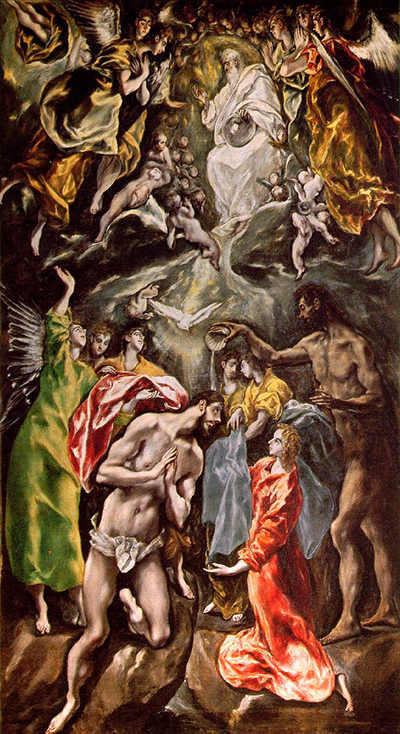
A small gap separates John the Baptist’s outstretched hand from the bowed head of Christ. In a painting over three metres tall, that interval is barely wider than the vessel John tips to pour the water. Look up from his hand and the space opens again around the white wings of a dove. Above it, God the Father sits among angels, one hand resting on a globe. The three figures belong to a single event, and the eye can find its way through a crowd of angels by following the water, the bird and the seated figure above. [1] [2]
This is the late Baptism of Christ that El Greco began for the Hospital de Tavera in Toledo. It was conceived for the high altar of a church dedicated to Saint John the Baptist. El Greco died while the commission was still in progress, and the surviving picture has long been associated with the work of his son, Jorge Manuel. Its reds and blues spread out around Christ’s kneeling body in a broad lower group. That breadth gives the angels space to handle the cloths and leaves John’s long arm visible across the overlapping bodies. [1] [2]
Baptism of Christ, begun by El Greco with further work by Jorge Manuel
At a Glance
- PaintingThe Baptism of Christ (El bautismo de Cristo)
- ArtistBegun by El Greco (Doménikos Theotokópoulos). The Fundación Casa Ducal de Medinaceli credits further work to Jorge Manuel Theotocópuli. [1]
- DateAround 1608–14, with further work in the early 1620s according to Walter Liedtke. The foundation dates the painting to around 1614. [1] [2]
- MediumOil on canvas [2]
- Dimensions330 × 211 cm (height × width) [2]
- LocationHospital de Tavera, Toledo, Fundación Casa Ducal de Medinaceli [1]
- Original commissionHigh-altarpiece painting for the Hospital of Saint John the Baptist, commissioned by Pedro Salazar de Mendoza as part of the hospital’s three-altarpiece project begun in 1608. [2]
This work across El Greco’s career
Martyrdom of Saint Maurice
1580–82The Burial of the Count of Orgaz
Commissioned 1586View of Toledo
c. 1599–1600Opening of the Fifth Seal
c. 1608–14Baptism of Christ (current article)
Around 1608–14, with further work in the early 1620s according to Walter Liedtke. The foundation dates the painting to around 1614. [1] [2]View and Plan of Toledo
1610–14Contents
- John at the Jordan
- The cloths below and the opening above
- The hospital’s three altarpieces
- Who painted the Tavera canvas?
- The earlier Baptism in Madrid
John at the Jordan
John stands on the right, where his feet and the bank beneath them catch a little light. His legs are nearly straight and the reach of his arm draws his upper body towards the centre. Christ’s body makes a sequence of bends from the dropped head to the clasped hands and the lowered knee. The pale shoulder and chest make the downward turn of his neck easy to follow. At the bottom, a line of light on the extended leg picks out the edge of a body that is otherwise close in colour to the rocks. [1] [2]
In Matthew’s Gospel, Jesus comes from Galilee to be baptised by John in the Jordan. John hesitates and says he ought to receive baptism from Jesus himself. Jesus asks him to go ahead, and John consents. When Jesus comes up from the water, he sees the heavens open and the Spirit of God descend like a dove. A voice from heaven declares him the beloved Son. El Greco brings these successive moments into view together. The bowed head and tilted vessel show the rite under way, while the dove and the figure of the Father give visible form to what happens next in Matthew’s account. [1] [3]
John’s extended forearm defines the distance the water has to fall. How little the picture needs to show of the river becomes apparent beside that sharply legible gesture. The rocks have enough definition to give the standing figure a foothold and Christ a place to kneel. Their broken contours leave very little of the bank continuous from one side to the other. The folds, faces and hands give a stronger sense of proximity than the landscape does. Two figures near enough to touch have the space of the Jordan condensed around them. [1] [2]
The cloths below and the opening above
At the left, the angel in yellow-green raises one arm into the space beside the dove. The red fabric sweeps across the angel’s other side and over Christ’s near shoulder. Its pale turning edges show where the cloth catches the light and where darker folds fall inward. Behind Christ, another angel holds the upper part of a blue cloth. The kneeling angel in red takes its lower edge. Looking from one grip to the other makes the blue fabric possible to read as a single thing stretched through a close group of bodies. [1] [2]
Each length of cloth has a different effect on the picture. The red sweeps across the group at shoulder height and frames the back of Christ’s neck. The blue falls more steeply and partly fills the space between the baptised man and the man performing the rite. The kneeling angel who helps hold it tips a face up towards the others. The lowered head of Christ and the lifted face of the angel put two different movements above the same uneven ground. The picture makes room for this task immediately beneath the pouring hand. The garments and the gestures of the angels bring an intimacy to an event seen from far below in a church. [1] [2]
From the left angel’s lifted arm, a band of pale cloud leads in towards the dove. The bird sits at the thinnest point of the opening. There are narrow bright edges along its wings and a more diffuse glow in the clouds around it. Against that glow the small childlike figure by one wing is easy to miss. The Medinaceli Foundation suggests it may stand for the Christian soul and the new life associated with baptism. The suggestion fits the child’s nearness to the descending Spirit. Its modest scale leaves the white wings of the dove and the interval below them as the clearest points of orientation. [1] [2]
Higher still, angels incline towards the Father from either side and smaller figures descend along the edges of the cloud. On the right, a large robe gathers gold along the ridges of deep folds. A paler robe on the left curls out into the dark. At the centre the Father’s broad area of white, from chest to knees, carries a steadier light, with the small shining globe held at his side. Below, the angels draw the fabrics towards Christ’s body. Above, the angels and their robes bend around the seated Father and the opening in the clouds. The hand raised at the outer edge of the lower scene starts to make sense as part of both gatherings. [1] [2]
The hospital’s three altarpieces
The Hospital de Tavera takes its familiar name from its founder, Cardinal Juan Pardo de Tavera. His marble tomb, carved by Alonso Berruguete, stands in the crossing of the church. One of the reliefs on the tomb shows the baptism at the Jordan, a scene that also belonged in the church’s largest altarpiece by virtue of its dedication. El Greco’s Portrait of Cardinal Tavera belongs to the same institution’s account of its founder. The administrator Pedro Salazar de Mendoza engaged El Greco for the central and two side altarpieces on 16 November 1608. In January 1609 Jorge Manuel undertook as guarantor to take charge of the work if his father died. In October 1613 he authorised Jorge de Torres to collect money from the city for the hospital works. The accounts still needed attention in May 1614, when he issued a similar authorisation after El Greco’s death. These records give his role in the commission a much firmer outline than the division of the brushwork does. [2] [4]
The 1621 inventory of Jorge Manuel’s possessions describes the hospital’s principal baptism painting. The agreement made with Félix Castello in 1635 again specifies a baptism for the high altar and an Annunciation and vision of the Apocalypse for the side altars. Liedtke sees these assignments as evidence of the programme Salazar and El Greco had already established. He reconstructs a high-altarpiece setting in which the lower centre of the Baptism would have been partly overlapped from below by the tabernacle’s small sculpture of the Risen Christ. The three levels of the surrounding altarpiece and the position of the tabernacle would have determined where viewers in the nave first saw the painting. According to Liedtke, the canvas reached the church after El Greco’s death and was installed on a side altar. He traces the change of position to delays in completing the high altarpiece. The canvas survives in the church today. [2]
The nearby altars were meant to offer other ways of looking up. The Opening of the Fifth Seal, now at the Metropolitan Museum of Art, survives with its top cut away. The Tavera Annunciation, intended for the right side altar, was divided. The scene with Gabriel and Mary belongs to the Banco Santander Collection, and its upper section is now The Concert of the Angels in Athens. The Athens fragment shows a group of angels coordinating music around instruments and a score. One figure holds the music and directs the others. In the Baptism, the corresponding upper gathering has its attention dispersed around the Father, whose white robe gives the eye a place to rest. Together the surviving pieces suggest how differently a worshipper might have looked into the upper part of each canvas. [2] [5] [6]
Who painted the Tavera canvas?
The Medinaceli Foundation describes El Greco as the painter of the upper part and sees Jorge Manuel’s participation principally below. Its account calls the figure of Christ unfinished. Liedtke credits both painters and places Jorge Manuel’s work in the early 1620s. The documents establish Jorge Manuel’s obligations to the hospital and show him directing business on the commission during his father’s lifetime. The degrees of finish around Christ’s legs, his hands and his face belong to a different kind of evidence, the paint surface itself. [1] [2] [4]
In 2019, Factum Foundation recorded the colour and surface relief of the painting in the church. The team mounted its scanner on scaffolding to reach the canvas in its altarpiece. A study published by Andrew Van Horn and colleagues in 2026 compared the tiny rises and hollows of the paint in 55 selected areas using a machine-learning method they call PATCH. The researchers found considerable similarity linking areas across the top, centre and lower figure group. They consider that one artist working with different brushes or varying his technique could account for the pattern. They also consider whether shared tools could produce a similar result. [7] [8]
The area around Christ’s legs and the foreground rocks formed a more distinct group in the analysis. Its position makes earlier additions and repairs to the foreground relevant to the reading of the surface. Two areas of poor condition, including part of an upper angel’s robe and the bottom-right landscape, fell outside the analysis. A record of how the paint sits today can support or complicate a division inferred from style. The research leaves the extent of Jorge Manuel’s contribution open and challenges the idea that a change of painter accounts for much of the lower scene. [8]
The earlier Baptism in Madrid
In the Museo del Prado is El Greco’s Baptism of Christ from the Colegio de la Encarnación, also called the Colegio de Doña María de Aragón. It is inventory P000821 and dates from 1597–1600. At 350 centimetres high and 144 wide, it is slightly taller than the Toledo canvas and considerably narrower. The Prado’s reconstruction places it beside the central Annunciation for the Madrid college in the lower tier of that altarpiece. Tavera’s Baptism was the principal painted scene in the church’s main retable. Each canvas fits an architectural setting with a different role for its central action. [2] [9]
Look first at the red cloth in the two paintings. At the Prado it runs behind the kneeling Christ like a canopy pulled almost the full width of the lower scene. A figure in green lifts an arm close under John’s extended hand, helping enclose the place where the water falls. At Tavera the long arm in green rises on the outer left, where it opens the scene towards the dove. The red sweeps down over Christ’s shoulder, and the hanging blue cloth has room to be seen between Christ and John. The lower group in Toledo opens sideways enough to show the kneeling angel holding the cloth in front of the Baptist. In Madrid the figures and fabric climb through a tighter space. [1] [2] [9]
Both paintings bring the pouring hand, the dove and the Father into a single view. In the narrow Prado painting the pale opening runs down from the Father between rows of airborne figures, and the dove appears almost directly above the pouring. In Toledo, the clouds spread farther to either side, then narrow to a pale bend just below the Father’s feet. The tilt of John’s arm reaches in from the right towards that opening, where the water must cross the short distance to Christ. Seen from one end of the canvas to the other, the brief act of pouring has its place among larger movements. The small gap is still what makes the event clear. [1] [2] [9]
Browse the artworks
Browse the paintings covered in this collection and related works in museum catalogues. Some are by El Greco’s workshop or were formerly attributed to him.
| Name | Date | Medium |
|---|---|---|
| View of Toledo | Around 1599–1600 | Oil on canvas |
| Adoration of the Shepherds | 1612–14 | Oil on canvas |
| Laocoön | About 1610–14 | Oil on canvas |
| The Tears of Saint Peter | 1587–96, Museo del Greco dating | Oil on canvas |
| The Holy Family with Saint Anne | About 1595 | Oil on canvas |
| The Holy Trinity | 1577–79 | Oil on canvas |
| The Burial of the Count of Orgaz | 1586–88, the conventional range | Oil on canvas |
| Disrobing of Christ | 1577–79 | Oil on canvas |
| Opening of the Fifth Seal | About 1608–14 | Oil on canvas |
| Saint Martin and the Beggar | 1597–99 | Oil on canvas |
| Martyrdom of Saint Maurice | 1580–82 | Oil on canvas |
| Adoration of the Name of Jesus | 1577–79 | Oil on canvas |
| Saint Peter in Penitence (Bowes Museum) | 1580s | Oil on canvas |
| Christ Carrying the Cross | Around 1577–87 | Oil on canvas |
| Crucifixion | 1597–1600 | Oil on canvas |
| Resurrection | 1597–1600 | Oil on canvas |
| Immaculate Conception | About 1608–13 | Oil on canvas |
| Annunciation | 1597–1600 | Oil on canvas |
| Coronation of the Virgin | 1591–92 | Oil on canvas |
| Lady in a Fur Wrap | About 1580–88 | Oil on canvas |
| Baptism of Christ | Around 1608–14, with further work in the early 1620s according to Walter Liedtke. The foundation dates the painting to around 1614. | Oil on canvas |
| Portrait of an Old Man (Possible Self-Portrait) | About 1595–1600 | Oil on canvas |
| Adoration of the Kings | 1565–67, Benaki Museum dating | Tempera on wood |
| Mary Magdalene in Penitence | About 1585–90, tentatively dated by the Museu del Cau Ferrat | Oil on canvas |
| Saint Sebastian | About 1577 in the cathedral centenary catalogue | Oil on canvas |
| Portrait of Cardinal Fernando Nino de Guevara | About 1600 | Oil on canvas |
| Penitent Magdalene | About 1576–77 | Oil on canvas |
| The Nobleman with his Hand on his Chest | About 1580 | Oil on canvas |
| Saint Peter and Saint Paul | 1590–1600 | Oil on canvas |
| Pentecost | Circa 1600 | Oil on canvas |
| The Fable | About 1580 | Oil on canvas |
| Pietà | 1580–90 | Oil on canvas |
| View and Plan of Toledo | 1610–1614, according to the Museo del Greco | Oil on canvas |
| Assumption of the Virgin | 1577–79, with 1577 in the Greek inscription | Oil on canvas |
| The Annunciation (1609) | Late Tavera period. The owner dates the canvas to 1614. Factum gives 1608–1613 in its initial recording account. | Oil on canvas |
| The Agony in the Garden of Gethsemane | 1590s | Oil on canvas |
| Portrait of Jorge Manuel Theotocópuli | Circa 1600–05 | Oil on canvas |
| Dormition of the Virgin | About 1565–66, according to the National Gallery of Greece | Tempera on wood |
| Saint Louis | 1585–90 | Oil on canvas |
| Ecstasy of St Francis of Assisi (1580) | About 1577–80 in the Vatican Museums’ account. The Diocesan Museum gives 1575–80. | Oil on canvas |
| Saint Francis of Assisi in Ecstasy, after El Greco | Seventeenth century | Oil on canvas |
| Christ Driving the Money Changers from the Temple | Probably before 1570 | Oil on wood |
| The Entombment of Christ | Circa 1568–70, Venice | Mixed technique on wood |
| Nativity | 1603–05 | Oil on canvas |
| Portrait of a Gentleman | About 1586 | Oil on canvas |
| Coronation of the Virgin (Illescas) | 1603–05 | Oil on canvas |
| A Boy Blowing on an Ember to Light a Candle (El Soplón) | About 1570–72 | Oil on canvas |
| The Feast in the House of Simon | About 1608–14 | Oil on canvas |
| Concert of Angels | About 1608–14 | Oil on canvas |
| Healing of the Man Born Blind | Around 1570 in Dresden’s printed collection guide | Mixed technique on wood |
| Fray Hortensio Félix Paravicino | 1609 | Oil on canvas |
| Purification of the Temple | Circa 1600 | Oil on canvas |
| Portrait of Vincenzo Anastagi | Circa 1575 | Oil on canvas |
| Saint Paul (Almadrones) | 1608–14 | Oil on canvas |
| Head of Christ | About 1579–86 | Oil on canvas |
| Last Supper | About 1567–68, Venice | Tempera on wood |
| Saint John the Evangelist (Prado Museum, Madrid) | About 1605 | Oil on canvas |
| Disrobing of Christ (Lyon, Half Painting Version) | About 1581–86 | Oil on canvas |
| The Dream of Philip II | 1577–79 | Oil on canvas |
| Portrait of a Sculptor | About 1577–80, 2019 exhibition dating | Oil on canvas |
| Saint Bernard | 1577–79 | Oil on canvas |
| Saint Benedict | 1577–79 | Oil on canvas |
| Portrait of Jerónimo de Cevallos | 1613, as catalogued by the Prado | Oil on canvas |
| The Flight into Egypt | About 1570 | Oil on wood |
| Saint Anthony of Padua | About 1580 | Oil on canvas |
| Portrait of a Doctor | 1582–85 | Oil on canvas |
| The Veil of Saint Veronica | 1586–95 | Oil on canvas |
| An Elderly Gentleman | About 1587–1600 | Oil on canvas |
| Saints Andrew and Francis | About 1595 | Oil on canvas |
| The Holy Family with Saint Anne and the Infant Saint John | Around 1600 in the Prado catalogue. The Balaguer record gives 1595–1600. | Oil on canvas |
| The Virgin Mary | 1595–1600 | Oil on canvas |
| Portrait of a Gentleman (1600-1605) | About 1600–05 | Oil on canvas |
| Portrait of a Young Gentleman | 1600–05 | Oil on canvas |
| John the Baptist and Saint John the Evangelist | 1600–10 | Oil on canvas |
| Portrait of a Friar | 1600–50 | Oil on canvas |
| Saint Thomas (Almadrones) | 1608–14 | Oil on canvas |
| Christ the Saviour (Almadrones) | 1608–14 | Oil on canvas |
| An Apostle (Prado P000814) | 1608–14 | Oil on canvas |
| Saint James (Almadrones) | 1608–14 | Oil on canvas |
| Julián Romero and his Patron Saint | 1612–18 | Oil on canvas |
| Allegory of the Camaldolese Order | Around 1600, Instituto Valencia de Don Juan dating | Oil on canvas |
| Saint Joseph and the Christ Child | 1597–99 | Oil on canvas |
| Saint Ildefonsus | Around 1600 according to the Prado's proposal, 1603–05 in Hadjinicolaou and Ficonofue | Oil on canvas |
| Saint Augustine | About 1585–1602, as listed in the 2014 exhibition study | Oil on canvas |
| Portrait of Diego de Covarrubias y Leyva | Circa 1600 | Oil on canvas |
| Saint Bernardino of Siena | 1603 in the Prado catalogue. The Museo del Greco object page lists 1602. | Oil on canvas |
| Portrait of Cardinal Tavera | About 1609 in the foundation's account, circa 1610 in its image heading | Oil on canvas |
| Visitation | About 1610–14 | Oil on canvas |
| Portrait of Francisco de Pisa | Circa 1610–14 | Oil on canvas |
| Saint Lawrence's Vision of the Madonna and Child (Apparition of the Virgin to St. Lawrence) | 1578–80 in the 2021 heritage decree | Oil on canvas |
| Christ on the Cross | Probably 1570s, assigned to El Greco’s Italian period in the sale literature | Oil on canvas |
| Portrait of Charles de Guise | 1572, as dated in the painted book | Oil on canvas |
| Portrait of Giulio Clovio | 1571–72, according to Capodimonte | Oil on canvas |
| Mount Sinai | About 1570–72 | Mixed technique on wood |
| Modena Triptych | 1567–1568, as dated by the Galleria Estense and the national catalogue | Tempera on wood |
| Saint Luke Painting the Virgin | 1560–67, Benaki Museum dating | Mixed technique on wood |
| Saint Ildefonso (Washington) | 1603–14 | Oil on canvas |
| Saint Martin and the Beggar (smaller Washington version) | 1600–14 | Oil on canvas |
| The Holy Family with Saint Anne and the Infant John the Baptist (Washington) | About 1595–1600 | Oil on canvas |
| The Adoration of the Name of Jesus (London panel) | Late 1570s | Oil on wood |
| Christ Driving the Traders from the Temple (London) | About 1600 | Oil on canvas |
| Saint Francis Receiving the Stigmata (Baltimore) | 1585–90 | Oil on canvas |
| Saint Luke (Almadrones, Indianapolis) | About 1610–14 | Oil on canvas |
| Saint Matthew (Almadrones, Indianapolis) | About 1610–14 | Oil on canvas |
| Saint Simon (Almadrones, Indianapolis) | About 1610–14 | Oil on canvas |
| The Tears of Saint Peter (Hospital de Tavera) | About 1605 | Oil on canvas Catalogue. |
Discussion
Look again at the images and ideas explored in Baptism of Christ by El Greco. These editorial prompts invite your observations.
Reader Insights
Follow John’s hand towards the dove. Which figure or fold of cloth most clearly carries your eye from one to the other?
Compare the Tavera and Madrid Baptisms. How does the taller gathering above the scene change the space around John and Christ?
Join the Conversation
Share a detail, comparison or question about Baptism of Christ by El Greco below.
References
- Fundación Casa Ducal de Medinaceli, El bautismo de Cristo, illustrated object study (in Spanish). View source.
- Walter Liedtke, “Three Paintings by El Greco,” Metropolitan Museum Journal 50 (2015), pp. 27–31, fig. 17 and note 14 on p. 37. View source.
- Vatican, New American Bible, Gospel of Matthew 3:13–17. View source.
- María Eugenia Alguacil Martín and Carlos Mas González, “El Greco y su entorno en el Archivo Histórico Provincial de Toledo,” Archivo Secreto 6 (2015), documents 74–76, 117 and 122 (in Spanish). View source.
- Fundación Banco Santander, Rafael Alonso Alonso’s collection entry for The Annunciation. View source.
- National Gallery, Athens, The Concert of the Angels, inv. Π.152. View source.
- Factum Foundation, El Greco’s The Baptism of Christ, recording and facsimile project. View source.
- Andrew Van Horn et al., “PATCH: A deep learning method to assess heterogeneity of artistic practice in historical paintings,” Science Advances 12, no. 16 (2026), eaea0485, fig. 3 and discussion. View source.
- Leticia Ruiz Gómez, El Greco en el Museo Nacional del Prado. Catálogo razonado (Museo Nacional del Prado, 2007), pp. 74–78 and cat. 10, pp. 84–89 (in Spanish). View source.







