


 by Tom Gurney
Tom Gurney BSc (Hons) is an art history expert with over 20 years experience
Published on June 19, 2020 / Updated on October 14, 2023
Email: tomgurney1@gmail.com / Phone: +44 7429 011000
Concert of Angels by El Greco: Introduction
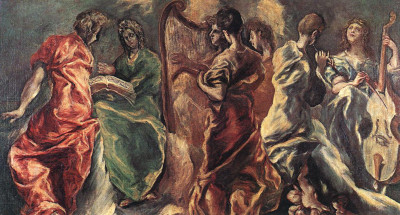
A tall harp divides the musicians in El Greco’s Concert of Angels. Its curled top rises above bent heads, and a hand reaches into the field of strings. To the left, two figures gather over an open score. At the right, an angel steadies the neck of a large bowed instrument and tilts their face upwards. The movement of hands and shoulders makes it easy to imagine the musicians following one another, even where the instruments themselves fade into the shadows. [1] [2]
This wide canvas in the National Gallery in Athens once formed the top of a very tall painting. It was the upper section of El Greco’s late Annunciation for the Hospital de Tavera in Toledo. The part with Mary and Gabriel is now in the Banco Santander collection in Madrid. Seen on its own, the Athens fragment draws attention to the musicians and the way El Greco arranged them around the score and the instruments. In the church that gathering was meant to crown the scene of Gabriel’s announcement to Mary. [1] [3]
At a Glance
- TitleThe Concert of the Angels
- ArtistEl Greco (Doménikos Theotokópoulos), as catalogued in Athens
- DateAbout 1608–14
- MediumOil on canvas
- Dimensions115 × 217 cm (height × width, Athens catalogue)
- CollectionNational Gallery – Alexandros Soutsos Museum, Athens, Π.152
- Original settingUpper section of the Annunciation intended for the right side altar of the Hospital de Tavera church, Toledo
This work across El Greco’s career
Martyrdom of Saint Maurice
1580–82The Burial of the Count of Orgaz
Commissioned 1586View of Toledo
c. 1599–1600Opening of the Fifth Seal
c. 1608–14Concert of Angels (current article)
About 1608–14View and Plan of Toledo
1610–14Contents
- The score, the strings and the bow
- Music at the top of the Tavera altarpiece
- Recording the two fragments
- An earlier Annunciation with music
The score, the strings and the bow
The open score catches the light towards the left. Its pages tilt out towards us, and faint marks run along them. A figure in green looks down over the book and lifts a hand at its edge. The Athens gallery sees this angel singing and directing the others. The musician in rose beside the book bends towards it, with one arm reaching low into the dark at the edge. Francisco José Rosal Nadales identifies a partly concealed spinet, a small keyboard instrument with plucked strings, in that area. The turn towards the music is much easier to see than the instrument. [1] [2]
The harp is immediately legible. The arch above its strings rises into the light, and the strings make a group of fine vertical lines amid the changing angles of the arms. One musician plays from behind the frame, with a face in profile just beyond it. The dark-haired figure nearer us turns away and partly overlaps the player. Rosal Nadales describes the lute in this cluster as seen from the back, its neck barely indicated. Look at the shoulders gathered here and the harp seems to put a little space between bodies that otherwise meet and overlap at almost every point. [1] [2]
Farther right, a musician with their back to us brings a small wind instrument up towards the face. The Athens catalogue calls it a flute. Rosal Nadales considers a flute probable and notes that the indistinct shape has also been read as a curved trumpet. The raised hand and the turn of the head carry more of the action than the few marks that describe the object. The viola da gamba beside it has a very different presence. Its broad pale body runs down the right edge and the scroll rises to the level of the angel’s head. One hand wraps around the long neck and the other holds the bow diagonally across the instrument. Rosal Nadales finds the grip less convincing than that of the bowed-string player in the earlier Prado Annunciation. The face above the bow turns away from the score. Follow that gaze and the harp’s upward curve and the viol’s long neck both direct attention well above the book. El Greco makes the small movements of playing and directing work within a much wider sweep of the figures. [1] [2]
Some of the most decisive changes of direction happen in the clothes. The rose sleeve and the green robe make two large turns around the open book. Pale yellow ridges run along the shoulder of the wind player, then disappear into blue-grey folds. Along the lower right, small faces show through the clouds beneath that sweep of cloth. The larger players have the bearing and gestures of people making music. The clouds and light beneath and around them place their performance above the figures who originally occupied the rest of the painting. Athens describes the work as unfinished. Its swift brushwork keeps an uneven degree of definition, from the pale flare of the bowed instrument to the almost submerged spinet. [1] [2] [3]
Music at the top of the Tavera altarpiece
In November 1608 Pedro Salazar de Mendoza, administrator of the Hospital de Tavera, commissioned El Greco to make three altarpieces for the hospital church. The architecture and sculpture were part of the undertaking. Walter Liedtke connects the Baptism of Christ with the high altar and the Annunciation and an apocalyptic vision with the side altars. He cites a 1635 agreement with the painter Félix Castello, made after the deaths of El Greco and his son Jorge Manuel, that names those subjects for the respective positions. The Annunciation was intended for the right side. With the musicians in place, Liedtke estimates that the picture would have stood about 4.1 metres high or a little more. [3] [4]
On the lower canvas in the Banco Santander collection, Gabriel approaches Mary across an interior. Her face lifts and one hand rests on the prayer stand. Above them a dove appears in spreading light. The clouds carry more figures farther up, and the top edge interrupts that gathering. The part in Athens has clouds and small angelic faces along its lower edge. Those are pieces of the visual movement that once carried a viewer’s attention from the encounter on the floor to the musicians in the sky. The present edges show where that continuity was interrupted. The exact appearance of the meeting between the two sections has to be reconstructed. [1] [3] [4] [5]
Rafael Alonso Alonso, writing for the Santander collection, places the division in the late nineteenth century. A companion account issued by the same collection leaves the date open and records the upper section in Athens since 1931. The surviving fragments have also been measured and credited differently. The Athens gallery gives 115 × 217 centimetres for the Concert and catalogues it under El Greco. Liedtke’s figure caption records 110.5 × 204.5 centimetres, credits El Greco and workshop and allows for work later than 1614. His dimensions for the fragment are distinct from his estimate of the original height of the joined composition. [1] [3] [4] [5]
The Opening of the Fifth Seal, now at the Metropolitan Museum of Art, is the surviving part of the apocalyptic painting associated with the other side altar. It too is cut at the top. Liedtke considers the reconstructed Annunciation a useful comparison for the kind of celestial grouping that might once have accompanied the figures in that painting. The musicians in Athens give us an actual surviving upper section from the commission. The lost forms above Saint John’s raised arms remain a subject of interpretation. [4]
Recording the two fragments
Factum Foundation recorded the Banco Santander Annunciation in 2021. It used a Lucida 3D Scanner to record the small variations in the height of the painted surface and took photographs for a high-resolution colour record. A flat colour image can show the line of an edge or a shift in tone. The surface record gives conservators a way to examine the physical relief that goes with those details. The project has since used the two kinds of recording at both collections. [6] [7] [8]
In May 2026 Factum recorded the Athens Concert with the same two approaches. The team then recorded the lower canvas again after conservation work. In the earlier Santander account, Gabriel stands with his feet on the floor following a twentieth-century alteration that changed the placement of his legs. Factum reports that conservators moved the legs back to the position indicated by current research. The 2021 and 2026 records document the lower canvas on either side of that treatment. They allow the effect of the change to be studied alongside the new recording of the Athens fragment. This matters when the two sections are compared, since the altered position of Gabriel’s legs affected the lower scene’s sense of weight and movement. [3] [6] [7]
Factum describes the next step as bringing the two sets of records together digitally with the custodians of the paintings. The intended full-scale facsimile would make it possible to see the two scenes on the scale of the original altarpiece. A reconstruction has to account for the separate histories of the canvases, including their surviving edges and the interventions each has undergone. The digital records give researchers exact points of comparison. The full-scale presentation would also recover an important part of the way the picture could be seen in church, with the musicians set high above Mary and Gabriel at the top of a single tall scene. [3] [6] [7]
An earlier Annunciation with music
El Greco’s Annunciation in the Prado is a separate oil painting of 1597–1600, made for the church of the Colegio de Doña María de Aragón in Madrid. At 315 × 174 centimetres, it gives an idea of what a large, continuous view of the subject can do. Mary and Gabriel are still in sight when the eye reaches the dove and the burst of light between them. That same light leads into the clouds overhead, where a spinet, harp and large bowed instrument help give the angels’ gathering weight and scale. The spinet projects brightly near the centre in the Prado painting. In the Athens concert it is barely visible towards the left. [1] [2] [9]
The earlier canvas lets the eye travel from Mary’s hand all the way to the musicians without leaving the picture. In Athens, a visitor can begin at the book, follow the reaching hands to the harp and work across to the bowed instrument before thinking about the light that once rose beneath them. That freedom comes from the fragment’s later history. A reunited view would return the group to its height above the encounter. Seen by itself, the Concert lets us notice how a small page of music and the turn of a musician’s head could give that upper space the feel of a performance. [1] [2] [3] [6] [9]
Browse the artworks
Browse the paintings covered in this collection and related works in museum catalogues. Some are by El Greco’s workshop or were formerly attributed to him.
| Name | Date | Medium |
|---|---|---|
| View of Toledo | Around 1599–1600 | Oil on canvas |
| Adoration of the Shepherds | 1612–14 | Oil on canvas |
| Laocoön | About 1610–14 | Oil on canvas |
| The Tears of Saint Peter | 1587–96, Museo del Greco dating | Oil on canvas |
| The Holy Family with Saint Anne | About 1595 | Oil on canvas |
| The Holy Trinity | 1577–79 | Oil on canvas |
| The Burial of the Count of Orgaz | 1586–88, the conventional range | Oil on canvas |
| Disrobing of Christ | 1577–79 | Oil on canvas |
| Opening of the Fifth Seal | About 1608–14 | Oil on canvas |
| Saint Martin and the Beggar | 1597–99 | Oil on canvas |
| Martyrdom of Saint Maurice | 1580–82 | Oil on canvas |
| Adoration of the Name of Jesus | 1577–79 | Oil on canvas |
| Saint Peter in Penitence (Bowes Museum) | 1580s | Oil on canvas |
| Christ Carrying the Cross | Around 1577–87 | Oil on canvas |
| Crucifixion | 1597–1600 | Oil on canvas |
| Resurrection | 1597–1600 | Oil on canvas |
| Immaculate Conception | About 1608–13 | Oil on canvas |
| Annunciation | 1597–1600 | Oil on canvas |
| Coronation of the Virgin | 1591–92 | Oil on canvas |
| Lady in a Fur Wrap | About 1580–88 | Oil on canvas |
| Baptism of Christ | Around 1608–14, with further work in the early 1620s according to Walter Liedtke. The foundation dates the painting to around 1614. | Oil on canvas |
| Portrait of an Old Man (Possible Self-Portrait) | About 1595–1600 | Oil on canvas |
| Adoration of the Kings | 1565–67, Benaki Museum dating | Tempera on wood |
| Mary Magdalene in Penitence | About 1585–90, tentatively dated by the Museu del Cau Ferrat | Oil on canvas |
| Saint Sebastian | About 1577 in the cathedral centenary catalogue | Oil on canvas |
| Portrait of Cardinal Fernando Nino de Guevara | About 1600 | Oil on canvas |
| Penitent Magdalene | About 1576–77 | Oil on canvas |
| The Nobleman with his Hand on his Chest | About 1580 | Oil on canvas |
| Saint Peter and Saint Paul | 1590–1600 | Oil on canvas |
| Pentecost | Circa 1600 | Oil on canvas |
| The Fable | About 1580 | Oil on canvas |
| Pietà | 1580–90 | Oil on canvas |
| View and Plan of Toledo | 1610–1614, according to the Museo del Greco | Oil on canvas |
| Assumption of the Virgin | 1577–79, with 1577 in the Greek inscription | Oil on canvas |
| The Annunciation (1609) | Late Tavera period. The owner dates the canvas to 1614. Factum gives 1608–1613 in its initial recording account. | Oil on canvas |
| The Agony in the Garden of Gethsemane | 1590s | Oil on canvas |
| Portrait of Jorge Manuel Theotocópuli | Circa 1600–05 | Oil on canvas |
| Dormition of the Virgin | About 1565–66, according to the National Gallery of Greece | Tempera on wood |
| Saint Louis | 1585–90 | Oil on canvas |
| Ecstasy of St Francis of Assisi (1580) | About 1577–80 in the Vatican Museums’ account. The Diocesan Museum gives 1575–80. | Oil on canvas |
| Saint Francis of Assisi in Ecstasy, after El Greco | Seventeenth century | Oil on canvas |
| Christ Driving the Money Changers from the Temple | Probably before 1570 | Oil on wood |
| The Entombment of Christ | Circa 1568–70, Venice | Mixed technique on wood |
| Nativity | 1603–05 | Oil on canvas |
| Portrait of a Gentleman | About 1586 | Oil on canvas |
| Coronation of the Virgin (Illescas) | 1603–05 | Oil on canvas |
| A Boy Blowing on an Ember to Light a Candle (El Soplón) | About 1570–72 | Oil on canvas |
| The Feast in the House of Simon | About 1608–14 | Oil on canvas |
| Concert of Angels | About 1608–14 | Oil on canvas |
| Healing of the Man Born Blind | Around 1570 in Dresden’s printed collection guide | Mixed technique on wood |
| Fray Hortensio Félix Paravicino | 1609 | Oil on canvas |
| Purification of the Temple | Circa 1600 | Oil on canvas |
| Portrait of Vincenzo Anastagi | Circa 1575 | Oil on canvas |
| Saint Paul (Almadrones) | 1608–14 | Oil on canvas |
| Head of Christ | About 1579–86 | Oil on canvas |
| Last Supper | About 1567–68, Venice | Tempera on wood |
| Saint John the Evangelist (Prado Museum, Madrid) | About 1605 | Oil on canvas |
| Disrobing of Christ (Lyon, Half Painting Version) | About 1581–86 | Oil on canvas |
| The Dream of Philip II | 1577–79 | Oil on canvas |
| Portrait of a Sculptor | About 1577–80, 2019 exhibition dating | Oil on canvas |
| Saint Bernard | 1577–79 | Oil on canvas |
| Saint Benedict | 1577–79 | Oil on canvas |
| Portrait of Jerónimo de Cevallos | 1613, as catalogued by the Prado | Oil on canvas |
| The Flight into Egypt | About 1570 | Oil on wood |
| Saint Anthony of Padua | About 1580 | Oil on canvas |
| Portrait of a Doctor | 1582–85 | Oil on canvas |
| The Veil of Saint Veronica | 1586–95 | Oil on canvas |
| An Elderly Gentleman | About 1587–1600 | Oil on canvas |
| Saints Andrew and Francis | About 1595 | Oil on canvas |
| The Holy Family with Saint Anne and the Infant Saint John | Around 1600 in the Prado catalogue. The Balaguer record gives 1595–1600. | Oil on canvas |
| The Virgin Mary | 1595–1600 | Oil on canvas |
| Portrait of a Gentleman (1600-1605) | About 1600–05 | Oil on canvas |
| Portrait of a Young Gentleman | 1600–05 | Oil on canvas |
| John the Baptist and Saint John the Evangelist | 1600–10 | Oil on canvas |
| Portrait of a Friar | 1600–50 | Oil on canvas |
| Saint Thomas (Almadrones) | 1608–14 | Oil on canvas |
| Christ the Saviour (Almadrones) | 1608–14 | Oil on canvas |
| An Apostle (Prado P000814) | 1608–14 | Oil on canvas |
| Saint James (Almadrones) | 1608–14 | Oil on canvas |
| Julián Romero and his Patron Saint | 1612–18 | Oil on canvas |
| Allegory of the Camaldolese Order | Around 1600, Instituto Valencia de Don Juan dating | Oil on canvas |
| Saint Joseph and the Christ Child | 1597–99 | Oil on canvas |
| Saint Ildefonsus | Around 1600 according to the Prado's proposal, 1603–05 in Hadjinicolaou and Ficonofue | Oil on canvas |
| Saint Augustine | About 1585–1602, as listed in the 2014 exhibition study | Oil on canvas |
| Portrait of Diego de Covarrubias y Leyva | Circa 1600 | Oil on canvas |
| Saint Bernardino of Siena | 1603 in the Prado catalogue. The Museo del Greco object page lists 1602. | Oil on canvas |
| Portrait of Cardinal Tavera | About 1609 in the foundation's account, circa 1610 in its image heading | Oil on canvas |
| Visitation | About 1610–14 | Oil on canvas |
| Portrait of Francisco de Pisa | Circa 1610–14 | Oil on canvas |
| Saint Lawrence's Vision of the Madonna and Child (Apparition of the Virgin to St. Lawrence) | 1578–80 in the 2021 heritage decree | Oil on canvas |
| Christ on the Cross | Probably 1570s, assigned to El Greco’s Italian period in the sale literature | Oil on canvas |
| Portrait of Charles de Guise | 1572, as dated in the painted book | Oil on canvas |
| Portrait of Giulio Clovio | 1571–72, according to Capodimonte | Oil on canvas |
| Mount Sinai | About 1570–72 | Mixed technique on wood |
| Modena Triptych | 1567–1568, as dated by the Galleria Estense and the national catalogue | Tempera on wood |
| Saint Luke Painting the Virgin | 1560–67, Benaki Museum dating | Mixed technique on wood |
| Saint Ildefonso (Washington) | 1603–14 | Oil on canvas |
| Saint Martin and the Beggar (smaller Washington version) | 1600–14 | Oil on canvas |
| The Holy Family with Saint Anne and the Infant John the Baptist (Washington) | About 1595–1600 | Oil on canvas |
| The Adoration of the Name of Jesus (London panel) | Late 1570s | Oil on wood |
| Christ Driving the Traders from the Temple (London) | About 1600 | Oil on canvas |
| Saint Francis Receiving the Stigmata (Baltimore) | 1585–90 | Oil on canvas |
| Saint Luke (Almadrones, Indianapolis) | About 1610–14 | Oil on canvas |
| Saint Matthew (Almadrones, Indianapolis) | About 1610–14 | Oil on canvas |
| Saint Simon (Almadrones, Indianapolis) | About 1610–14 | Oil on canvas |
| The Tears of Saint Peter (Hospital de Tavera) | About 1605 | Oil on canvas Catalogue. |
Discussion
Look again at the images and ideas explored in Concert of Angels by El Greco. These editorial prompts invite your observations.
Reader Insights
Find the bow and the open score. How can you tell whether two angels are attending to the same thing?
Look for a fold of cloth that continues a motion made by a hand or instrument. How does it carry your eye through the group?
Join the Conversation
Share a detail, comparison or question about Concert of Angels by El Greco below.
References
- National Gallery – Alexandros Soutsos Museum, The Concert of the Angels, Π.152 View source.
- Francisco José Rosal Nadales, Representaciones musicales en la obra de El Greco, pp. 988–994 and figures 4 and 7 (in Spanish) View source.
- Rafael Alonso Alonso, Fundación Banco Santander collection entry, The Annunciation View source.
- Walter Liedtke, Three Paintings by El Greco, Metropolitan Museum Journal 50, 2015, pp. 27–31 and figures 16–18 View source.
- Fundación Banco Santander, The Annunciation, collection account on Google Arts & Culture View source.
- Factum Foundation, El Greco’s Annunciation, 2021 and 2026 recordings and conservation update View source.
- Factum Foundation, Reuniting El Greco, record of the Athens campaign, May 2026 View source.
- Factum Foundation, Lucida 3D Scanner, description of surface recording View source.
- Esther Alsina Galofré, Crónica de La Anunciación (1597–1600), pp. 1449–1472, figure 5 (in Spanish) View source.







