


 by Tom Gurney
Tom Gurney BSc (Hons) is an art history expert with over 20 years experience
Published on June 19, 2020 / Updated on October 14, 2023
Email: tomgurney1@gmail.com / Phone: +44 7429 011000
Saints Andrew and Francis: Introduction
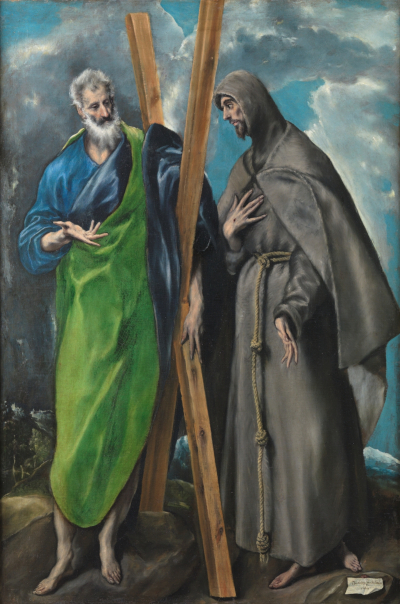
In El Greco’s Saints Andrew and Francis, a wooden cross rises between two men who turn to acknowledge one another. Andrew steadies the cross and holds his free hand forward, palm tilted up. Francis draws one hand to his chest and lets the other extend below it. They stand barefoot on the same patch of rocky ground, under clouds heavy enough to fill most of the canvas. Their gestures suggest a conversation between figures separated by more than a thousand years. [1] [2]
At a Glance
- ArtistEl Greco (Doménikos Theotokópoulos)
- DateAbout 1595
- MediumOil on canvas
- Dimensions167 × 113 cm
- CollectionMuseo Nacional del Prado, Madrid, P002819
- Spanish titleSan Andrés y san Francisco
This work across El Greco’s career
Martyrdom of Saint Maurice
1580–82The Burial of the Count of Orgaz
Commissioned 1586View of Toledo
c. 1599–1600Opening of the Fifth Seal
c. 1608–14View and Plan of Toledo
1610–14Contents
- The cross between the saints
- Cloth, rock and distant weather
- An apostle and a Franciscan
- A later Andrew on his own
- From the Encarnación to the Prado
The cross between the saints
Begin with Andrew’s hand on the wood. His fingers extend along the plank that slopes from the upper left of the canvas towards Francis’s feet. The other plank rises more steeply, meeting it at the height of the saints’ shoulders. Above that crossing the two lengths of timber mark out a wedge of sky between the heads. Knots and uneven strokes of brown give the wood its own surface. The cross identifies Andrew through the tradition of his martyrdom on a cross in the shape of an X. Its size gives it a second role in the scene. The beams keep the saints distinct and draw the eye from one figure to the other. [2]
Andrew’s body faces out. He turns his head towards Francis, with the light catching the white in his beard and the line of his forehead. His raised right hand comes forward from the broad green of his cloak. The fingers open unevenly, and the smallest shifts in their angles make the gesture look as if it belongs to a moment of speech. The other hand keeps its easy grip on the cross. In the Prado’s catalogue, Leticia Ruiz Gómez notes that the most pronounced revisions revealed by X-radiography are in Andrew’s raised hand. El Greco also altered the position of one of the crossbeams. Both revisions concern elements that define how the figures occupy the space between them. [2]
Francis answers with his whole body turned partway towards Andrew. The hood encloses the profile, and a short line of light catches the cheek and nose. At the chest, two fingers of his right hand come together against the cloth. His left arm drops and comes forward, exposing the hand in a patch of light below the dark sleeve. Seen together, the three open or extended hands form a loose progression across the canvas, from Andrew’s palm at the left to Francis’s lower hand at the right. The still faces give the movement of the fingers room to register. [2]
Cloth, rock and distant weather
Andrew wears a cobalt-blue tunic and a green cloak lined with purple. Blue fills the space between his beard and his extended hand. The darker lining turns out from the shoulder beside the wood, while the green falls in a broad sweep to the shins. A diagonal fold across the chest carries the eye from the blue to the green, and below it the green fabric gathers into a succession of long, irregular ridges. Francis’s grey habit has its own lighter and darker passages, especially where the cowl hangs over his arm. The knotted cord at his waist interrupts that expanse and drops in a pale line against the cloth. His hand on his chest stands out clearly against the muted habit. [2]
The figures stand far forward on an uneven ledge. Their feet give a sense of the ground tilting and breaking away. Below the fold of Francis’s habit, a tiny painted piece of paper lies against a rock. El Greco signed the picture in Greek on this folded label, or cartellino. It is easy to pass over from a distance, where the eye follows the larger changes from the dark edge of the grey habit to the pale ground. At close range the paper has folds and shading of its own, like another small object subject to the same light as the fabric and wood. [2]
The few lines of landscape sit below most of the action. Behind Andrew, a path winds upwards past trees to a distant building, which Ruiz Gómez identifies as a sketch of the Alcázar of Toledo. Farther right, a pale, snowy mountain appears low behind Francis. The two views offer different ways of measuring distance. The road can be followed a little at a time, while the snowy summit appears abruptly in a narrow opening. The low horizon leaves both heads against the turbulent sky. It also makes the two men look much larger than the setting that accommodates them. [2]
An apostle and a Franciscan
Andrew belongs to the first generation of Christ’s disciples. Francis lived in the late twelfth and early thirteenth centuries and founded the Franciscan order. Their shared ground belongs to the painting, where El Greco uses the turn of a head, the tilt of a body and the extension of a hand to make a meeting possible. Ruiz Gómez traces the practice of showing saints in pairs through Byzantine and Italian precedents as well as paintings in Toledo. She singles out Juan Fernández de Navarrete, called El Mudo, whose paired saints for the Escorial often seem to have paused during a walk. His pairing of Andrew with Saint James offers a precedent for how two figures can share space through a small turn and a gesture. The exact circumstances that brought Andrew and Francis together here remain uncertain. [2]
Enrique Lafuente Ferrari read Andrew as an apostle actively engaged in his mission and Francis as absorbed in mystical experience. The raised palm and the hand drawn to the chest sustain that reading. Lafuente also associated the two men with contrasting settings, the fortified town and the open mountain landscape. Ruiz Gómez leaves open whether El Greco intended that distinction to carry such a specific meaning. The landscape fulfils a visible purpose in its own right. Both views sit on the same low line beneath the cloud banks, giving the eye a place to go beyond the figures without loosening their hold on the foreground. [2]
The pairing is also useful beside El Greco’s Apostolates, where a saint’s head, hands and attributes can be carried by an individual canvas within a series. Ruiz Gómez points out that the apostle in the Prado’s Saint James from the Almadrones series repeats Andrew’s extended right hand. In the double portrait, Francis’s response gives the gesture an immediate addressee. [2]
Francis takes on a different bearing in the Prado’s separate Saint Francis in Ecstasy, a seventeenth-century anonymous painting after El Greco. The hooded figure there appears alone at closer range and lifts his face and extends his hands towards the light. In the double portrait, the profile and the hands give an exchange between two saints its measured pace. [2]
A later Andrew on his own
Ruiz Gómez dates the double portrait to about 1595 on the strength of its technique and similarities to paintings El Greco made around that time in Toledo. In Saint Joseph and the Christ Child, painted for the chapel of San José in 1597–99, she identifies a related use of landscape and modelling. She also points to the gentle placement of Joseph’s hand on the child as a parallel for the way Andrew rests his fingertips on the wood. The comparison draws attention to the slight pressure in a hand that belongs to a monumental figure. [2]
A smaller Saint Andrew at the Metropolitan Museum of Art in New York shows how the motif was adapted. The Met dates its oil on canvas to about 1610 and credits it to the Workshop of El Greco. It measures 109.9 × 64.1 cm and has its own accession number, 61.101.8. Andrew keeps the bare feet, the green and blue garments and the cross with its sharply crossing planks. The workshop gives Andrew and his cross nearly the full height of the smaller canvas. The long wooden member at the right takes up space beside the figure, with open sky and a distant ridge beyond it. Andrew’s eyebrows and open palm retain their intensity, giving the isolated figure the bearing of someone in the act of speaking. [2] [3]
From the Encarnación to the Prado
The painting came to the Prado for safekeeping in 1936, during the Spanish Civil War, from the Real Monasterio de la Encarnación in Madrid. The monastery was a royal foundation and the canvas belonged to the Augustinian community. Lafuente Ferrari proposed that Agustín de Alencastre and Juana Noroña, the Duke and Duchess of Abrantes, gave it to the monastery on the occasion of their daughter taking the veil. Sor Ana Agustina del Niño Jesús took her vows on 3 October 1676. Ruiz Gómez reports that the monastery’s surviving archive lacks a record of the gift itself. The proposed donation would account for the painting’s arrival at the Encarnación, while the earliest circumstances of its production remain unknown. [2] [4]
The Prado presented the picture in its 1939 exhibition in Geneva. In 1942 it was bought from the community for 200,000 pesetas, using proceeds from admissions to that exhibition. The temporary wartime transfer and the subsequent purchase are distinct events. The picture’s long residence in the monastery and its emergence into public view during the war help explain how a signed canvas of this size only entered the modern discussion of El Greco’s work in the twentieth century. [2] [4]
The painting also carries traces of its care after leaving the Encarnación. An intervention between 1936 and 1939 added edge material, a small patch and a new stretcher. In 1981 Rocío Dávila treated areas where pronounced cracking was unstable and where paint had been lost. She also addressed an uneven, oxidised varnish and applied fresh varnish. Ruiz Gómez describes the original plain-weave canvas as unlined and much of the surface relief as surviving, despite local changes. The green cloak, where cracking is especially visible, also has dark accretions that she tentatively associates with deterioration of copper-based glazes. That evidence places a limit on how precisely the present darkness of individual passages can be read as El Greco’s choice. [2]
Browse the artworks
Browse the paintings covered in this collection and related works in museum catalogues. Some are by El Greco’s workshop or were formerly attributed to him.
| Name | Date | Medium |
|---|---|---|
| View of Toledo | Around 1599–1600 | Oil on canvas |
| Adoration of the Shepherds | 1612–14 | Oil on canvas |
| Laocoön | About 1610–14 | Oil on canvas |
| The Tears of Saint Peter | 1587–96, Museo del Greco dating | Oil on canvas |
| The Holy Family with Saint Anne | About 1595 | Oil on canvas |
| The Holy Trinity | 1577–79 | Oil on canvas |
| The Burial of the Count of Orgaz | 1586–88, the conventional range | Oil on canvas |
| Disrobing of Christ | 1577–79 | Oil on canvas |
| Opening of the Fifth Seal | About 1608–14 | Oil on canvas |
| Saint Martin and the Beggar | 1597–99 | Oil on canvas |
| Martyrdom of Saint Maurice | 1580–82 | Oil on canvas |
| Adoration of the Name of Jesus | 1577–79 | Oil on canvas |
| Saint Peter in Penitence (Bowes Museum) | 1580s | Oil on canvas |
| Christ Carrying the Cross | Around 1577–87 | Oil on canvas |
| Crucifixion | 1597–1600 | Oil on canvas |
| Resurrection | 1597–1600 | Oil on canvas |
| Immaculate Conception | About 1608–13 | Oil on canvas |
| Annunciation | 1597–1600 | Oil on canvas |
| Coronation of the Virgin | 1591–92 | Oil on canvas |
| Lady in a Fur Wrap | About 1580–88 | Oil on canvas |
| Baptism of Christ | Around 1608–14, with further work in the early 1620s according to Walter Liedtke. The foundation dates the painting to around 1614. | Oil on canvas |
| Portrait of an Old Man (Possible Self-Portrait) | About 1595–1600 | Oil on canvas |
| Adoration of the Kings | 1565–67, Benaki Museum dating | Tempera on wood |
| Mary Magdalene in Penitence | About 1585–90, tentatively dated by the Museu del Cau Ferrat | Oil on canvas |
| Saint Sebastian | About 1577 in the cathedral centenary catalogue | Oil on canvas |
| Portrait of Cardinal Fernando Nino de Guevara | About 1600 | Oil on canvas |
| Penitent Magdalene | About 1576–77 | Oil on canvas |
| The Nobleman with his Hand on his Chest | About 1580 | Oil on canvas |
| Saint Peter and Saint Paul | 1590–1600 | Oil on canvas |
| Pentecost | Circa 1600 | Oil on canvas |
| The Fable | About 1580 | Oil on canvas |
| Pietà | 1580–90 | Oil on canvas |
| View and Plan of Toledo | 1610–1614, according to the Museo del Greco | Oil on canvas |
| Assumption of the Virgin | 1577–79, with 1577 in the Greek inscription | Oil on canvas |
| The Annunciation (1609) | Late Tavera period. The owner dates the canvas to 1614. Factum gives 1608–1613 in its initial recording account. | Oil on canvas |
| The Agony in the Garden of Gethsemane | 1590s | Oil on canvas |
| Portrait of Jorge Manuel Theotocópuli | Circa 1600–05 | Oil on canvas |
| Dormition of the Virgin | About 1565–66, according to the National Gallery of Greece | Tempera on wood |
| Saint Louis | 1585–90 | Oil on canvas |
| Ecstasy of St Francis of Assisi (1580) | About 1577–80 in the Vatican Museums’ account. The Diocesan Museum gives 1575–80. | Oil on canvas |
| Saint Francis of Assisi in Ecstasy, after El Greco | Seventeenth century | Oil on canvas |
| Christ Driving the Money Changers from the Temple | Probably before 1570 | Oil on wood |
| The Entombment of Christ | Circa 1568–70, Venice | Mixed technique on wood |
| Nativity | 1603–05 | Oil on canvas |
| Portrait of a Gentleman | About 1586 | Oil on canvas |
| Coronation of the Virgin (Illescas) | 1603–05 | Oil on canvas |
| A Boy Blowing on an Ember to Light a Candle (El Soplón) | About 1570–72 | Oil on canvas |
| The Feast in the House of Simon | About 1608–14 | Oil on canvas |
| Concert of Angels | About 1608–14 | Oil on canvas |
| Healing of the Man Born Blind | Around 1570 in Dresden’s printed collection guide | Mixed technique on wood |
| Fray Hortensio Félix Paravicino | 1609 | Oil on canvas |
| Purification of the Temple | Circa 1600 | Oil on canvas |
| Portrait of Vincenzo Anastagi | Circa 1575 | Oil on canvas |
| Saint Paul (Almadrones) | 1608–14 | Oil on canvas |
| Head of Christ | About 1579–86 | Oil on canvas |
| Last Supper | About 1567–68, Venice | Tempera on wood |
| Saint John the Evangelist (Prado Museum, Madrid) | About 1605 | Oil on canvas |
| Disrobing of Christ (Lyon, Half Painting Version) | About 1581–86 | Oil on canvas |
| The Dream of Philip II | 1577–79 | Oil on canvas |
| Portrait of a Sculptor | About 1577–80, 2019 exhibition dating | Oil on canvas |
| Saint Bernard | 1577–79 | Oil on canvas |
| Saint Benedict | 1577–79 | Oil on canvas |
| Portrait of Jerónimo de Cevallos | 1613, as catalogued by the Prado | Oil on canvas |
| The Flight into Egypt | About 1570 | Oil on wood |
| Saint Anthony of Padua | About 1580 | Oil on canvas |
| Portrait of a Doctor | 1582–85 | Oil on canvas |
| The Veil of Saint Veronica | 1586–95 | Oil on canvas |
| An Elderly Gentleman | About 1587–1600 | Oil on canvas |
| Saints Andrew and Francis | About 1595 | Oil on canvas |
| The Holy Family with Saint Anne and the Infant Saint John | Around 1600 in the Prado catalogue. The Balaguer record gives 1595–1600. | Oil on canvas |
| The Virgin Mary | 1595–1600 | Oil on canvas |
| Portrait of a Gentleman (1600-1605) | About 1600–05 | Oil on canvas |
| Portrait of a Young Gentleman | 1600–05 | Oil on canvas |
| John the Baptist and Saint John the Evangelist | 1600–10 | Oil on canvas |
| Portrait of a Friar | 1600–50 | Oil on canvas |
| Saint Thomas (Almadrones) | 1608–14 | Oil on canvas |
| Christ the Saviour (Almadrones) | 1608–14 | Oil on canvas |
| An Apostle (Prado P000814) | 1608–14 | Oil on canvas |
| Saint James (Almadrones) | 1608–14 | Oil on canvas |
| Julián Romero and his Patron Saint | 1612–18 | Oil on canvas |
| Allegory of the Camaldolese Order | Around 1600, Instituto Valencia de Don Juan dating | Oil on canvas |
| Saint Joseph and the Christ Child | 1597–99 | Oil on canvas |
| Saint Ildefonsus | Around 1600 according to the Prado's proposal, 1603–05 in Hadjinicolaou and Ficonofue | Oil on canvas |
| Saint Augustine | About 1585–1602, as listed in the 2014 exhibition study | Oil on canvas |
| Portrait of Diego de Covarrubias y Leyva | Circa 1600 | Oil on canvas |
| Saint Bernardino of Siena | 1603 in the Prado catalogue. The Museo del Greco object page lists 1602. | Oil on canvas |
| Portrait of Cardinal Tavera | About 1609 in the foundation's account, circa 1610 in its image heading | Oil on canvas |
| Visitation | About 1610–14 | Oil on canvas |
| Portrait of Francisco de Pisa | Circa 1610–14 | Oil on canvas |
| Saint Lawrence's Vision of the Madonna and Child (Apparition of the Virgin to St. Lawrence) | 1578–80 in the 2021 heritage decree | Oil on canvas |
| Christ on the Cross | Probably 1570s, assigned to El Greco’s Italian period in the sale literature | Oil on canvas |
| Portrait of Charles de Guise | 1572, as dated in the painted book | Oil on canvas |
| Portrait of Giulio Clovio | 1571–72, according to Capodimonte | Oil on canvas |
| Mount Sinai | About 1570–72 | Mixed technique on wood |
| Modena Triptych | 1567–1568, as dated by the Galleria Estense and the national catalogue | Tempera on wood |
| Saint Luke Painting the Virgin | 1560–67, Benaki Museum dating | Mixed technique on wood |
| Saint Ildefonso (Washington) | 1603–14 | Oil on canvas |
| Saint Martin and the Beggar (smaller Washington version) | 1600–14 | Oil on canvas |
| The Holy Family with Saint Anne and the Infant John the Baptist (Washington) | About 1595–1600 | Oil on canvas |
| The Adoration of the Name of Jesus (London panel) | Late 1570s | Oil on wood |
| Christ Driving the Traders from the Temple (London) | About 1600 | Oil on canvas |
| Saint Francis Receiving the Stigmata (Baltimore) | 1585–90 | Oil on canvas |
| Saint Luke (Almadrones, Indianapolis) | About 1610–14 | Oil on canvas |
| Saint Matthew (Almadrones, Indianapolis) | About 1610–14 | Oil on canvas |
| Saint Simon (Almadrones, Indianapolis) | About 1610–14 | Oil on canvas |
| The Tears of Saint Peter (Hospital de Tavera) | About 1605 | Oil on canvas Catalogue. |
Discussion
Look again at the images and ideas explored in Saints Andrew and Francis. These editorial prompts invite your observations.
Reader Insights
Trace the diagonal of Andrew’s cross and the movement of both hands. How does the painting join two saints from different centuries?
Compare the sky behind the Prado pair with the narrower Andrew. What does the second figure add to the encounter?
Join the Conversation
Share a detail, comparison or question about Saints Andrew and Francis below.
References
- Centro Virtual Cervantes and Museo del Prado, El Greco gallery, San Andrés y san Francisco, inventory 2819 View source.
- Leticia Ruiz Gómez, El Greco en el Museo Nacional del Prado, 2007, cat. 14, pp. 110–114, cat. 23, pp. 158–161, and cat. 41, pp. 242–244 View source.
- The Metropolitan Museum of Art, Saint Andrew, 61.101.8 View source.
- Javier Portús, Museo del Prado 1819–2019. Un lugar de memoria, 2018, fig. 5.24, p. 144, and p. 149 View source.







