


 by Tom Gurney
Tom Gurney BSc (Hons) is an art history expert with over 20 years experience
Published on June 19, 2020 / Updated on October 14, 2023
Email: tomgurney1@gmail.com / Phone: +44 7429 011000
The Feast in the House of Simon: Introduction
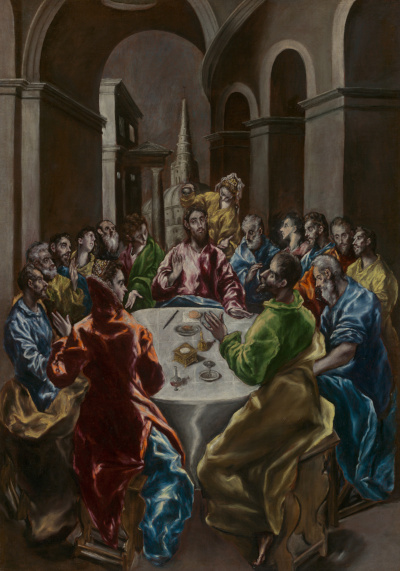
A woman in yellow tips a small vessel over Christ's head. Her arm reaches out from behind his chair, leaving a sliver of darkness between the vessel and his hair. A man in green turns across the table with one hand raised, while the grey-bearded guest next to him leans forward to see. The anointing occupies a small patch of paint. El Greco makes it legible from across the room by letting the reactions spread around the table.
The Art Institute of Chicago dates The Feast in the House of Simon to about 1608–14 and credits El Greco and his workshop. The museum sees El Greco's design behind the scene and relates parts of its execution to assistants. Look first at the way the painted space brings a gathering of people into contact with the woman and her vessel. The tall arches that fill the upper canvas make her gesture seem all the more intimate. [1] [2]
The Feast in the House of Simon by El Greco and workshop
At a Glance
- TitleThe Feast in the House of Simon
- AttributionEl Greco and workshop
- DateAbout 1608–14
- MediumOil on canvas
- Dimensions143.3 × 100.4 cm
- CollectionArt Institute of Chicago, 1949.397
- Credit lineGift of Joseph Winterbotham Collection [1]
This work across El Greco’s career
Martyrdom of Saint Maurice
1580–82The Burial of the Count of Orgaz
Commissioned 1586View of Toledo
c. 1599–1600Opening of the Fifth Seal
c. 1608–14The Feast in the House of Simon (current article)
About 1608–14View and Plan of Toledo
1610–14Contents
- A dinner interrupted
- The spire above the table
- The anointing in the Gospels
- The woman with the vessel and the solitary Magdalene
- Who painted the feast?
- From a private collection to the Art Institute
A dinner interrupted
The guests in the foreground give the table its shape. An orange-red figure on the left turns his back partly towards us. Across from him, the man in green and ochre is seated at an angle, his face in profile. Their chairs leave a narrow gap through which the white cloth seems to come towards us. Follow the edge of the cloth past the plates and the small vessels, and the eye arrives at Christ on the far side. The tilt of the tabletop keeps the remains of the meal in view, including little pieces of bread near Christ and the foot of a stemmed cup nearer the front. The feast looks as if it was in progress when the woman approached. [2]
Different hands register the break in the meal. The fingers of the man in green fan out over the white cloth, where the gap between them becomes easy to read. On the left, an open palm near the red figure's shoulder catches a flicker of light before the eye reaches the smaller faces beyond. Christ brings one hand up towards his chest and extends the other along the table. The movements occur at several heights, from a hand almost meeting the cloth to one held close to a man's face. The men towards the back turn at different angles and have less room to move. Watching the scene takes time because each gesture offers a slightly different response to the same interruption. [2]
Colour does some of the work of those motions. The orange and scarlet folds at the front left gain force from the blue beside and below them. The broad green sleeve across the table sweeps towards a hand lit in pink and white. Near the centre, the pink of Christ's robe is quieter, picked out with pale accents that let us read its creases and find his wrist. The loose edges of these highlights give a turned sleeve or shoulder a sharp presence against the dark. They also make a seated gathering feel active even where a face is nearly still. [1] [2]
The spire above the table
The stonework is easiest to follow from the outside in. Broad piers on both sides rise to the arches and leave the people crowded low in the picture. To the right, smaller arched openings repeat the curve of the main vault. Farther back, a strip of grey-blue sky appears between the buildings, and a narrow spire rises over a rounded roof. The background returns the eye to the people by a different path from the table. The art historian Diane Apostolos-Cappadona points out how the spire and the downward course of the oil belong to the same upright movement through the centre. Once seen, the upright is a way to find the tiny vessel even when the light on the table initially catches the eye. [2]
The scene also gives its figures sharply different amounts of space. Against the high arches, the standing woman has a clear outline. Around Christ, heads and shoulders overlap so closely that some guests emerge chiefly as a pale brow or a strip of blue. The architecture still leaves a tall stretch of canvas above them, where most of the movement is made by the curves of the arches. As the eye drops from this quieter part of the picture to the circle of guests, a hand or a turn of the head can seem unusually emphatic. [2]
The anointing in the Gospels
The raised vessel brings the picture close to Matthew 26 and Mark 14. Both tell of a meal in Bethany at the house of Simon the leper. An unnamed woman pours costly ointment on Jesus' head. Matthew attributes the protest over its cost to the disciples, and Mark describes some of those present objecting. In each account Jesus defends the woman and connects the anointing with his burial. That reading gives the painted gestures around the cloth a particular force. The seated men appear to be in the midst of deciding how to respond, as the woman standing behind them has already acted. [2] [3] [4]
Luke 7 tells a story at the house of Simon the Pharisee during Jesus' Galilean ministry. Here an unnamed woman wets Jesus' feet with tears, wipes them with her hair, kisses them and applies ointment. Simon privately questions whether Jesus knows who is touching him. Jesus asks him which of two debtors will love their creditor more after both debts are forgiven. He then recalls the courtesies Simon failed to offer, such as water to wash a guest's feet, and recognises the love the woman has shown. In Luke, forgiveness gives the exchange its shape. [5]
John 12 also describes an anointing of the feet, at a dinner in Bethany six days before Passover. Martha serves, Lazarus is among those at table and their sister Mary anoints Jesus' feet with nard and wipes them with her hair. Judas voices the objection about money for the poor, and Jesus speaks of his burial. The speakers and gestures differ across the accounts. The act most clearly visible in the Chicago painting is the one described by Matthew and Mark, the pouring of oil on the head. [2] [3] [4] [6]
The woman with the vessel and the solitary Magdalene
In Western Christian tradition, Mary Magdalene came to be identified with Mary of Bethany and the unnamed woman in Luke. That association helps explain why an interpreter might name the woman in the banquet. Apostolos-Cappadona draws attention to the red hair showing beneath the standing woman's veil, a feature traditionally associated with the Magdalene. The name belongs to the history of how the story was read and pictured. Matthew and Mark leave the woman unnamed. [2] [3] [4] [7]
El Greco's Mary Magdalene in Penitence at the Museu del Cau Ferrat offers a different setting for that tradition. A red cloak covers the saint's shoulders, her attention settles near a crucifix and a skull, and she has room to be still. In Chicago, the raised arm brings a private act of devotion into the view of a crowded table. In Sitges the skull and crucifix give the viewer objects for sustained contemplation. The Penitent Magdalene in Budapest offers another kind of solitude. Her face turns upwards into the pale light, and the ivy stretching up beyond her carries the eye in the direction of her gaze. Both paintings lose the play of glances around a meal. They give the viewer time to follow the attention of one person. [2] [8] [9]
Who painted the feast?
The Art Institute gives El Greco the design and credits the workshop with painting some parts. The museum draws attention to the varied handling of the heads and suggests Jorge Manuel Theotocopoulos, El Greco's son and a leader of the workshop in its later years, as a probable participant. It also raises the possibility that an assistant devised the unusual architecture. The catalogue leaves the exact division of work open. Even within a pair of neighbouring faces, the angle at which each man turns and the amount of light reaching him change what a painter can make visible. [1]
The elongated figures, coloured shadows and bright strokes along the drapery belong to the visual language of El Greco's later paintings. They help explain how a scene executed by several painters can hold together. A crease on the sleeve of the man in green leads into the lighter fingers above the table, just as the lights on Christ's clothing take us to his extended wrist. The style and technique of El Greco can be seen here in the coordination of colour and gesture across the whole scene. [1] [2]
From a private collection to the Art Institute
The earliest ownership remains uncertain. The museum's provenance notes three paintings of the subject in the 1621 inventory of Jorge Manuel's possessions and records that the subject is absent from El Greco's own estate inventory. The entries establish the presence of several versions in the son's collection, and the museum leaves open the possibility that he inherited the Chicago canvas. The record becomes firmer in the twentieth century. It places the painting with the Prince of Wagram in Paris by 1908, at Galerie H. O. Miethke in Vienna by 1911, and with Durand-Ruel in New York by 1914. Joseph Winterbotham Jr. acquired it in February 1929, and it was on loan to the Art Institute in 1930. The catalogue of the 1934 Century of Progress exhibition lists the painting as a loan from Mr. and Mrs. Joseph Winterbotham and prints it under El Greco's name. [1] [10]
The fund behind the purchase dated to 1921, when Joseph Winterbotham Sr. put up money to help the Art Institute build a collection of European paintings. His terms allowed the museum to replace existing works once the collection reached thirty-five paintings, a number attained in 1946. In 1949, when the museum first had the opportunity to make such an exchange, Winterbotham Jr. offered to sell the Feast from his own collection for a modest sum. The painting entered the Art Institute through a purchase by the Winterbotham Fund that year. Its credit line preserves the name of the collection that made the acquisition possible. [1] [11]
The museum's 1994 checklist still lists El Greco alone and gives the date as about 1610–14. It records the painting's transfer that year into the Art Institute's general collection. The present record keeps the 1949 accession number and opens the dating range to about 1608–14. With the addition of the workshop to the attribution, the painting that visitors once saw under a single name can now be read as the result of several painters coordinating their work around one design. [1] [11]
Browse the artworks
Browse the paintings covered in this collection and related works in museum catalogues. Some are by El Greco’s workshop or were formerly attributed to him.
| Name | Date | Medium |
|---|---|---|
| View of Toledo | Around 1599–1600 | Oil on canvas |
| Adoration of the Shepherds | 1612–14 | Oil on canvas |
| Laocoön | About 1610–14 | Oil on canvas |
| The Tears of Saint Peter | 1587–96, Museo del Greco dating | Oil on canvas |
| The Holy Family with Saint Anne | About 1595 | Oil on canvas |
| The Holy Trinity | 1577–79 | Oil on canvas |
| The Burial of the Count of Orgaz | 1586–88, the conventional range | Oil on canvas |
| Disrobing of Christ | 1577–79 | Oil on canvas |
| Opening of the Fifth Seal | About 1608–14 | Oil on canvas |
| Saint Martin and the Beggar | 1597–99 | Oil on canvas |
| Martyrdom of Saint Maurice | 1580–82 | Oil on canvas |
| Adoration of the Name of Jesus | 1577–79 | Oil on canvas |
| Saint Peter in Penitence (Bowes Museum) | 1580s | Oil on canvas |
| Christ Carrying the Cross | Around 1577–87 | Oil on canvas |
| Crucifixion | 1597–1600 | Oil on canvas |
| Resurrection | 1597–1600 | Oil on canvas |
| Immaculate Conception | About 1608–13 | Oil on canvas |
| Annunciation | 1597–1600 | Oil on canvas |
| Coronation of the Virgin | 1591–92 | Oil on canvas |
| Lady in a Fur Wrap | About 1580–88 | Oil on canvas |
| Baptism of Christ | Around 1608–14, with further work in the early 1620s according to Walter Liedtke. The foundation dates the painting to around 1614. | Oil on canvas |
| Portrait of an Old Man (Possible Self-Portrait) | About 1595–1600 | Oil on canvas |
| Adoration of the Kings | 1565–67, Benaki Museum dating | Tempera on wood |
| Mary Magdalene in Penitence | About 1585–90, tentatively dated by the Museu del Cau Ferrat | Oil on canvas |
| Saint Sebastian | About 1577 in the cathedral centenary catalogue | Oil on canvas |
| Portrait of Cardinal Fernando Nino de Guevara | About 1600 | Oil on canvas |
| Penitent Magdalene | About 1576–77 | Oil on canvas |
| The Nobleman with his Hand on his Chest | About 1580 | Oil on canvas |
| Saint Peter and Saint Paul | 1590–1600 | Oil on canvas |
| Pentecost | Circa 1600 | Oil on canvas |
| The Fable | About 1580 | Oil on canvas |
| Pietà | 1580–90 | Oil on canvas |
| View and Plan of Toledo | 1610–1614, according to the Museo del Greco | Oil on canvas |
| Assumption of the Virgin | 1577–79, with 1577 in the Greek inscription | Oil on canvas |
| The Annunciation (1609) | Late Tavera period. The owner dates the canvas to 1614. Factum gives 1608–1613 in its initial recording account. | Oil on canvas |
| The Agony in the Garden of Gethsemane | 1590s | Oil on canvas |
| Portrait of Jorge Manuel Theotocópuli | Circa 1600–05 | Oil on canvas |
| Dormition of the Virgin | About 1565–66, according to the National Gallery of Greece | Tempera on wood |
| Saint Louis | 1585–90 | Oil on canvas |
| Ecstasy of St Francis of Assisi (1580) | About 1577–80 in the Vatican Museums’ account. The Diocesan Museum gives 1575–80. | Oil on canvas |
| Saint Francis of Assisi in Ecstasy, after El Greco | Seventeenth century | Oil on canvas |
| Christ Driving the Money Changers from the Temple | Probably before 1570 | Oil on wood |
| The Entombment of Christ | Circa 1568–70, Venice | Mixed technique on wood |
| Nativity | 1603–05 | Oil on canvas |
| Portrait of a Gentleman | About 1586 | Oil on canvas |
| Coronation of the Virgin (Illescas) | 1603–05 | Oil on canvas |
| A Boy Blowing on an Ember to Light a Candle (El Soplón) | About 1570–72 | Oil on canvas |
| The Feast in the House of Simon | About 1608–14 | Oil on canvas |
| Concert of Angels | About 1608–14 | Oil on canvas |
| Healing of the Man Born Blind | Around 1570 in Dresden’s printed collection guide | Mixed technique on wood |
| Fray Hortensio Félix Paravicino | 1609 | Oil on canvas |
| Purification of the Temple | Circa 1600 | Oil on canvas |
| Portrait of Vincenzo Anastagi | Circa 1575 | Oil on canvas |
| Saint Paul (Almadrones) | 1608–14 | Oil on canvas |
| Head of Christ | About 1579–86 | Oil on canvas |
| Last Supper | About 1567–68, Venice | Tempera on wood |
| Saint John the Evangelist (Prado Museum, Madrid) | About 1605 | Oil on canvas |
| Disrobing of Christ (Lyon, Half Painting Version) | About 1581–86 | Oil on canvas |
| The Dream of Philip II | 1577–79 | Oil on canvas |
| Portrait of a Sculptor | About 1577–80, 2019 exhibition dating | Oil on canvas |
| Saint Bernard | 1577–79 | Oil on canvas |
| Saint Benedict | 1577–79 | Oil on canvas |
| Portrait of Jerónimo de Cevallos | 1613, as catalogued by the Prado | Oil on canvas |
| The Flight into Egypt | About 1570 | Oil on wood |
| Saint Anthony of Padua | About 1580 | Oil on canvas |
| Portrait of a Doctor | 1582–85 | Oil on canvas |
| The Veil of Saint Veronica | 1586–95 | Oil on canvas |
| An Elderly Gentleman | About 1587–1600 | Oil on canvas |
| Saints Andrew and Francis | About 1595 | Oil on canvas |
| The Holy Family with Saint Anne and the Infant Saint John | Around 1600 in the Prado catalogue. The Balaguer record gives 1595–1600. | Oil on canvas |
| The Virgin Mary | 1595–1600 | Oil on canvas |
| Portrait of a Gentleman (1600-1605) | About 1600–05 | Oil on canvas |
| Portrait of a Young Gentleman | 1600–05 | Oil on canvas |
| John the Baptist and Saint John the Evangelist | 1600–10 | Oil on canvas |
| Portrait of a Friar | 1600–50 | Oil on canvas |
| Saint Thomas (Almadrones) | 1608–14 | Oil on canvas |
| Christ the Saviour (Almadrones) | 1608–14 | Oil on canvas |
| An Apostle (Prado P000814) | 1608–14 | Oil on canvas |
| Saint James (Almadrones) | 1608–14 | Oil on canvas |
| Julián Romero and his Patron Saint | 1612–18 | Oil on canvas |
| Allegory of the Camaldolese Order | Around 1600, Instituto Valencia de Don Juan dating | Oil on canvas |
| Saint Joseph and the Christ Child | 1597–99 | Oil on canvas |
| Saint Ildefonsus | Around 1600 according to the Prado's proposal, 1603–05 in Hadjinicolaou and Ficonofue | Oil on canvas |
| Saint Augustine | About 1585–1602, as listed in the 2014 exhibition study | Oil on canvas |
| Portrait of Diego de Covarrubias y Leyva | Circa 1600 | Oil on canvas |
| Saint Bernardino of Siena | 1603 in the Prado catalogue. The Museo del Greco object page lists 1602. | Oil on canvas |
| Portrait of Cardinal Tavera | About 1609 in the foundation's account, circa 1610 in its image heading | Oil on canvas |
| Visitation | About 1610–14 | Oil on canvas |
| Portrait of Francisco de Pisa | Circa 1610–14 | Oil on canvas |
| Saint Lawrence's Vision of the Madonna and Child (Apparition of the Virgin to St. Lawrence) | 1578–80 in the 2021 heritage decree | Oil on canvas |
| Christ on the Cross | Probably 1570s, assigned to El Greco’s Italian period in the sale literature | Oil on canvas |
| Portrait of Charles de Guise | 1572, as dated in the painted book | Oil on canvas |
| Portrait of Giulio Clovio | 1571–72, according to Capodimonte | Oil on canvas |
| Mount Sinai | About 1570–72 | Mixed technique on wood |
| Modena Triptych | 1567–1568, as dated by the Galleria Estense and the national catalogue | Tempera on wood |
| Saint Luke Painting the Virgin | 1560–67, Benaki Museum dating | Mixed technique on wood |
| Saint Ildefonso (Washington) | 1603–14 | Oil on canvas |
| Saint Martin and the Beggar (smaller Washington version) | 1600–14 | Oil on canvas |
| The Holy Family with Saint Anne and the Infant John the Baptist (Washington) | About 1595–1600 | Oil on canvas |
| The Adoration of the Name of Jesus (London panel) | Late 1570s | Oil on wood |
| Christ Driving the Traders from the Temple (London) | About 1600 | Oil on canvas |
| Saint Francis Receiving the Stigmata (Baltimore) | 1585–90 | Oil on canvas |
| Saint Luke (Almadrones, Indianapolis) | About 1610–14 | Oil on canvas |
| Saint Matthew (Almadrones, Indianapolis) | About 1610–14 | Oil on canvas |
| Saint Simon (Almadrones, Indianapolis) | About 1610–14 | Oil on canvas |
| The Tears of Saint Peter (Hospital de Tavera) | About 1605 | Oil on canvas Catalogue. |
Discussion
Look again at the images and ideas explored in The Feast in the House of Simon. These editorial prompts invite your observations.
Reader Insights
Follow the reactions around the table from the woman’s vessel. Which guest’s gesture carries your eye furthest?
What does the tall arcade let you see about the standing woman that the overlapping guests obscure below?
Join the Conversation
Share a detail, comparison or question about The Feast in the House of Simon below.
References
- Art Institute of Chicago, The Feast in the House of Simon, collection catalogue record and provenance, 1949.397 View source.
- Diane Apostolos-Cappadona, ‘Anointing as Visionary Illumination’, Visual Commentary on Scripture View source.
- Gospel of Matthew 26:6–13, United States Conference of Catholic Bishops View source.
- Gospel of Mark 14:3–9, United States Conference of Catholic Bishops View source.
- Gospel of Luke 7:36–50, United States Conference of Catholic Bishops View source.
- Gospel of John 12:1–8, United States Conference of Catholic Bishops View source.
- Arthur Roche, ‘The New Preface of Saint Mary Magdalene’, Congregation for Divine Worship and the Discipline of the Sacraments View source.
- Maria Margarita Cuyàs, Penitent Magdalene with the Cross, Museu del Cau Ferrat, Museus de Sitges View source.
- Museum of Fine Arts, Budapest, The Penitent Mary Magdalene, inventory 5640 View source.
- Art Institute of Chicago, Catalogue of a Century of Progress Exhibition of Paintings and Sculpture, 1934, no. 72 View source.
- Lyn DelliQuadri and Sophia Shaw Pettus, collection history and checklist in The Joseph Winterbotham Collection, Art Institute of Chicago, 1994, pp. 104–108, 110, 186 View source.







