


 by Tom Gurney
Tom Gurney BSc (Hons) is an art history expert with over 20 years experience
Published on June 19, 2020 / Updated on October 14, 2023
Email: tomgurney1@gmail.com / Phone: +44 7429 011000
The Fable by El Greco: Introduction
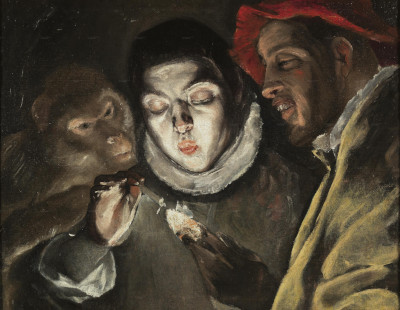
A boy lowers his face and blows on a glowing ember. His fingers bring a thin wick towards it, and the light rises across his pursed lips, lowered eyelids and white ruff. A monkey on the left draws near enough for its muzzle to catch the glow. On the right, a man in a red cap leans in with his teeth showing. The light gives each face a different expression. It also makes the three figures appear close enough to share the warmth from the small piece of wood. [1]
The Fable in the Museo Nacional del Prado is the smallest surviving canvas among the three versions of this group that the museum’s catalogue attributes to El Greco. Its edges have been cut down, and an X-ray shows that the painter changed the arrangement of the figures. Both facts matter to the encounter we have with it today. The man’s shoulder and cap meet the edges of the picture, and the monkey and boy press so closely together that the light almost joins their faces. [1]
At a Glance
- ArtistEl Greco (Doménikos Theotokópoulos)
- TitleThe Fable (Una fábula)
- DateAbout 1580
- MediumOil on canvas
- Dimensions50.5 × 63.6 cm (height × width)
- CollectionMuseo Nacional del Prado, Madrid, P007657 [1]
This work across El Greco’s career
The Disrobing of Christ
1577–79The Assumption of the Virgin
1577–79The Holy Trinity
1577–79Martyrdom of Saint Maurice
1580–82The Fable (current article)
About 1580The Burial of the Count of Orgaz
Commissioned 1586Contents
- What the ember reveals
- The boy alone, and the wider versions
- What the X-ray and cleaning revealed
- An ancient subject and its possible meanings
- Finding this canvas in the records
What the ember reveals
The brightest paint is concentrated just below the boy’s chin. Small marks of white and orange suggest the rough surface of the glowing tip, and a thin pale stroke approaches it from the viewer’s left. The fingers holding the wick are close together, with a brown edge over the knuckles and a clearer light across the palm. The boy’s other hand supports the wood from below. It largely disappears into shadow, with a few long strokes to indicate the fingers. The position of the two hands is clearest when seen from the glow outwards. [1]
The same upward light makes the face look unfamiliar. The underside of the nose is sharp and the bridge falls into a much deeper shadow. Highlights on the rounded lids lead towards the forehead, which begins to darken beneath the hair. The ruff receives light across its lower curve and turns up into shadow on either side of the jaw. Below it, passages of red-brown colour interrupt the muted green of the doublet. The transition from the pale face to the duller cloth allows a small patch of painted brightness to suggest a much stronger light than the size of the ember would lead us to expect. [1]
The boy’s attention stays with the wick. The monkey follows at nearly the same level, with its lips gathered and its eyes turned sideways towards the boy’s hand. Its shoulder and head can scarcely be separated from the darkness behind. Look for the light on the ridge above its eyes and on the end of its nose. Those scattered marks give the animal a face and a direction before the rest of its body becomes clear. On the other side the man’s teeth and the ridge of his nose receive the strongest light. The yellow folds of his cloak occupy the bottom right corner, rising towards the white collar and then the red of his cap. The ember itself is partly obscured, but its light gives us enough information to place all three figures in relation to it. [1]
The boy alone, and the wider versions
In the Capodimonte painting known as A Boy Blowing on an Ember to Light a Candle, El Greco gave the boy the whole picture. The lowered gaze, rounded mouth and lighting from beneath are already there. The Naples boy wears a light garment, with an open collar and broad folds down his front. The space to either side of his head remains dark, and the pale cuff and fingers lead to the small area where the wick and ember meet. The Museo di Capodimonte places the canvas in 1570–72. The Prado painting retains the recognisable action and puts another two faces within reach of the light. [1] [2]
Edinburgh’s An Allegory (Fábula), National Galleries of Scotland NG 2491, is a separate oil on canvas. The gallery dates it to about 1580–85 and gives its dimensions as 67.3 × 88.6 cm. There is room for more of the figures towards the outer edges. The man’s yellow garment has a wider area over which to catch the light. In the centre, the boy’s jacket has darkened from its original green, according to the Edinburgh catalogue. The Prado catalogue records a different change in Madrid, where a blue repaint had once covered much of the boy’s doublet and was removed in 1993. Similar groups can look different today for reasons that belong to the materials and histories of the individual canvases. [1] [3]
The third canvas is at Harewood House near Leeds. The Prado catalogue illustrates it at 65 × 90 cm and draws attention to the monkey’s chain. In Madrid, worn paint has made the chain difficult to read. Leticia Ruiz Gómez identifies traces of its highlights near the upper left corner. The animal’s proximity to the boy remains clear even where the marks that show it was tethered are hard to see. The wider Harewood picture helps a viewer recover that part of the subject without supplying missing details to the Madrid surface. [1] [4]
What the X-ray and cleaning revealed
The Prado canvas is trimmed at all four margins. Ruiz Gómez records long runs of damage and paint loss in the fabric that suggest it spent time rolled and out of its stretcher. The wear is particularly noticeable around the monkey. The paint on the central figure was applied more thickly and survives better, though cracks are visible. In 1993 Rafael Alonso removed oxidised varnish and overpaint, including the blue on the doublet, and retouched local losses. A short passage of the boy’s sleeve gives a close view of El Greco’s painting technique. A few broad strokes establish the turned fabric, while much smaller touches are reserved for the fingers and the point they hold. [1]
An X-radiograph reproduced in the Prado catalogue shows earlier positions beneath the visible surface. The boy’s head and hands were already much where they are today. The laughing man was initially painted to the boy’s right, on the viewer’s left, close to the hand holding the wick. El Greco covered that version of the man with the monkey, whose head had initially been sketched between the two people. In the finished picture the man has crossed to the viewer’s right and the monkey has a larger part in the group. Light still travels outward from the boy’s hands, but its recipients have changed places. [1]
Ruiz Gómez takes those revisions as grounds for considering whether the small canvas could represent an early working-out of the group composition. Its crowded arrangement had also suggested a later simplification, and trimming made that compact effect more pronounced. Ruiz Gómez places all three group paintings in El Greco’s early years in Spain, while earlier scholars placed the Madrid canvas in his Italian period. The X-ray shows decisions made on this particular canvas. The precise sequence of the three group pictures remains open. [1] [3]
An ancient subject and its possible meanings
Pliny the Elder records two ancient works that help explain the interest in this small action. In Natural History 34.79 he describes a sculpture by Lycius, a pupil of Myron, of a boy blowing on a dying fire. At 35.138 he praises Antiphilus for painting a boy blowing on a fire and making its light visible on the boy’s face and in the room. The first account concerns the posture and action of a figure in sculpture. The second offers a particular challenge to a painter, who has to show the source of a light and what it changes around it. Both are relevant to a boy bending over an ember. Neither passage describes the full group seen in Madrid. [1] [5] [6]
Jan Białostocki connected the subject with Pliny. José Riello, discussing the works in the Prado’s study of El Greco’s library, points to an additional piece of evidence. El Greco underlined a passage in his copy of Vasari where Giambattista Adriani mentions an ancient representation of a boy blowing on a fire. The annotation gives direct evidence of the painter’s interest in an account of the motif. A comparison with an ancient work can explain the appeal of the lighting problem. It still leaves the function of the added figures to be considered. [1] [7]
Riello suggests that the group may invite reflection on imitation, with the monkey’s instinctive mimicry set alongside the painter’s considered re-creation of what he sees. Other proposals read the grinning man as a figure of folly and the other figures as part of a warning about desire. The National Galleries of Scotland also discusses an interpretation centred on the fleeting pleasure of the flame, which would make the picture a vanitas, a reminder of life’s brevity. In Madrid there is an actual monkey, a spectator and a boy absorbed in a task. The available evidence leaves more than one way to understand what joins them. [1] [3] [7]
Finding this canvas in the records
A 1611 inventory made after the death of Juan de Ribera lists a picture of a boy blowing on an ember and another of two people and a monkey gathered around one. The description of the group is specific, and Ruiz Gómez considers the measurements compatible with the Madrid painting before its edges were cut. The catalogue also discusses a 1621 listing among the possessions of El Greco’s son Jorge Manuel. That entry calls the work a large fable, giving little help in identifying any of the three canvases individually. These records establish how such subjects were described in the early seventeenth century. Matching the documents to individual surviving works requires evidence of size, subject and later ownership. [1]
The Prado catalogue places this canvas securely on the London market in 1927. The museum acquired it from Stanley Moss in March 1993 with funds from Manuel Villaescusa’s bequest. That purchase and the restoration in the same year belong to the Madrid canvas alone. They help explain how a small painting with substantial changes at its margins and in the paint layer can still make the arresting effect of a brief light seem so immediate. [1] [8]
Browse the artworks
Browse the paintings covered in this collection and related works in museum catalogues. Some are by El Greco’s workshop or were formerly attributed to him.
| Name | Date | Medium |
|---|---|---|
| View of Toledo | Around 1599–1600 | Oil on canvas |
| Adoration of the Shepherds | 1612–14 | Oil on canvas |
| Laocoön | About 1610–14 | Oil on canvas |
| The Tears of Saint Peter | 1587–96, Museo del Greco dating | Oil on canvas |
| The Holy Family with Saint Anne | About 1595 | Oil on canvas |
| The Holy Trinity | 1577–79 | Oil on canvas |
| The Burial of the Count of Orgaz | 1586–88, the conventional range | Oil on canvas |
| Disrobing of Christ | 1577–79 | Oil on canvas |
| Opening of the Fifth Seal | About 1608–14 | Oil on canvas |
| Saint Martin and the Beggar | 1597–99 | Oil on canvas |
| Martyrdom of Saint Maurice | 1580–82 | Oil on canvas |
| Adoration of the Name of Jesus | 1577–79 | Oil on canvas |
| Saint Peter in Penitence (Bowes Museum) | 1580s | Oil on canvas |
| Christ Carrying the Cross | Around 1577–87 | Oil on canvas |
| Crucifixion | 1597–1600 | Oil on canvas |
| Resurrection | 1597–1600 | Oil on canvas |
| Immaculate Conception | About 1608–13 | Oil on canvas |
| Annunciation | 1597–1600 | Oil on canvas |
| Coronation of the Virgin | 1591–92 | Oil on canvas |
| Lady in a Fur Wrap | About 1580–88 | Oil on canvas |
| Baptism of Christ | Around 1608–14, with further work in the early 1620s according to Walter Liedtke. The foundation dates the painting to around 1614. | Oil on canvas |
| Portrait of an Old Man (Possible Self-Portrait) | About 1595–1600 | Oil on canvas |
| Adoration of the Kings | 1565–67, Benaki Museum dating | Tempera on wood |
| Mary Magdalene in Penitence | About 1585–90, tentatively dated by the Museu del Cau Ferrat | Oil on canvas |
| Saint Sebastian | About 1577 in the cathedral centenary catalogue | Oil on canvas |
| Portrait of Cardinal Fernando Nino de Guevara | About 1600 | Oil on canvas |
| Penitent Magdalene | About 1576–77 | Oil on canvas |
| The Nobleman with his Hand on his Chest | About 1580 | Oil on canvas |
| Saint Peter and Saint Paul | 1590–1600 | Oil on canvas |
| Pentecost | Circa 1600 | Oil on canvas |
| The Fable | About 1580 | Oil on canvas |
| Pietà | 1580–90 | Oil on canvas |
| View and Plan of Toledo | 1610–1614, according to the Museo del Greco | Oil on canvas |
| Assumption of the Virgin | 1577–79, with 1577 in the Greek inscription | Oil on canvas |
| The Annunciation (1609) | Late Tavera period. The owner dates the canvas to 1614. Factum gives 1608–1613 in its initial recording account. | Oil on canvas |
| The Agony in the Garden of Gethsemane | 1590s | Oil on canvas |
| Portrait of Jorge Manuel Theotocópuli | Circa 1600–05 | Oil on canvas |
| Dormition of the Virgin | About 1565–66, according to the National Gallery of Greece | Tempera on wood |
| Saint Louis | 1585–90 | Oil on canvas |
| Ecstasy of St Francis of Assisi (1580) | About 1577–80 in the Vatican Museums’ account. The Diocesan Museum gives 1575–80. | Oil on canvas |
| Saint Francis of Assisi in Ecstasy, after El Greco | Seventeenth century | Oil on canvas |
| Christ Driving the Money Changers from the Temple | Probably before 1570 | Oil on wood |
| The Entombment of Christ | Circa 1568–70, Venice | Mixed technique on wood |
| Nativity | 1603–05 | Oil on canvas |
| Portrait of a Gentleman | About 1586 | Oil on canvas |
| Coronation of the Virgin (Illescas) | 1603–05 | Oil on canvas |
| A Boy Blowing on an Ember to Light a Candle (El Soplón) | About 1570–72 | Oil on canvas |
| The Feast in the House of Simon | About 1608–14 | Oil on canvas |
| Concert of Angels | About 1608–14 | Oil on canvas |
| Healing of the Man Born Blind | Around 1570 in Dresden’s printed collection guide | Mixed technique on wood |
| Fray Hortensio Félix Paravicino | 1609 | Oil on canvas |
| Purification of the Temple | Circa 1600 | Oil on canvas |
| Portrait of Vincenzo Anastagi | Circa 1575 | Oil on canvas |
| Saint Paul (Almadrones) | 1608–14 | Oil on canvas |
| Head of Christ | About 1579–86 | Oil on canvas |
| Last Supper | About 1567–68, Venice | Tempera on wood |
| Saint John the Evangelist (Prado Museum, Madrid) | About 1605 | Oil on canvas |
| Disrobing of Christ (Lyon, Half Painting Version) | About 1581–86 | Oil on canvas |
| The Dream of Philip II | 1577–79 | Oil on canvas |
| Portrait of a Sculptor | About 1577–80, 2019 exhibition dating | Oil on canvas |
| Saint Bernard | 1577–79 | Oil on canvas |
| Saint Benedict | 1577–79 | Oil on canvas |
| Portrait of Jerónimo de Cevallos | 1613, as catalogued by the Prado | Oil on canvas |
| The Flight into Egypt | About 1570 | Oil on wood |
| Saint Anthony of Padua | About 1580 | Oil on canvas |
| Portrait of a Doctor | 1582–85 | Oil on canvas |
| The Veil of Saint Veronica | 1586–95 | Oil on canvas |
| An Elderly Gentleman | About 1587–1600 | Oil on canvas |
| Saints Andrew and Francis | About 1595 | Oil on canvas |
| The Holy Family with Saint Anne and the Infant Saint John | Around 1600 in the Prado catalogue. The Balaguer record gives 1595–1600. | Oil on canvas |
| The Virgin Mary | 1595–1600 | Oil on canvas |
| Portrait of a Gentleman (1600-1605) | About 1600–05 | Oil on canvas |
| Portrait of a Young Gentleman | 1600–05 | Oil on canvas |
| John the Baptist and Saint John the Evangelist | 1600–10 | Oil on canvas |
| Portrait of a Friar | 1600–50 | Oil on canvas |
| Saint Thomas (Almadrones) | 1608–14 | Oil on canvas |
| Christ the Saviour (Almadrones) | 1608–14 | Oil on canvas |
| An Apostle (Prado P000814) | 1608–14 | Oil on canvas |
| Saint James (Almadrones) | 1608–14 | Oil on canvas |
| Julián Romero and his Patron Saint | 1612–18 | Oil on canvas |
| Allegory of the Camaldolese Order | Around 1600, Instituto Valencia de Don Juan dating | Oil on canvas |
| Saint Joseph and the Christ Child | 1597–99 | Oil on canvas |
| Saint Ildefonsus | Around 1600 according to the Prado's proposal, 1603–05 in Hadjinicolaou and Ficonofue | Oil on canvas |
| Saint Augustine | About 1585–1602, as listed in the 2014 exhibition study | Oil on canvas |
| Portrait of Diego de Covarrubias y Leyva | Circa 1600 | Oil on canvas |
| Saint Bernardino of Siena | 1603 in the Prado catalogue. The Museo del Greco object page lists 1602. | Oil on canvas |
| Portrait of Cardinal Tavera | About 1609 in the foundation's account, circa 1610 in its image heading | Oil on canvas |
| Visitation | About 1610–14 | Oil on canvas |
| Portrait of Francisco de Pisa | Circa 1610–14 | Oil on canvas |
| Saint Lawrence's Vision of the Madonna and Child (Apparition of the Virgin to St. Lawrence) | 1578–80 in the 2021 heritage decree | Oil on canvas |
| Christ on the Cross | Probably 1570s, assigned to El Greco’s Italian period in the sale literature | Oil on canvas |
| Portrait of Charles de Guise | 1572, as dated in the painted book | Oil on canvas |
| Portrait of Giulio Clovio | 1571–72, according to Capodimonte | Oil on canvas |
| Mount Sinai | About 1570–72 | Mixed technique on wood |
| Modena Triptych | 1567–1568, as dated by the Galleria Estense and the national catalogue | Tempera on wood |
| Saint Luke Painting the Virgin | 1560–67, Benaki Museum dating | Mixed technique on wood |
| Saint Ildefonso (Washington) | 1603–14 | Oil on canvas |
| Saint Martin and the Beggar (smaller Washington version) | 1600–14 | Oil on canvas |
| The Holy Family with Saint Anne and the Infant John the Baptist (Washington) | About 1595–1600 | Oil on canvas |
| The Adoration of the Name of Jesus (London panel) | Late 1570s | Oil on wood |
| Christ Driving the Traders from the Temple (London) | About 1600 | Oil on canvas |
| Saint Francis Receiving the Stigmata (Baltimore) | 1585–90 | Oil on canvas |
| Saint Luke (Almadrones, Indianapolis) | About 1610–14 | Oil on canvas |
| Saint Matthew (Almadrones, Indianapolis) | About 1610–14 | Oil on canvas |
| Saint Simon (Almadrones, Indianapolis) | About 1610–14 | Oil on canvas |
| The Tears of Saint Peter (Hospital de Tavera) | About 1605 | Oil on canvas Catalogue. |
Discussion
Look again at the images and ideas explored in The Fable by El Greco. These editorial prompts invite your observations.
Reader Insights
Follow the ember’s light to each face in turn. Which small highlight tells you most about where that figure is looking?
Look for the yellow cloak and red hat. How does their position affect the attention you give the monkey at the left?
Join the Conversation
Share a detail, comparison or question about The Fable by El Greco below.
References
- Leticia Ruiz Gómez, El Greco en el Museo Nacional del Prado. Catálogo razonado, Museo Nacional del Prado, 2007, cat. 35, pp. 212–217 and figs. 151–154 View source.
- Museo e Real Bosco di Capodimonte, collection account identifying and dating El Soplón View source.
- National Galleries of Scotland, An Allegory (Fábula), NG 2491, collection record and curatorial commentary View source.
- Harewood House Trust, Allegory, collection entry View source.
- Pliny the Elder, Natural History, 34.79, text on the sculptor Lycius View source.
- Pliny the Elder, Natural History, 35.138, text on the painter Antiphilus View source.
- José Riello, La biblioteca del Greco, Museo Nacional del Prado, 2014, pp. 72–74 and notes 133–139 View source.
- Isabel Quintana Jiménez, El Museo del Prado como heredero universal, section on the Villaescusa bequest View source.







