


 by Tom Gurney
Tom Gurney BSc (Hons) is an art history expert with over 20 years experience
Published on June 19, 2020 / Updated on October 14, 2023
Email: tomgurney1@gmail.com / Phone: +44 7429 011000
Portrait of Giulio Clovio: Introduction
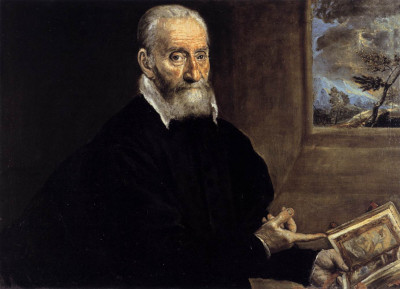
Giulio Clovio carries an open book in his left hand and extends his right index finger towards a miniature. His shoulders turn towards the book, while his head and eyes come round to meet the viewer. Behind him, a window opens onto a hillside where light breaks through heavy clouds. El Greco gives both openings, the book and the window, a place at the right edge of the canvas. The glint of the page and the outdoor light draw attention away from Clovio’s face, and his gaze brings it back. [1] [2]
Capodimonte dates the portrait to 1571–72. Clovio was a manuscript illuminator who had already been working for Cardinal Alessandro Farnese for years when he helped El Greco secure lodgings in Rome. The book is the Farnese Hours, now at the Morgan Library & Museum. El Greco shows Clovio presenting something he made, and enough of the pictured opening survives on the canvas to compare it with two actual leaves of the book. [1] [2] [3]
At a Glance
- ArtistEl Greco (Doménikos Theotokópoulos) [1] [2]
- TitlePortrait of Giulio Clovio (Ritratto di Giulio Clovio) [1]
- Date1571–72, according to Capodimonte [1]
- MediumOil on canvas [2]
- Dimensions62 × 84 cm (height × width in Capodimonte’s loan record) [2]
- CollectionMuseo e Real Bosco di Capodimonte, Naples, inv. Q 191 [2]
- Book depictedFarnese Hours, Morgan Library & Museum, MS M.69 [1] [3]
This work across El Greco’s career
Dormition of the Virgin
c. 1565–66Modena Triptych
1567–68Portrait of Giulio Clovio (current article)
1571–72, according to Capodimonte [1]The Disrobing of Christ
1577–79The Assumption of the Virgin
1577–79The Holy Trinity
1577–79Contents
- The sitter’s look and gesture
- Two pages of the Farnese Hours
- What Clovio asked of Alessandro Farnese
- From Fulvio Orsini’s collection to Naples
- How El Greco shows a sitter’s work
The sitter’s look and gesture
The upper part of Clovio’s body fills much of the left half of the picture. In the dark cloth, the shoulder and sleeve are more readily traced by their edges than by seams or folds. A narrow collar brightens the transition to the beard. There is more detail in the face than anywhere else at this scale. Fine highlights pick out the bridge of the nose, the eyes and the high forehead. The rim of the ear follows the turn of the head, and small changes in the direction of the grey paint give the beard a much softer outline than the collar. [1] [2]
The hands make the turn of the body intelligible. Clovio’s left hand comes up under the volume to take its weight. The right hand comes out of the sleeve with the index finger extended and the other fingers curled in. The long finger is nearly horizontal, while the page rises sharply away from it. Follow that small change in angle and the book looks as if it has just been raised into view. It sits low enough for the face and the hands to take their own turns in the viewer’s attention. [2] [4]
The room is plain apart from the window. Its deep recess can be read in the pale vertical edge and the ledge under the landscape. Outside, a forked tree tilts towards the opening in the clouds. Light falls on patches of hillside and sky, with dark foliage crossing them. The firmer lines of the window hold that movement within a narrow area. A similar effect occurs in the book, where a small bright rectangle contains a group of bodies in motion. The book is closest to us and the hillside farthest away. El Greco gives both the intensity of a much larger picture. [2] [4]
Two pages of the Farnese Hours
The Morgan dates the Farnese Hours to 1546 in Rome. A book of hours orders prayers around the hours of the day. This one, made for Alessandro Farnese, measures about 17 by 11 centimetres when closed. Its illuminations were made to be studied with the book in the hands. The full-page miniatures on folios 59v and 60r face one another across the fold. Each has a gold architectural border with layered mouldings and ornament. In the oil portrait the broad gold-coloured band around the upper miniature, the turn of the page and the approximate position of the light figures all help make the connection. Elena De Laurentiis identifies the pointed-to miniature as the scene on the left. [3] [4] [5] [6]
On folio 59v, God stretches his arms from a bright opening above the clouds. His robes make a sweep of pink and blue over a dark lower field. The Morgan describes the scene as the Creation, possibly its first day, and identifies the kneeling Virgin to the right of God. The scene is often associated with Michelangelo’s Creation of the Sun and Moon on the Sistine Chapel ceiling. De Laurentiis draws out the relationship and the changes Clovio made when adapting it to a small page. In the portrait, a light mass of figures above darker colour and the surrounding gold can still be made out. The smaller figures, their gestures and the precise ornament of the border are much harder to distinguish than on the Morgan leaf. [4] [5]
The facing miniature, folio 60r, shows the Holy Family. Mary embraces the child on her lap beneath an open shed, and Joseph stands behind them leaning on a crutch. On the Morgan page the shed’s diagonal roof and the generous blue folds around Mary’s lap are easy to follow. In the portrait the canvas edge cuts the view of the book and much less of the facing page is available for comparison. The surviving gold edging and the relation between the two pages support the identification of the spread. Joseph and the details of the shed belong to what can be read clearly in the manuscript itself. [2] [4] [5] [6]
The Morgan records that the book originally had a flexible vellum binding fastened with red silk ribbons. Its later silver-gilt covers, now kept separately, carry the arms of Alessandro and Odoardo Farnese. El Greco shows the object from the page side and includes the thickness of its leaves. The border he paints catches the light even where the details within it fade. That balance makes the volume recognisable as a particular piece of work and makes it feel light enough for Clovio to hold in one hand. [2] [3] [5] [6]
What Clovio asked of Alessandro Farnese
On 16 November 1570, Clovio wrote to Alessandro Farnese about a young painter from Candia who had arrived in Rome. He presented El Greco as a pupil of Titian and singled out a self-portrait that, he said, had astonished other painters in the city. He asked the cardinal to have his steward find the newcomer a room upstairs at Palazzo Farnese for a short time, until he found other arrangements. The reference to Titian was part of a recommendation to a prospective patron. It records how Clovio introduced the newcomer, and the self-portrait is described in the letter without dimensions or other particulars that would identify a surviving work. [7] [8]
The Vatican Museums’ chronology places El Greco in the palace after that recommendation. On 6 July 1572 he wrote to Farnese seeking an explanation for being dismissed from the household. He entered the painters’ association of San Luca in October. These dates give the circumstances of his residence and departure a documentary outline. The date range Capodimonte gives the portrait falls within the same phase of El Greco’s life. The surviving correspondence gives no account of a sitting or of the arrangements under which the picture was painted. [1] [7] [8]
There is a further connection between the painter and sitter in the inscription. Capodimonte’s exhibition catalogue transcribes a signature in Greek at the left, in which Doménikos Theotokópoulos identifies himself as Cretan and says that he made the picture. Clovio’s letter had introduced a painter from Candia to the cardinal. The signature preserves that place of origin in the painter’s own terms, alongside a likeness that points to Clovio’s own work. A reader has two ways of seeing authorship here, one in lettering and the other in the action of the hands. [7] [9]
From Fulvio Orsini’s collection to Naples
The earliest recorded owner was Fulvio Orsini, the Farnese librarian and collector. His inventory, in the entry published by Pierre de Nolhac and transcribed in the Benaki Museum’s study of Farnese patronage, records a picture of the miniaturist Don Giulio by El Greco in a carved walnut frame. It identifies both the maker and the sitter and puts the portrait in an identifiable collection. The Morgan’s exhibition label identifies Orsini as the patron of the portrait. The surviving inventory entry establishes that he owned it by 1600 and gives the name of its painter. The circumstances of acquisition remain less securely documented. [9] [10] [11]
Orsini’s art collection passed to Cardinal Odoardo Farnese in 1600. An inventory of Palazzo Farnese in 1644 describes a canvas portrait of Clovio with an illuminated office of his own making. The description puts the book in his right hand, whereas the painting shows that hand indicating a page and the left supporting the book. The portrait appears with other works in the Farnese records, including the single-figure picture now called A Boy Blowing on an Ember to Light a Candle. The 1644 description of that canvas specifies a young man blowing on a burning ember to light a flame. The portrait and the boy are separate pictures now at Capodimonte, and their early descriptions give some sense of how they were recognised in a collection. [1] [7] [9] [10]
The portrait subsequently appears in records of the Farnese collection at Parma and then in the royal collections in Naples. Capodimonte’s exhibition catalogue traces it through the Palazzo del Giardino and Ducal Gallery at Parma, to Capodimonte by 1799, and later to the museum in the Palazzo degli Studi. It gives 1957 as the year the portrait entered the present Museo di Capodimonte. Those movements concern the oil painting. The illuminated book followed a separate route to the Morgan, where its small pages can now be examined individually. [3] [9]
How El Greco shows a sitter’s work
In the portrait of Vincenzo Anastagi, dated about 1575 by the Frick Collection, El Greco shows a man standing full length in armour. The helmet on the floor draws attention down from the face and helps set the scale of the standing figure. It belongs to the sitter’s military life, which the Frick connects with his appointment at Castel Sant’Angelo in Rome. Clovio’s occupation calls for an entirely different distance. He turns a small object towards the viewer and uses a single finger to mark the place to look. The two portraits let a viewer learn something about a sitter by seeing how he stands in relation to the things he uses. [2] [4] [12]
The opening of the book also sets a pace for the encounter. Clovio’s face is clear at a glance, while the book rewards a closer look. Its tilt gives the sense of a volume held open for someone nearby, and the finger guides that person to a particular part of the page. Through the window the hillside is far away, but we are close enough to Clovio to see the light along his knuckles. That is also about the distance from which the illuminations themselves begin to make sense. [2] [4] [5] [6]
Browse the artworks
Browse the paintings covered in this collection and related works in museum catalogues. Some are by El Greco’s workshop or were formerly attributed to him.
| Name | Date | Medium |
|---|---|---|
| View of Toledo | Around 1599–1600 | Oil on canvas |
| Adoration of the Shepherds | 1612–14 | Oil on canvas |
| Laocoön | About 1610–14 | Oil on canvas |
| The Tears of Saint Peter | 1587–96, Museo del Greco dating | Oil on canvas |
| The Holy Family with Saint Anne | About 1595 | Oil on canvas |
| The Holy Trinity | 1577–79 | Oil on canvas |
| The Burial of the Count of Orgaz | 1586–88, the conventional range | Oil on canvas |
| Disrobing of Christ | 1577–79 | Oil on canvas |
| Opening of the Fifth Seal | About 1608–14 | Oil on canvas |
| Saint Martin and the Beggar | 1597–99 | Oil on canvas |
| Martyrdom of Saint Maurice | 1580–82 | Oil on canvas |
| Adoration of the Name of Jesus | 1577–79 | Oil on canvas |
| Saint Peter in Penitence (Bowes Museum) | 1580s | Oil on canvas |
| Christ Carrying the Cross | Around 1577–87 | Oil on canvas |
| Crucifixion | 1597–1600 | Oil on canvas |
| Resurrection | 1597–1600 | Oil on canvas |
| Immaculate Conception | About 1608–13 | Oil on canvas |
| Annunciation | 1597–1600 | Oil on canvas |
| Coronation of the Virgin | 1591–92 | Oil on canvas |
| Lady in a Fur Wrap | About 1580–88 | Oil on canvas |
| Baptism of Christ | Around 1608–14, with further work in the early 1620s according to Walter Liedtke. The foundation dates the painting to around 1614. | Oil on canvas |
| Portrait of an Old Man (Possible Self-Portrait) | About 1595–1600 | Oil on canvas |
| Adoration of the Kings | 1565–67, Benaki Museum dating | Tempera on wood |
| Mary Magdalene in Penitence | About 1585–90, tentatively dated by the Museu del Cau Ferrat | Oil on canvas |
| Saint Sebastian | About 1577 in the cathedral centenary catalogue | Oil on canvas |
| Portrait of Cardinal Fernando Nino de Guevara | About 1600 | Oil on canvas |
| Penitent Magdalene | About 1576–77 | Oil on canvas |
| The Nobleman with his Hand on his Chest | About 1580 | Oil on canvas |
| Saint Peter and Saint Paul | 1590–1600 | Oil on canvas |
| Pentecost | Circa 1600 | Oil on canvas |
| The Fable | About 1580 | Oil on canvas |
| Pietà | 1580–90 | Oil on canvas |
| View and Plan of Toledo | 1610–1614, according to the Museo del Greco | Oil on canvas |
| Assumption of the Virgin | 1577–79, with 1577 in the Greek inscription | Oil on canvas |
| The Annunciation (1609) | Late Tavera period. The owner dates the canvas to 1614. Factum gives 1608–1613 in its initial recording account. | Oil on canvas |
| The Agony in the Garden of Gethsemane | 1590s | Oil on canvas |
| Portrait of Jorge Manuel Theotocópuli | Circa 1600–05 | Oil on canvas |
| Dormition of the Virgin | About 1565–66, according to the National Gallery of Greece | Tempera on wood |
| Saint Louis | 1585–90 | Oil on canvas |
| Ecstasy of St Francis of Assisi (1580) | About 1577–80 in the Vatican Museums’ account. The Diocesan Museum gives 1575–80. | Oil on canvas |
| Saint Francis of Assisi in Ecstasy, after El Greco | Seventeenth century | Oil on canvas |
| Christ Driving the Money Changers from the Temple | Probably before 1570 | Oil on wood |
| The Entombment of Christ | Circa 1568–70, Venice | Mixed technique on wood |
| Nativity | 1603–05 | Oil on canvas |
| Portrait of a Gentleman | About 1586 | Oil on canvas |
| Coronation of the Virgin (Illescas) | 1603–05 | Oil on canvas |
| A Boy Blowing on an Ember to Light a Candle (El Soplón) | About 1570–72 | Oil on canvas |
| The Feast in the House of Simon | About 1608–14 | Oil on canvas |
| Concert of Angels | About 1608–14 | Oil on canvas |
| Healing of the Man Born Blind | Around 1570 in Dresden’s printed collection guide | Mixed technique on wood |
| Fray Hortensio Félix Paravicino | 1609 | Oil on canvas |
| Purification of the Temple | Circa 1600 | Oil on canvas |
| Portrait of Vincenzo Anastagi | Circa 1575 | Oil on canvas |
| Saint Paul (Almadrones) | 1608–14 | Oil on canvas |
| Head of Christ | About 1579–86 | Oil on canvas |
| Last Supper | About 1567–68, Venice | Tempera on wood |
| Saint John the Evangelist (Prado Museum, Madrid) | About 1605 | Oil on canvas |
| Disrobing of Christ (Lyon, Half Painting Version) | About 1581–86 | Oil on canvas |
| The Dream of Philip II | 1577–79 | Oil on canvas |
| Portrait of a Sculptor | About 1577–80, 2019 exhibition dating | Oil on canvas |
| Saint Bernard | 1577–79 | Oil on canvas |
| Saint Benedict | 1577–79 | Oil on canvas |
| Portrait of Jerónimo de Cevallos | 1613, as catalogued by the Prado | Oil on canvas |
| The Flight into Egypt | About 1570 | Oil on wood |
| Saint Anthony of Padua | About 1580 | Oil on canvas |
| Portrait of a Doctor | 1582–85 | Oil on canvas |
| The Veil of Saint Veronica | 1586–95 | Oil on canvas |
| An Elderly Gentleman | About 1587–1600 | Oil on canvas |
| Saints Andrew and Francis | About 1595 | Oil on canvas |
| The Holy Family with Saint Anne and the Infant Saint John | Around 1600 in the Prado catalogue. The Balaguer record gives 1595–1600. | Oil on canvas |
| The Virgin Mary | 1595–1600 | Oil on canvas |
| Portrait of a Gentleman (1600-1605) | About 1600–05 | Oil on canvas |
| Portrait of a Young Gentleman | 1600–05 | Oil on canvas |
| John the Baptist and Saint John the Evangelist | 1600–10 | Oil on canvas |
| Portrait of a Friar | 1600–50 | Oil on canvas |
| Saint Thomas (Almadrones) | 1608–14 | Oil on canvas |
| Christ the Saviour (Almadrones) | 1608–14 | Oil on canvas |
| An Apostle (Prado P000814) | 1608–14 | Oil on canvas |
| Saint James (Almadrones) | 1608–14 | Oil on canvas |
| Julián Romero and his Patron Saint | 1612–18 | Oil on canvas |
| Allegory of the Camaldolese Order | Around 1600, Instituto Valencia de Don Juan dating | Oil on canvas |
| Saint Joseph and the Christ Child | 1597–99 | Oil on canvas |
| Saint Ildefonsus | Around 1600 according to the Prado's proposal, 1603–05 in Hadjinicolaou and Ficonofue | Oil on canvas |
| Saint Augustine | About 1585–1602, as listed in the 2014 exhibition study | Oil on canvas |
| Portrait of Diego de Covarrubias y Leyva | Circa 1600 | Oil on canvas |
| Saint Bernardino of Siena | 1603 in the Prado catalogue. The Museo del Greco object page lists 1602. | Oil on canvas |
| Portrait of Cardinal Tavera | About 1609 in the foundation's account, circa 1610 in its image heading | Oil on canvas |
| Visitation | About 1610–14 | Oil on canvas |
| Portrait of Francisco de Pisa | Circa 1610–14 | Oil on canvas |
| Saint Lawrence's Vision of the Madonna and Child (Apparition of the Virgin to St. Lawrence) | 1578–80 in the 2021 heritage decree | Oil on canvas |
| Christ on the Cross | Probably 1570s, assigned to El Greco’s Italian period in the sale literature | Oil on canvas |
| Portrait of Charles de Guise | 1572, as dated in the painted book | Oil on canvas |
| Portrait of Giulio Clovio | 1571–72, according to Capodimonte | Oil on canvas |
| Mount Sinai | About 1570–72 | Mixed technique on wood |
| Modena Triptych | 1567–1568, as dated by the Galleria Estense and the national catalogue | Tempera on wood |
| Saint Luke Painting the Virgin | 1560–67, Benaki Museum dating | Mixed technique on wood |
| Saint Ildefonso (Washington) | 1603–14 | Oil on canvas |
| Saint Martin and the Beggar (smaller Washington version) | 1600–14 | Oil on canvas |
| The Holy Family with Saint Anne and the Infant John the Baptist (Washington) | About 1595–1600 | Oil on canvas |
| The Adoration of the Name of Jesus (London panel) | Late 1570s | Oil on wood |
| Christ Driving the Traders from the Temple (London) | About 1600 | Oil on canvas |
| Saint Francis Receiving the Stigmata (Baltimore) | 1585–90 | Oil on canvas |
| Saint Luke (Almadrones, Indianapolis) | About 1610–14 | Oil on canvas |
| Saint Matthew (Almadrones, Indianapolis) | About 1610–14 | Oil on canvas |
| Saint Simon (Almadrones, Indianapolis) | About 1610–14 | Oil on canvas |
| The Tears of Saint Peter (Hospital de Tavera) | About 1605 | Oil on canvas Catalogue. |
Discussion
Look again at the images and ideas explored in Portrait of Giulio Clovio. These editorial prompts invite your observations.
Reader Insights
Compare the painted pages with the original Farnese Hours. Which details can you read in both, and which depend on the angle of the book?
Look from the pointing hand to the opening behind Clovio. Where does the contrast between the pale hand and the dark clothing direct you?
Join the Conversation
Share a detail, comparison or question about Portrait of Giulio Clovio below.
References
- Museo e Real Bosco di Capodimonte, 2024 reinstallation announcement, Il percorso View source.
- Museo e Real Bosco di Capodimonte, 2022 loan checklist, Q 191 with photograph View source.
- Morgan Library & Museum, Farnese Hours, MS M.69, manuscript record and binding description View source.
- Elena De Laurentiis, El Greco, Giulio Clovio y la manera di figure piccole, pp. 49–52, figs. 11–16 View source.
- Morgan Library & Museum, Farnese Hours, folio 59v, Creation scene View source.
- Morgan Library & Museum, Farnese Hours, folio 60r, Holy Family View source.
- Guido Checchi, Roma 1572, pp. 58–59, transcriptions of the 1570 letter and 1644 Farnese inventory View source.
- Vatican Museums, El Greco biographical note, 1570 and 1572 entries View source.
- Alessandra Zaccagnini, Ritratto di Giulio Clovio, Capodimonte exhibition catalogue entry 8 View source.
- Benaki Museum, The Maecenas Alessandro Farnese and the Question of His Patronage of El Greco, p. 128 n. 99, Orsini inventory entry 43 View source.
- Morgan Library & Museum, Masterworks from the Morgan: Medieval and Renaissance Manuscripts, label for the Clovio portrait View source.
- The Frick Collection, Men in Armor, 2014 exhibition programme, p. 4 and cover View source.







