


 by Tom Gurney
Tom Gurney BSc (Hons) is an art history expert with over 20 years experience
Published on June 19, 2020 / Updated on October 14, 2023
Email: tomgurney1@gmail.com / Phone: +44 7429 011000
The Agony in the Garden of Gethsemane by the Studio of El Greco: Introduction
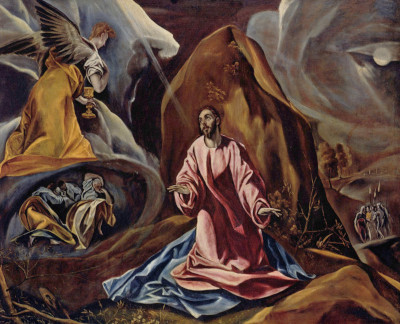
Christ kneels on a blue mantle that spreads over the ground. He looks towards an angel holding a small gold cup. Beneath the angel, three disciples sleep inside a dark oval recess, their bodies folded together under their robes. At the far right, figures scarcely taller than Christ’s hand come along a path. The broad canvas lets us see who is praying, who is sleeping and who is on the way to arrest him, all before the two groups meet. [1]
The National Gallery in London dates this Agony in the Garden of Gethsemane to the 1590s and credits it to the Studio of El Greco. The gallery identifies a painting by El Greco himself, now in the Toledo Museum of Art in Ohio, as the basis for the London version. Much of the dramatic force of that design lies in the distances it creates. The angel is close enough for Christ to see the chalice, while a bank of rock and cloud seems to shut the sleeping men inside a world of their own. [1]
The Agony in the Garden of Gethsemane, studio of El Greco
At a Glance
- ArtistStudio of El Greco
- Date1590s
- MediumOil on canvas
- Dimensions102 × 131 cm (height × width)
- CollectionNational Gallery, London, NG3476
- AcquisitionPurchased in 1919
This work across El Greco’s career
The Disrobing of Christ
1577–79Martyrdom of Saint Maurice
1580–82The Burial of the Count of Orgaz
Commissioned 1586View of Toledo
c. 1599–1600Opening of the Fifth Seal
c. 1608–14Contents
- The figures in the night
- The cup and the sleeping disciples
- What changes from one version to another
- From the 1614 inventory to the London gallery
The figures in the night
Christ’s robe gives the clearest sense of how he kneels. Pale pink runs down from the shoulder, breaks at the elbow and comes forward again over one knee. Dark red runs alongside it and into the folds beneath his body. Both hands emerge from wide cuffs with the fingers open, the hand to our left closer to the angel. The deep blue mantle fans out along the ground and fixes the lower edge of his figure. Behind the lifted head, the tall, sharply bounded mass of brown rock marks out a space almost as private as the one around the sleepers. [1]
Look up at the angel’s shoulder and the space begins to move in another direction. The wings spread leftwards and up. The face turns down and the hands bring the cup towards the centre of the canvas. A yellow fold across the angel’s knees makes a ledge of colour above the disciples. Their garments have their own sharp boundaries. A pale mantle follows a bent knee at the front of the group and a blue sleeve disappears behind another shoulder. Between the angel’s robe and the oval there is a dark curve edged in blue. It can look like the mouth of a cave at first. Farther to the left it is hard to tell where rock ends and cloud begins. The oval holds its shape even as the kind of space it encloses remains uncertain. The National Gallery suggests that this use of an abstract boundary to separate figures may recall Byzantine painting, the tradition in which El Greco trained in Crete. [1]
To the right of the rock, the scale changes abruptly. A narrow path falls away beyond the scrub at Christ’s side, and the approaching party is marked by pale touches and thin uprights. Above it, a bright disc shows through curling clouds. A much stronger light falls near the angel and picks out Christ’s pink sleeve and knee. The National Gallery distinguishes the supernatural source from the light of the moon. The two lights let one side of the picture hold the encounter that Christ sees and the other show the danger that is still some way off. [1]
The cup and the sleeping disciples
In Matthew 26:36–46 Jesus goes to a place called Gethsemane and takes Peter and the two sons of Zebedee with him before withdrawing to pray. Mark 14:32–42 names the three as Peter, James and John. Jesus asks them to keep watch and finds them asleep when he returns. In the London canvas the painter can put the disciples in view even while Christ is apart from them. Their bowed and covered heads make sleep legible across a distance. The space around Christ’s outstretched arms gives his prayer room to unfold. [1] [2] [3]
Luke 22:39–46 sets the scene on the Mount of Olives and describes Jesus withdrawing about a stone’s throw from the disciples and kneeling. He asks the Father to take away the cup and submits to the Father’s will. In verses 43–44, an angel comes to strengthen him and his distress intensifies. The painting gives the cup in the prayer the form of a gold chalice held by the angel. The National Gallery also reads that vessel as a reference to the Eucharist, in which a chalice holds the wine. Its rim and stem are small enough to reward a close look, yet it controls the direction of Christ’s gaze across the painting. [1] [4]
El Greco on video
Open the film at 3:35 on YouTube. The National Gallery credits this canvas to the studio of El Greco. The gallery also includes related films from museum curators.
El Greco's Most Famous Paintings
A short survey of El Greco’s paintings, including View of Toledo.
Watch on YouTubeJohn 18:1–11 places the arrest in a garden across the Kidron Valley and describes Judas approaching with soldiers and officials carrying lanterns, torches and weapons. In that account Jesus speaks of the cup again at the point of arrest, when he tells Peter to put away his sword. The London composition holds the moment of prayer open while the people who will end it are already in view. The next stages of the Passion have quite different gestures in Christ Carrying the Cross and the Crucifixion. Here the open hands are still free and the chalice makes the coming suffering visible before the arrest. [1] [4] [5]
What changes from one version to another
The original identified by the National Gallery is The Agony in the Garden at the Toledo Museum of Art, Ohio, accession 1946.5. Toledo dates its oil on canvas to about 1590–95 and gives the dimensions as 102.2 × 113.7 cm. That makes the two paintings almost the same height. The London version is over seventeen centimetres wider. Their shared arrangement places the angel and the sleeping Peter, James and John on the left and Judas’s company in the distance on the right. The extra width is one immediate way to distinguish the London canvas from its model. The Toledo Museum points to the deliberately uncertain distance between the angel and the disciples. In London, the overlap makes them look close on the surface. The darkness inside the oval makes it difficult to place the sleepers in the same space as the brilliantly lit figure over their heads. [1] [6]
In another version, in Budapest’s Museum of Fine Arts, the canvas stands 170 centimetres high and is 112.5 centimetres wide. The museum credits it to El Greco and dates it about 1610–14. A rugged slope carries the kneeling Christ and the angel high above the sleepers. Christ holds his hands apart, as in London, while the angel leans forward across the slope. The disciples take up much of the Budapest foreground. The pale folds over their legs are among the largest shapes in the picture, and one of the men sleeps with an arm curved up around his head. The London oval keeps their counterparts together at the side of the scene and on a smaller scale. The changes in width, height and placement show how the same subject could be reorganised around the viewer’s first encounter with the figures. [1] [7]
London’s attribution recognises the role of assistants in making versions of El Greco’s compositions. The repeated details, from the open hands to the distant party, help us trace the design. Comparing related canvases is also part of studying El Greco’s style and technique. Some choices, such as how a robe shapes a bend in the knee, can be followed through several versions. The National Gallery’s credit describes its judgement about the making of this particular object. [1] [6] [7]
From the 1614 inventory to the London gallery
After El Greco’s death in 1614, his son Jorge Manuel drew up an inventory of his possessions on 12 April. Francisco de Borja de San Román’s transcription contains several short entries for a prayer in the garden. One appears immediately after a small painted Crucifixion. The National Gallery suggests that its painting could be one of the Garden pictures on the list. The entries record that the subject was present in the estate, and their brief descriptions leave the proposed identification open. [1] [8] [9]
The gallery records the London canvas at the Convento de las Salesas Nuevas in Madrid. The dealer Lionel Harris apparently bought it from the convent in May 1919, and the National Gallery purchased it from him that November as a painting by El Greco. The acquisition drew strong reactions. Writing in 1920, the critic Roger Fry recalls crowds arguing in front of it and calls the arrival of the picture an “electric shock”. He picked out the diagonals in Christ’s sleeve and across his thigh, where the light catches two folds travelling in the same direction. Those lines help explain how a figure whose hands reach to either side of him can still be seen as a single, sweeping shape. [1] [10]
In 2015 the National Gallery displayed its studio version near another Agony in the Garden, on loan from a private collection. The pairing let viewers compare two paintings shaped around the same story. It also gave them room to look again at what drew Fry’s attention to the London one. Begin with the sleeve he singled out and follow the tilt of the folds down to Christ’s knees. Then look across to the upright stem of the cup. A sweep of cloth and a tiny painted vessel are enough to hold Christ’s figure in the moment before the figures on the path arrive. [1] [10] [11]
Browse the artworks
Browse the paintings covered in this collection and related works in museum catalogues. Some are by El Greco’s workshop or were formerly attributed to him.
| Name | Date | Medium |
|---|---|---|
| View of Toledo | Around 1599–1600 | Oil on canvas |
| Adoration of the Shepherds | 1612–14 | Oil on canvas |
| Laocoön | About 1610–14 | Oil on canvas |
| The Tears of Saint Peter | 1587–96, Museo del Greco dating | Oil on canvas |
| The Holy Family with Saint Anne | About 1595 | Oil on canvas |
| The Holy Trinity | 1577–79 | Oil on canvas |
| The Burial of the Count of Orgaz | 1586–88, the conventional range | Oil on canvas |
| Disrobing of Christ | 1577–79 | Oil on canvas |
| Opening of the Fifth Seal | About 1608–14 | Oil on canvas |
| Saint Martin and the Beggar | 1597–99 | Oil on canvas |
| Martyrdom of Saint Maurice | 1580–82 | Oil on canvas |
| Adoration of the Name of Jesus | 1577–79 | Oil on canvas |
| Saint Peter in Penitence (Bowes Museum) | 1580s | Oil on canvas |
| Christ Carrying the Cross | Around 1577–87 | Oil on canvas |
| Crucifixion | 1597–1600 | Oil on canvas |
| Resurrection | 1597–1600 | Oil on canvas |
| Immaculate Conception | About 1608–13 | Oil on canvas |
| Annunciation | 1597–1600 | Oil on canvas |
| Coronation of the Virgin | 1591–92 | Oil on canvas |
| Lady in a Fur Wrap | About 1580–88 | Oil on canvas |
| Baptism of Christ | Around 1608–14, with further work in the early 1620s according to Walter Liedtke. The foundation dates the painting to around 1614. | Oil on canvas |
| Portrait of an Old Man (Possible Self-Portrait) | About 1595–1600 | Oil on canvas |
| Adoration of the Kings | 1565–67, Benaki Museum dating | Tempera on wood |
| Mary Magdalene in Penitence | About 1585–90, tentatively dated by the Museu del Cau Ferrat | Oil on canvas |
| Saint Sebastian | About 1577 in the cathedral centenary catalogue | Oil on canvas |
| Portrait of Cardinal Fernando Nino de Guevara | About 1600 | Oil on canvas |
| Penitent Magdalene | About 1576–77 | Oil on canvas |
| The Nobleman with his Hand on his Chest | About 1580 | Oil on canvas |
| Saint Peter and Saint Paul | 1590–1600 | Oil on canvas |
| Pentecost | Circa 1600 | Oil on canvas |
| The Fable | About 1580 | Oil on canvas |
| Pietà | 1580–90 | Oil on canvas |
| View and Plan of Toledo | 1610–1614, according to the Museo del Greco | Oil on canvas |
| Assumption of the Virgin | 1577–79, with 1577 in the Greek inscription | Oil on canvas |
| The Annunciation (1609) | Late Tavera period. The owner dates the canvas to 1614. Factum gives 1608–1613 in its initial recording account. | Oil on canvas |
| The Agony in the Garden of Gethsemane | 1590s | Oil on canvas |
| Portrait of Jorge Manuel Theotocópuli | Circa 1600–05 | Oil on canvas |
| Dormition of the Virgin | About 1565–66, according to the National Gallery of Greece | Tempera on wood |
| Saint Louis | 1585–90 | Oil on canvas |
| Ecstasy of St Francis of Assisi (1580) | About 1577–80 in the Vatican Museums’ account. The Diocesan Museum gives 1575–80. | Oil on canvas |
| Saint Francis of Assisi in Ecstasy, after El Greco | Seventeenth century | Oil on canvas |
| Christ Driving the Money Changers from the Temple | Probably before 1570 | Oil on wood |
| The Entombment of Christ | Circa 1568–70, Venice | Mixed technique on wood |
| Nativity | 1603–05 | Oil on canvas |
| Portrait of a Gentleman | About 1586 | Oil on canvas |
| Coronation of the Virgin (Illescas) | 1603–05 | Oil on canvas |
| A Boy Blowing on an Ember to Light a Candle (El Soplón) | About 1570–72 | Oil on canvas |
| The Feast in the House of Simon | About 1608–14 | Oil on canvas |
| Concert of Angels | About 1608–14 | Oil on canvas |
| Healing of the Man Born Blind | Around 1570 in Dresden’s printed collection guide | Mixed technique on wood |
| Fray Hortensio Félix Paravicino | 1609 | Oil on canvas |
| Purification of the Temple | Circa 1600 | Oil on canvas |
| Portrait of Vincenzo Anastagi | Circa 1575 | Oil on canvas |
| Saint Paul (Almadrones) | 1608–14 | Oil on canvas |
| Head of Christ | About 1579–86 | Oil on canvas |
| Last Supper | About 1567–68, Venice | Tempera on wood |
| Saint John the Evangelist (Prado Museum, Madrid) | About 1605 | Oil on canvas |
| Disrobing of Christ (Lyon, Half Painting Version) | About 1581–86 | Oil on canvas |
| The Dream of Philip II | 1577–79 | Oil on canvas |
| Portrait of a Sculptor | About 1577–80, 2019 exhibition dating | Oil on canvas |
| Saint Bernard | 1577–79 | Oil on canvas |
| Saint Benedict | 1577–79 | Oil on canvas |
| Portrait of Jerónimo de Cevallos | 1613, as catalogued by the Prado | Oil on canvas |
| The Flight into Egypt | About 1570 | Oil on wood |
| Saint Anthony of Padua | About 1580 | Oil on canvas |
| Portrait of a Doctor | 1582–85 | Oil on canvas |
| The Veil of Saint Veronica | 1586–95 | Oil on canvas |
| An Elderly Gentleman | About 1587–1600 | Oil on canvas |
| Saints Andrew and Francis | About 1595 | Oil on canvas |
| The Holy Family with Saint Anne and the Infant Saint John | Around 1600 in the Prado catalogue. The Balaguer record gives 1595–1600. | Oil on canvas |
| The Virgin Mary | 1595–1600 | Oil on canvas |
| Portrait of a Gentleman (1600-1605) | About 1600–05 | Oil on canvas |
| Portrait of a Young Gentleman | 1600–05 | Oil on canvas |
| John the Baptist and Saint John the Evangelist | 1600–10 | Oil on canvas |
| Portrait of a Friar | 1600–50 | Oil on canvas |
| Saint Thomas (Almadrones) | 1608–14 | Oil on canvas |
| Christ the Saviour (Almadrones) | 1608–14 | Oil on canvas |
| An Apostle (Prado P000814) | 1608–14 | Oil on canvas |
| Saint James (Almadrones) | 1608–14 | Oil on canvas |
| Julián Romero and his Patron Saint | 1612–18 | Oil on canvas |
| Allegory of the Camaldolese Order | Around 1600, Instituto Valencia de Don Juan dating | Oil on canvas |
| Saint Joseph and the Christ Child | 1597–99 | Oil on canvas |
| Saint Ildefonsus | Around 1600 according to the Prado's proposal, 1603–05 in Hadjinicolaou and Ficonofue | Oil on canvas |
| Saint Augustine | About 1585–1602, as listed in the 2014 exhibition study | Oil on canvas |
| Portrait of Diego de Covarrubias y Leyva | Circa 1600 | Oil on canvas |
| Saint Bernardino of Siena | 1603 in the Prado catalogue. The Museo del Greco object page lists 1602. | Oil on canvas |
| Portrait of Cardinal Tavera | About 1609 in the foundation's account, circa 1610 in its image heading | Oil on canvas |
| Visitation | About 1610–14 | Oil on canvas |
| Portrait of Francisco de Pisa | Circa 1610–14 | Oil on canvas |
| Saint Lawrence's Vision of the Madonna and Child (Apparition of the Virgin to St. Lawrence) | 1578–80 in the 2021 heritage decree | Oil on canvas |
| Christ on the Cross | Probably 1570s, assigned to El Greco’s Italian period in the sale literature | Oil on canvas |
| Portrait of Charles de Guise | 1572, as dated in the painted book | Oil on canvas |
| Portrait of Giulio Clovio | 1571–72, according to Capodimonte | Oil on canvas |
| Mount Sinai | About 1570–72 | Mixed technique on wood |
| Modena Triptych | 1567–1568, as dated by the Galleria Estense and the national catalogue | Tempera on wood |
| Saint Luke Painting the Virgin | 1560–67, Benaki Museum dating | Mixed technique on wood |
| Saint Ildefonso (Washington) | 1603–14 | Oil on canvas |
| Saint Martin and the Beggar (smaller Washington version) | 1600–14 | Oil on canvas |
| The Holy Family with Saint Anne and the Infant John the Baptist (Washington) | About 1595–1600 | Oil on canvas |
| The Adoration of the Name of Jesus (London panel) | Late 1570s | Oil on wood |
| Christ Driving the Traders from the Temple (London) | About 1600 | Oil on canvas |
| Saint Francis Receiving the Stigmata (Baltimore) | 1585–90 | Oil on canvas |
| Saint Luke (Almadrones, Indianapolis) | About 1610–14 | Oil on canvas |
| Saint Matthew (Almadrones, Indianapolis) | About 1610–14 | Oil on canvas |
| Saint Simon (Almadrones, Indianapolis) | About 1610–14 | Oil on canvas |
| The Tears of Saint Peter (Hospital de Tavera) | About 1605 | Oil on canvas Catalogue. |
Discussion
Look again at the images and ideas explored in The Agony in the Garden of Gethsemane by the Studio of El Greco. These editorial prompts invite your observations.
Reader Insights
Follow the line of Christ’s sleeve and then look towards the angel. Which shapes keep their encounter apart from the soldiers?
Compare the space given to the sleeping disciples in London and Budapest. How does the format affect how quickly you notice them?
Join the Conversation
Share a detail, comparison or question about The Agony in the Garden of Gethsemane by the Studio of El Greco below.
References
- National Gallery, London, The Agony in the Garden of Gethsemane, NG3476, collection and provenance entry View source.
- Gospel of Matthew 26:36–46, New American Bible View source.
- Gospel of Mark 14:32–42, New American Bible View source.
- Gospel of Luke 22:39–46, New American Bible View source.
- Gospel of John 18:1–11, New American Bible View source.
- Toledo Museum of Art, El Greco, The Agony in the Garden, 1946.5 View source.
- Museum of Fine Arts, Budapest, El Greco, The Agony in the Garden, 51.2827 View source.
- Archivo Histórico Provincial de Toledo and Portal de Cultura de Castilla-La Mancha, inventory of El Greco’s estate, 12 April 1614, item 42 (in Spanish) View source.
- Francisco de Borja de San Román y Fernández, El Greco en Toledo, 1910, transcription of the 1614 inventory, pp. 191–194 (in Spanish) View source.
- Roger Fry, El Greco, in Vision and Design, 1920 View source.
- National Gallery, Review of the Year 2014–2015, pp. 46–47, El Greco at the National Gallery View source.







